
Effective Records Management
Focus By the end of this presentation, you will have a better understanding of the importance of Records Management the basics of what to keep, what to discard, and when to do so, and how to handle the records you keep, and records to be created in the future
 
It’s a Jungle Out There In 2008, the average employee sent and received  160 e-mails  per day*  Average of  30% increase   in growth  in electronic records per year How many e-mails are in your Inbox?  Sent items? *Statistics courtesy of Radicati Group, Gartner,  PriceWaterhouseCooper, IDC
The average worker spends   30% of time searching  for or recreating lost documents The average organization makes  19 copies  of each document
On the average, each employee spends  3.5 hours per week  every year searching for information they can’t find. At an average information-worker salary, that comes to  $5,251 per person  per year.* How many people are in your agency? * IDC “Hidden Costs of Information Work” white paper
Why do we need a system for managing records? •  How many people in your office regularly make use of records? •  Is your office clogged up with piles of paper? •  As a rule, can you find a document generated two months ago in less than five minutes? What about a document generated by a colleague? •  How much time does your colleagues or you spend looking for a document which add to your overall costs? •  What would happen in the event of a fire or flood on your agency's premises? Does your office have an off-site storage of important records? •  Does your office have a back-up system for computer-based records?
Special Libraries Association Docbase WWW HTML pdf XML Tablets Paper Digital
Early records management The most permanent media available was used to record history Early text messages
Paper  is the standard for the next few millennia
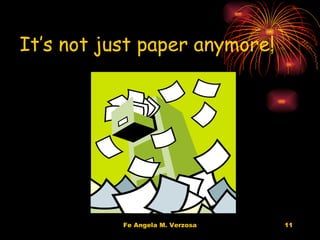
It’s not just paper anymore!
Records Management today has to link the past with the present and preserve for the future while trying to keep up with constantly evolving technologies WHY DOES IT SEEM SO HARD?
“ I get no respect” Rodney Dangerfield 1921-2004
Then – typing a letter Typewriter, keys, ribbon Multiple copies - use carbon or NCR paper I goofed!  Where’s the Correction fluid? Boss made revisions – but not a lot Cc: Was a pretty short list File in file drawer or cabinet
Office?  What office? The line between work and personal time has blended or gone completely 24/7 access to information Telecommuting Attend meetings without being present Mobile phones, laptops
Human Nature Resistant to change “ Can’t teach an old dog new tricks” Non-human readable Language is binary code, ones and zeros Need a computer to access and read “ That’s my e-mail” attitude -  it’s personal and you can’t have it (even though it’s on office equipment and generated on office time)
Quote on E-mail Management “ Technology based solutions alone are inadequate. E-mail management is really a procedural problem, not a technological one, although its impact on IT has been significant” William Saffady, Professor at Long Island University and author of Records and Information Management: Fundamentals of Professional Practice (ARMA 2004)
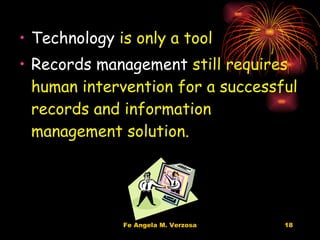
The Human Touch Technology  is only a tool Records management  still requires human intervention for a successful records and information management solution.
“ Digital information lasts forever, or five years …. whichever comes first” Jeff Rothenberg Senior computer scientist, RAND (1999)
Gone forever There are electronic records that are now extinct and gone forever. On the endangered list How many floppy disks, CD’s, tapes, DVD’s, or other soon to be obsolete media may contain records of importance that are not well preserved and may be  unreadable,  inaccessible – and gone?
Why Manage Records? It makes your office run more efficiently. Removes unneeded paper and frees office and drawer space. Makes retrieval of information quicker and easier. Reduces costs - On average, it costs about $900/year to maintain a single filing cabinet
Why an integrated  approach to RM? Lack of uniform classification and filing system lack of systematic and orderly transfer of inactive records lack of standardization and control to the creation of forms and directives loss or misfiling of records lack of storage space and filing equipment
A good records system: contains complete and comprehensive files thereby enabling effective decision making  provides integrity and continuity regardless of changes in personnel facilitates protection and preservation of records  provides low cost and efficient maintenance of records reduces the possibility of misfiling and duplication means less time spent searching for files and documents.
Goals of an RM program create  only necessary records for efficient and successful operation of the office/institution. produce  the records when needed. retain/preserve  only records needed for continued operation of the office/ institution, and dispose what is not needed.
2-5% 95-98% Transfer   to   Archives Destroy when retention has been met Creation and Use Active or Semi-Active Retention Period X = Minimum period of time to keep  Disposition Destroy or Transfer to Archives 2-5% 95-98%
Objectives Protect information resources throughout their life cycle, including identifying vital records, and implementing strategies to preserve records of long-term value  Improve the flow of information in the organization  Establish an RM component in information resource policy and planning Provide for adequate data collection and information access and retrieval, including policies on privacy and confidentiality.
Components of a Records Management Program   policy and procedure development  records inventory, appraisal, retention, and disposition  inactive files management and control (records center)  management of active files  reprographics, micrographics, digitization vital records management  training and outreach programs
RECORD  :  information captured in reproducible form required for conducting any transaction or activity. RECORDS MANAGEMENT:  a logical and practical approach to the creation, maintenance, use and disposition of records. LIFE CYCLE CONCEPT :  records pass thru three stages from its creation and active use to its final disposition . Definitions
LIFE-CYCLE CONCEPT
FUNCTIONS RECORDS CREATION recording of information on  paper, print, tape or any transmitting medium RECORDS MAINTENANCE producing the records when needed RECORDS DISPOSITION determining the ultimate fate of the records
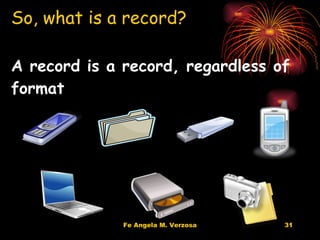
So, what is a record? A record is a record, regardless of format
Content and Function It is the  CONTENT  and  FUNCTION  that determines a record – regardless of it being paper, carved on a rock, written on  a cocktail napkin, in an electronic device, or whatever media contains the information
Regardless of format – and the list keeps getting longer! ELECTRONIC RECORD  - A record generated, communicated, received or stored by electronic means. E-mail & attachments Websites Databases Text Messaging  Instant Messaging Voice mail (can now be converted to e-mail) Digital photos Scanned documents Outlook calendars Handheld devices  (PDA’s) Spreadsheets Word documents Wiki’s, Blogs, Twitter
No, you don’t have to keep everything. There are some exceptions. Remember: It is the  CONTENT  and  FUNCTION  that will determine record-keeping.
Quiz #1   A policeman is called to the scene of an accident.  The officer takes a digital photo of the car involved.  Is this photo a record worth keeping?  □   Yes  □ No
In your desk drawer, you have a copy of the contents of your personnel file.  It contains duplicates of your application, training taken, awards received, etc. Are these records worth keeping? □  Yes  □ No Quiz #2
In your desk drawer, you have a copy of the contents of your personnel file.  It contains duplicates of your application, training taken, awards received, etc. Are these records worth keeping? □  Yes   □ No Quiz #2
You come back to your desk following lunch and your computer indicates that you have two e-mail messages waiting for you. A.) One message is from the assistant director requesting shared leave for an employee on extended sick leave. B.) The other message is from your boss, giving you the agreed-upon timelines and goals for an upcoming project. Which message would you keep? □  A only  □ B only  □ Both A and B  □ Neither A nor B Quiz #3
You come back to your desk following lunch and your computer indicates that you have two e-mail messages waiting for you. A.) One message is from the assistant director requesting shared leave for an employee on extended sick leave. B.) The other message is from your boss, giving you the agreed-upon timelines and goals for an upcoming project. Which message would you keep? □  A only  □ B only  □ Both A and B   □ Neither A nor B Quiz #3
While cleaning out the shelves in your office, you come across a 1994 copy of an annual report. Will you discard the copy?  □  Yes   □ No Quiz #4
Quiz # 5 Your office has a website and has invited public comment on a controversial issue. Would you keep the comments?  □  Yes   □ No
Technology du jour Technology  is just a tool used to create records, it is not the record Media  DOES NOT matter when it comes to creating a record CONTENT  and  FUNCTION  of the information contained within the media are what matters most
When does a document become a record? Think about writing a letter… When you start typing on the keyboard? When you save the first draft? When you save the final draft? When you print it? When the hardcopy is signed?
Official or record copies When does the official copy become “official”? E-mail approval or approval in hard copy? Other electronic means? Digital Signatures Requires hard copy signature?
Who is the keeper? Who is the record or primary copy holder? Is someone else keeping this message? Who would be the official “record keeper”? How many people were cc’d? Does this record already exist in your office’s official files?  Another department or section? There may be times when two “record” copies (both sides) will be kept in order to complete the documentation of actions.
Primary or record copy Only one copy of the record needs to be kept and retained according to the appropriate retention schedule Policies and decisions need to be made and a determination made as to who is the primary copy holder and responsible for the retention and disposition of the record
Content matters Policies, significant decisions, commitments, or important meetings Communications that facilitate or document actions affecting the conduct of business Any material that provides substantive information If content protects rights – legal, fiscal, property, etc.
Non-records  If content is: of a transitory nature social, meeting or announcement type of notices information only requiring no action personal messages and “chit-chat” THEN GET RID OF IT!
Examples of Non-records  Personal information not related to business Reference material Duplicate / multiple copies General announcements Drafts /working papers without substantive comments/rough notes, calculations, etc. THEN GET RID OF IT!
Checklist  - Keep or delete? Is it a  substantive  message or chit-chat? Does it have to do with your work, office, or program and  document actions taken ? Does it require you to  take action ? Will someone else  need it  for operational, fiscal or legal reasons? Will I need this information in the  future ?
Prove it If you have to substantiate a decision, action, policy, financial transaction, proof of ownership, etc…  What would you need to provide as evidence ?
Decisions, decisions… Apply same decisions to retaining electronic information as you would to the traditional paper format
It’s all about the records Having a good recordkeeping system in place just makes sense! Work flow – improves efficiency Lowers costs – improves bottom line Which leads to  LESS STRESS! AND  SAVES MONEY !
“ The field of management responsible for the efficient and systematic control of the creation, receipt, maintenance, use and disposition of records, including the processes for capturing and maintaining evidence of and information about business activities and transactions in the form of records”  Citation: ISO 15489: 2001 (International Standard for Records Management) RECORDS MANAGEMENT
Also known as… “ Should it stay, or should it go?”
Why records management? Besides the laws and rules, good recordkeeping promotes effective and productive business practices Good recordkeeping makes compliance easier Audits Public Disclosure Discovery
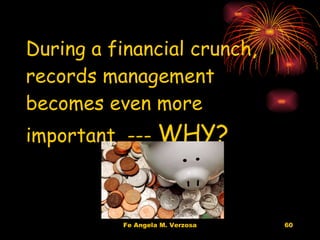
During a financial crunch, records management becomes even more important  ---  WHY?
Records and information are an agency’s most important assets  While ordinary and mundane to most,  records are a vital necessity People come and go Records provide the continuity for the function and mission of an agency
Without records, an agency cannot effectively run its business A business fails without records!
Improve your bottom line Records management: Promotes effective business practices Promotes efficient use of resources Promotes compliance and cost savings in disclosure issues
Tell me why Is it important to know why a record is created? Is it important to know how often you may use or access a record? Is it important to know how long you need to keep a record? Is it important to know when you may legally dispose or transfer a record?
CRITERIA in creating records is it necessary? what constitutes adequate   documentation? is it desirable to have it in a consistent format ? what is its future life  ? what is the best way to store  and retrieve it?
Records creation CORRESPONDENCE  MANAGEMENT REPORTS CONTROL FORMS ANALYSIS AND DESIGN DIRECTIVES MANAGEMENT
Records maintenance adoption of a files plan choice of equipment/supplies mail management files management filing procedures cross-referencing releasing checking sorting
Records disposition inventorying  appraising  scheduling retiring   disposal policies transfer guidelines archival procedures
Personnel involved   Creator/originator  user/processor office clerk records clerk
Training and Outreach regularly provide workshops and other training which outline basic program policies and procedures and office responsibilities establish a system of records liaisons or coordinators within the major units of the institution to serve as basic contacts for the records management program publicize, inform, educate the campus community thru campus newsletters, brochures on various records management topics, and electronic communication technologies (emails, library blogs)
Tools for Effective Records Management Files Plan Retention Schedule Security Access Schedule Staff involvement
Summary The ultimate test of a  good records management program  is whether the records are available to those who need them, when and where they are needed ( effectiveness) , the manner in which they are  made available ( efficiency ) ,  and at what cost  ( economy ) .
Contact fe.verzosa@dlsu.edu.ph Questions?

Effective Records Management Introduction

  • 1.
  • 2.
    Focus By theend of this presentation, you will have a better understanding of the importance of Records Management the basics of what to keep, what to discard, and when to do so, and how to handle the records you keep, and records to be created in the future
  • 3.
  • 4.
    It’s a JungleOut There In 2008, the average employee sent and received 160 e-mails per day* Average of 30% increase in growth in electronic records per year How many e-mails are in your Inbox? Sent items? *Statistics courtesy of Radicati Group, Gartner, PriceWaterhouseCooper, IDC
  • 5.
    The average workerspends 30% of time searching for or recreating lost documents The average organization makes 19 copies of each document
  • 6.
    On the average,each employee spends 3.5 hours per week every year searching for information they can’t find. At an average information-worker salary, that comes to $5,251 per person per year.* How many people are in your agency? * IDC “Hidden Costs of Information Work” white paper
  • 7.
    Why do weneed a system for managing records? • How many people in your office regularly make use of records? • Is your office clogged up with piles of paper? • As a rule, can you find a document generated two months ago in less than five minutes? What about a document generated by a colleague? • How much time does your colleagues or you spend looking for a document which add to your overall costs? • What would happen in the event of a fire or flood on your agency's premises? Does your office have an off-site storage of important records? • Does your office have a back-up system for computer-based records?
  • 8.
    Special Libraries AssociationDocbase WWW HTML pdf XML Tablets Paper Digital
  • 9.
    Early records managementThe most permanent media available was used to record history Early text messages
  • 10.
    Paper isthe standard for the next few millennia
  • 11.
    It’s not justpaper anymore!
  • 12.
    Records Management todayhas to link the past with the present and preserve for the future while trying to keep up with constantly evolving technologies WHY DOES IT SEEM SO HARD?
  • 13.
    “ I getno respect” Rodney Dangerfield 1921-2004
  • 14.
    Then – typinga letter Typewriter, keys, ribbon Multiple copies - use carbon or NCR paper I goofed! Where’s the Correction fluid? Boss made revisions – but not a lot Cc: Was a pretty short list File in file drawer or cabinet
  • 15.
    Office? Whatoffice? The line between work and personal time has blended or gone completely 24/7 access to information Telecommuting Attend meetings without being present Mobile phones, laptops
  • 16.
    Human Nature Resistantto change “ Can’t teach an old dog new tricks” Non-human readable Language is binary code, ones and zeros Need a computer to access and read “ That’s my e-mail” attitude - it’s personal and you can’t have it (even though it’s on office equipment and generated on office time)
  • 17.
    Quote on E-mailManagement “ Technology based solutions alone are inadequate. E-mail management is really a procedural problem, not a technological one, although its impact on IT has been significant” William Saffady, Professor at Long Island University and author of Records and Information Management: Fundamentals of Professional Practice (ARMA 2004)
  • 18.
    The Human TouchTechnology is only a tool Records management still requires human intervention for a successful records and information management solution.
  • 19.
    “ Digital informationlasts forever, or five years …. whichever comes first” Jeff Rothenberg Senior computer scientist, RAND (1999)
  • 20.
    Gone forever Thereare electronic records that are now extinct and gone forever. On the endangered list How many floppy disks, CD’s, tapes, DVD’s, or other soon to be obsolete media may contain records of importance that are not well preserved and may be unreadable, inaccessible – and gone?
  • 21.
    Why Manage Records?It makes your office run more efficiently. Removes unneeded paper and frees office and drawer space. Makes retrieval of information quicker and easier. Reduces costs - On average, it costs about $900/year to maintain a single filing cabinet
  • 22.
    Why an integrated approach to RM? Lack of uniform classification and filing system lack of systematic and orderly transfer of inactive records lack of standardization and control to the creation of forms and directives loss or misfiling of records lack of storage space and filing equipment
  • 23.
    A good recordssystem: contains complete and comprehensive files thereby enabling effective decision making provides integrity and continuity regardless of changes in personnel facilitates protection and preservation of records provides low cost and efficient maintenance of records reduces the possibility of misfiling and duplication means less time spent searching for files and documents.
  • 24.
    Goals of anRM program create only necessary records for efficient and successful operation of the office/institution. produce the records when needed. retain/preserve only records needed for continued operation of the office/ institution, and dispose what is not needed.
  • 25.
    2-5% 95-98% Transfer to Archives Destroy when retention has been met Creation and Use Active or Semi-Active Retention Period X = Minimum period of time to keep Disposition Destroy or Transfer to Archives 2-5% 95-98%
  • 26.
    Objectives Protect informationresources throughout their life cycle, including identifying vital records, and implementing strategies to preserve records of long-term value Improve the flow of information in the organization Establish an RM component in information resource policy and planning Provide for adequate data collection and information access and retrieval, including policies on privacy and confidentiality.
  • 27.
    Components of aRecords Management Program policy and procedure development records inventory, appraisal, retention, and disposition inactive files management and control (records center) management of active files reprographics, micrographics, digitization vital records management training and outreach programs
  • 28.
    RECORD : information captured in reproducible form required for conducting any transaction or activity. RECORDS MANAGEMENT: a logical and practical approach to the creation, maintenance, use and disposition of records. LIFE CYCLE CONCEPT : records pass thru three stages from its creation and active use to its final disposition . Definitions
  • 29.
  • 30.
    FUNCTIONS RECORDS CREATIONrecording of information on paper, print, tape or any transmitting medium RECORDS MAINTENANCE producing the records when needed RECORDS DISPOSITION determining the ultimate fate of the records
  • 31.
    So, what isa record? A record is a record, regardless of format
  • 32.
    Content and FunctionIt is the CONTENT and FUNCTION that determines a record – regardless of it being paper, carved on a rock, written on a cocktail napkin, in an electronic device, or whatever media contains the information
  • 33.
    Regardless of format– and the list keeps getting longer! ELECTRONIC RECORD - A record generated, communicated, received or stored by electronic means. E-mail & attachments Websites Databases Text Messaging Instant Messaging Voice mail (can now be converted to e-mail) Digital photos Scanned documents Outlook calendars Handheld devices (PDA’s) Spreadsheets Word documents Wiki’s, Blogs, Twitter
  • 34.
    No, you don’thave to keep everything. There are some exceptions. Remember: It is the CONTENT and FUNCTION that will determine record-keeping.
  • 35.
    Quiz #1 A policeman is called to the scene of an accident. The officer takes a digital photo of the car involved. Is this photo a record worth keeping? □ Yes □ No
  • 36.
    Quiz #1 A policeman is called to the scene of an accident. The officer takes a digital photo of the car involved. Is this photo a record worth keeping? □ Yes □ No
  • 37.
    In your deskdrawer, you have a copy of the contents of your personnel file. It contains duplicates of your application, training taken, awards received, etc. Are these records worth keeping? □ Yes □ No Quiz #2
  • 38.
    In your deskdrawer, you have a copy of the contents of your personnel file. It contains duplicates of your application, training taken, awards received, etc. Are these records worth keeping? □ Yes □ No Quiz #2
  • 39.
    You come backto your desk following lunch and your computer indicates that you have two e-mail messages waiting for you. A.) One message is from the assistant director requesting shared leave for an employee on extended sick leave. B.) The other message is from your boss, giving you the agreed-upon timelines and goals for an upcoming project. Which message would you keep? □ A only □ B only □ Both A and B □ Neither A nor B Quiz #3
  • 40.
    You come backto your desk following lunch and your computer indicates that you have two e-mail messages waiting for you. A.) One message is from the assistant director requesting shared leave for an employee on extended sick leave. B.) The other message is from your boss, giving you the agreed-upon timelines and goals for an upcoming project. Which message would you keep? □ A only □ B only □ Both A and B □ Neither A nor B Quiz #3
  • 41.
    While cleaning outthe shelves in your office, you come across a 1994 copy of an annual report. Will you discard the copy? □ Yes □ No Quiz #4
  • 42.
    While cleaning outthe shelves in your office, you come across a 1994 copy of an annual report. Will you discard the copy? □ Yes □ No Quiz #4
  • 43.
    Quiz # 5Your office has a website and has invited public comment on a controversial issue. Would you keep the comments? □ Yes □ No
  • 44.
    Quiz # 5Your office has a website and has invited public comment on a controversial issue. Would you keep the comments? □ Yes □ No
  • 45.
    Technology du jourTechnology is just a tool used to create records, it is not the record Media DOES NOT matter when it comes to creating a record CONTENT and FUNCTION of the information contained within the media are what matters most
  • 46.
    When does adocument become a record? Think about writing a letter… When you start typing on the keyboard? When you save the first draft? When you save the final draft? When you print it? When the hardcopy is signed?
  • 47.
    Official or recordcopies When does the official copy become “official”? E-mail approval or approval in hard copy? Other electronic means? Digital Signatures Requires hard copy signature?
  • 48.
    Who is thekeeper? Who is the record or primary copy holder? Is someone else keeping this message? Who would be the official “record keeper”? How many people were cc’d? Does this record already exist in your office’s official files? Another department or section? There may be times when two “record” copies (both sides) will be kept in order to complete the documentation of actions.
  • 49.
    Primary or recordcopy Only one copy of the record needs to be kept and retained according to the appropriate retention schedule Policies and decisions need to be made and a determination made as to who is the primary copy holder and responsible for the retention and disposition of the record
  • 50.
    Content matters Policies,significant decisions, commitments, or important meetings Communications that facilitate or document actions affecting the conduct of business Any material that provides substantive information If content protects rights – legal, fiscal, property, etc.
  • 51.
    Non-records Ifcontent is: of a transitory nature social, meeting or announcement type of notices information only requiring no action personal messages and “chit-chat” THEN GET RID OF IT!
  • 52.
    Examples of Non-records Personal information not related to business Reference material Duplicate / multiple copies General announcements Drafts /working papers without substantive comments/rough notes, calculations, etc. THEN GET RID OF IT!
  • 53.
    Checklist -Keep or delete? Is it a substantive message or chit-chat? Does it have to do with your work, office, or program and document actions taken ? Does it require you to take action ? Will someone else need it for operational, fiscal or legal reasons? Will I need this information in the future ?
  • 54.
    Prove it Ifyou have to substantiate a decision, action, policy, financial transaction, proof of ownership, etc… What would you need to provide as evidence ?
  • 55.
    Decisions, decisions… Applysame decisions to retaining electronic information as you would to the traditional paper format
  • 56.
    It’s all aboutthe records Having a good recordkeeping system in place just makes sense! Work flow – improves efficiency Lowers costs – improves bottom line Which leads to LESS STRESS! AND SAVES MONEY !
  • 57.
    “ The fieldof management responsible for the efficient and systematic control of the creation, receipt, maintenance, use and disposition of records, including the processes for capturing and maintaining evidence of and information about business activities and transactions in the form of records” Citation: ISO 15489: 2001 (International Standard for Records Management) RECORDS MANAGEMENT
  • 58.
    Also known as…“ Should it stay, or should it go?”
  • 59.
    Why records management?Besides the laws and rules, good recordkeeping promotes effective and productive business practices Good recordkeeping makes compliance easier Audits Public Disclosure Discovery
  • 60.
    During a financialcrunch, records management becomes even more important --- WHY?
  • 61.
    Records and informationare an agency’s most important assets While ordinary and mundane to most, records are a vital necessity People come and go Records provide the continuity for the function and mission of an agency
  • 62.
    Without records, anagency cannot effectively run its business A business fails without records!
  • 63.
    Improve your bottomline Records management: Promotes effective business practices Promotes efficient use of resources Promotes compliance and cost savings in disclosure issues
  • 64.
    Tell me whyIs it important to know why a record is created? Is it important to know how often you may use or access a record? Is it important to know how long you need to keep a record? Is it important to know when you may legally dispose or transfer a record?
  • 65.
    CRITERIA in creatingrecords is it necessary? what constitutes adequate documentation? is it desirable to have it in a consistent format ? what is its future life ? what is the best way to store and retrieve it?
  • 66.
    Records creation CORRESPONDENCE MANAGEMENT REPORTS CONTROL FORMS ANALYSIS AND DESIGN DIRECTIVES MANAGEMENT
  • 67.
    Records maintenance adoptionof a files plan choice of equipment/supplies mail management files management filing procedures cross-referencing releasing checking sorting
  • 68.
    Records disposition inventorying appraising scheduling retiring disposal policies transfer guidelines archival procedures
  • 69.
    Personnel involved Creator/originator user/processor office clerk records clerk
  • 70.
    Training and Outreachregularly provide workshops and other training which outline basic program policies and procedures and office responsibilities establish a system of records liaisons or coordinators within the major units of the institution to serve as basic contacts for the records management program publicize, inform, educate the campus community thru campus newsletters, brochures on various records management topics, and electronic communication technologies (emails, library blogs)
  • 71.
    Tools for EffectiveRecords Management Files Plan Retention Schedule Security Access Schedule Staff involvement
  • 72.
    Summary The ultimatetest of a good records management program is whether the records are available to those who need them, when and where they are needed ( effectiveness) , the manner in which they are made available ( efficiency ) , and at what cost ( economy ) .
  • 73.

Editor's Notes

  • #5 ERM- Washington State Archives
  • #26 ERM- Washington State Archives
  • #32 ERM- Washington State Archives
  • #34 ERM- Washington State Archives
  • #36 http://www.secstate.wa.gov/archives When test is completed by participants – review answers.
  • #37 http://www.secstate.wa.gov/archives When test is completed by participants – review answers.
  • #38 http://www.secstate.wa.gov/archives When test is completed by participants – review answers.
  • #39 http://www.secstate.wa.gov/archives When test is completed by participants – review answers.
  • #49 ERM- Washington State Archives
  • #58 http://www.secstate.wa.gov/archives All public records are required to be maintained and disposed of by state agencies in accordance with the provisions of chapter 40.14 RCW (the Preservation and Destruction of Public Records) as stated in the State Government Agencies General Retention Schedule. A retention schedule (general records schedule/records retention schedule) is a document that identifies and describes an organization's records, usually at the series level, and provides instructions for the disposition of records throughout their life cycle.
  • #65 ERM- Washington State Archives