CONTENTS
• DEFINITIONS
• ALCOA (+) PLUS
• PRINCIPLE OF GOOD DOCUMENTATION
• TYPES OF GMP DOCUMENTS
• LABORATORY RECORDS
• EQUIPMENT RELATED DOCUMENTATION
• DEVIATION AND INVESTIGATIONS
• BATCH RECORDS
• CERTIFICATE OF ANALYSIS
• STANDRD OPERATING PROCEDURE
• PROTOCOLS AND RECORDS
• TRIANING DOCUMNTATION
• RETENTION TIME OF DOCUMENTS
• PROCEDURE OF DOCUMENTATION
• DO’S & DON’T’S
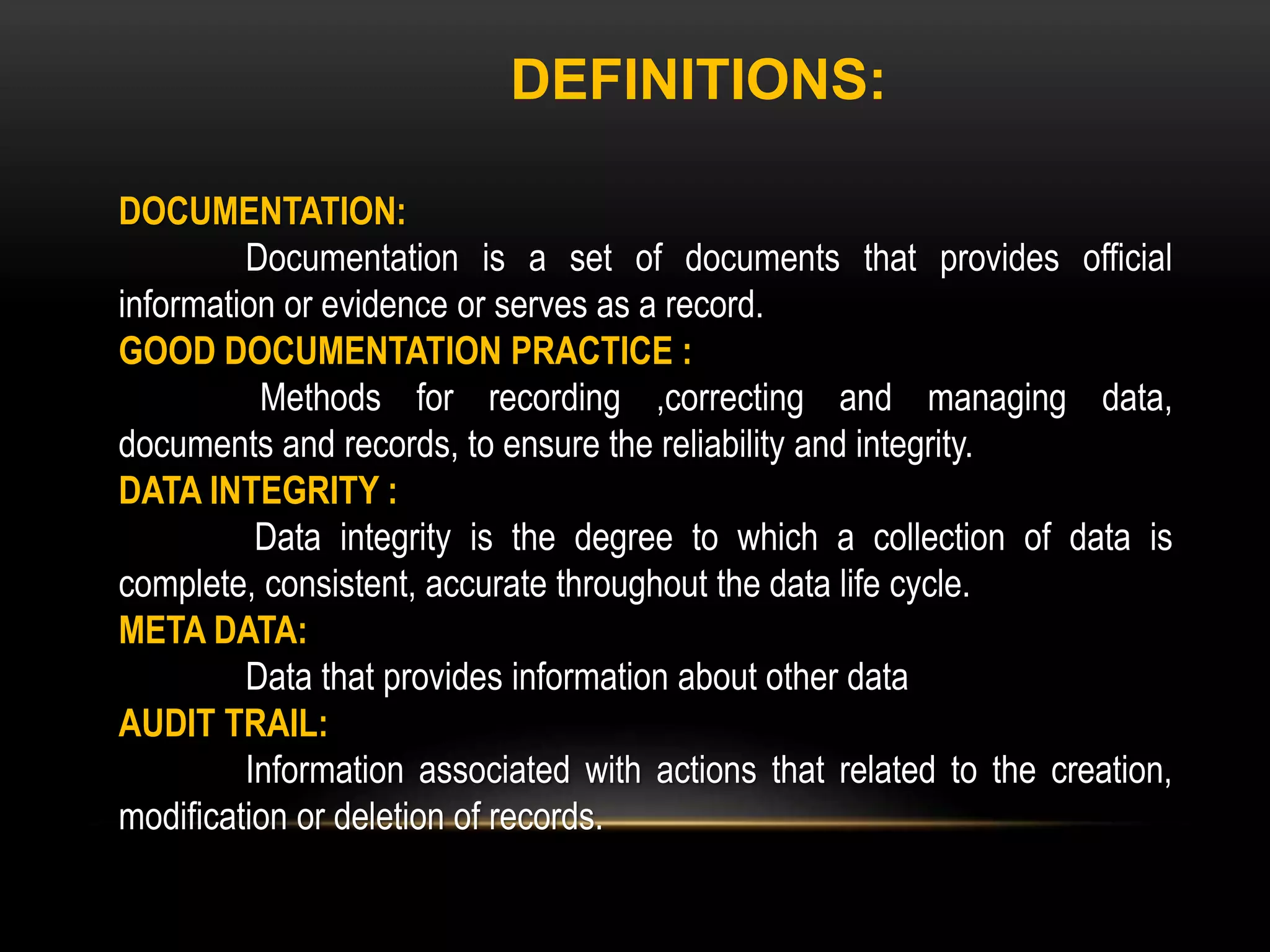
DOCUMENTATION:
Documentation is a set of documents that provides official
information or evidence or serves as a record.
GOOD DOCUMENTATION PRACTICE :
Methods for recording ,correcting and managing data,
documents and records, to ensure the reliability and integrity.
DATA INTEGRITY :
Data integrity is the degree to which a collection of data is
complete, consistent, accurate throughout the data life cycle.
META DATA:
Data that provides information about other data
AUDIT TRAIL:
Information associated with actions that related to the creation,
modification or deletion of records.
DEFINITIONS:
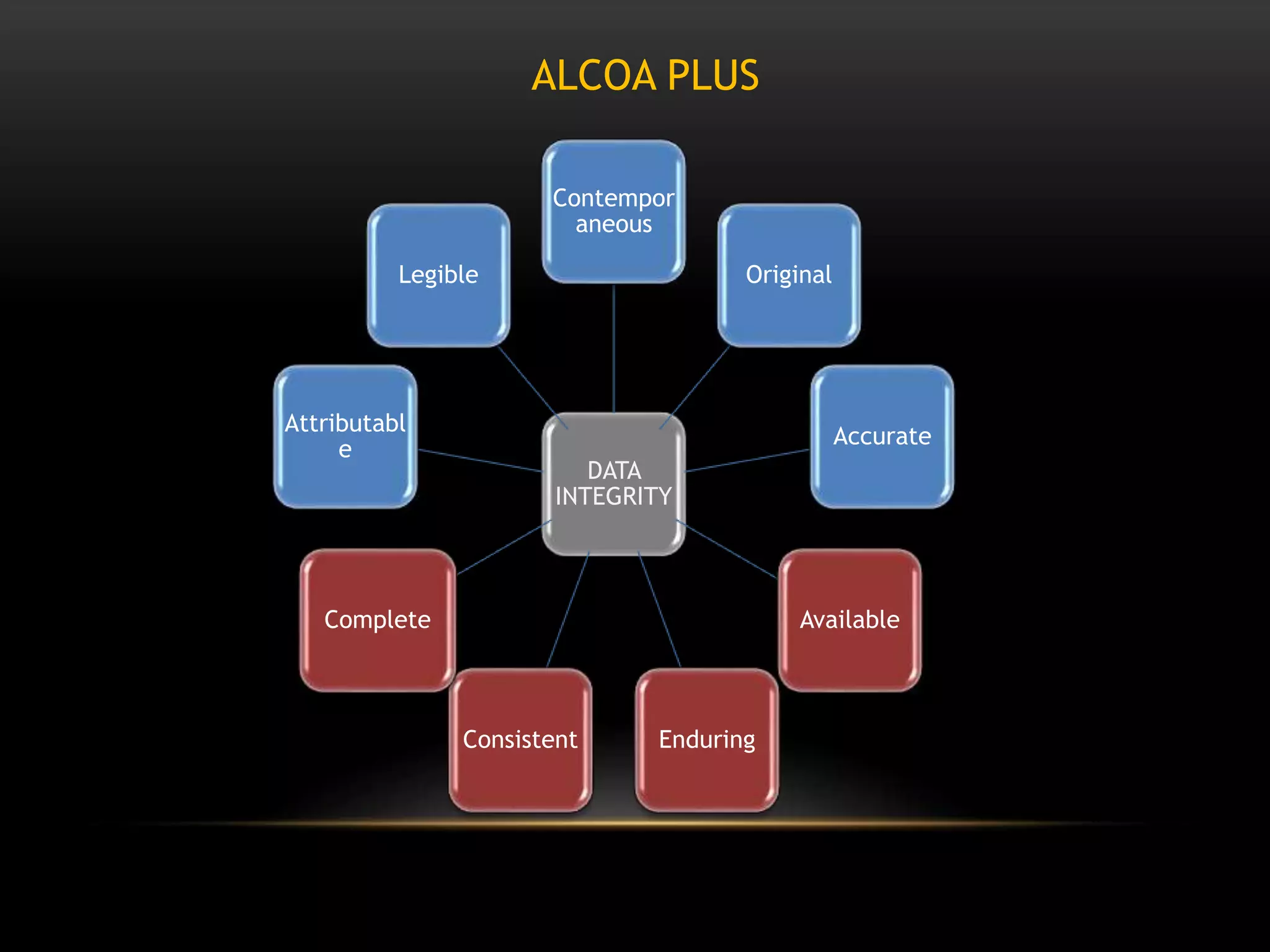
DATA
INTEGRITY
Contempor
aneous
Original
Accurate
Available
EnduringConsistent
Complete
Attributabl
e
Legible
ALCOA PLUS
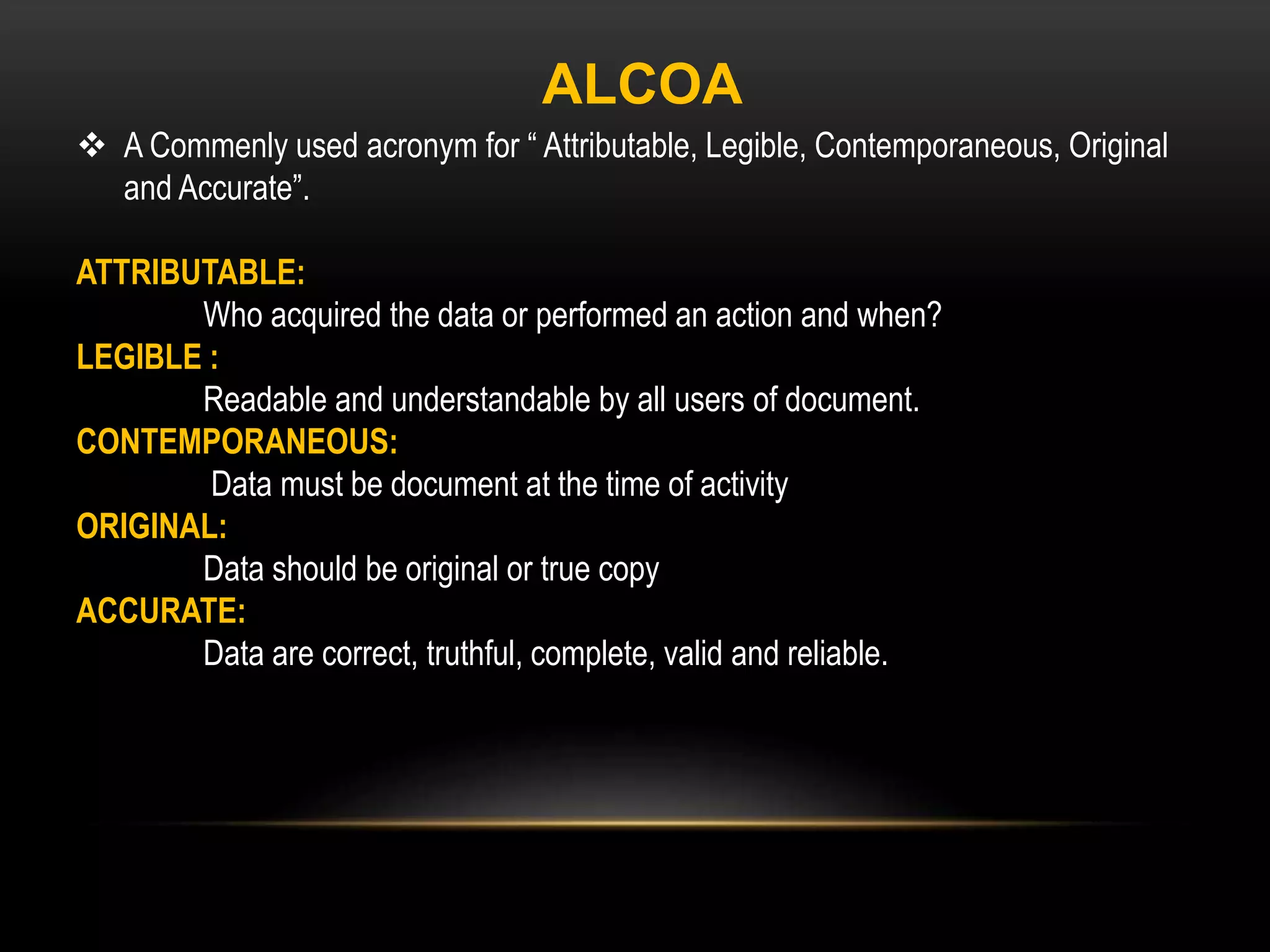
 A Commenly used acronym for “ Attributable, Legible, Contemporaneous, Original
and Accurate”.
ATTRIBUTABLE:
Who acquired the data or performed an action and when?
LEGIBLE :
Readable and understandable by all users of document.
CONTEMPORANEOUS:
Data must be document at the time of activity
ORIGINAL:
Data should be original or true copy
ACCURATE:
Data are correct, truthful, complete, valid and reliable.
ALCOA
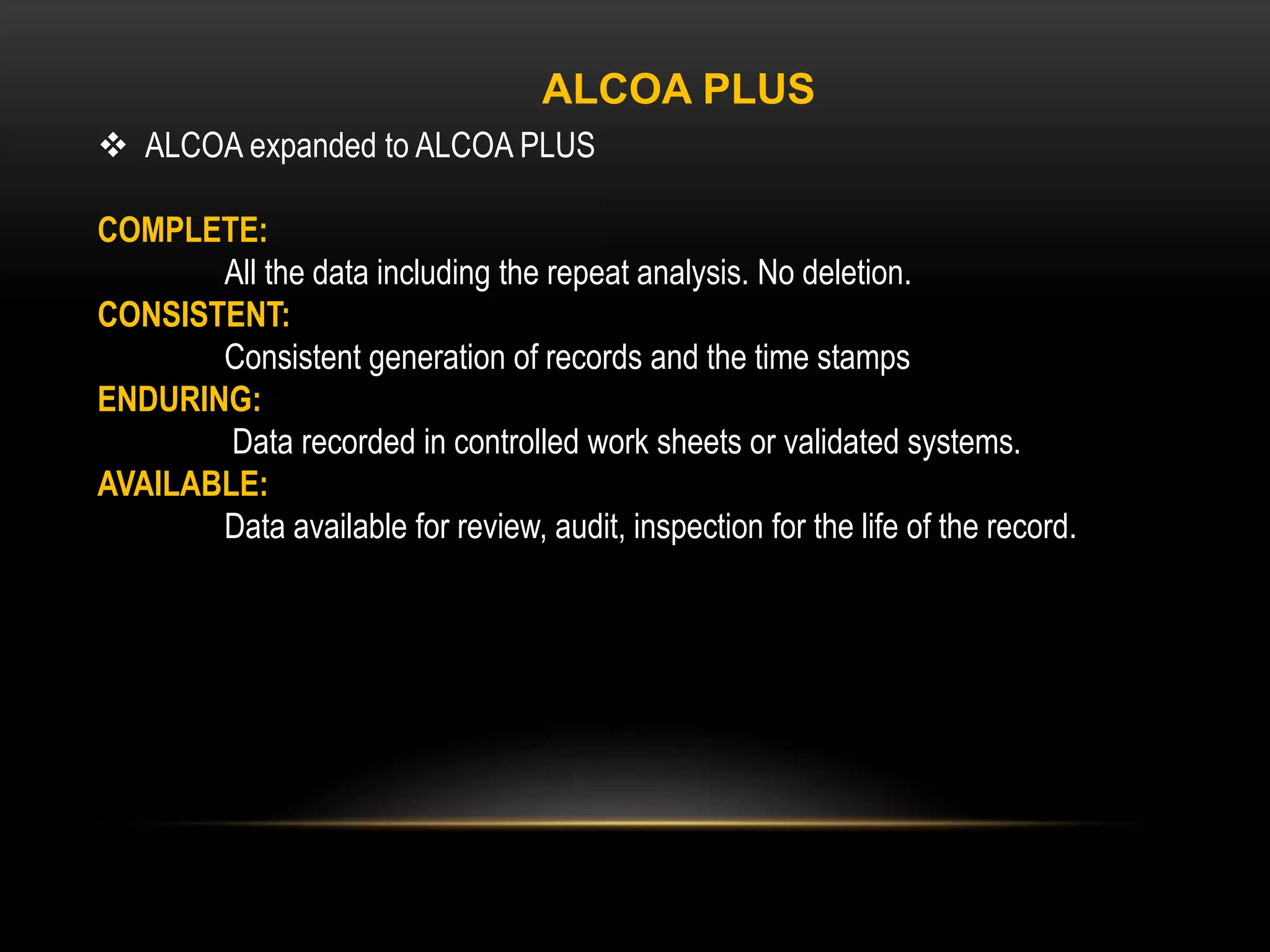
 ALCOA expanded to ALCOA PLUS
COMPLETE:
All the data including the repeat analysis. No deletion.
CONSISTENT:
Consistent generation of records and the time stamps
ENDURING:
Data recorded in controlled work sheets or validated systems.
AVAILABLE:
Data available for review, audit, inspection for the life of the record.
ALCOA PLUS
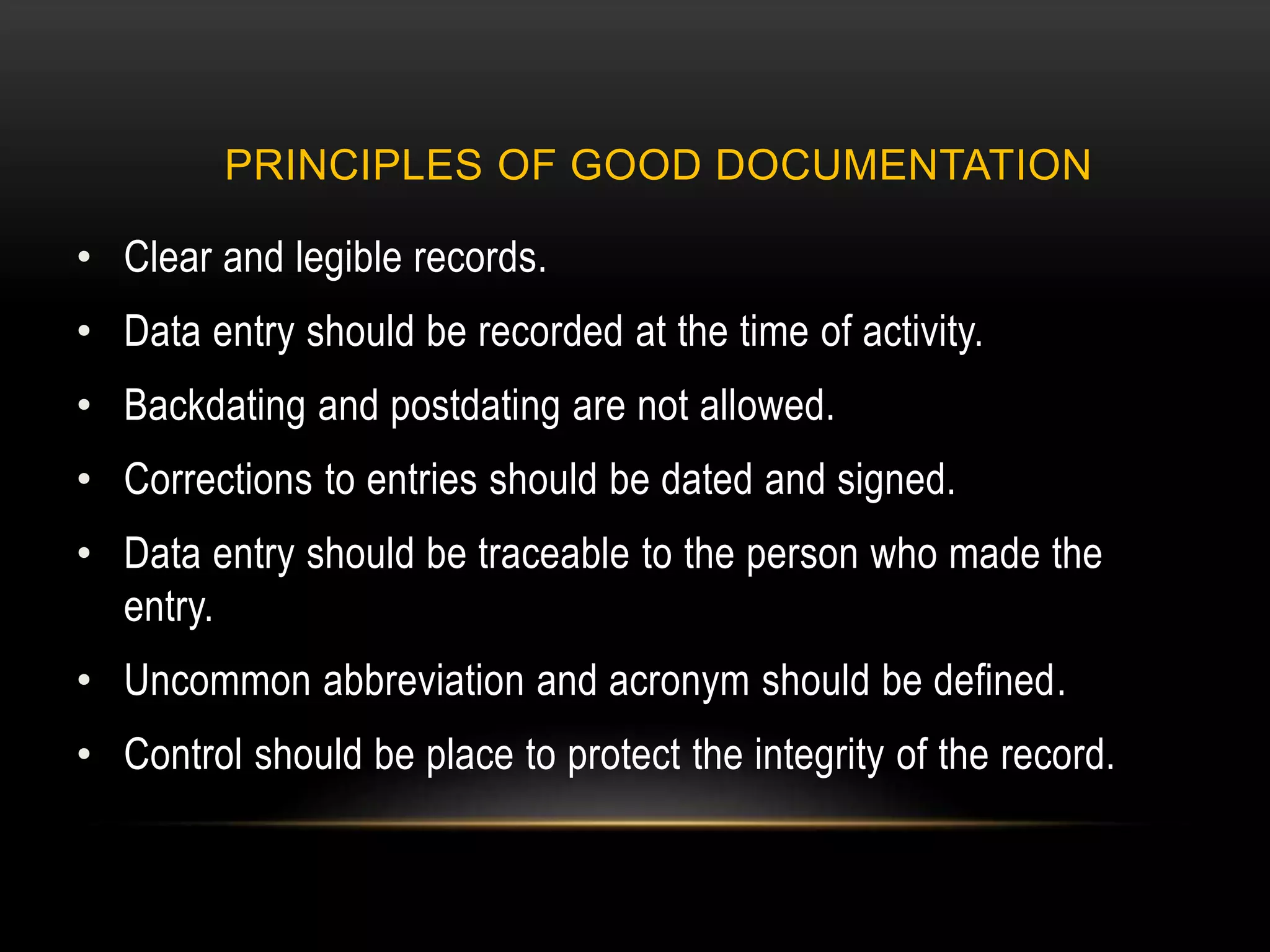
PRINCIPLES OF GOOD DOCUMENTATION
• Clear and legible records.
• Data entry should be recorded at the time of activity.
• Backdating and postdating are not allowed.
• Corrections to entries should be dated and signed.
• Data entry should be traceable to the person who made the
entry.
• Uncommon abbreviation and acronym should be defined.
• Control should be place to protect the integrity of the record.
PRINCIPLES OF GOOD DOCUMENTATION
• Printouts taken on the thermal paper or easily fading inks should
be photocopied.
• Notebooks, Data sheets and Worksheets should be traceable.
• Documentation system is needed to ensure the data integrity and
availability of records.
• During the retention period, the records should be readily
available.
• All pages should be paginated. Attachments to be paginated with a
reference to parent document.
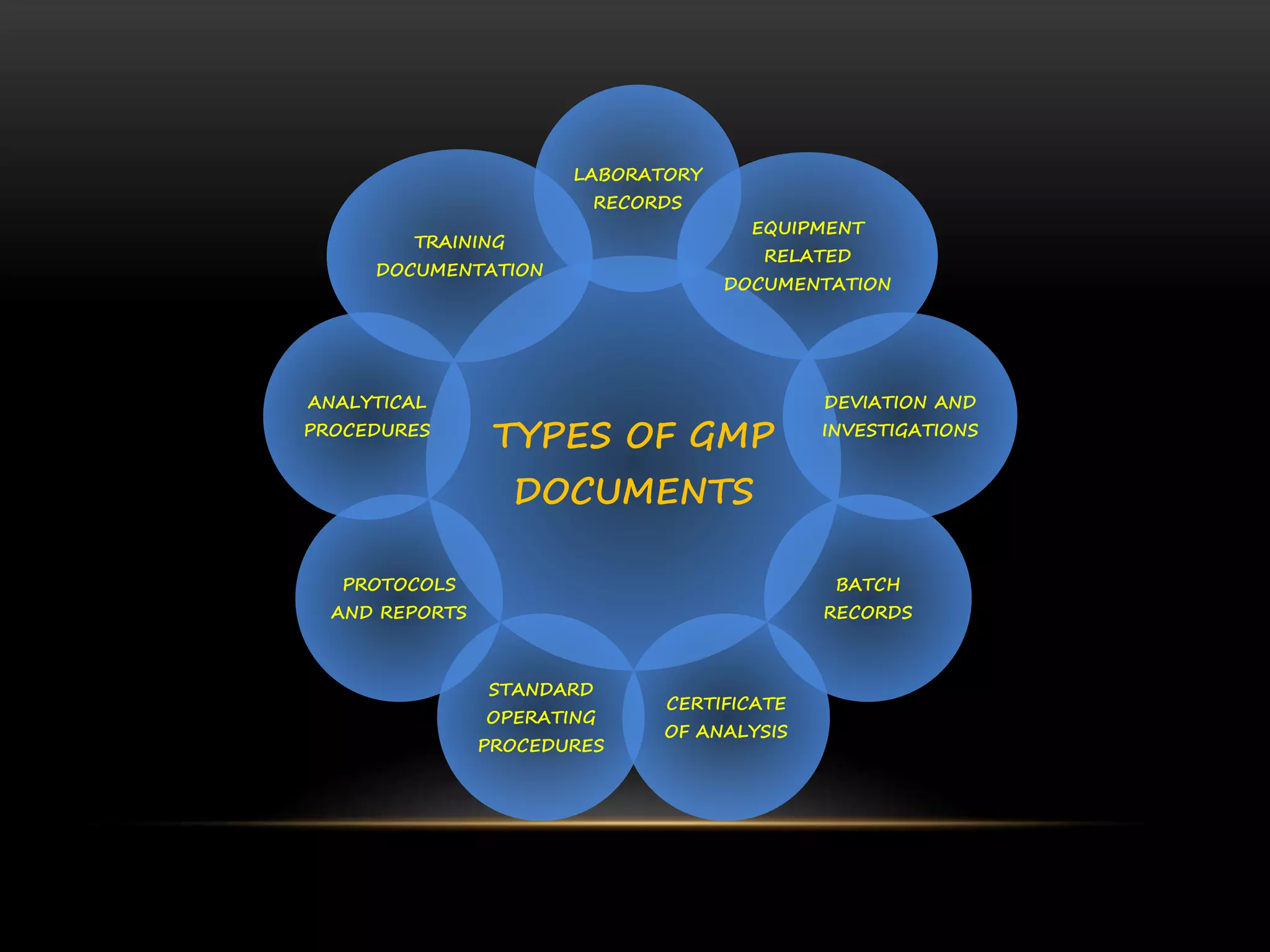
TYPES OF GMP
DOCUMENTS
LABORATORY
RECORDS
EQUIPMENT
RELATED
DOCUMENTATION
DEVIATION AND
INVESTIGATIONS
BATCH
RECORDS
CERTIFICATE
OF ANALYSIS
STANDARD
OPERATING
PROCEDURES
PROTOCOLS
AND REPORTS
ANALYTICAL
PROCEDURES
TRAINING
DOCUMENTATION
LABORATORY RECORDS
 Laboratory records should be organized to ensure that the records are
concise ,clear, legible and accurate and detail the following:
• Description of Materials(E.g. Reagents)
• Identification of equipment used
• Procedures Used
• Measurements
• Formulae and Calculations
• Results and Conclusions.
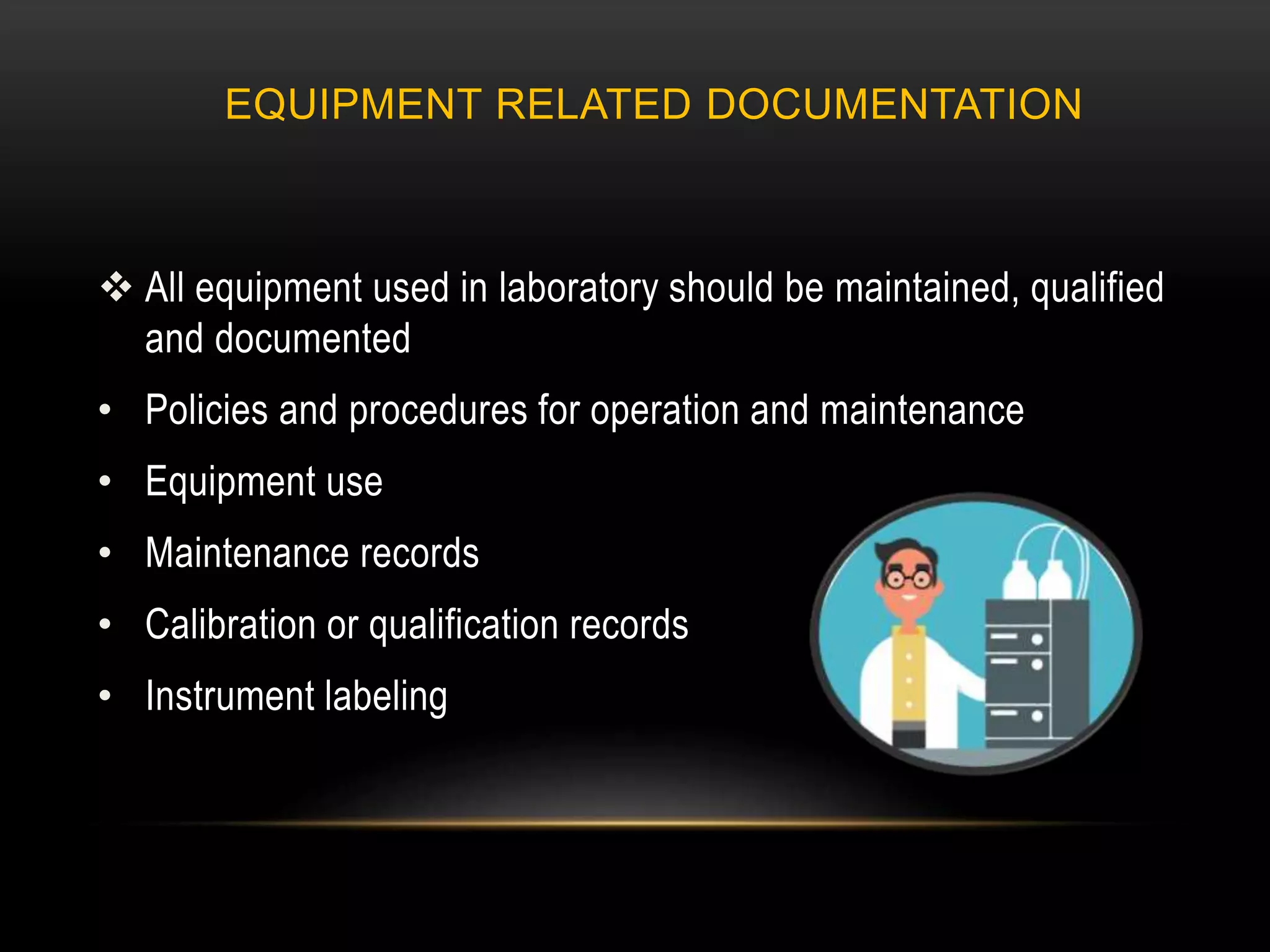
EQUIPMENT RELATED DOCUMENTATION
 All equipment used in laboratory should be maintained, qualified
and documented
• Policies and procedures for operation and maintenance
• Equipment use
• Maintenance records
• Calibration or qualification records
• Instrument labeling
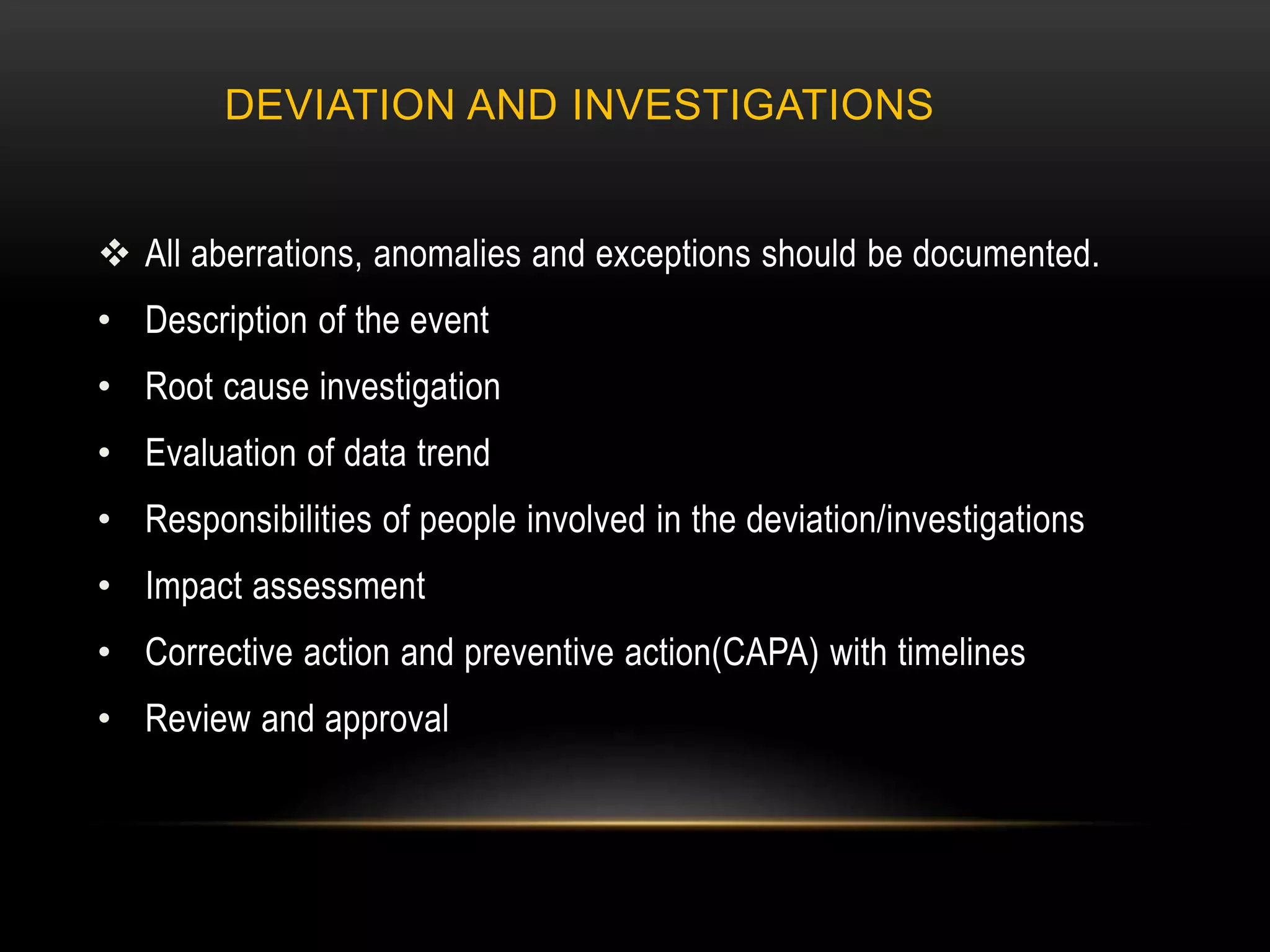
DEVIATION AND INVESTIGATIONS
 All aberrations, anomalies and exceptions should be documented.
• Description of the event
• Root cause investigation
• Evaluation of data trend
• Responsibilities of people involved in the deviation/investigations
• Impact assessment
• Corrective action and preventive action(CAPA) with timelines
• Review and approval
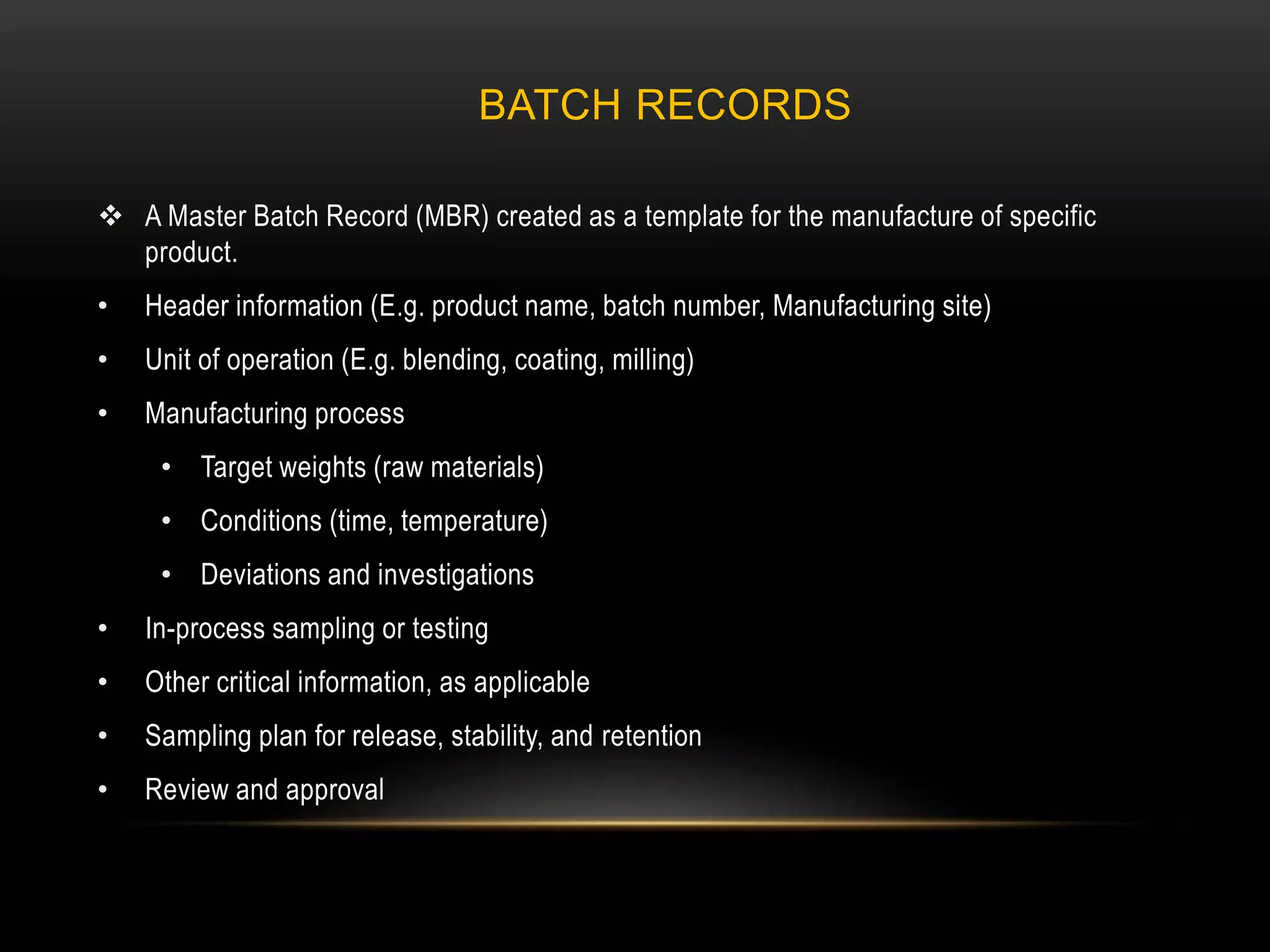
BATCH RECORDS
 A Master Batch Record (MBR) created as a template for the manufacture of specific
product.
• Header information (E.g. product name, batch number, Manufacturing site)
• Unit of operation (E.g. blending, coating, milling)
• Manufacturing process
• Target weights (raw materials)
• Conditions (time, temperature)
• Deviations and investigations
• In-process sampling or testing
• Other critical information, as applicable
• Sampling plan for release, stability, and retention
• Review and approval
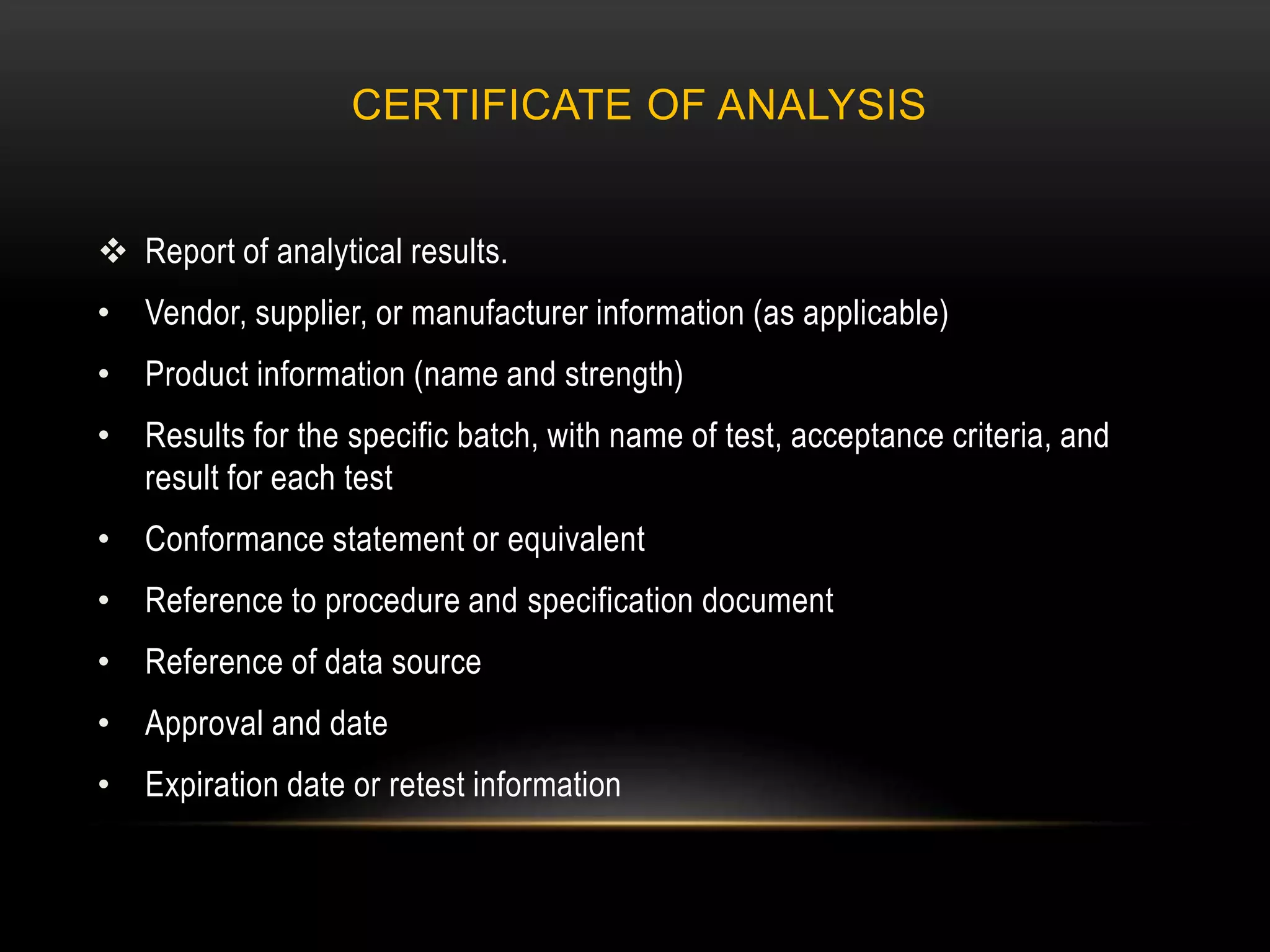
CERTIFICATE OF ANALYSIS
 Report of analytical results.
• Vendor, supplier, or manufacturer information (as applicable)
• Product information (name and strength)
• Results for the specific batch, with name of test, acceptance criteria, and
result for each test
• Conformance statement or equivalent
• Reference to procedure and specification document
• Reference of data source
• Approval and date
• Expiration date or retest information
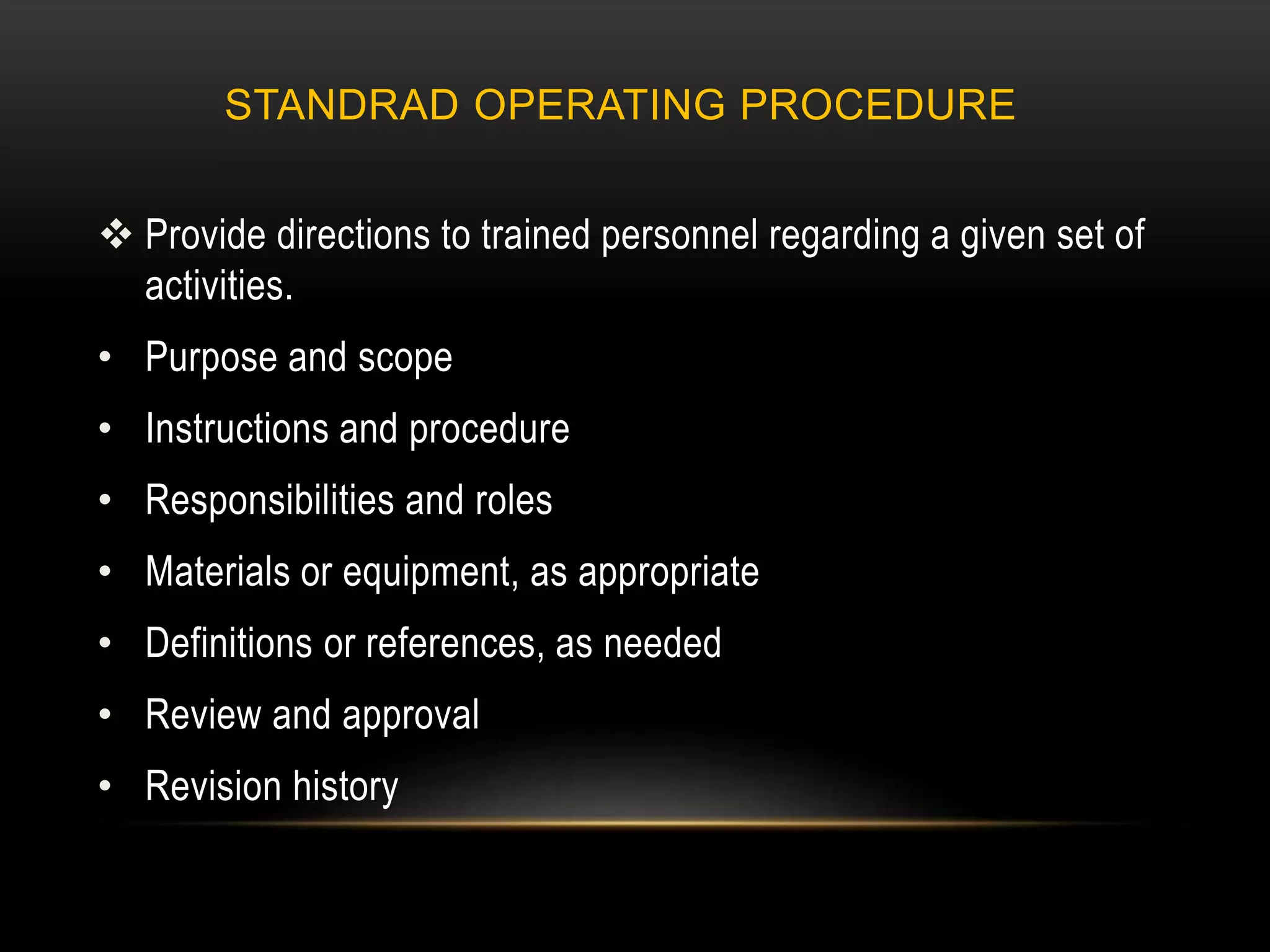
STANDRAD OPERATING PROCEDURE
 Provide directions to trained personnel regarding a given set of
activities.
• Purpose and scope
• Instructions and procedure
• Responsibilities and roles
• Materials or equipment, as appropriate
• Definitions or references, as needed
• Review and approval
• Revision history
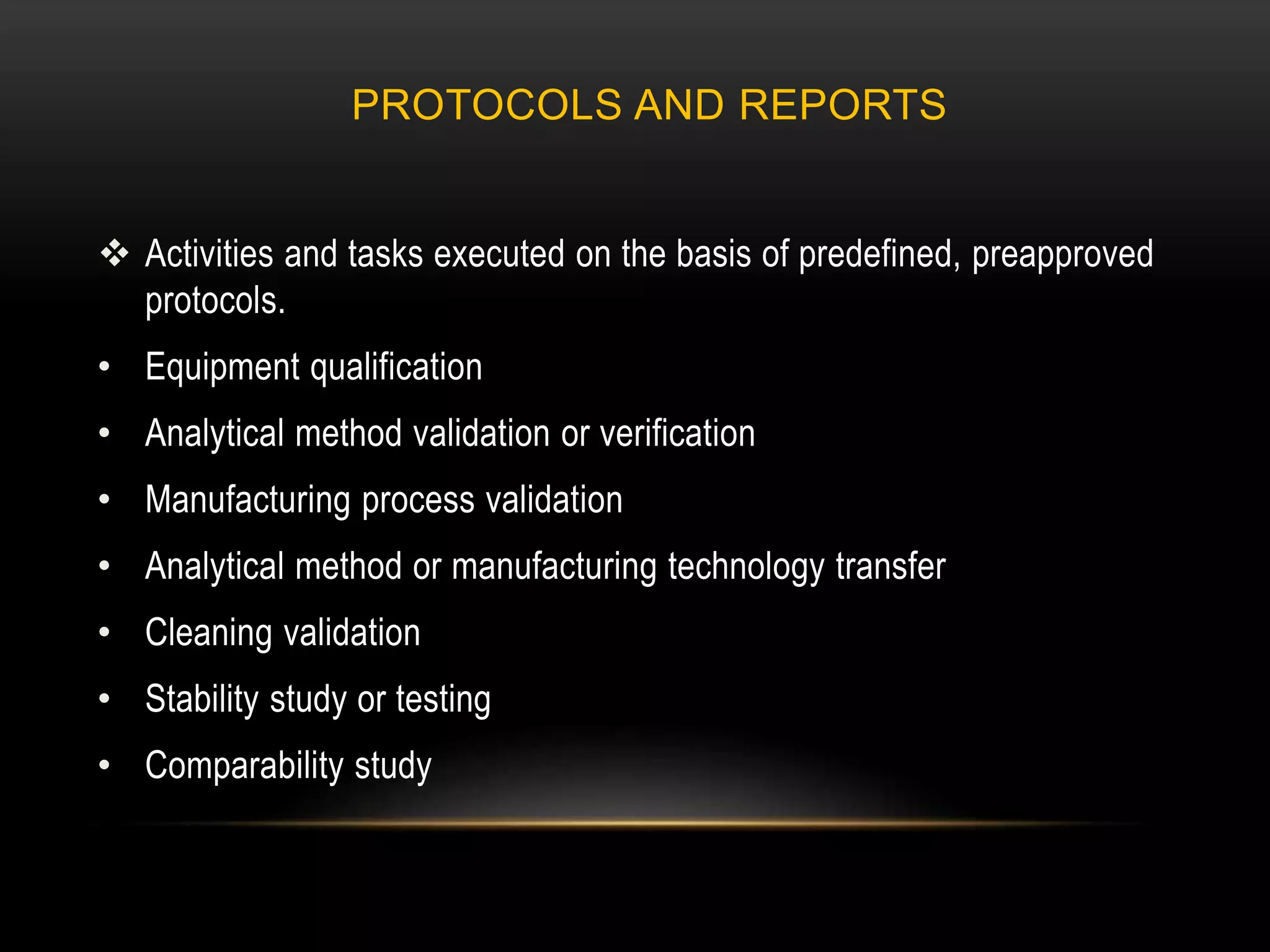
PROTOCOLS AND REPORTS
 Activities and tasks executed on the basis of predefined, preapproved
protocols.
• Equipment qualification
• Analytical method validation or verification
• Manufacturing process validation
• Analytical method or manufacturing technology transfer
• Cleaning validation
• Stability study or testing
• Comparability study
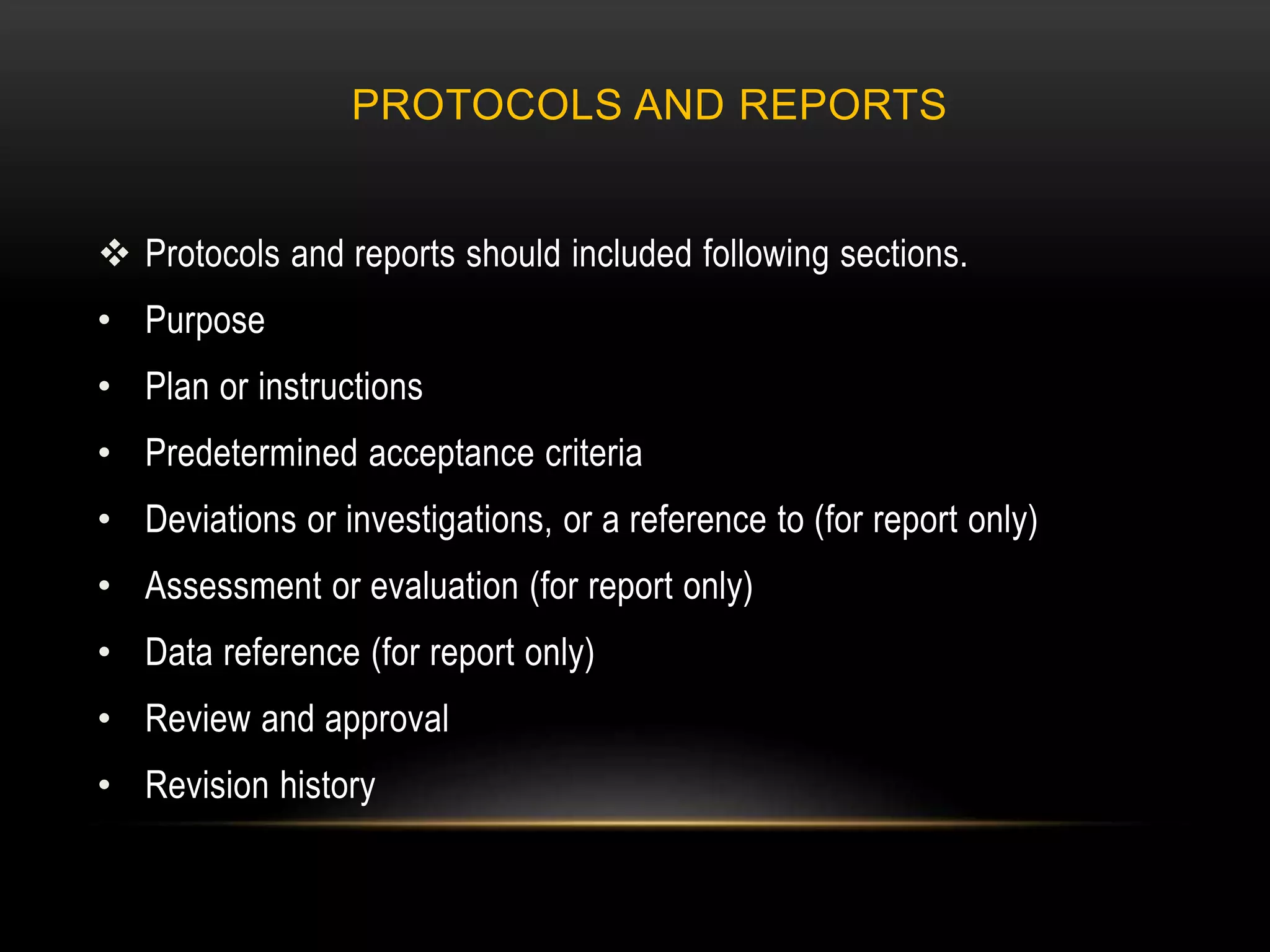
PROTOCOLS AND REPORTS
 Protocols and reports should included following sections.
• Purpose
• Plan or instructions
• Predetermined acceptance criteria
• Deviations or investigations, or a reference to (for report only)
• Assessment or evaluation (for report only)
• Data reference (for report only)
• Review and approval
• Revision history
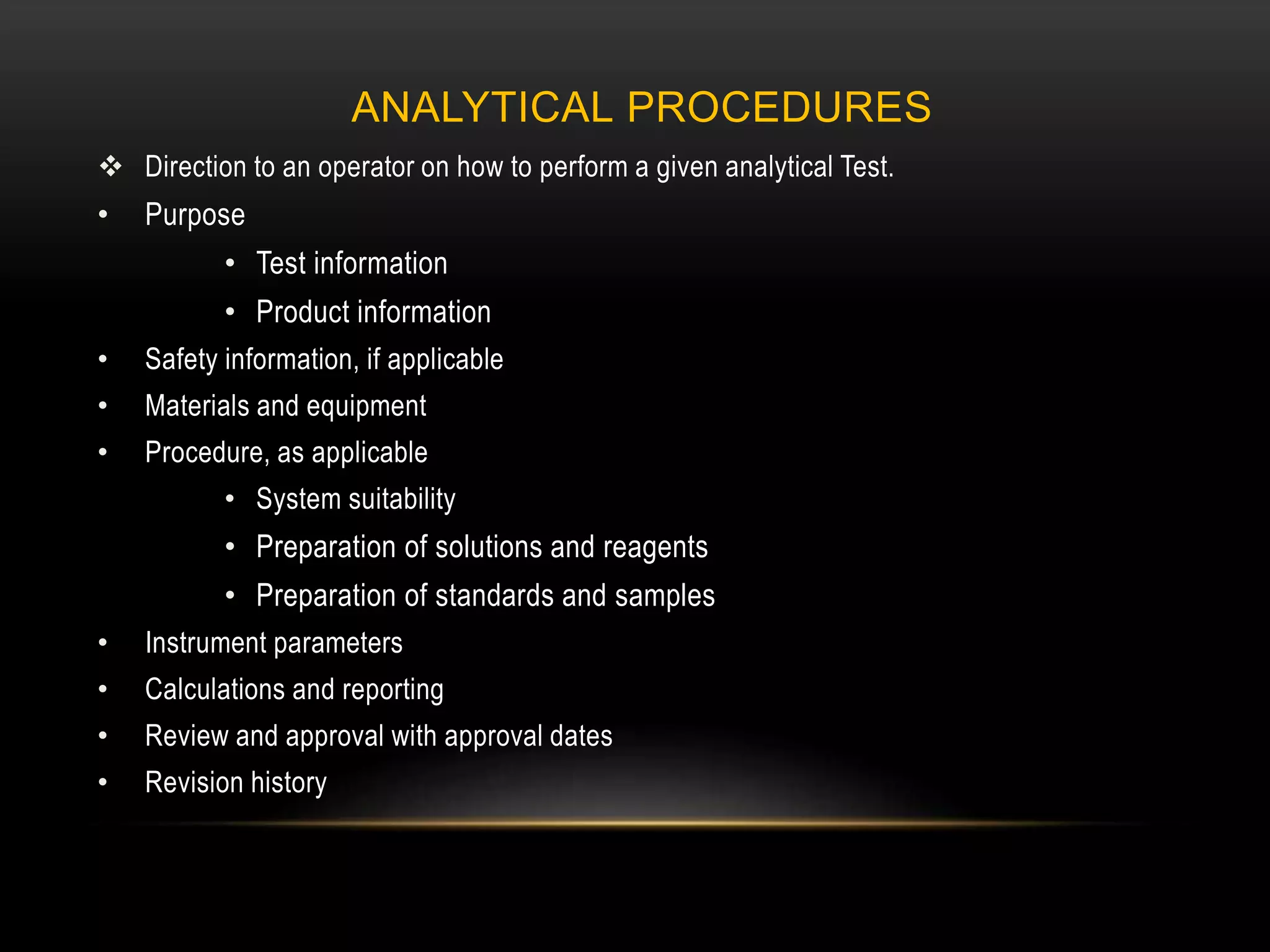
ANALYTICAL PROCEDURES
 Direction to an operator on how to perform a given analytical Test.
• Purpose
• Test information
• Product information
• Safety information, if applicable
• Materials and equipment
• Procedure, as applicable
• System suitability
• Preparation of solutions and reagents
• Preparation of standards and samples
• Instrument parameters
• Calculations and reporting
• Review and approval with approval dates
• Revision history
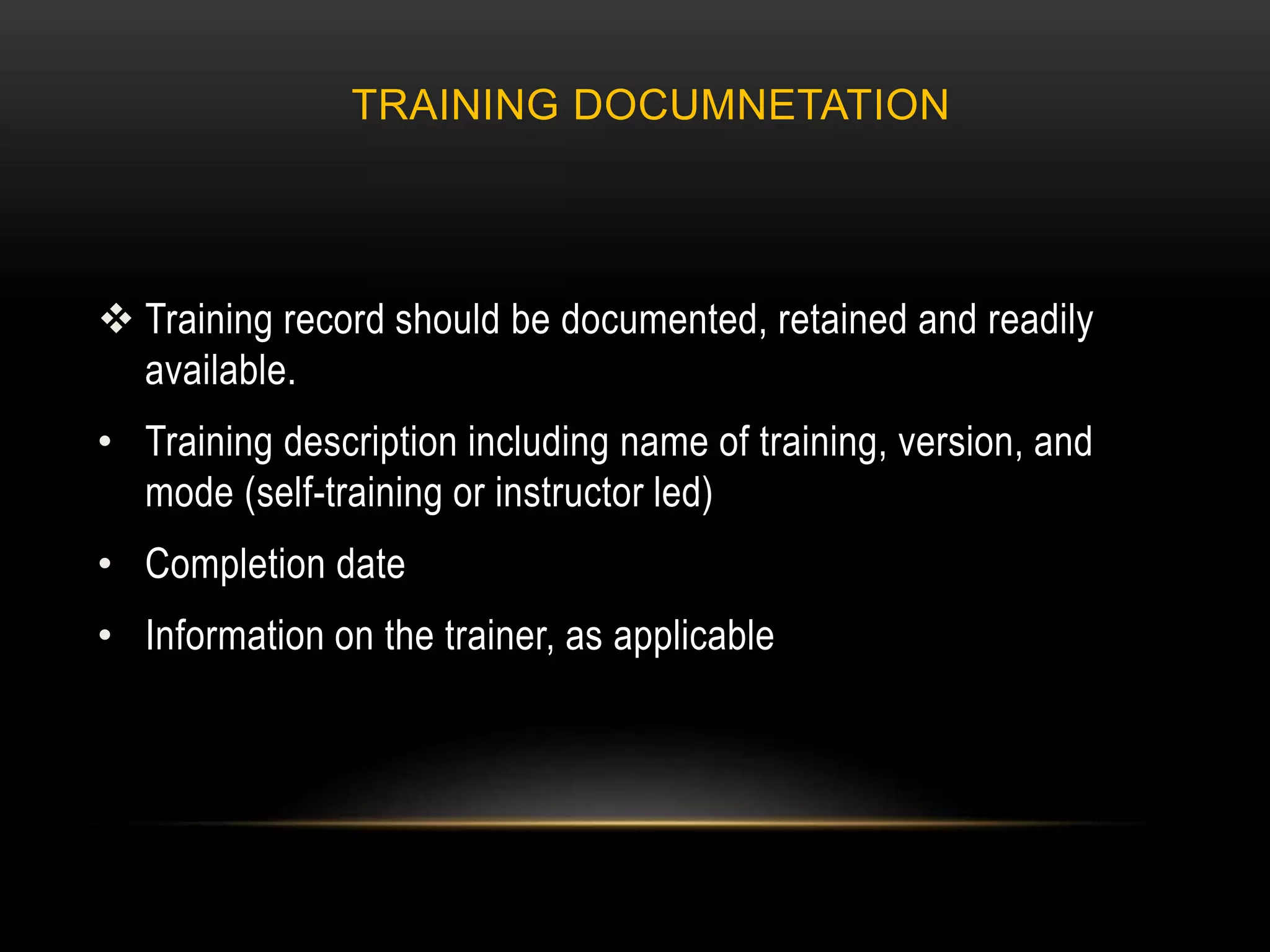
TRAINING DOCUMNETATION
 Training record should be documented, retained and readily
available.
• Training description including name of training, version, and
mode (self-training or instructor led)
• Completion date
• Information on the trainer, as applicable
RETENTION OF DOCUMNETS
 Retention time length of document depends on the regulatory
requirements or company procedures.
 However it should be at least 1 year after the batch expiration
date.
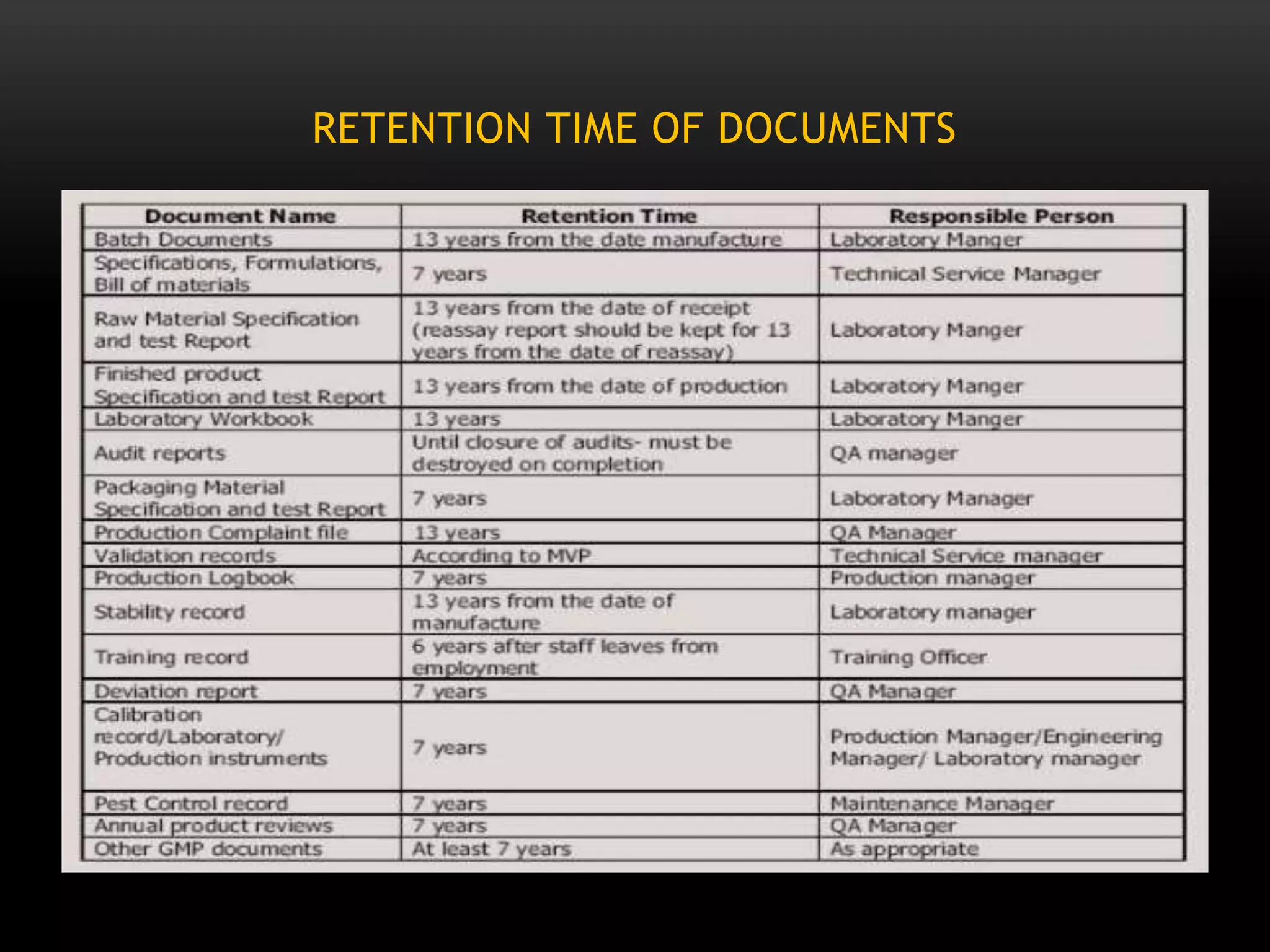
RETENTION TIME OF DOCUMENTS
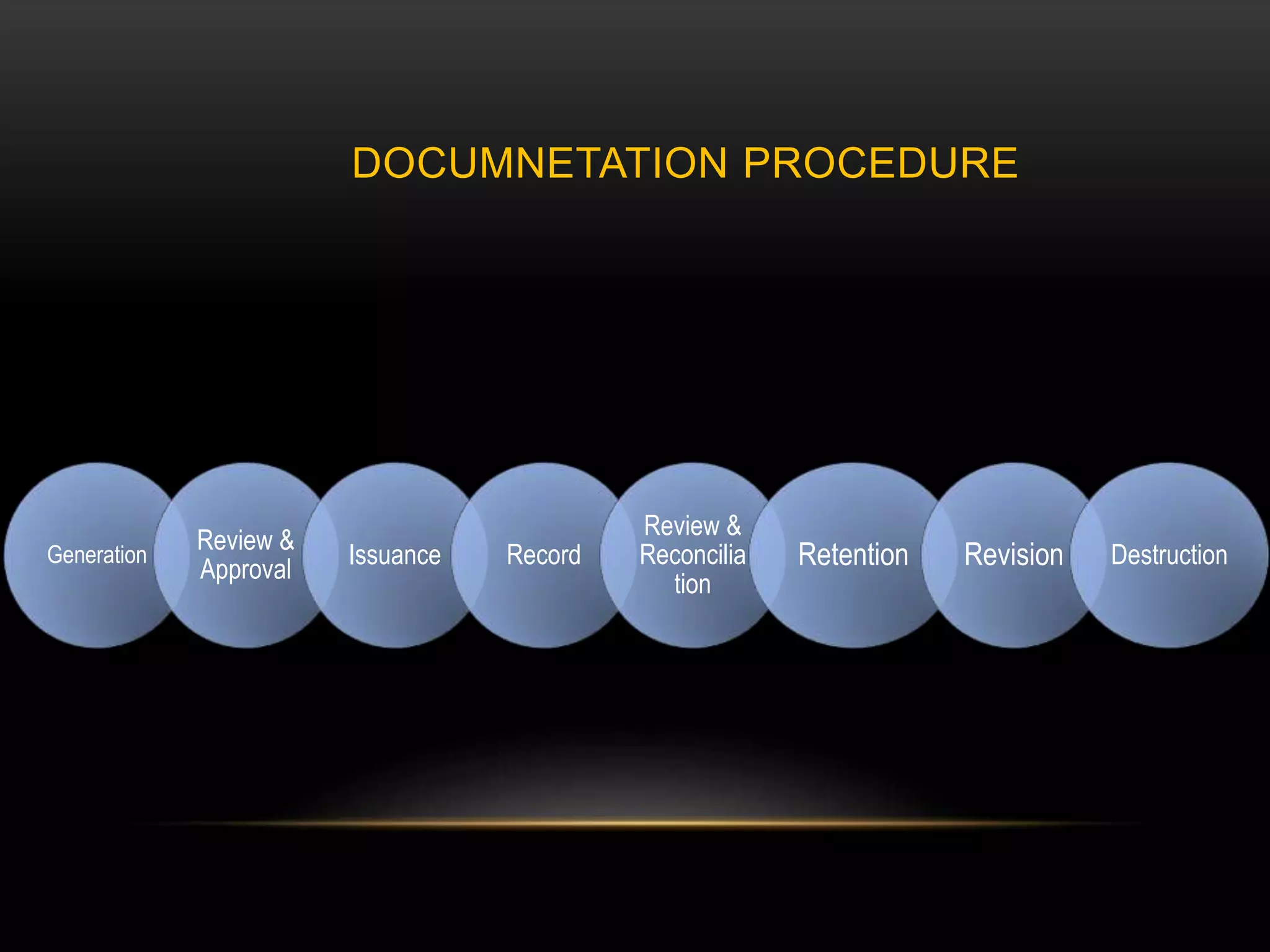
DOCUMNETATION PROCEDURE
Generation
Review &
Approval
Issuance Record
Review &
Reconcilia
tion
Retention Revision Destruction
GOOD DOCUMENTATION PRACTICE
DO’S:
• Use pre numbered bounded note book.
(Every register form/note shall have header, date of opening, date of closing, Table of
content)
• Enter complete and accurate information at the time of activity.
• Enter signature or Initials (According to procedure)
• When more than one person completed the task, all person should be sign.
• Use a non water soluble black or blue color ball point pen to make entries.
• Corrections to written records must be made properly.
• Draw a single line through the incorrect entry.
• Write initials and date of correction.
• Record the Data clearly.
• When Spaces or shell don’t contain information, entry N/A.
• Limit the use of abbreviation and acronym.
• Second verification is must.
GOOD DOCUMENTION PRACTICE
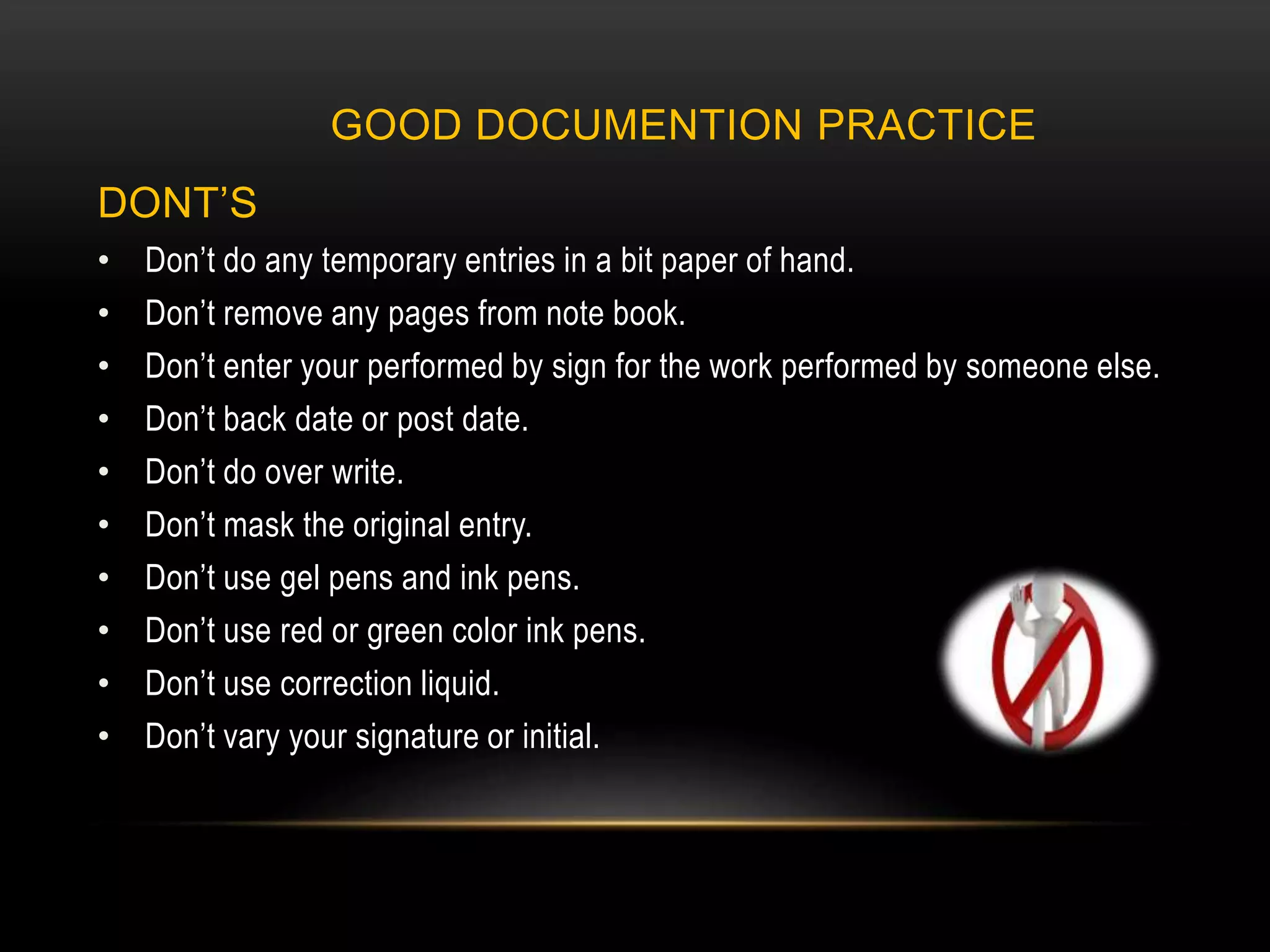
DONT’S
• Don’t do any temporary entries in a bit paper of hand.
• Don’t remove any pages from note book.
• Don’t enter your performed by sign for the work performed by someone else.
• Don’t back date or post date.
• Don’t do over write.
• Don’t mask the original entry.
• Don’t use gel pens and ink pens.
• Don’t use red or green color ink pens.
• Don’t use correction liquid.
• Don’t vary your signature or initial.
REFERENCE
• HTTPS://ONLINE.USPNF.COM/USPNF/DOCUMENT/GUID-5A751AEB-D4F1-
488C-AE4B-018D9D6D698A_3_EN-US
• HTTPS://WWW.IPA-INDIA.ORG/STATIC-FILES/PDF/EVENT/IPF2018-
PRESENTATION22.PDF
• HTTPS://WWW.SLIDESHARE.NET/HARDIK_MISTRY/GOOD-
DOCUMENTATION-PRACTICE-14427854
• HTTPS://WWW.SLIDESHARE.NET/DRAMSAVELVEL/GOOD-
DOCUMENTATION-PRACTICE-88810012
Good documentation practice

Good documentation practice

  • 3.
    CONTENTS • DEFINITIONS • ALCOA(+) PLUS • PRINCIPLE OF GOOD DOCUMENTATION • TYPES OF GMP DOCUMENTS • LABORATORY RECORDS • EQUIPMENT RELATED DOCUMENTATION • DEVIATION AND INVESTIGATIONS • BATCH RECORDS • CERTIFICATE OF ANALYSIS • STANDRD OPERATING PROCEDURE • PROTOCOLS AND RECORDS • TRIANING DOCUMNTATION • RETENTION TIME OF DOCUMENTS • PROCEDURE OF DOCUMENTATION • DO’S & DON’T’S
  • 4.
    DOCUMENTATION: Documentation is aset of documents that provides official information or evidence or serves as a record. GOOD DOCUMENTATION PRACTICE : Methods for recording ,correcting and managing data, documents and records, to ensure the reliability and integrity. DATA INTEGRITY : Data integrity is the degree to which a collection of data is complete, consistent, accurate throughout the data life cycle. META DATA: Data that provides information about other data AUDIT TRAIL: Information associated with actions that related to the creation, modification or deletion of records. DEFINITIONS:
  • 5.
  • 6.
     A Commenlyused acronym for “ Attributable, Legible, Contemporaneous, Original and Accurate”. ATTRIBUTABLE: Who acquired the data or performed an action and when? LEGIBLE : Readable and understandable by all users of document. CONTEMPORANEOUS: Data must be document at the time of activity ORIGINAL: Data should be original or true copy ACCURATE: Data are correct, truthful, complete, valid and reliable. ALCOA
  • 7.
     ALCOA expandedto ALCOA PLUS COMPLETE: All the data including the repeat analysis. No deletion. CONSISTENT: Consistent generation of records and the time stamps ENDURING: Data recorded in controlled work sheets or validated systems. AVAILABLE: Data available for review, audit, inspection for the life of the record. ALCOA PLUS
  • 8.
    PRINCIPLES OF GOODDOCUMENTATION • Clear and legible records. • Data entry should be recorded at the time of activity. • Backdating and postdating are not allowed. • Corrections to entries should be dated and signed. • Data entry should be traceable to the person who made the entry. • Uncommon abbreviation and acronym should be defined. • Control should be place to protect the integrity of the record.
  • 9.
    PRINCIPLES OF GOODDOCUMENTATION • Printouts taken on the thermal paper or easily fading inks should be photocopied. • Notebooks, Data sheets and Worksheets should be traceable. • Documentation system is needed to ensure the data integrity and availability of records. • During the retention period, the records should be readily available. • All pages should be paginated. Attachments to be paginated with a reference to parent document.
  • 10.
    TYPES OF GMP DOCUMENTS LABORATORY RECORDS EQUIPMENT RELATED DOCUMENTATION DEVIATIONAND INVESTIGATIONS BATCH RECORDS CERTIFICATE OF ANALYSIS STANDARD OPERATING PROCEDURES PROTOCOLS AND REPORTS ANALYTICAL PROCEDURES TRAINING DOCUMENTATION
  • 11.
    LABORATORY RECORDS  Laboratoryrecords should be organized to ensure that the records are concise ,clear, legible and accurate and detail the following: • Description of Materials(E.g. Reagents) • Identification of equipment used • Procedures Used • Measurements • Formulae and Calculations • Results and Conclusions.
  • 12.
    EQUIPMENT RELATED DOCUMENTATION All equipment used in laboratory should be maintained, qualified and documented • Policies and procedures for operation and maintenance • Equipment use • Maintenance records • Calibration or qualification records • Instrument labeling
  • 13.
    DEVIATION AND INVESTIGATIONS All aberrations, anomalies and exceptions should be documented. • Description of the event • Root cause investigation • Evaluation of data trend • Responsibilities of people involved in the deviation/investigations • Impact assessment • Corrective action and preventive action(CAPA) with timelines • Review and approval
  • 14.
    BATCH RECORDS  AMaster Batch Record (MBR) created as a template for the manufacture of specific product. • Header information (E.g. product name, batch number, Manufacturing site) • Unit of operation (E.g. blending, coating, milling) • Manufacturing process • Target weights (raw materials) • Conditions (time, temperature) • Deviations and investigations • In-process sampling or testing • Other critical information, as applicable • Sampling plan for release, stability, and retention • Review and approval
  • 15.
    CERTIFICATE OF ANALYSIS Report of analytical results. • Vendor, supplier, or manufacturer information (as applicable) • Product information (name and strength) • Results for the specific batch, with name of test, acceptance criteria, and result for each test • Conformance statement or equivalent • Reference to procedure and specification document • Reference of data source • Approval and date • Expiration date or retest information
  • 16.
    STANDRAD OPERATING PROCEDURE Provide directions to trained personnel regarding a given set of activities. • Purpose and scope • Instructions and procedure • Responsibilities and roles • Materials or equipment, as appropriate • Definitions or references, as needed • Review and approval • Revision history
  • 17.
    PROTOCOLS AND REPORTS Activities and tasks executed on the basis of predefined, preapproved protocols. • Equipment qualification • Analytical method validation or verification • Manufacturing process validation • Analytical method or manufacturing technology transfer • Cleaning validation • Stability study or testing • Comparability study
  • 18.
    PROTOCOLS AND REPORTS Protocols and reports should included following sections. • Purpose • Plan or instructions • Predetermined acceptance criteria • Deviations or investigations, or a reference to (for report only) • Assessment or evaluation (for report only) • Data reference (for report only) • Review and approval • Revision history
  • 19.
    ANALYTICAL PROCEDURES  Directionto an operator on how to perform a given analytical Test. • Purpose • Test information • Product information • Safety information, if applicable • Materials and equipment • Procedure, as applicable • System suitability • Preparation of solutions and reagents • Preparation of standards and samples • Instrument parameters • Calculations and reporting • Review and approval with approval dates • Revision history
  • 20.
    TRAINING DOCUMNETATION  Trainingrecord should be documented, retained and readily available. • Training description including name of training, version, and mode (self-training or instructor led) • Completion date • Information on the trainer, as applicable
  • 21.
    RETENTION OF DOCUMNETS Retention time length of document depends on the regulatory requirements or company procedures.  However it should be at least 1 year after the batch expiration date.
  • 22.
  • 23.
    DOCUMNETATION PROCEDURE Generation Review & Approval IssuanceRecord Review & Reconcilia tion Retention Revision Destruction
  • 24.
    GOOD DOCUMENTATION PRACTICE DO’S: •Use pre numbered bounded note book. (Every register form/note shall have header, date of opening, date of closing, Table of content) • Enter complete and accurate information at the time of activity. • Enter signature or Initials (According to procedure) • When more than one person completed the task, all person should be sign. • Use a non water soluble black or blue color ball point pen to make entries. • Corrections to written records must be made properly. • Draw a single line through the incorrect entry. • Write initials and date of correction. • Record the Data clearly. • When Spaces or shell don’t contain information, entry N/A. • Limit the use of abbreviation and acronym. • Second verification is must.
  • 25.
    GOOD DOCUMENTION PRACTICE DONT’S •Don’t do any temporary entries in a bit paper of hand. • Don’t remove any pages from note book. • Don’t enter your performed by sign for the work performed by someone else. • Don’t back date or post date. • Don’t do over write. • Don’t mask the original entry. • Don’t use gel pens and ink pens. • Don’t use red or green color ink pens. • Don’t use correction liquid. • Don’t vary your signature or initial.
  • 26.
    REFERENCE • HTTPS://ONLINE.USPNF.COM/USPNF/DOCUMENT/GUID-5A751AEB-D4F1- 488C-AE4B-018D9D6D698A_3_EN-US • HTTPS://WWW.IPA-INDIA.ORG/STATIC-FILES/PDF/EVENT/IPF2018- PRESENTATION22.PDF •HTTPS://WWW.SLIDESHARE.NET/HARDIK_MISTRY/GOOD- DOCUMENTATION-PRACTICE-14427854 • HTTPS://WWW.SLIDESHARE.NET/DRAMSAVELVEL/GOOD- DOCUMENTATION-PRACTICE-88810012