The document outlines a comprehensive preservation and conservation program for library and archival materials, detailing the differences between preservation and conservation, guidelines for handling materials, and strategies for treatment and environmental control. It emphasizes the importance of a well-structured conservation policy, staff training, and ongoing evaluation to protect against damage caused by environmental factors, pests, and user handling. Additionally, it addresses legal and ethical considerations surrounding intellectual property rights in relation to the conservation practices.
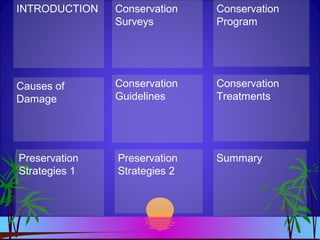
Introduction to the preservation and conservation program, outlining key topics to be discussed.
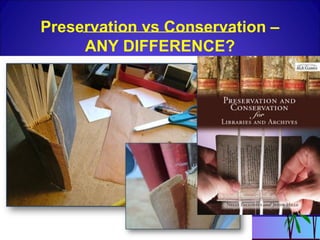
Differentiates preservation (maintaining access) from conservation (repairing items).
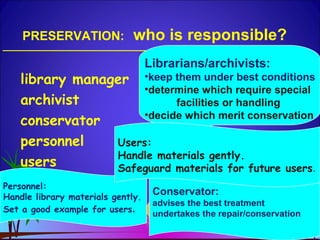
Discusses responsibilities of library managers, archivists, conservators, and users in preservation.
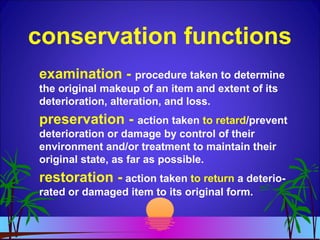
Three main conservation functions: examination, preservation, and restoration of documents.
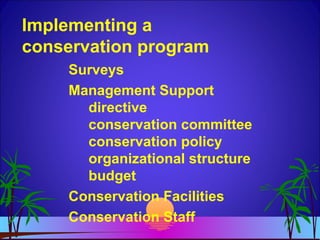
Key components for a conservation program: surveys, management support, and conservation policy.
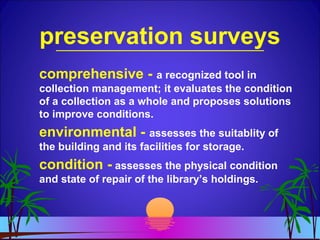
Types of surveys: comprehensive, environmental, and condition surveys for library collections.
Gathering extensive data about library materials through detailed surveys and conditions.
Criteria for prioritizing conservation efforts, including content quality, use, and condition.
Establishment of a conservation committee with defined responsibilities and policy statements.
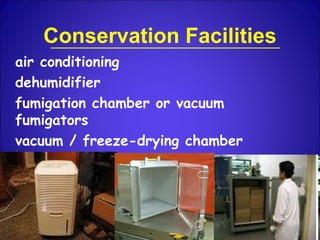
Financial planning for conservation, including budget allocation and necessary facilities.
Essential supplies for conservation and the importance of trained personnel in the process.
Various factors causing damage and deterioration to library materials, including water and handling.
Strategies for mitigating damage, such as environmental control and careful handling practices.
Fundamental principles to guide conservation practices, including reversibility and compatibility.
Guidelines on handling and storing materials to prevent damage and ensure longevity.
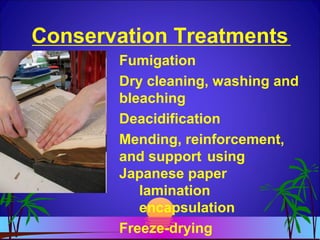
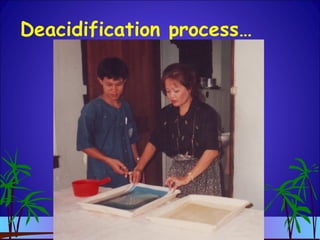
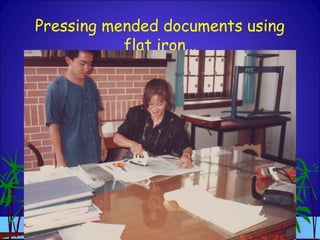
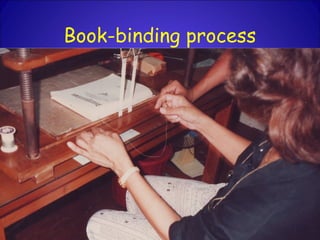
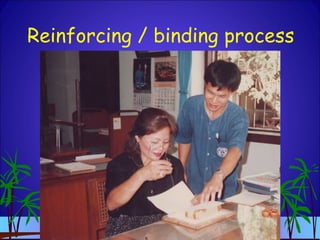
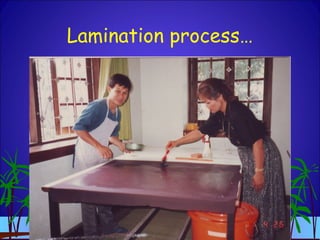
Various treatment methods including deacidification, mending, and binding processes.
Strategies and best practices for handling and preserving library materials.
Guidelines on proper handling of materials and restrictions to protect collections.
Recap of essential steps for an effective preservation program including environment inspection.Covers legal aspects surrounding preservation including intellectual property rights and confidentiality.
Acknowledgments, references for further reading, and contact information for inquiries.
What’s the difference?
Preservationis a
branch of library and
information science
concerned with
maintaining or restoring
access to artifacts,
documents and records
through the study,
diagnosis, treatment
and prevention of decay
and damage.
Conservation
refers to the
treatment and repair
of individual items to
slow decay or
restore them to a
usable state.
(Source:
http://en.wikipedia.org/wiki/P
reservation_(library_and_arc
hival_science)
5.
PRESERVATION
deals with theacquisition,
organization, and distribution of
resources (human, physical, monetary)
to ensure adequate protection and
access to historical and cultural
information of enduring value for
present and future generations of
users.
encompasses three aspects:
planning, implementation, prevention
6.
PRESERVATION: who isresponsible?
library manager
archivist
conservator
personnel
users
Librarians/archivists:
•keep them under best conditions
•determine which require special
facilities or handling
•decide which merit conservation
Conservator:
advises the best treatment
undertakes the repair/conservation
Personnel:
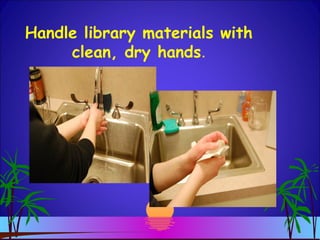
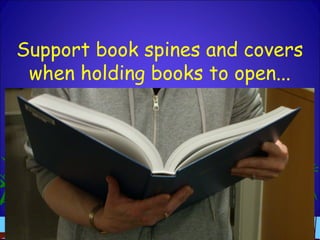
Handle library materials gently.
Set a good example for users.
Users:
Handle materials gently.
Safeguard materials for future users.
7.
CONSERVATION
program that dealswith the physical
or chemical treatment of documents
encompasses three functions:
examination
preservation
restoration
8.
conservation functions
examination -procedure taken to determine
the original makeup of an item and extent of its
deterioration, alteration, and loss.
preservation - action taken to retard/prevent
deterioration or damage by control of their
environment and/or treatment to maintain their
original state, as far as possible.
restoration - action taken to return a deterio-
rated or damaged item to its original form.
preservation surveys
comprehensive -a recognized tool in
collection management; it evaluates the condition
of a collection as a whole and proposes solutions
to improve conditions.
environmental - assesses the suitablity of
the building and its facilities for storage.
condition - assesses the physical condition
and state of repair of the library’s holdings.
11.
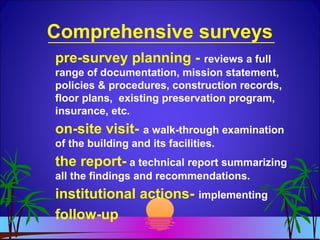
Comprehensive surveys
pre-survey planning- reviews a full
range of documentation, mission statement,
policies & procedures, construction records,
floor plans, existing preservation program,
insurance, etc.
on-site visit- a walk-through examination
of the building and its facilities.
the report- a technical report summarizing
all the findings and recommendations.
institutional actions- implementing
follow-up
12.
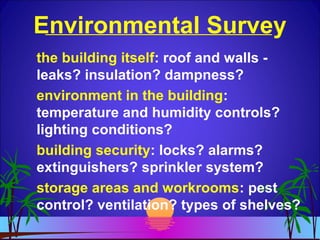
Environmental Survey
the buildingitself: roof and walls -
leaks? insulation? dampness?
environment in the building:
temperature and humidity controls?
lighting conditions?
building security: locks? alarms?
extinguishers? sprinkler system?
storage areas and workrooms: pest
control? ventilation? types of shelves?
13.
Condition Survey
best meansof gathering data needed to
evaluate treatment priorities
survey instrument should be as
extensive as possible
survey form should be simple to fill out
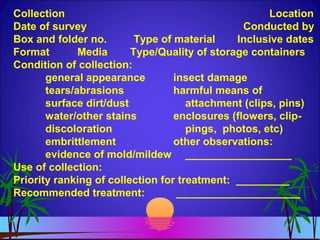
survey data may include the following:
14.
Collection Location
Date ofsurvey Conducted by
Box and folder no. Type of material Inclusive dates
Format Media Type/Quality of storage containers
Condition of collection:
general appearance insect damage
tears/abrasions harmful means of
surface dirt/dust attachment (clips, pins)
water/other stains enclosures (flowers, clip-
discoloration pings, photos, etc)
embrittlement other observations:
evidence of mold/mildew __________________
Use of collection:
Priority ranking of collection for treatment: _________
Recommended treatment: _____________________
administrative order
outlines prioritiesand goals
short-term
intermediate
long-term
provides a conservation policy
statement
designates responsibility for the
conservation effort
17.
Conservation Committee
knowledge ofnature of collections
knowledge of conservation, or
enthusiasm, interest, willingness to
learn conservation skills
formal appointment
authority to gather information, plan
the program, review facilities and
environment, execute the program
18.
Conservation Policy
Statement
must bewritten
approved by the Conservation Committee
adheres to basic principles in conservation
contains manual of procedures that should
serve as helpful guide and training aid
lists specific “do’s and dont’s”
19.
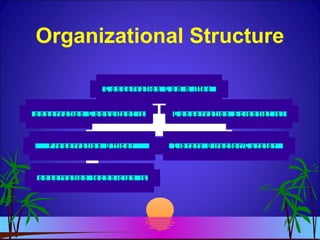
Organizational Structure
C on s e r v a t i o n C o n s u l t a n t ( s ) C o n s e r v a t i o n S c i e n t i s t ( s )
c o n s e r v a t i o n t e c h n i c i a n ( s )
P r e s e r v a t i o n O f f i c e r L i b r a r y D i r e c t o r / C u r a t o r
C o n s e r v a t i o n C o m m i t t e e
20.
Budget
must be aline item in the institutional budget
at least 15-20 % of total budget
expenses should include
archival storage materials
extermination services
subscription to literature on conservation
expanded projects such as
establishment of conservation laboratory,
microfilming, etc.
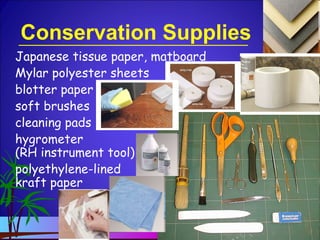
Conservation Supplies
Japanese tissuepaper, matboard
Mylar polyester sheets
blotter paper
soft brushes
cleaning pads
hygrometer
(RH instrument tool)
polyethylene-lined
kraft paper
23.
Conservation Staff
restoration workmust be done only by
trained personnel
staff training is an ongoing responsibility
training and orientation must be
directed toward staff at all levels
the number of staff involved will depend
on the size and type of the institution,
and on the extent of conservation
program
24.
Causes of
Damage/Deterioration
acid –internal factors affecting quality of paper
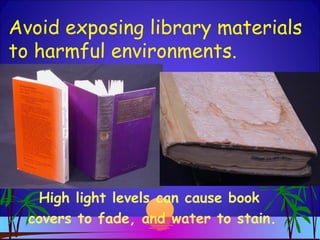
light - ultraviolet rays in sunlight and fluorescent light
cause chemical changes in the paper and accelerate the
process of fading
temperature and humidity - accelerates the
growth of mold and the internal decomposition of paper
air pollution - causing discoloration, embrittlement
and disintegration of the paper fibers
Insects and rodents
25.
Causes of
Damage/Deterioration
Water damageis a fairly common cause and one
that should be anticipated in most disaster prevention/
planning programs
Photocopying frequently damages bound volumes
Shelving - Leaning books cause undue strain on the
spine, and tightly packed books are harmed with
shelving and removal.
Book drops
Wear and tear from use
26.
retarding deterioration
temperature andhumidity control
filtration screens against dirt and air
pollutants
filters against ultraviolet and infrared rays
deacidification
acid-free/rust-free storage facilities
careful handling
good housekeeping (and pest control)
27.
Principles in Conservation
ruleof reversibility - no procedure or
treatment should be undertaken that cannot
later be undone.
compatibility of problem and solution -
the chosen treatment to be applied should not
be greater or weaker than the problem. It may
be best to do nothing at all if no acceptable
treatment solution is compatible to the
problem.
28.
more principles ...
ruleon restoration - how far reconstruc-
tion may be undertaken without losing or
diminishing the integrity of the item or
document.
documentation - maintaining a complete
and accurate record of all treatments.
narrative description
checklist of work done
photographic record (before, during,
and after)
29.
Do not useany measure,
treatment, or program that:
cannot be reversed if necessary
cannot be used properly
will not last a long time
is harmful to people
changes the physical property of
material
dissolves or damages any part of the
material
Conservation Guidelines
store materialsin acid-free
containers
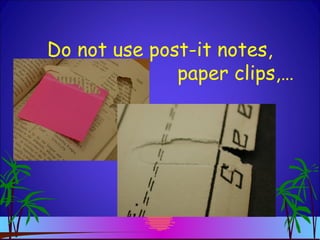
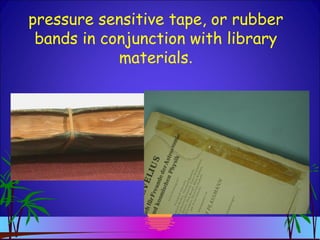
remove paper clips, staple wires,
pins, string, tape, etc. while
processing (use plastic clips,
fasteners, etc instead)
use metal shelving at least 4- 5
inches above floor level
Acid:
32.
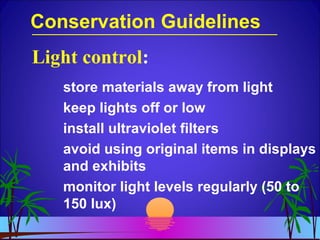
Conservation Guidelines
store materialsaway from light
keep lights off or low
install ultraviolet filters
avoid using original items in displays
and exhibits
monitor light levels regularly (50 to
150 lux)
Light control:
33.
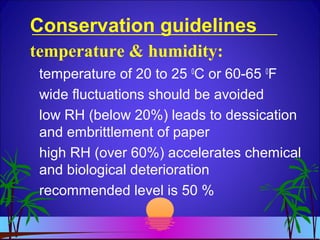
Conservation guidelines
temperature of20 to 25 0
C or 60-65 0
F
wide fluctuations should be avoided
low RH (below 20%) leads to dessication
and embrittlement of paper
high RH (over 60%) accelerates chemical
and biological deterioration
recommended level is 50 %
temperature & humidity:
34.
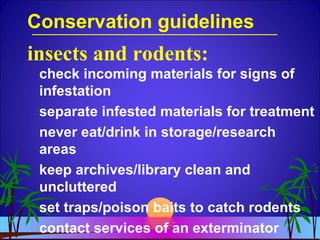
Conservation guidelines
check incomingmaterials for signs of
infestation
separate infested materials for treatment
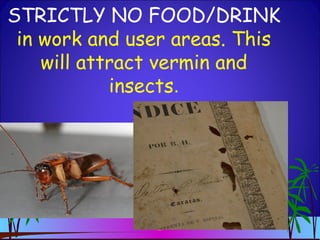
never eat/drink in storage/research
areas
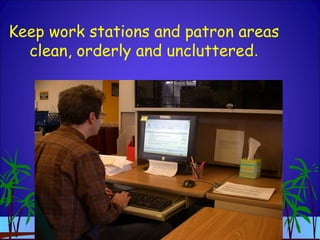
keep archives/library clean and
uncluttered
set traps/poison baits to catch rodents
contact services of an exterminator
insects and rodents:
35.
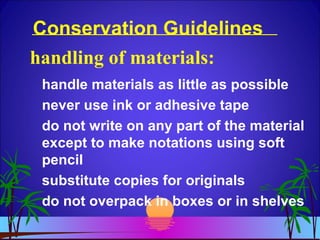
Conservation Guidelines
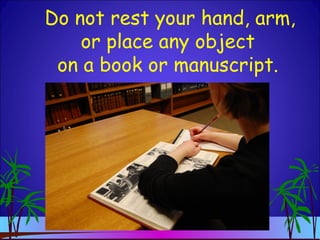
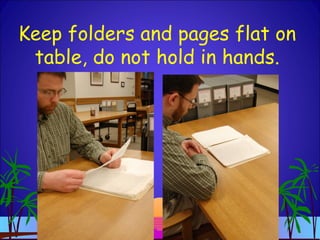
handle materialsas little as possible
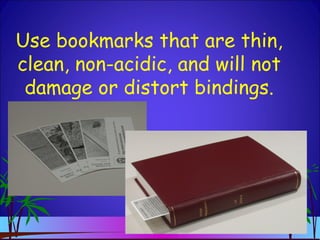
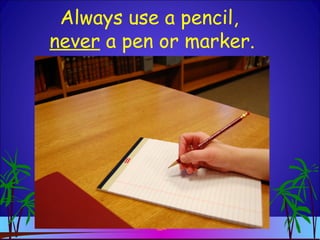
never use ink or adhesive tape
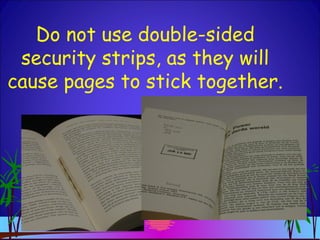
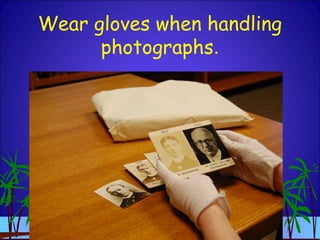
do not write on any part of the material
except to make notations using soft
pencil
substitute copies for originals
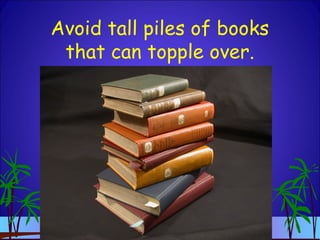
do not overpack in boxes or in shelves
handling of materials:
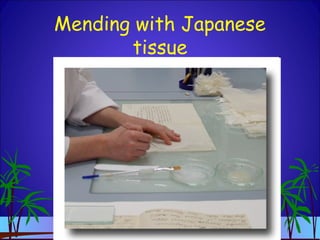
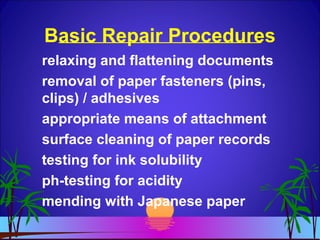
Basic Repair Procedures
relaxingand flattening documents
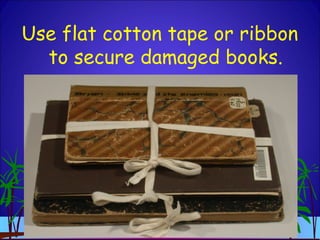
removal of paper fasteners (pins,
clips) / adhesives
appropriate means of attachment
surface cleaning of paper records
testing for ink solubility
ph-testing for acidity
mending with Japanese paper
44.
Salvage Techniques
air-drying
interleaving pageswith absorbent
paper and books placed upright
pressing when dry
hair-drying on cool setting
dehumidification
freezing (at minus 20 o
F )
Vacuum drying
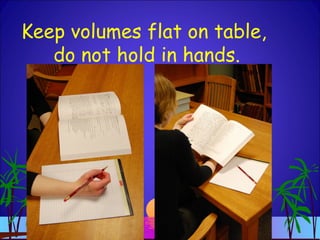
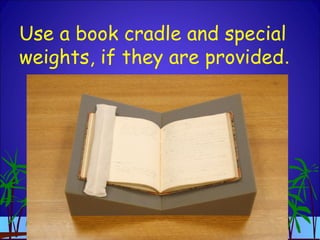
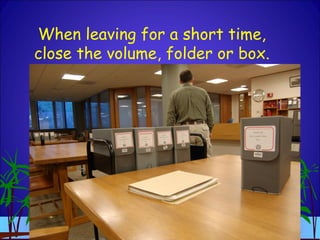
Handling of archivalmaterials
do not leave users unattended
only issue a limited number of docu-
ments or folders, or one box at a time
do not allow material to be taken out
from reading room
do not allow materials to be rearranged
only staff should take charge of
photocopying
examine materials after use
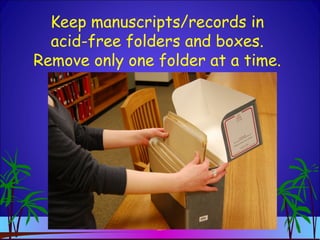
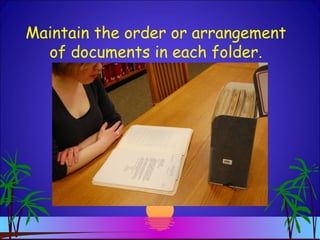
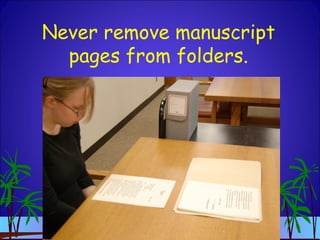
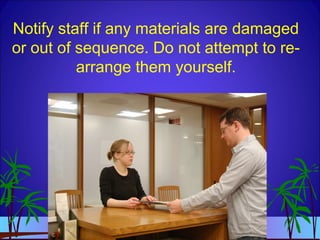
Notify staff ifany materials are damaged
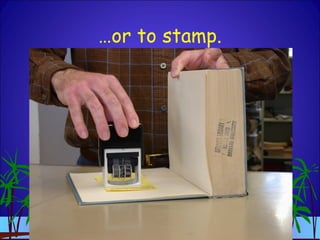
or out of sequence. Do not attempt to re-
arrange them yourself.
72.
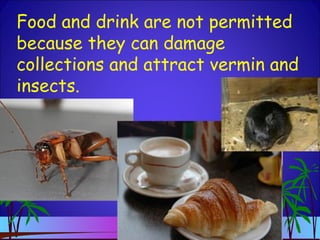
Food and drinkare not permitted
because they can damage
collections and attract vermin and
insects.
73.
Summarizing a preservationprogram...
examine the environment
improve the environment
examine the materials / establish priorities
for treatment
separate materials for in-house treatment
from those requiring professional care
establish a work room for remedial
treatment
supervise in-house repairs and restoration
work with a professional conservator
keep informed
Legal and ethicalIssues
•Intellectual Property Rights
•Reproduction rights of Libraries
and Archives in Copyright laws
•Legal constraints in use of
reprographic and digital copies
• Access and security issues
•Privacy and Confidentiality issues
•Keeping the integrity of originals
76.
Acknowledgement/Credits
and references:
Library Preservationat
Harvard
http://preserve.harvard.edu/care/index.html
Library of Congress Preservation
http://www.loc.gov/preserv/
New York University Libraries
http://library.nyu.edu/preservation/