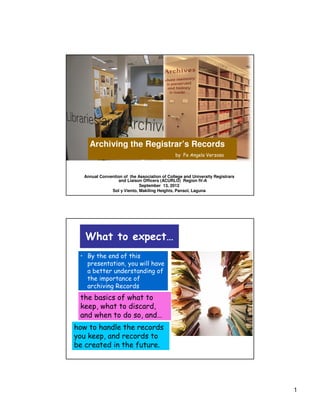
Archiving the Registrar’s Records
                                              by Fe Angela Verzosa


  Annual Convention of the Association of College and University Registrars
                  and Liaison Officers (ACURLO) Region IV-A
                            September 13, 2012
              Sol y Viento, Makiling Heights, Pansol, Laguna


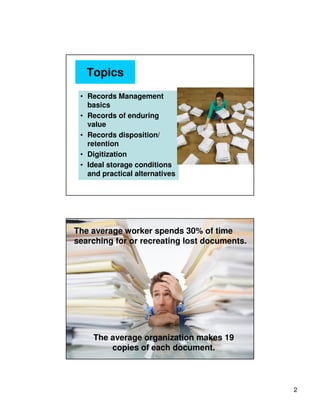
   What to expect…
 • By the end of this
   presentation, you will have
   a better understanding of
   the importance of
   archiving Records
 the basics of what to
 keep, what to discard,
 and when to do so, and…
how to handle the records
you keep, and records to
be created in the future.


                                                                              1
Topics
 • Records Management
   basics
 • Records of enduring
   value
 • Records disposition/
   retention
 • Digitization
 • Ideal storage conditions
   and practical alternatives


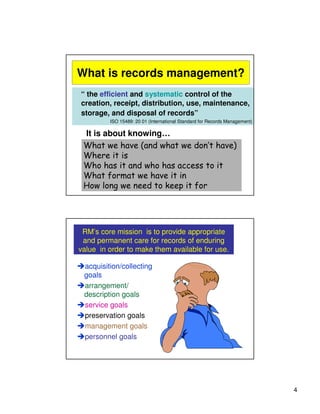
The average worker spends 30% of time
searching for or recreating lost documents.


    The average organization makes 19
        copies of each document.


                                              2
On the
   average,
     each
  employee
 spends 3.5
  hours per
 week every
     year
searching for
 information
  they can’t
     find.
  How many
people are in
 your office?


    Why do we need a system for
        managing records?
• How many people in your office regularly make use of
records?
• Is your office clogged up with piles of paper?
• As a rule, can you find a document generated two months
ago in less than five minutes? What about a document
generated by a colleague?
• What would happen in the event of a fire or flood on your
premises? Does your office have an off-site storage of
important records?
• Does your office have a back-up system for computer-
based records?


                                                              3
What is records management?
“ the efficient and systematic control of the
creation, receipt, distribution, use, maintenance,
storage, and disposal of records”
         ISO 15489: 20 01 (International Standard for Records Management)

 It is about knowing…
 What we have (and what we don’t have)
 Where it is
 Who has it and who has access to it
 What format we have it in
 How long we need to keep it for


 RM’s core mission is to provide appropriate
 and permanent care for records of enduring
value in order to make them available for use.

 acquisition/collecting
 goals
 arrangement/
 description goals
 service goals
 preservation goals
 management goals
 personnel goals


                                                                            4
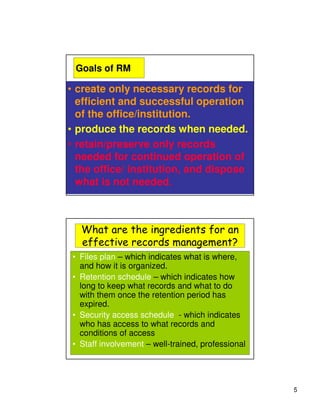
Goals of RM

• create only necessary records for
  efficient and successful operation
  of the office/institution.
• produce the records when needed.
• retain/preserve only records
  needed for continued operation of
  the office/ institution, and dispose
  what is not needed.


   What are the ingredients for an
   effective records management?
 • Files plan – which indicates what is where,
   and how it is organized.
 • Retention schedule – which indicates how
   long to keep what records and what to do
   with them once the retention period has
   expired.
 • Security access schedule - which indicates
   who has access to what records and
   conditions of access
 • Staff involvement – well-trained, professional


                                                    5
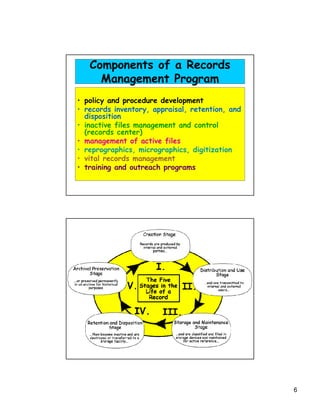
Components of a Records
     Management Program
• policy and procedure development
• records inventory, appraisal, retention, and
  disposition
• inactive files management and control
  (records center)
• management of active files
• reprographics, micrographics, digitization
• vital records management
• training and outreach programs


                                                 6
CRITERIA                in creating records

       • is it necessary?
           • what constitutes adequate
                    documentation?
    • is it desirable to have it in a
    consistent format?
    • what is its future life ?
    • what is the best way to store
          and retrieve it?


      What Registrar’s records to keep?
•   Transcripts
•   examination papers [such as compre,
    including major class tests, etc.]
•   students’ coursework [including theses,
    dissertations, project papers, etc.];
•   minutes, marksheets and other data
    from Panels and Boards of Examiners;
•   attendance records and other material
    relating to student’s engagement with
    their studies;
•   course syllabi, descriptions, etc.
•   academic references;
•   copies of handbooks and policy manuals


                                                  7
Student records – any or all information
created or received by the university which document
• student's academic progress (i.e., courses taken,
  grades received and formal notations made by the
  institutional registrar regarding the student's
  progress towards receipt of a degree, theses,
  awards)
• class material in whatever form (e-learning, paper
  etc.).
• administrative processes: medical, career
  placements, disciplinary, financial, etc.
• student’s social life, including (but not limited to)
  housing, student’s employment at university or
  student organizations, volunteer jobs, athletics,
• governance, organizational activities, social life etc.
Source: http://www.library.uiuc.edu/ica-suv/StudentRecordsGuidelines.pdf


  Registrar’s records of students
• records of admission;
• registration & enrolment to courses/training
  modules, etc;
• attendance and engagement;
• exam scripts and coursework answers;
• marks, progression and award outcomes;
• records of examiners’ meetings and of the
  consideration of appeals; and
• references or other documents supplied to
  confirm a student’s achievements.
 Source:
 http://www.hope.ac.uk/media/liverpoolhope/contentassets/documents/po
 liciesandprocedures/media,1046,en.pdf


                                                                           8
Curriculum records
  • relate to the course, not to the student.
  • includes records of curriculum structures,
    assessment patterns and weightings,
    progression and award rules,
  • calendars and examination timetables,
  • regulations & published regulatory guidance
    and
  • any other information about the curriculum

Source:
http://www.hope.ac.uk/media/liverpoolhope/contentassets/documents/polic
iesandprocedures/media,1046,en.pdf


 Personal data in student records
  • in many cases student records have
    sensitive data – health, religious and political affiliation,
     sexual preferences, etc.

  • also for reason of privacy, access to student
    records for research purposes should be
    allowed only after the student’s death.
  • restriction to access should not, by itself,
    make an argument for destruction of
    records.

Source: http://www.library.uiuc.edu/ica-suv/StudentRecordsGuidelines.pdf


                                                                           9
Archiving policy
 “Each individual institution should decide whether
   it wishes to retain core student records
   permanently to support wider academic and
   personal research. From a purely business point
   of view the institution need only retain records
   which allow it to provide a transcript showing
   when a student attended the institution, what
   courses they followed while they were there and
   the grades achieved, the final degree awarded
   and any academic distinctions achieved.”
  Source:
  http://www.hope.ac.uk/media/liverpoolhope/contentassets/documents/po
  liciesandprocedures/media,1046,en.pdf


Archiving policy
 • Records should be kept at least to fulfill
   legal requirements and obligations and
   operational needs of the university.
 • After legal and operational needs to
   keep student records have expired, the
   university should consider appraisal
   that results in permanent retention of at
   least part of the student records.

Source: http://www.library.uiuc.edu/ica-suv/StudentRecordsGuidelines.pdf


                                                                           10
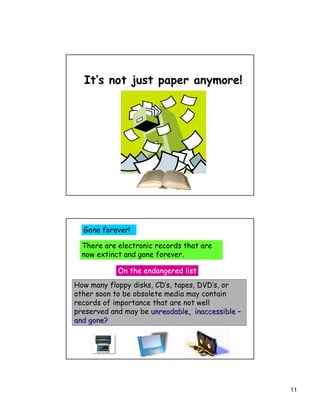
It’s not just paper anymore!


  Gone forever!

  There are electronic records that are
  now extinct and gone forever.

            On the endangered list
How many floppy disks, CD’s, tapes, DVD’s, or
other soon to be obsolete media may contain
records of importance that are not well
preserved and may be unreadable, inaccessible –
and gone?


                                                  11
Decisions,
    decisions…
   Apply same
  decisions to
  retaining
  electronic
  information as
  you would to
  the traditional
  paper format


                      Also known
Records disposition       as…

“Should it stay, or should it
 go?”


                                   12
Records disposition
• inventorying
• appraising
• scheduling
• retiring
       disposal policies
   transfer guidelines
archival procedures


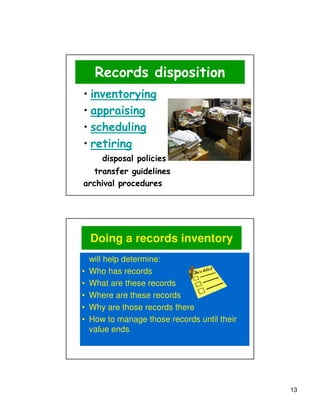
    Doing a records inventory
    will help determine:
•   Who has records
•   What are these records
•   Where are these records
•   Why are those records there
•   How to manage those records until their
    value ends


                                              13
Records disposition
   • inventorying
   • appraising
   • scheduling
   • retiring
           disposal policies
      transfer guidelines
   archival procedures


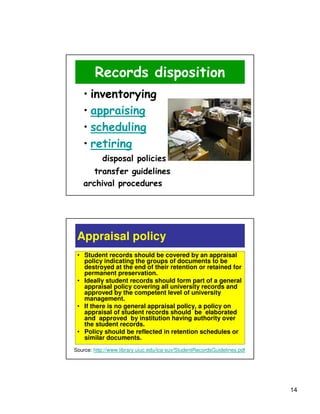
 Appraisal policy
 • Student records should be covered by an appraisal
   policy indicating the groups of documents to be
   destroyed at the end of their retention or retained for
   permanent preservation.
 • Ideally student records should form part of a general
   appraisal policy covering all university records and
   approved by the competent level of university
   management.
 • If there is no general appraisal policy, a policy on
   appraisal of student records should be elaborated
   and approved by institution having authority over
   the student records.
 • Policy should be reflected in retention schedules or
   similar documents.
Source: http://www.library.uiuc.edu/ica-suv/StudentRecordsGuidelines.pdf


                                                                           14
Records disposition
 • inventorying
 • appraising
 • scheduling
 • retiring
       disposal policies
    transfer guidelines
 archival procedures


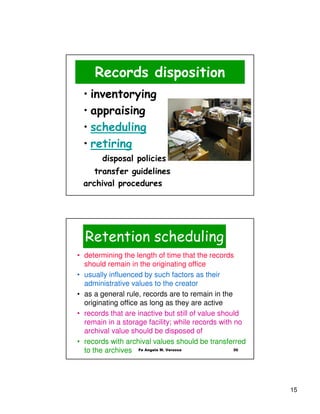
  Retention scheduling
• determining the length of time that the records
  should remain in the originating office
• usually influenced by such factors as their
  administrative values to the creator
• as a general rule, records are to remain in the
  originating office as long as they are active
• records that are inactive but still of value should
  remain in a storage facility; while records with no
  archival value should be disposed of
• records with archival values should be transferred
  to the archives Fe Angela M. Verzosa             30


                                                        15
Records disposition
   • inventorying
   • appraising
   • scheduling
   • retiring
        disposal policies
      transfer guidelines
   archival procedures


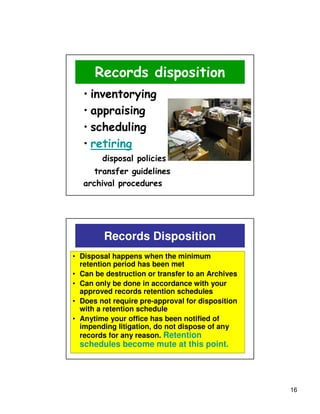
        Records Disposition
• Disposal happens when the minimum
  retention period has been met
• Can be destruction or transfer to an Archives
• Can only be done in accordance with your
  approved records retention schedules
• Does not require pre-approval for disposition
  with a retention schedule
• Anytime your office has been notified of
  impending litigation, do not dispose of any
  records for any reason. Retention
  schedules become mute at this point.


                                                  16
Disposal policy
 • Once records are appraised, those records
   having no archival value should be destroyed.
 • However, the university may consider the
   possibility to give records back to students.
 • Taking into account sensitive nature of
   personal data in student records, they should
   be destroyed in accordance with national
   legislation for data protection. Any data leaks
   should be prevented.
 • Appropriate documentation should be made
   about the disposal of records.
Source: http://www.library.uiuc.edu/ica-suv/StudentRecordsGuidelines.pdf


                  “Going paperless”

          If an agency wants to “go
         paperless” there are certain
        legal requirements to be met
        before source documents can
                 be destroyed.


                                                                           17
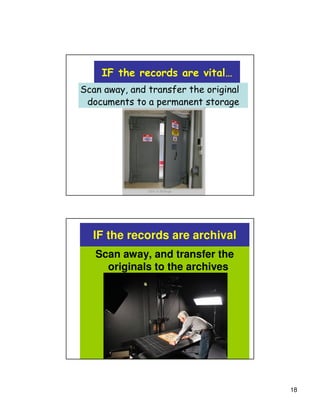
IF the records are vital…
Scan away, and transfer the original
 documents to a permanent storage


  IF the records are archival
   Scan away, and transfer the
     originals to the archives


                                       18
Digitization – principal reasons

• For enhanced access                Not for
  to improve services by
  facilitating retrieval        • space-saving
• To reduce handling                 because originals may
  and use of fragile or              require off-site storage
  heavily used originals,
  thereby reducing risk         • cost-reduction
  of loss/damage/                    because digitization is
  misuse                             a costly program
• For securing back-up          • preservation
  copies                             because originals are
                                     retained.


   Ideal storage conditions and
       practical alternatives
  • Ideal storage: climate
    and humidity controlled
    environment in acid-free
    boxes and file folders
  • Practical alternatives:
     – acid-free folders in filing
       cabinets
     – acid-free folders in acid-
       free record storage
       cartons
     – acid-free folders in acid-
       free manuscript boxes


                                                                19
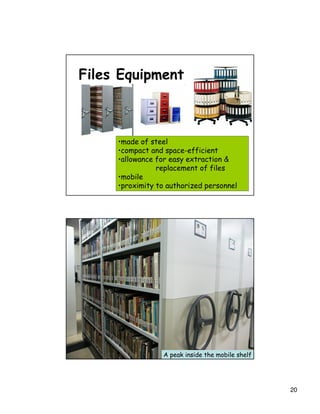
Files Equipment


     •made of steel
     •compact and space-efficient
     •allowance for easy extraction &
                replacement of files
     •mobile
     •proximity to authorized personnel


                 A peak inside the mobile shelf


                                                  20
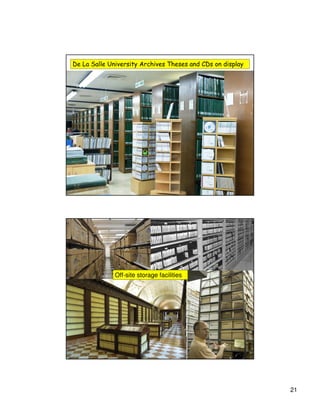
De La Salle University Archives Theses and CDs on display


              Off-site storage facilities


                                                            21
FACILITIES & EQUIPMENT
    FIREPROOFING           ULTRAVIOLET
    AIRCONDITIONING        FILTER SCREENS
    HUMIDITY CONTROL       HEAVY CURTAINS
    SMOKE and HEAT         ACID-FREE BOXES
       DETECTORS           ACID-FREE
    DOUBLE LOCKS           FOLDERS
    SECURITY ALARM         RUST-FREE
                           SUPPLIES


    COMMON HAZARDS
•   temperature           • PEOPLE
•   humidity               using ink/pens
•   light                  using adhesives
•   insects and rodents    laminating
•   fungi, mold, mildew    folding, tearing
•   acid                   spilling food/drink
•   fire                   bending, tracing
•   water                  stealing/mutilating


                                                 22
Finally… the 3 e’s
     The ultimate test of a good
     records management program
     is whether the records are
     available to those who need
     them, when and where they
     are needed (effectiveness),
     the manner in which they are
     made available (efficiency),
     and at what cost (economy).


Questions ?


              famverzosa@yahoo.com


                                     23

Archiving the registrar's records

  • 1.
    Archiving the Registrar’sRecords by Fe Angela Verzosa Annual Convention of the Association of College and University Registrars and Liaison Officers (ACURLO) Region IV-A September 13, 2012 Sol y Viento, Makiling Heights, Pansol, Laguna What to expect… • By the end of this presentation, you will have a better understanding of the importance of archiving Records the basics of what to keep, what to discard, and when to do so, and… how to handle the records you keep, and records to be created in the future. 1
  • 2.
    Topics • RecordsManagement basics • Records of enduring value • Records disposition/ retention • Digitization • Ideal storage conditions and practical alternatives The average worker spends 30% of time searching for or recreating lost documents. The average organization makes 19 copies of each document. 2
  • 3.
    On the average, each employee spends 3.5 hours per week every year searching for information they can’t find. How many people are in your office? Why do we need a system for managing records? • How many people in your office regularly make use of records? • Is your office clogged up with piles of paper? • As a rule, can you find a document generated two months ago in less than five minutes? What about a document generated by a colleague? • What would happen in the event of a fire or flood on your premises? Does your office have an off-site storage of important records? • Does your office have a back-up system for computer- based records? 3
  • 4.
    What is recordsmanagement? “ the efficient and systematic control of the creation, receipt, distribution, use, maintenance, storage, and disposal of records” ISO 15489: 20 01 (International Standard for Records Management) It is about knowing… What we have (and what we don’t have) Where it is Who has it and who has access to it What format we have it in How long we need to keep it for RM’s core mission is to provide appropriate and permanent care for records of enduring value in order to make them available for use. acquisition/collecting goals arrangement/ description goals service goals preservation goals management goals personnel goals 4
  • 5.
    Goals of RM •create only necessary records for efficient and successful operation of the office/institution. • produce the records when needed. • retain/preserve only records needed for continued operation of the office/ institution, and dispose what is not needed. What are the ingredients for an effective records management? • Files plan – which indicates what is where, and how it is organized. • Retention schedule – which indicates how long to keep what records and what to do with them once the retention period has expired. • Security access schedule - which indicates who has access to what records and conditions of access • Staff involvement – well-trained, professional 5
  • 6.
    Components of aRecords Management Program • policy and procedure development • records inventory, appraisal, retention, and disposition • inactive files management and control (records center) • management of active files • reprographics, micrographics, digitization • vital records management • training and outreach programs 6
  • 7.
    CRITERIA in creating records • is it necessary? • what constitutes adequate documentation? • is it desirable to have it in a consistent format? • what is its future life ? • what is the best way to store and retrieve it? What Registrar’s records to keep? • Transcripts • examination papers [such as compre, including major class tests, etc.] • students’ coursework [including theses, dissertations, project papers, etc.]; • minutes, marksheets and other data from Panels and Boards of Examiners; • attendance records and other material relating to student’s engagement with their studies; • course syllabi, descriptions, etc. • academic references; • copies of handbooks and policy manuals 7
  • 8.
    Student records –any or all information created or received by the university which document • student's academic progress (i.e., courses taken, grades received and formal notations made by the institutional registrar regarding the student's progress towards receipt of a degree, theses, awards) • class material in whatever form (e-learning, paper etc.). • administrative processes: medical, career placements, disciplinary, financial, etc. • student’s social life, including (but not limited to) housing, student’s employment at university or student organizations, volunteer jobs, athletics, • governance, organizational activities, social life etc. Source: http://www.library.uiuc.edu/ica-suv/StudentRecordsGuidelines.pdf Registrar’s records of students • records of admission; • registration & enrolment to courses/training modules, etc; • attendance and engagement; • exam scripts and coursework answers; • marks, progression and award outcomes; • records of examiners’ meetings and of the consideration of appeals; and • references or other documents supplied to confirm a student’s achievements. Source: http://www.hope.ac.uk/media/liverpoolhope/contentassets/documents/po liciesandprocedures/media,1046,en.pdf 8
  • 9.
    Curriculum records • relate to the course, not to the student. • includes records of curriculum structures, assessment patterns and weightings, progression and award rules, • calendars and examination timetables, • regulations & published regulatory guidance and • any other information about the curriculum Source: http://www.hope.ac.uk/media/liverpoolhope/contentassets/documents/polic iesandprocedures/media,1046,en.pdf Personal data in student records • in many cases student records have sensitive data – health, religious and political affiliation, sexual preferences, etc. • also for reason of privacy, access to student records for research purposes should be allowed only after the student’s death. • restriction to access should not, by itself, make an argument for destruction of records. Source: http://www.library.uiuc.edu/ica-suv/StudentRecordsGuidelines.pdf 9
  • 10.
    Archiving policy “Eachindividual institution should decide whether it wishes to retain core student records permanently to support wider academic and personal research. From a purely business point of view the institution need only retain records which allow it to provide a transcript showing when a student attended the institution, what courses they followed while they were there and the grades achieved, the final degree awarded and any academic distinctions achieved.” Source: http://www.hope.ac.uk/media/liverpoolhope/contentassets/documents/po liciesandprocedures/media,1046,en.pdf Archiving policy • Records should be kept at least to fulfill legal requirements and obligations and operational needs of the university. • After legal and operational needs to keep student records have expired, the university should consider appraisal that results in permanent retention of at least part of the student records. Source: http://www.library.uiuc.edu/ica-suv/StudentRecordsGuidelines.pdf 10
  • 11.
    It’s not justpaper anymore! Gone forever! There are electronic records that are now extinct and gone forever. On the endangered list How many floppy disks, CD’s, tapes, DVD’s, or other soon to be obsolete media may contain records of importance that are not well preserved and may be unreadable, inaccessible – and gone? 11
  • 12.
    Decisions, decisions… Apply same decisions to retaining electronic information as you would to the traditional paper format Also known Records disposition as… “Should it stay, or should it go?” 12
  • 13.
    Records disposition • inventorying •appraising • scheduling • retiring disposal policies transfer guidelines archival procedures Doing a records inventory will help determine: • Who has records • What are these records • Where are these records • Why are those records there • How to manage those records until their value ends 13
  • 14.
    Records disposition • inventorying • appraising • scheduling • retiring disposal policies transfer guidelines archival procedures Appraisal policy • Student records should be covered by an appraisal policy indicating the groups of documents to be destroyed at the end of their retention or retained for permanent preservation. • Ideally student records should form part of a general appraisal policy covering all university records and approved by the competent level of university management. • If there is no general appraisal policy, a policy on appraisal of student records should be elaborated and approved by institution having authority over the student records. • Policy should be reflected in retention schedules or similar documents. Source: http://www.library.uiuc.edu/ica-suv/StudentRecordsGuidelines.pdf 14
  • 15.
    Records disposition •inventorying • appraising • scheduling • retiring disposal policies transfer guidelines archival procedures Retention scheduling • determining the length of time that the records should remain in the originating office • usually influenced by such factors as their administrative values to the creator • as a general rule, records are to remain in the originating office as long as they are active • records that are inactive but still of value should remain in a storage facility; while records with no archival value should be disposed of • records with archival values should be transferred to the archives Fe Angela M. Verzosa 30 15
  • 16.
    Records disposition • inventorying • appraising • scheduling • retiring disposal policies transfer guidelines archival procedures Records Disposition • Disposal happens when the minimum retention period has been met • Can be destruction or transfer to an Archives • Can only be done in accordance with your approved records retention schedules • Does not require pre-approval for disposition with a retention schedule • Anytime your office has been notified of impending litigation, do not dispose of any records for any reason. Retention schedules become mute at this point. 16
  • 17.
    Disposal policy •Once records are appraised, those records having no archival value should be destroyed. • However, the university may consider the possibility to give records back to students. • Taking into account sensitive nature of personal data in student records, they should be destroyed in accordance with national legislation for data protection. Any data leaks should be prevented. • Appropriate documentation should be made about the disposal of records. Source: http://www.library.uiuc.edu/ica-suv/StudentRecordsGuidelines.pdf “Going paperless” If an agency wants to “go paperless” there are certain legal requirements to be met before source documents can be destroyed. 17
  • 18.
    IF the recordsare vital… Scan away, and transfer the original documents to a permanent storage IF the records are archival Scan away, and transfer the originals to the archives 18
  • 19.
    Digitization – principalreasons • For enhanced access Not for to improve services by facilitating retrieval • space-saving • To reduce handling because originals may and use of fragile or require off-site storage heavily used originals, thereby reducing risk • cost-reduction of loss/damage/ because digitization is misuse a costly program • For securing back-up • preservation copies because originals are retained. Ideal storage conditions and practical alternatives • Ideal storage: climate and humidity controlled environment in acid-free boxes and file folders • Practical alternatives: – acid-free folders in filing cabinets – acid-free folders in acid- free record storage cartons – acid-free folders in acid- free manuscript boxes 19
  • 20.
    Files Equipment •made of steel •compact and space-efficient •allowance for easy extraction & replacement of files •mobile •proximity to authorized personnel A peak inside the mobile shelf 20
  • 21.
    De La SalleUniversity Archives Theses and CDs on display Off-site storage facilities 21
  • 22.
    FACILITIES & EQUIPMENT FIREPROOFING ULTRAVIOLET AIRCONDITIONING FILTER SCREENS HUMIDITY CONTROL HEAVY CURTAINS SMOKE and HEAT ACID-FREE BOXES DETECTORS ACID-FREE DOUBLE LOCKS FOLDERS SECURITY ALARM RUST-FREE SUPPLIES COMMON HAZARDS • temperature • PEOPLE • humidity using ink/pens • light using adhesives • insects and rodents laminating • fungi, mold, mildew folding, tearing • acid spilling food/drink • fire bending, tracing • water stealing/mutilating 22
  • 23.
    Finally… the 3e’s The ultimate test of a good records management program is whether the records are available to those who need them, when and where they are needed (effectiveness), the manner in which they are made available (efficiency), and at what cost (economy). Questions ? famverzosa@yahoo.com 23