
MANAGEMENT OF RECORD CENTRE 
(IMD 256) 
FUNCTIONS OF RECORDS CENTRE 
(CHAPTER 2)
APPRAISALS AND DISPOSITION OF 
RECORDS 
APPRAISAL 
- Process to determine the value of the records. 
There are 2 basics appraisal categories: 
1. Records of a permanence nature to be preserved. 
2. Records that is disposable.
Appraisal Involves Two Tasks: 
First is the process of deciding what records need to be 
kept for their continuing value to their creators and 
users for the conduct of business, and how long they 
should be kept. 
Second is the process of deciding what records have an 
enduring value for purposes other than those for which 
they were created, such as historical research.
DISPOSITION 
Action taken in due course as a result of appraisal. 
Note: Disposal is not synonymous with destruction, though 
that may be an option.
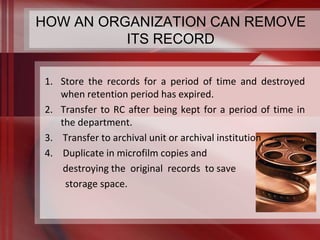
HOW AN ORGANIZATION CAN REMOVE 
ITS RECORD 
1. Store the records for a period of time and destroyed 
when retention period has expired. 
2. Transfer to RC after being kept for a period of time in 
the department. 
3. Transfer to archival unit or archival institution 
4. Duplicate in microfilm copies and 
destroying the original records to save 
storage space.
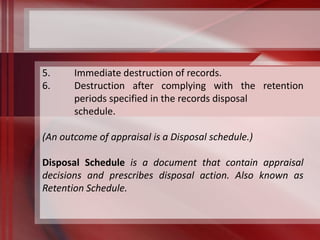
5. Immediate destruction of records. 
6. Destruction after complying with the retention 
periods specified in the records disposal 
schedule. 
(An outcome of appraisal is a Disposal schedule.) 
Disposal Schedule is a document that contain appraisal 
decisions and prescribes disposal action. Also known as 
Retention Schedule.
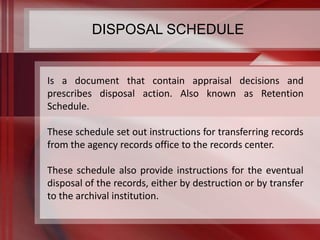
DISPOSAL SCHEDULE 
Is a document that contain appraisal decisions and 
prescribes disposal action. Also known as Retention 
Schedule. 
These schedule set out instructions for transferring records 
from the agency records office to the records center. 
These schedule also provide instructions for the eventual 
disposal of the records, either by destruction or by transfer 
to the archival institution.
OBJECTIVE OF APPRAISAL AND 
DISPOSITION 
1. To ensure destruction process for records without 
value. 
2. Ensure transferring process (Record Transfer) for 
valuable (Permanent) records to archive and 
temporary records to RC.
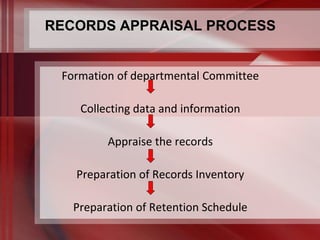
RECORDS APPRAISAL PROCESS 
Formation of departmental Committee 
Collecting data and information 
Appraise the records 
Preparation of Records Inventory 
Preparation of Retention Schedule
FORMATION OF DEPARTMENTAL COMMITTEE 
OF APPRAISAL 
Head of the department/agency appoint: 
1. Officer and staff who prepare the records retention 
schedules (Record Manager and Registry Staff) 
2. Head of all divisions within the department eg: Legal 
and Financial advisor, Archivist (if any)
COLLECTING DATA AND INFORMATION 
It can be done by conducting record survey eg. 
conducting interview or circulated questionnaire. 
The record survey will enable appraisal team to: 
• Understand the functions of the agency. 
• Identify the various type of records created and used. 
• Identify the frequency use of information. 
• Identify current, semi current and non current 
records.
• Identify records management legislation. 
• Locate the records and understand how they are used. 
• Identify the value of records. 
• Prepare records inventory. 
• Develop retention/disposal schedules.
APPRAISAL OF RECORDS 
From the information gathered by appraisal team, the committee 
will appraise the records according to the following appraisal 
criteria: 
Primary value : Administrative value 
: Fiscal Value 
: Legal value 
Secondary value : Research value 
: Information value 
: Evidential value 
: Historical /Cultural / National Value.
PREPARATION OF RECORDS 
INVENTORY 
Records Inventory is a list of every records series in a 
department/agency. It consists of: 
• Categories of records 
• Contents and values of records 
• Total volume of records 
• Different format of records 
• Retention periods
PREPARATION OF DISPOSAL 
SCHEDULE 
• The disposal action suggested in records retention 
schedule must be clearly worded. 
• The Committee should suggest the most suitable 
retention period for every records series that are 
inventoried. 
• The complete retention schedule must be endorsed by 
the Appraisal Committee, approved and signed by the 
Director of the department/Agency and then 
implemented.
THE OBJECTIVE OF APPRAISAL AND 
DISPOSITION 
1. To ensure records of continuing value are retained 
for as long as they are required. 
2. To disposed records appropriately, either by 
destruction or transfer to an archival repository, as 
soon as that value has ended.
THINGS TO NOTE WHEN PREPARING THE 
RECORDS INVENTORY AND RECORDS 
RETENTION/DISPOSAL SCHEDULE: 
● Financial Records must be carried out in accordance to 
the Treasury circular Letter 3rd. November 1993 and 
General Circular Letter No 1/1997 
● Record pertaining of Legal claims are control by the 
Limitation Act which specifies a minimum period of 6 
years where by claims can be made.
● Disposition of Public Records must be accordance to 
the National Archives Act no 44/1966 and government 
instruction from time to time. 
● Disposition of business records must be accordance to 
the Companies Act, the Evidence Act, Banking and 
Financial Institution Act, Employees Act and other 
company internal instructions and procedures.
FOUNDER OF APPRAISAL OF 
1. T.R. Schellenberg 
RECORDS 
Appraisal should refer to primary value and secondary value. 
2. Sir Hilary Jekinson 
“A manual of Archive Administration, 1966” suggested : 
• Appraisal manage by the agency that create the 
documents. 
• Appraisal should refer the operational value of the 
records. 
• Records with historical value should be protected.
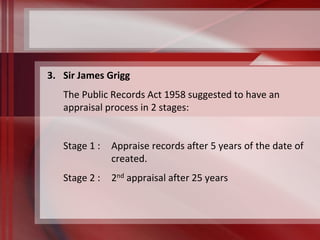
3. Sir James Grigg 
The Public Records Act 1958 suggested to have an 
appraisal process in 2 stages: 
Stage 1 : Appraise records after 5 years of the date of 
created. 
Stage 2 : 2nd appraisal after 25 years
THANK YOU

Chapter 2

  • 1.
    MANAGEMENT OF RECORDCENTRE (IMD 256) FUNCTIONS OF RECORDS CENTRE (CHAPTER 2)
  • 2.
    APPRAISALS AND DISPOSITIONOF RECORDS APPRAISAL - Process to determine the value of the records. There are 2 basics appraisal categories: 1. Records of a permanence nature to be preserved. 2. Records that is disposable.
  • 3.
    Appraisal Involves TwoTasks: First is the process of deciding what records need to be kept for their continuing value to their creators and users for the conduct of business, and how long they should be kept. Second is the process of deciding what records have an enduring value for purposes other than those for which they were created, such as historical research.
  • 4.
    DISPOSITION Action takenin due course as a result of appraisal. Note: Disposal is not synonymous with destruction, though that may be an option.
  • 5.
    HOW AN ORGANIZATIONCAN REMOVE ITS RECORD 1. Store the records for a period of time and destroyed when retention period has expired. 2. Transfer to RC after being kept for a period of time in the department. 3. Transfer to archival unit or archival institution 4. Duplicate in microfilm copies and destroying the original records to save storage space.
  • 6.
    5. Immediate destructionof records. 6. Destruction after complying with the retention periods specified in the records disposal schedule. (An outcome of appraisal is a Disposal schedule.) Disposal Schedule is a document that contain appraisal decisions and prescribes disposal action. Also known as Retention Schedule.
  • 7.
    DISPOSAL SCHEDULE Isa document that contain appraisal decisions and prescribes disposal action. Also known as Retention Schedule. These schedule set out instructions for transferring records from the agency records office to the records center. These schedule also provide instructions for the eventual disposal of the records, either by destruction or by transfer to the archival institution.
  • 8.
    OBJECTIVE OF APPRAISALAND DISPOSITION 1. To ensure destruction process for records without value. 2. Ensure transferring process (Record Transfer) for valuable (Permanent) records to archive and temporary records to RC.
  • 9.
    RECORDS APPRAISAL PROCESS Formation of departmental Committee Collecting data and information Appraise the records Preparation of Records Inventory Preparation of Retention Schedule
  • 10.
    FORMATION OF DEPARTMENTALCOMMITTEE OF APPRAISAL Head of the department/agency appoint: 1. Officer and staff who prepare the records retention schedules (Record Manager and Registry Staff) 2. Head of all divisions within the department eg: Legal and Financial advisor, Archivist (if any)
  • 11.
    COLLECTING DATA ANDINFORMATION It can be done by conducting record survey eg. conducting interview or circulated questionnaire. The record survey will enable appraisal team to: • Understand the functions of the agency. • Identify the various type of records created and used. • Identify the frequency use of information. • Identify current, semi current and non current records.
  • 12.
    • Identify recordsmanagement legislation. • Locate the records and understand how they are used. • Identify the value of records. • Prepare records inventory. • Develop retention/disposal schedules.
  • 13.
    APPRAISAL OF RECORDS From the information gathered by appraisal team, the committee will appraise the records according to the following appraisal criteria: Primary value : Administrative value : Fiscal Value : Legal value Secondary value : Research value : Information value : Evidential value : Historical /Cultural / National Value.
  • 14.
    PREPARATION OF RECORDS INVENTORY Records Inventory is a list of every records series in a department/agency. It consists of: • Categories of records • Contents and values of records • Total volume of records • Different format of records • Retention periods
  • 15.
    PREPARATION OF DISPOSAL SCHEDULE • The disposal action suggested in records retention schedule must be clearly worded. • The Committee should suggest the most suitable retention period for every records series that are inventoried. • The complete retention schedule must be endorsed by the Appraisal Committee, approved and signed by the Director of the department/Agency and then implemented.
  • 16.
    THE OBJECTIVE OFAPPRAISAL AND DISPOSITION 1. To ensure records of continuing value are retained for as long as they are required. 2. To disposed records appropriately, either by destruction or transfer to an archival repository, as soon as that value has ended.
  • 17.
    THINGS TO NOTEWHEN PREPARING THE RECORDS INVENTORY AND RECORDS RETENTION/DISPOSAL SCHEDULE: ● Financial Records must be carried out in accordance to the Treasury circular Letter 3rd. November 1993 and General Circular Letter No 1/1997 ● Record pertaining of Legal claims are control by the Limitation Act which specifies a minimum period of 6 years where by claims can be made.
  • 18.
    ● Disposition ofPublic Records must be accordance to the National Archives Act no 44/1966 and government instruction from time to time. ● Disposition of business records must be accordance to the Companies Act, the Evidence Act, Banking and Financial Institution Act, Employees Act and other company internal instructions and procedures.
  • 19.
    FOUNDER OF APPRAISALOF 1. T.R. Schellenberg RECORDS Appraisal should refer to primary value and secondary value. 2. Sir Hilary Jekinson “A manual of Archive Administration, 1966” suggested : • Appraisal manage by the agency that create the documents. • Appraisal should refer the operational value of the records. • Records with historical value should be protected.
  • 20.
    3. Sir JamesGrigg The Public Records Act 1958 suggested to have an appraisal process in 2 stages: Stage 1 : Appraise records after 5 years of the date of created. Stage 2 : 2nd appraisal after 25 years
  • 21.