Records Management
Records Managment
                               Overview


What is Record Management
What is a Records Retention Schedule
Why do I need a schedule
I do not have records
Records with legal or Litigation
Employee Responsibilities
Benefits of Record Management
Question
Record Management
             What is Record Management


The field of management responsible
for the systematic control of the
creation, maintenance, use, and
disposition of records in order to
achieve adequate and proper
documentation of the policies and
transaction and effective and
economical management of
agency operations
Record Management
                       What is Record Management


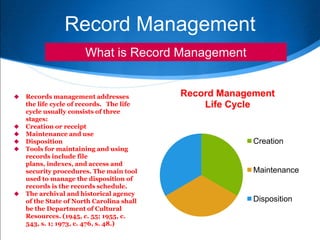
   Records management addresses           Record Management
    the life cycle of records. The life        Life Cycle
    cycle usually consists of three
    stages:
   Creation or receipt
   Maintenance and use
   Disposition                                         Creation
   Tools for maintaining and using
    records include file
    plans, indexes, and access and
    security procedures. The main tool                  Maintenance
    used to manage the disposition of
    records is the records schedule.
   The archival and historical agency
    of the State of North Carolina shall                Disposition
    be the Department of Cultural
    Resources. (1945, c. 55; 1955, c.
    543, s. 1; 1973, c. 476, s. 48.)
Record Management
      What is a Record Retention and Disposition
                      Schedule

 A records schedule is a tool for the employees of the Elizabeth
  City State University to use when managing the records of the
  university. It lists records found in an office and gives an
  assessment of their value by indicating when (and if) those
  records should be destroyed. The schedule is also an agreement
  between the office, the University Archives and Records Service
  (UARS) and the North Carolina Department of Cultural
  Resources (DCR).


 This schedule serves as the inventory and schedule that the
  Department of Cultural Resources is directed by North Carolina
  General Statutes 121-5 (c) and 132-8 to provide. It supersedes all
  previous editions, including all amendments.
Record Management
      What is a Record Retention and Disposition
                      Schedule

 Tools for maintaining and using
   records include file
   plans, indexes, and access and
   security procedures. The main tool
   used to manage the disposition of
   records is the records schedule.


 The archival and historical agency of
   the State of North Carolina shall be
   the Department of Cultural
   Resources. (1945, c. 55; 1955, c.
   543, s. 1; 1973, c. 476, s. 48.)
Record Management
What is a Record Retention and Disposition
                Schedule
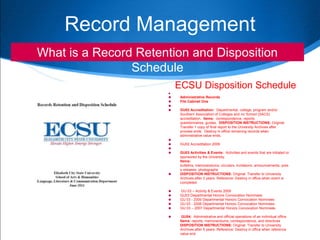
                          ECSU Disposition Schedule
                      
                          Administrative Records
                          File Cabinet One
                      
                          GU02 Accreditation: Departmental, college, program and/or
                           Southern Association of Colleges and /or School (SACS)
                           accreditation. Items: correspondence, reports
                           questionnaires, guides. DISPOSITION INSTRUCTIONS; Original:
                           Transfer 1 copy of final report to the University Archives after
                           process ends. Destroy in office remaining records when
                           administrative value ends.
                      
                          GU02 Accreditation 2009
                      
                          GU03 Activities & Events: Activities and events that are initiated or
                           sponsored by the University.
                           Items:
                           bulletins, memorandums, circulars, invitations, announcements, pres
                           s releases, photographs
                          DISPOSITION INSTRUCTIONS: Original: Transfer to University
                           Archives after 3 years. Reference: Destroy in office when event is
                           completed.

                          GU 03 – Activity & Events 2009
                          GU03 Departmental Honors Convocation Nominees
                          GU 03 - 2009 Departmental Honors Convocation Nominees
                          GU 03 - 2008 Departmental Honors Convocation Nominees
                          GU 03 – 2007 Departmental Honors Convocation Nominees

                           GU04: Administrative and official operations of an individual office.
                           Items: reports, memorandums, correspondence, and directives
                           DISPOSITION INSTRUCTIONS: Original: Transfer to University
                           Archives after 5 years. Reference: Destroy in office when reference
                           value end
Record Management
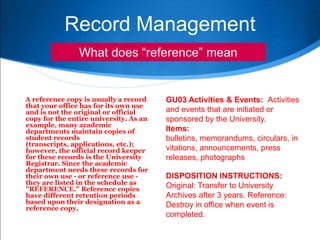
                What does “reference” mean


A reference copy is usually a record    GU03 Activities & Events: Activities
that your office has for its own use
and is not the original or official     and events that are initiated or
copy for the entire university. As an   sponsored by the University.
example, many academic
departments maintain copies of          Items:
student records                         bulletins, memorandums, circulars, in
(transcripts, applications, etc.);
however, the official record keeper     vitations, announcements, press
for these records is the University     releases, photographs
Registrar. Since the academic
department needs these records for
their own use - or reference use -      DISPOSITION INSTRUCTIONS:
they are listed in the schedule as      Original: Transfer to University
"REFERENCE." Reference copies
have different retention periods        Archives after 3 years. Reference:
based upon their designation as a       Destroy in office when event is
reference copy.
                                        completed.
Record Management
What if I have two records series with the same name in my
        schedule – an official and a “REFERENCE”.


It is possible for an office to have official or record copies and
reference copies of the same records series. A records series is a
group of related records (in any format) held by an organization.
An example would be Committee and Council Records. The
official records of a committee are maintained by the chair of the
committee. If your office has someone who is the chair of a
committee, their records are the official/record copy and would
follow that series in your schedule. However, if that person is a
member of a committee (not the chair) those records would be
reference copies and should follow the reference series in your
schedule.
Record Management
             Why do I need a Schedule


According to G.S. 132-5 and G.S. 132-3, you may destroy
public records only with the consent of DCR. DCR has an
agreement with UARS to provide records management
services to the University of North Carolina at Chapel Hill.
This schedule is the primary way DCR gives consent
through UARS for the destruction of university records.
Without an approved schedule, your office cannot destroy
any record, no matter how insignificant.
Record Management
              I Do Not Have Records


Nearly every university office generates, receives, or uses
 records. Computer files of any kind, including drafts and
 email, are public records. Even if your records are not the
 official or final versions, your records are public records.
 Not all records have great historical, legal, or fiscal
 value, but they all must be managed according to a records
 retention and disposition schedule.
Record Management
What is a “legal hold” or “litigation hold” on Records
              and When does it Apply?

 Records that are subject to a legal hold or litigation hold must
 not be destroyed until officially released from the hold. A hold is
 placed when either an official discovery order is served on the
 university requesting the production of certain records (for a
 litigation, regulatory investigation, audit, open records
 request, etc.), or when litigation is pending and the university is
 on notice to preserve all potentially relevant records. You must
 ensure that for a claim or litigation that is reasonably foreseeable
 but has not yet been initiated, any relevant records (in paper or
 electronic formats) are preserved and not destroyed until
 released by the University Counsel. The records in question must
 not be destroyed until the completion of the action and the
 resolution of all issues that arise from it regardless of the
 retention period set forth in the schedule. If you have any
 questions contact the University Counsel.
Record Management
    What are the benefits of Record Management

   Records enable and support an agency's work to fulfill its mission. Every
    organization, including Federal agencies, must address well-defined objectives that
    add value, either by achieving the organization's goals or by reducing costs. Since
    records contain information, a valuable resource, it is essential to take a systematic
    approach to the management of records. Records management:
   Contributes to the smooth operation of your agency's programs by making the
    information needed for decision making and operations readily available

   Helps deliver services in a consistent and equitable manner

   Facilitates effective performance of activities throughout an agency

   Protects the rights of the agency, its employees, and its customers

   Provides continuity in the event of a disaster

   Protects records from inappropriate and unauthorized access
Record Management
What are the benefits of Record Management Cont

 Meets statutory and regulatory requirements including
   archival, audit, and oversight activities

 Provides protection and support in litigation

 Allows quicker retrieval of documents and information from files

 Improves office efficiency and productivity

 Provides better documentation more efficiently

 Supports and documents historical and other research


 Frees up office space for other purposes by moving inactive records
   to storage facilities

 Avoids unnecessary purchases of office equipment
Record Management
  Questions and Comments

Records Management

  • 1.
  • 2.
    Records Managment Overview What is Record Management What is a Records Retention Schedule Why do I need a schedule I do not have records Records with legal or Litigation Employee Responsibilities Benefits of Record Management Question
  • 3.
    Record Management What is Record Management The field of management responsible for the systematic control of the creation, maintenance, use, and disposition of records in order to achieve adequate and proper documentation of the policies and transaction and effective and economical management of agency operations
  • 4.
    Record Management What is Record Management  Records management addresses Record Management the life cycle of records. The life Life Cycle cycle usually consists of three stages:  Creation or receipt  Maintenance and use  Disposition Creation  Tools for maintaining and using records include file plans, indexes, and access and security procedures. The main tool Maintenance used to manage the disposition of records is the records schedule.  The archival and historical agency of the State of North Carolina shall Disposition be the Department of Cultural Resources. (1945, c. 55; 1955, c. 543, s. 1; 1973, c. 476, s. 48.)
  • 5.
    Record Management What is a Record Retention and Disposition Schedule  A records schedule is a tool for the employees of the Elizabeth City State University to use when managing the records of the university. It lists records found in an office and gives an assessment of their value by indicating when (and if) those records should be destroyed. The schedule is also an agreement between the office, the University Archives and Records Service (UARS) and the North Carolina Department of Cultural Resources (DCR).  This schedule serves as the inventory and schedule that the Department of Cultural Resources is directed by North Carolina General Statutes 121-5 (c) and 132-8 to provide. It supersedes all previous editions, including all amendments.
  • 6.
    Record Management What is a Record Retention and Disposition Schedule  Tools for maintaining and using records include file plans, indexes, and access and security procedures. The main tool used to manage the disposition of records is the records schedule.  The archival and historical agency of the State of North Carolina shall be the Department of Cultural Resources. (1945, c. 55; 1955, c. 543, s. 1; 1973, c. 476, s. 48.)
  • 7.
    Record Management What isa Record Retention and Disposition Schedule ECSU Disposition Schedule   Administrative Records  File Cabinet One   GU02 Accreditation: Departmental, college, program and/or Southern Association of Colleges and /or School (SACS) accreditation. Items: correspondence, reports questionnaires, guides. DISPOSITION INSTRUCTIONS; Original: Transfer 1 copy of final report to the University Archives after process ends. Destroy in office remaining records when administrative value ends.   GU02 Accreditation 2009   GU03 Activities & Events: Activities and events that are initiated or sponsored by the University. Items: bulletins, memorandums, circulars, invitations, announcements, pres s releases, photographs  DISPOSITION INSTRUCTIONS: Original: Transfer to University Archives after 3 years. Reference: Destroy in office when event is completed.  GU 03 – Activity & Events 2009  GU03 Departmental Honors Convocation Nominees  GU 03 - 2009 Departmental Honors Convocation Nominees  GU 03 - 2008 Departmental Honors Convocation Nominees  GU 03 – 2007 Departmental Honors Convocation Nominees  GU04: Administrative and official operations of an individual office. Items: reports, memorandums, correspondence, and directives DISPOSITION INSTRUCTIONS: Original: Transfer to University Archives after 5 years. Reference: Destroy in office when reference value end
  • 8.
    Record Management What does “reference” mean A reference copy is usually a record GU03 Activities & Events: Activities that your office has for its own use and is not the original or official and events that are initiated or copy for the entire university. As an sponsored by the University. example, many academic departments maintain copies of Items: student records bulletins, memorandums, circulars, in (transcripts, applications, etc.); however, the official record keeper vitations, announcements, press for these records is the University releases, photographs Registrar. Since the academic department needs these records for their own use - or reference use - DISPOSITION INSTRUCTIONS: they are listed in the schedule as Original: Transfer to University "REFERENCE." Reference copies have different retention periods Archives after 3 years. Reference: based upon their designation as a Destroy in office when event is reference copy. completed.
  • 9.
    Record Management What ifI have two records series with the same name in my schedule – an official and a “REFERENCE”. It is possible for an office to have official or record copies and reference copies of the same records series. A records series is a group of related records (in any format) held by an organization. An example would be Committee and Council Records. The official records of a committee are maintained by the chair of the committee. If your office has someone who is the chair of a committee, their records are the official/record copy and would follow that series in your schedule. However, if that person is a member of a committee (not the chair) those records would be reference copies and should follow the reference series in your schedule.
  • 10.
    Record Management Why do I need a Schedule According to G.S. 132-5 and G.S. 132-3, you may destroy public records only with the consent of DCR. DCR has an agreement with UARS to provide records management services to the University of North Carolina at Chapel Hill. This schedule is the primary way DCR gives consent through UARS for the destruction of university records. Without an approved schedule, your office cannot destroy any record, no matter how insignificant.
  • 11.
    Record Management I Do Not Have Records Nearly every university office generates, receives, or uses records. Computer files of any kind, including drafts and email, are public records. Even if your records are not the official or final versions, your records are public records. Not all records have great historical, legal, or fiscal value, but they all must be managed according to a records retention and disposition schedule.
  • 12.
    Record Management What isa “legal hold” or “litigation hold” on Records and When does it Apply? Records that are subject to a legal hold or litigation hold must not be destroyed until officially released from the hold. A hold is placed when either an official discovery order is served on the university requesting the production of certain records (for a litigation, regulatory investigation, audit, open records request, etc.), or when litigation is pending and the university is on notice to preserve all potentially relevant records. You must ensure that for a claim or litigation that is reasonably foreseeable but has not yet been initiated, any relevant records (in paper or electronic formats) are preserved and not destroyed until released by the University Counsel. The records in question must not be destroyed until the completion of the action and the resolution of all issues that arise from it regardless of the retention period set forth in the schedule. If you have any questions contact the University Counsel.
  • 13.
    Record Management What are the benefits of Record Management  Records enable and support an agency's work to fulfill its mission. Every organization, including Federal agencies, must address well-defined objectives that add value, either by achieving the organization's goals or by reducing costs. Since records contain information, a valuable resource, it is essential to take a systematic approach to the management of records. Records management:  Contributes to the smooth operation of your agency's programs by making the information needed for decision making and operations readily available  Helps deliver services in a consistent and equitable manner  Facilitates effective performance of activities throughout an agency  Protects the rights of the agency, its employees, and its customers  Provides continuity in the event of a disaster  Protects records from inappropriate and unauthorized access
  • 14.
    Record Management What arethe benefits of Record Management Cont  Meets statutory and regulatory requirements including archival, audit, and oversight activities  Provides protection and support in litigation  Allows quicker retrieval of documents and information from files  Improves office efficiency and productivity  Provides better documentation more efficiently  Supports and documents historical and other research  Frees up office space for other purposes by moving inactive records to storage facilities  Avoids unnecessary purchases of office equipment
  • 15.
    Record Management Questions and Comments