RECORDS MANAGEMENT by Fe Angela M. Verzosa
Why need an integrated approach to records management ? Lack of uniform classification and filing system lack of systematic and orderly transfer of inactive records lack of standardization and control to the creation of forms and directives loss or misfiling of records lack of storage space and filing equipment
Goals of a records management program create only necessary records for efficient and successful operation of the office/institution. produce the records when needed. retain/preserve only records needed for continued operation of the office/ institution, and dispose what is not needed.
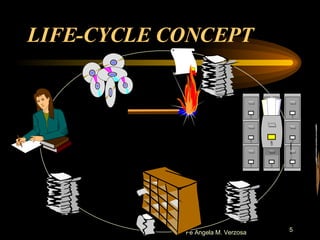
RECORD :  information captured in reproducible form required for conducting any transaction or activity. RECORDS MANAGEMENT: a logical and practical approach to the creation, maintenance, use and disposition of records. LIFE CYCLE CONCEPT: records pass thru three stages from its creation and active use to its final disposition. Definitions
LIFE-CYCLE CONCEPT
FUNCTIONS RECORDS CREATION recording of information on  paper, print, tape or any transmitting medium RECORDS MAINTENANCE producing the records when needed RECORDS DISPOSITION determining the ultimate fate of the records
CRITERIA in creating records is it necessary? what constitutes adequate   documentation? is it desirable to have it in a consistent format ? what is its future life  ? what is the best way to store  and retrieve it?
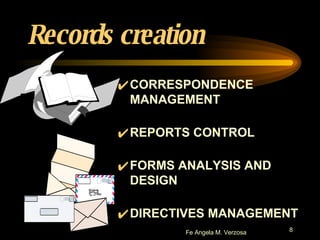
Records creation CORRESPONDENCE  MANAGEMENT REPORTS CONTROL FORMS ANALYSIS AND DESIGN DIRECTIVES MANAGEMENT
Records maintenance adoption of a files plan choice of equipment/supplies mail management files management filing procedures cross-referencing releasing checking sorting
Records disposition inventorying  appraising  scheduling retiring   disposal policies  transfer guidelines  archival procedures
Personnel involved  Creator/originator  user/processor office clerk records clerk
Appraisal   act of determining the worth of records to their  creator or user in terms of use:  primary  or  secondary in terms of content : evidential informational categories: administrative  value fiscal  value legal  value historical/research  value intrinsic  value
Records with evidential values organizational charts annual reports directives/policy memos official histories correspondence accreditation records legal opinions/decisions handbooks and manuals minutes of meetings
Record groups general correspondence transitory correspondence case files references audiovisual materials cartographic records engineering drawings cards machine-readable records microforms
Other record groups Administrative records  academic records accounting/financial records legal records personnel records personal records “ convenience” copies
basic categories  Active inactive dead
University/college Filing system Institutional records administrative records academic dept records faculty records student/alumni records school publications theses and dissertations memorabilia
Files management -  ensures control at the file level Filing involves Arranging records according to a simple, logical system Placing records in a storage container in correct sequence Retrieving the records so that they can be used
Filing systems provide only the  mechanical structure for arranging records. inadequacies of filing stem  from human failing, not  system failure. most suitable system should be applied to a particular type of record, uniformly.
Filing systems CRITERIA of a good filing system Simplicity Flexibility /  Expansibility Adaptibility
Filing methods numerical alphabetic functional  geographic form chronologic
determining the length of time that the records should remain in the originating office usually influenced by such factors as their administrative values to the creator as a general rule, records are to remain in the originating office as long as they are active records that are inactive should remain in a storage facility; while records with no archival value should be disposed of records with archival values should be transferred to the archives Retention scheduling
Suggested Retention Periods Keep permanently and preserve. Keep permanently (transfer to Archives at intervals of 5 years) Keep for 10 years, then destroy. Keep for 5 years, then destroy. Keep for two years, then destroy. Review at intervals, keeping only those with continuing value.
Keep permanently and preserve. annual reports minutes of meetings papers relating to policies & decisions, development plans, budget approvals,  etc.) property/investment records contracts/agreements personnel records (201 files)
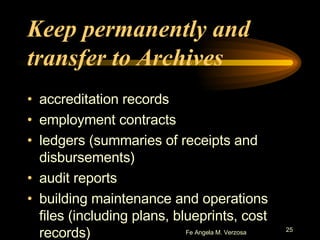
Keep permanently and transfer to Archives accreditation records employment contracts ledgers (summaries of receipts and disbursements) audit reports building maintenance and operations files (including plans, blueprints, cost records)
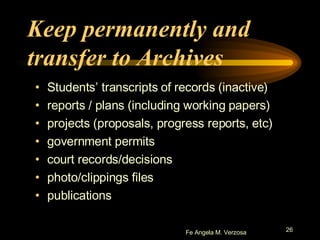
Keep permanently and transfer to Archives Students’ transcripts of records (inactive) reports / plans (including working papers)  projects (proposals, progress reports, etc) government permits court records/decisions photo/clippings files publications
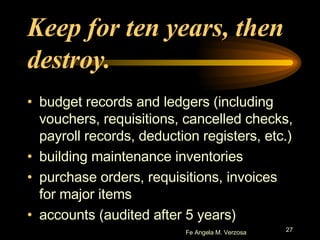
Keep for ten years, then destroy. budget records and ledgers (including vouchers, requisitions, cancelled checks, payroll records, deduction registers, etc.) building maintenance inventories purchase orders, requisitions, invoices for major items accounts (audited after 5 years)
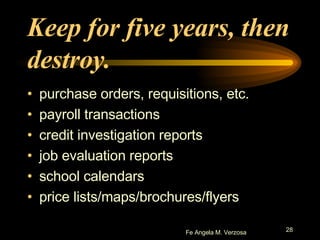
Keep for five years, then destroy. purchase orders, requisitions, etc. payroll transactions credit investigation reports job evaluation reports school calendars price lists/maps/brochures/flyers
Keep for two years, then destroy. acknowledgements application records attendance / job performance reports duplicate/multiple copies of minutes, reports, plans, printed material (catalogs, brochures),  etc. survey questionnaires unused forms
Subject to Regular Review/Appraisal correspondence and other papers (review every five years, keeping/ transferring to Archives those with continuing value) accreditation records/government permits  projects/program proposals student files (correspondence, etc.)  student accounts
Records for disposal drafts routine transmittals acknowledgments specific financial transactions requests/replies to questionnaires blank/unused forms multiple copies
VITAL RECORDS records needed for continued operation records with long retention periods irreplaceable records records where no other copies are available records of historical/ permanent value
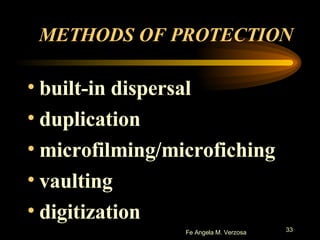
METHODS OF PROTECTION built-in dispersal duplication microfilming/microfiching vaulting digitization
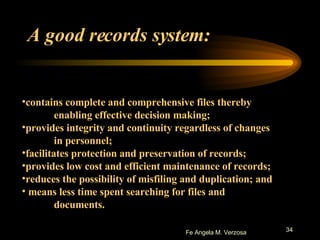
A good records system: contains complete and comprehensive files thereby  enabling effective decision making;  provides integrity and continuity regardless of changes  in personnel;  facilitates protection and preservation of records;  provides low cost and efficient maintenance of records;  reduces the possibility of misfiling and duplication; and means less time spent searching for files and  documents.
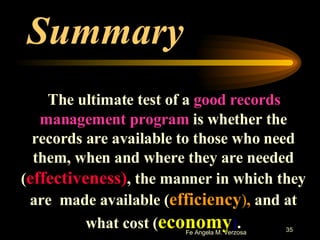
Summary The ultimate test of a  good records management program  is whether the records are available to those who need them, when and where they are needed ( effectiveness) , the manner in which they are  made available ( efficiency ) ,  and at what cost ( economy ) .

Records Management

  • 1.
    RECORDS MANAGEMENT byFe Angela M. Verzosa
  • 2.
    Why need anintegrated approach to records management ? Lack of uniform classification and filing system lack of systematic and orderly transfer of inactive records lack of standardization and control to the creation of forms and directives loss or misfiling of records lack of storage space and filing equipment
  • 3.
    Goals of arecords management program create only necessary records for efficient and successful operation of the office/institution. produce the records when needed. retain/preserve only records needed for continued operation of the office/ institution, and dispose what is not needed.
  • 4.
    RECORD : information captured in reproducible form required for conducting any transaction or activity. RECORDS MANAGEMENT: a logical and practical approach to the creation, maintenance, use and disposition of records. LIFE CYCLE CONCEPT: records pass thru three stages from its creation and active use to its final disposition. Definitions
  • 5.
  • 6.
    FUNCTIONS RECORDS CREATIONrecording of information on paper, print, tape or any transmitting medium RECORDS MAINTENANCE producing the records when needed RECORDS DISPOSITION determining the ultimate fate of the records
  • 7.
    CRITERIA in creatingrecords is it necessary? what constitutes adequate documentation? is it desirable to have it in a consistent format ? what is its future life ? what is the best way to store and retrieve it?
  • 8.
    Records creation CORRESPONDENCE MANAGEMENT REPORTS CONTROL FORMS ANALYSIS AND DESIGN DIRECTIVES MANAGEMENT
  • 9.
    Records maintenance adoptionof a files plan choice of equipment/supplies mail management files management filing procedures cross-referencing releasing checking sorting
  • 10.
    Records disposition inventorying appraising scheduling retiring disposal policies transfer guidelines archival procedures
  • 11.
    Personnel involved Creator/originator user/processor office clerk records clerk
  • 12.
    Appraisal act of determining the worth of records to their creator or user in terms of use: primary or secondary in terms of content : evidential informational categories: administrative value fiscal value legal value historical/research value intrinsic value
  • 13.
    Records with evidentialvalues organizational charts annual reports directives/policy memos official histories correspondence accreditation records legal opinions/decisions handbooks and manuals minutes of meetings
  • 14.
    Record groups generalcorrespondence transitory correspondence case files references audiovisual materials cartographic records engineering drawings cards machine-readable records microforms
  • 15.
    Other record groupsAdministrative records academic records accounting/financial records legal records personnel records personal records “ convenience” copies
  • 16.
    basic categories Active inactive dead
  • 17.
    University/college Filing systemInstitutional records administrative records academic dept records faculty records student/alumni records school publications theses and dissertations memorabilia
  • 18.
    Files management - ensures control at the file level Filing involves Arranging records according to a simple, logical system Placing records in a storage container in correct sequence Retrieving the records so that they can be used
  • 19.
    Filing systems provideonly the mechanical structure for arranging records. inadequacies of filing stem from human failing, not system failure. most suitable system should be applied to a particular type of record, uniformly.
  • 20.
    Filing systems CRITERIAof a good filing system Simplicity Flexibility / Expansibility Adaptibility
  • 21.
    Filing methods numericalalphabetic functional geographic form chronologic
  • 22.
    determining the lengthof time that the records should remain in the originating office usually influenced by such factors as their administrative values to the creator as a general rule, records are to remain in the originating office as long as they are active records that are inactive should remain in a storage facility; while records with no archival value should be disposed of records with archival values should be transferred to the archives Retention scheduling
  • 23.
    Suggested Retention PeriodsKeep permanently and preserve. Keep permanently (transfer to Archives at intervals of 5 years) Keep for 10 years, then destroy. Keep for 5 years, then destroy. Keep for two years, then destroy. Review at intervals, keeping only those with continuing value.
  • 24.
    Keep permanently andpreserve. annual reports minutes of meetings papers relating to policies & decisions, development plans, budget approvals, etc.) property/investment records contracts/agreements personnel records (201 files)
  • 25.
    Keep permanently andtransfer to Archives accreditation records employment contracts ledgers (summaries of receipts and disbursements) audit reports building maintenance and operations files (including plans, blueprints, cost records)
  • 26.
    Keep permanently andtransfer to Archives Students’ transcripts of records (inactive) reports / plans (including working papers) projects (proposals, progress reports, etc) government permits court records/decisions photo/clippings files publications
  • 27.
    Keep for tenyears, then destroy. budget records and ledgers (including vouchers, requisitions, cancelled checks, payroll records, deduction registers, etc.) building maintenance inventories purchase orders, requisitions, invoices for major items accounts (audited after 5 years)
  • 28.
    Keep for fiveyears, then destroy. purchase orders, requisitions, etc. payroll transactions credit investigation reports job evaluation reports school calendars price lists/maps/brochures/flyers
  • 29.
    Keep for twoyears, then destroy. acknowledgements application records attendance / job performance reports duplicate/multiple copies of minutes, reports, plans, printed material (catalogs, brochures), etc. survey questionnaires unused forms
  • 30.
    Subject to RegularReview/Appraisal correspondence and other papers (review every five years, keeping/ transferring to Archives those with continuing value) accreditation records/government permits projects/program proposals student files (correspondence, etc.) student accounts
  • 31.
    Records for disposaldrafts routine transmittals acknowledgments specific financial transactions requests/replies to questionnaires blank/unused forms multiple copies
  • 32.
    VITAL RECORDS recordsneeded for continued operation records with long retention periods irreplaceable records records where no other copies are available records of historical/ permanent value
  • 33.
    METHODS OF PROTECTIONbuilt-in dispersal duplication microfilming/microfiching vaulting digitization
  • 34.
    A good recordssystem: contains complete and comprehensive files thereby enabling effective decision making; provides integrity and continuity regardless of changes in personnel; facilitates protection and preservation of records; provides low cost and efficient maintenance of records; reduces the possibility of misfiling and duplication; and means less time spent searching for files and documents.
  • 35.
    Summary The ultimatetest of a good records management program is whether the records are available to those who need them, when and where they are needed ( effectiveness) , the manner in which they are made available ( efficiency ) , and at what cost ( economy ) .