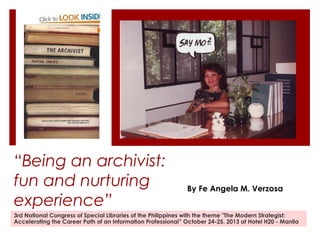
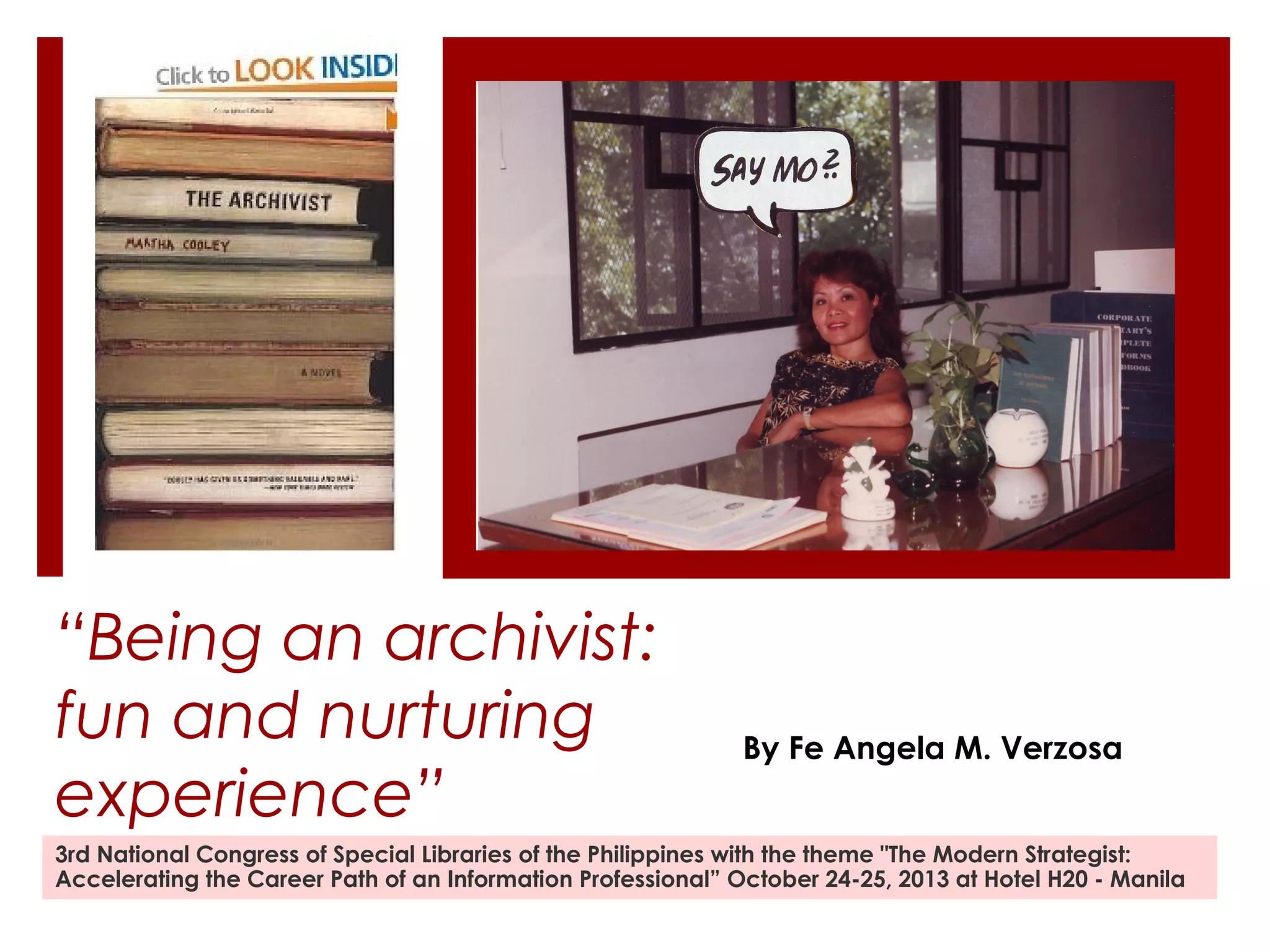
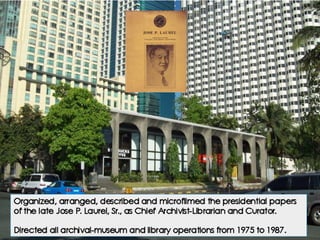
“Being an archivist:
fun and nurturing
experience”

By Fe Angela M. Verzosa

3rd National Congress of Special Libraries of the Philippines with the theme "The Modern Strategist:
Accelerating the Career Path of an Information Professional” October 24-25, 2013 at Hotel H20 - Manila
What’s an archivist?

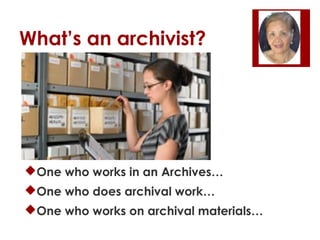
One who works in an Archives…
One who does archival work…
One who works on archival materials…
Sometimes, also known as (but
not really)
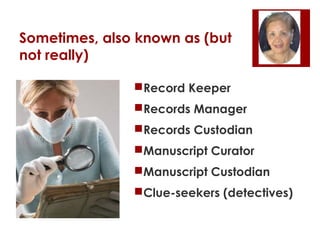
Record Keeper
Records Manager
Records Custodian
Manuscript Curator
Manuscript Custodian
Clue-seekers (detectives)
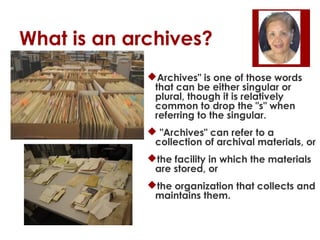
What is an archives?
Archives" is one of those words
that can be either singular or
plural, though it is relatively
common to drop the "s" when
referring to the singular.
 "Archives" can refer to a
collection of archival materials, or
the facility in which the materials
are stored, or
the organization that collects and
maintains them.
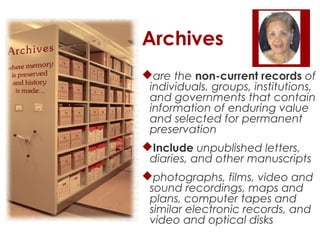
Archives
are the non-current records of
individuals, groups, institutions,
and governments that contain
information of enduring value
and selected for permanent
preservation
Include unpublished letters,
diaries, and other manuscripts
photographs, films, video and
sound recordings, maps and
plans, computer tapes and
similar electronic records, and
video and optical disks
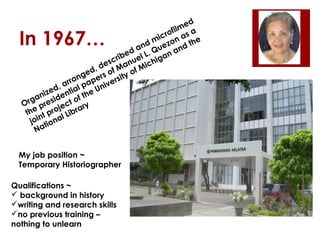
ed
lm a
fi
cro n as
e
mi zo
nd ue nd t h
a
e d l L. Q a n a
ib
scr anue ichig
e
,d fM fM
d
ge ers o sity o
an
r
arr l pap nive
,
zed entia the U
ni
ga resid t of
Or p
c
y
e proje ibrar
th t
lL
n
joi tiona
Na

In 1967…

My job position ~
Temporary Historiographer
Qualifications ~
 background in history
writing and research skills
no previous training –
nothing to unlearn
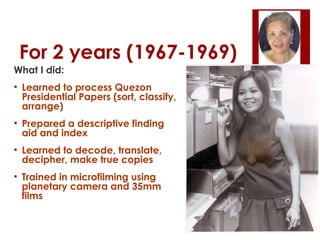
For 2 years (1967-1969)
What I did:
• Learned to process Quezon
Presidential Papers (sort, classify,
arrange)
• Prepared a descriptive finding
aid and index
• Learned to decode, translate,
decipher, make true copies
• Trained in microfilming using
planetary camera and 35mm
films
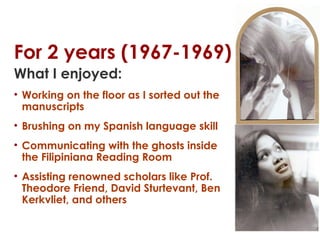
For 2 years (1967-1969)
What I enjoyed:
• Working on the floor as I sorted out the
manuscripts
• Brushing on my Spanish language skill
• Communicating with the ghosts inside
the Filipiniana Reading Room
• Assisting renowned scholars like Prof.
Theodore Friend, David Sturtevant, Ben
Kerkvliet, and others
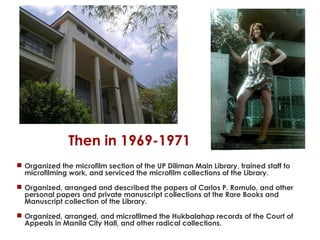
Then in 1969-1971
 Organized the microfilm section of the UP Diliman Main Library, trained staff to
microfilming work, and serviced the microfilm collections of the Library.
 Organized, arranged and described the papers of Carlos P. Romulo, and other
personal papers and private manuscript collections at the Rare Books and
Manuscript collection of the Library.
 Organized, arranged, and microfilmed the Hukbalahap records of the Court of
Appeals in Manila City Hall, and other radical collections.
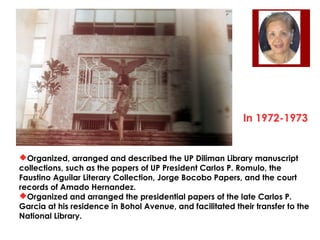
In 1972-1973

Organized, arranged and described the UP Diliman Library manuscript
collections, such as the papers of UP President Carlos P. Romulo, the
Faustino Aguilar Literary Collection, Jorge Bocobo Papers, and the court
records of Amado Hernandez.
Organized and arranged the presidential papers of the late Carlos P.
Garcia at his residence in Bohol Avenue, and facilitated their transfer to the
National Library.
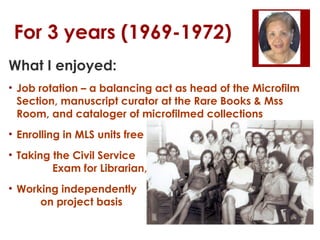
For 3 years (1969-1972)
What I enjoyed:
• Job rotation – a balancing act as head of the Microfilm
Section, manuscript curator at the Rare Books & Mss
Room, and cataloger of microfilmed collections
• Enrolling in MLS units free
• Taking the Civil Service
Exam for Librarian, and
• Working independently
on project basis
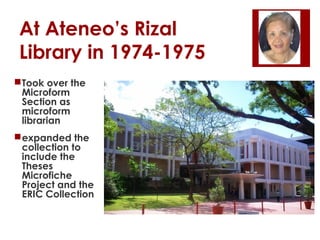
At Ateneo’s Rizal
Library in 1974-1975
Took over the
Microform
Section as
microform
librarian
expanded the
collection to
include the
Theses
Microfiche
Project and the
ERIC Collection
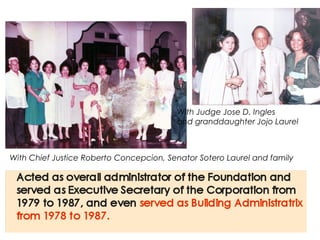
With Judge Jose D. Ingles
and granddaughter Jojo Laurel

With Chief Justice Roberto Concepcion, Senator Sotero Laurel and family
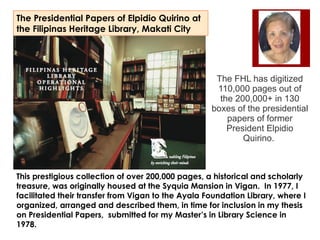
The Presidential Papers of Elpidio Quirino at
the Filipinas Heritage Library, Makati City

The FHL has digitized
110,000 pages out of
the 200,000+ in 130
boxes of the presidential
papers of former
President Elpidio
Quirino.

This prestigious collection of over 200,000 pages, a historical and scholarly
treasure, was originally housed at the Syquia Mansion in Vigan. In 1977, I
facilitated their transfer from Vigan to the Ayala Foundation Library, where I
organized, arranged and described them, in time for inclusion in my thesis
on Presidential Papers, submitted for my Master’s in Library Science in
1978.
What archivists do
Archivists perform a wide variety of tasks:
acquire, select, store and provide access to materials
(that may come in the form of written documents, maps,
photographs, films, memorabilia, etc) by providing
description and finding aids to these collections…
assist users in using the collections; answer inquiries, give
talks to groups, mount exhibitions, and publish…
plan and organize systems and procedures for the
safekeeping of records and valuable documents to keep
them secure, well-maintained, and preserved for
posterity.
What archivists do
The time archivists spend on these activities varies
depending on where they work.
In local government offices, archivists work with a variety of
local records (local/oral histories).
Those who work in the national libraries often look after
literary Manuscripts collections or Personal Papers.
University archivists may manage university records, or look
after collections that belong to the institution’s illustrious
alumni or faculty, and those relating to specific subjects.
In businesses, archivists look after records about company
history and product development.
What archivists do
Some archivists specialize in the acquisition,
management, description, and preservation of
photographic or audiovisual materials or electronic
records.
Other aspects of the job may include records
management, digitization, public outreach, writing, and
teaching or mentoring.
Archivists may keep records for local governments,
educational institutions, business companies, churches,
religious organizations, family estates, courts, hospitals,
or charities.
What archivists do
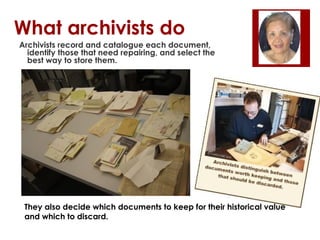
Archivists record and catalogue each document,
identify those that need repairing, and select the
best way to store them.

They also decide which documents to keep for their historical value
and which to discard.
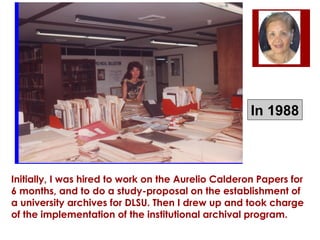
In 1988

Initially, I was hired to work on the Aurelio Calderon Papers for
6 months, and to do a study-proposal on the establishment of
a university archives for DLSU. Then I drew up and took charge
of the implementation of the institutional archival program.
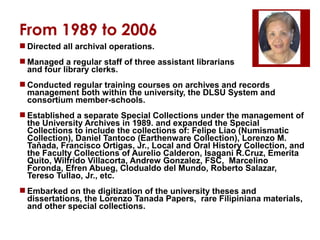
From 1989 to 2006
 Directed all archival operations.
 Managed a regular staff of three assistant librarians
and four library clerks.
 Conducted regular training courses on archives and records
management both within the university, the DLSU System and
consortium member-schools.
 Established a separate Special Collections under the management of
the University Archives in 1989. and expanded the Special
Collections to include the collections of: Felipe Liao (Numismatic
Collection), Daniel Tantoco (Earthenware Collection), Lorenzo M.
Taňada, Francisco Ortigas, Jr., Local and Oral History Collection, and
the Faculty Collections of Aurelio Calderon, Isagani R.Cruz, Emerita
Quito, Wilfrido Villacorta, Andrew Gonzalez, FSC, Marcelino
Foronda, Efren Abueg, Clodualdo del Mundo, Roberto Salazar,
Tereso Tullao, Jr., etc.
 Embarked on the digitization of the university theses and
dissertations, the Lorenzo Tanada Papers, rare Filipiniana materials,
and other special collections.
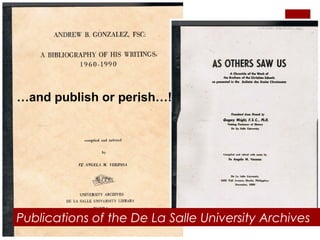
…and publish or perish…!

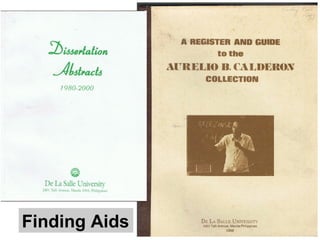
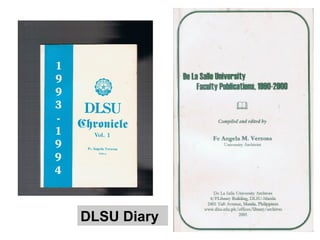
Publications of the De La Salle University Archives
Finding Aids
DLSU Diary
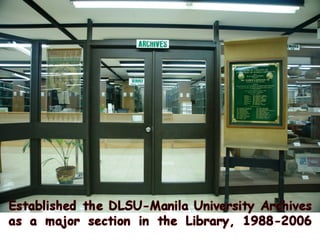
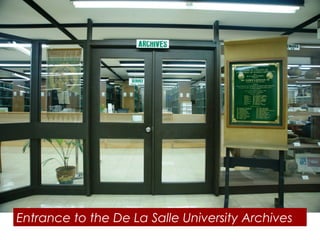
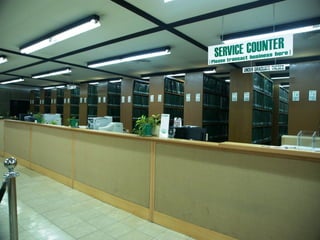
Entrance to the De La Salle University Archives
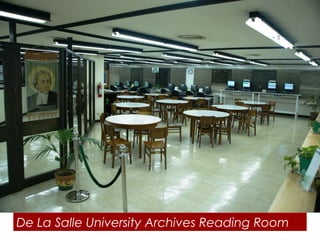
De La Salle University Archives Reading Room
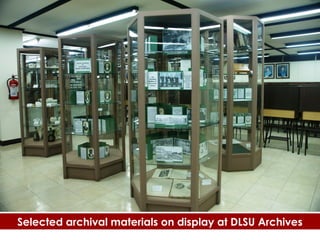
Selected archival materials on display at DLSU Archives
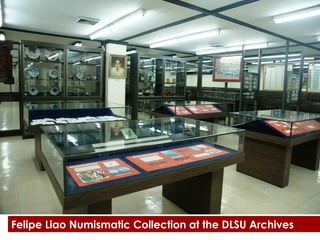
Felipe Liao Numismatic Collection at the DLSU Archives
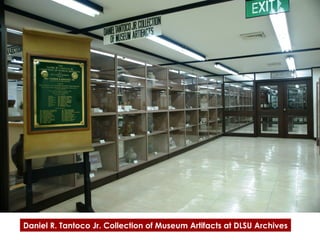
Daniel R. Tantoco Jr. Collection of Museum Artifacts at DLSU Archives
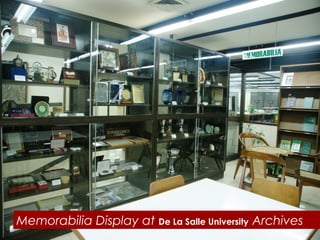
Memorabilia Display at De La Salle University Archives
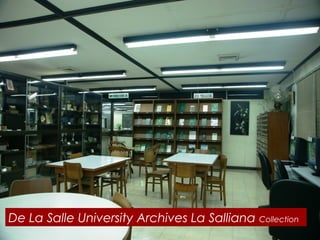
De La Salle University Archives La Salliana Collection
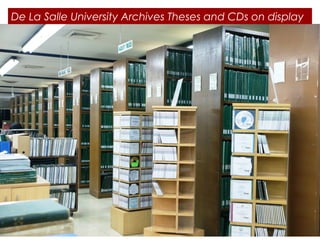
De La Salle University Archives Theses and CDs on display
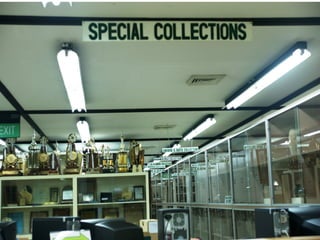
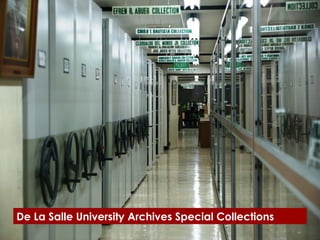
De La Salle University Archives Special Collections
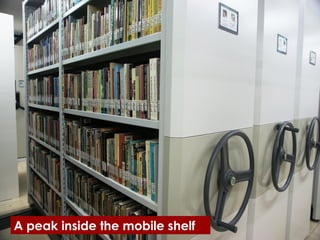
A peak inside the mobile shelf
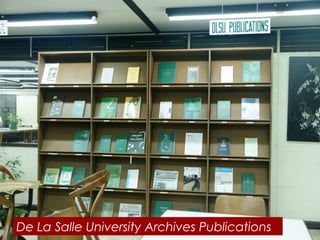
De La Salle University Archives Publications
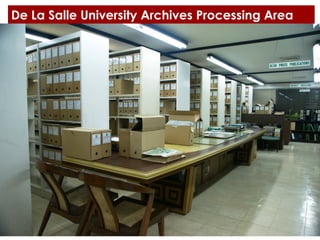
De La Salle University Archives Processing Area
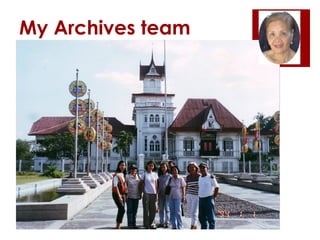
My Archives team
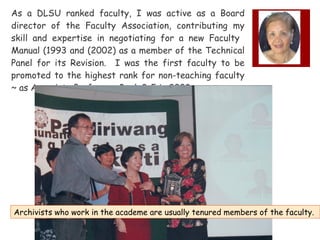
As a DLSU ranked faculty, I was active as a Board
director of the Faculty Association, contributing my
skill and expertise in negotiating for a new Faculty
Manual (1993 and (2002) as a member of the Technical
Panel for its Revision. I was the first faculty to be
promoted to the highest rank for non-teaching faculty
~ as Associate Professor, Rank 3-5 in 2003.

Archivists who work in the academe are usually tenured members of the faculty.
Publications
Among her published articles are:
•“The Japanese Reparation Papers on Microfilm,” (in Southeast Asia Microfilms
Newsletter 17: 1-8, July 1979)
•“Archiving the Presidents’ Papers,” (in Philippine Panorama 22, no. 37: 7, 26, Sept.
12, 1993)
•“Developing an Archival Curriculum,” (in Tanglaw 2, no. 2: 51-56, January 1994)
•“Building environments for library and archival collections,” (PAARL Bulletin 1, no.
1: 27-35, 1997).
•Among the in-house publications and books she has authored/co-edited/compiled
are the following: Filipiniana on Microfilms (1971), Andrew B. Gonzalez, FSC: a
Bibliography of his Writings, 1960-1990 (1990), As Others Saw Us: a Chronicle of
the Works of the Brothers of the Christian Schools (1990), Faculty Publications
and Other Writings (1991), and DLSU Chronicle, 1993-1994 (1994).
•Her recent paper on “Library Automation And Its Impact On Strategic Planning
For Academic Libraries” appeared as an electronic publication of Asian Libraries, a
quarterly publication of MCB University Press (1997). Other articles appeared in
the Asia Library News, namely: “Occupational Safety and Health Concerns in
Library Work Places”, and “The State of the Filipiniana Collections at DLSU
Library”.
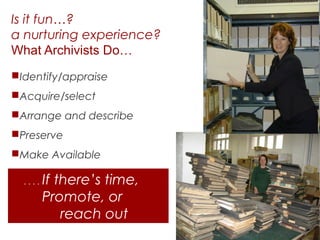
Is it fun…?
a nurturing experience?
What Archivists Do…
Identify/appraise
Acquire/select
Arrange and describe
Preserve
Make Available
....

If there’s time,
Promote, or
reach out
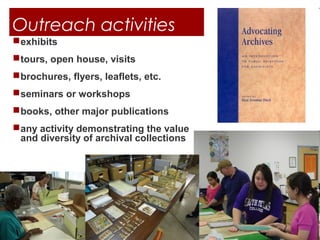
Outreach activities
exhibits
tours, open house, visits
brochures, flyers, leaflets, etc.
seminars or workshops
books, other major publications
any activity demonstrating the value
and diversity of archival collections
Personal Qualities and
Skills
methodical and pay attention to detail.
communication skills to interact with different kinds of people,
to advise the public and to give lectures
research skills are important in this work as you need to find
out about the background of materials.
background in history is useful as is good literary skills (writing)
comfortable with new technology
Work independently and without much supervision (can work
in dirty conditions and carry heavy volumes)
Discerning ~ be aware that some documents are confidential.
Opportunities
Undergraduate degree necessary, preferably in relevant
discipline or field of study; graduate degree is desirable….
no upper age limit for entry to this occupation
 mature entrants with relevant skills and experience, such as
that gained in library or information profession, have a fair
chance of entry
salary and benefits depend on financial capacity of
employing institution, and on how they value archival work,
and appreciate your qualifications, skills and experience
Welcome to a rare breed of professionals…
Unsolicited advice to
potential archivists…
 Take on the challenges as they come; just
believe you can do it, motivate yourself
 Be a lifelong learner; don’t stop learning; there
are so many things in an archivist’s job that are
not taught in school; you learn on the job
 There are no hard and fast rules; the only
archivist’s motto to go by ~ “create order from
chaos”
 Do the best with what you have ~ there’s no
such thing as a perfect workplace
famverzosa@yahoo.com

Being an archivist

  • 1.
    “Being an archivist: funand nurturing experience” By Fe Angela M. Verzosa 3rd National Congress of Special Libraries of the Philippines with the theme "The Modern Strategist: Accelerating the Career Path of an Information Professional” October 24-25, 2013 at Hotel H20 - Manila
  • 2.
    What’s an archivist? Onewho works in an Archives… One who does archival work… One who works on archival materials…
  • 3.
    Sometimes, also knownas (but not really) Record Keeper Records Manager Records Custodian Manuscript Curator Manuscript Custodian Clue-seekers (detectives)
  • 4.
    What is anarchives? Archives" is one of those words that can be either singular or plural, though it is relatively common to drop the "s" when referring to the singular.  "Archives" can refer to a collection of archival materials, or the facility in which the materials are stored, or the organization that collects and maintains them.
  • 5.
    Archives are the non-currentrecords of individuals, groups, institutions, and governments that contain information of enduring value and selected for permanent preservation Include unpublished letters, diaries, and other manuscripts photographs, films, video and sound recordings, maps and plans, computer tapes and similar electronic records, and video and optical disks
  • 6.
    ed lm a fi cro nas e mi zo nd ue nd t h a e d l L. Q a n a ib scr anue ichig e ,d fM fM d ge ers o sity o an r arr l pap nive , zed entia the U ni ga resid t of Or p c y e proje ibrar th t lL n joi tiona Na In 1967… My job position ~ Temporary Historiographer Qualifications ~  background in history writing and research skills no previous training – nothing to unlearn
  • 7.
    For 2 years(1967-1969) What I did: • Learned to process Quezon Presidential Papers (sort, classify, arrange) • Prepared a descriptive finding aid and index • Learned to decode, translate, decipher, make true copies • Trained in microfilming using planetary camera and 35mm films
  • 8.
    For 2 years(1967-1969) What I enjoyed: • Working on the floor as I sorted out the manuscripts • Brushing on my Spanish language skill • Communicating with the ghosts inside the Filipiniana Reading Room • Assisting renowned scholars like Prof. Theodore Friend, David Sturtevant, Ben Kerkvliet, and others
  • 9.
    Then in 1969-1971 Organized the microfilm section of the UP Diliman Main Library, trained staff to microfilming work, and serviced the microfilm collections of the Library.  Organized, arranged and described the papers of Carlos P. Romulo, and other personal papers and private manuscript collections at the Rare Books and Manuscript collection of the Library.  Organized, arranged, and microfilmed the Hukbalahap records of the Court of Appeals in Manila City Hall, and other radical collections.
  • 10.
    In 1972-1973 Organized, arrangedand described the UP Diliman Library manuscript collections, such as the papers of UP President Carlos P. Romulo, the Faustino Aguilar Literary Collection, Jorge Bocobo Papers, and the court records of Amado Hernandez. Organized and arranged the presidential papers of the late Carlos P. Garcia at his residence in Bohol Avenue, and facilitated their transfer to the National Library.
  • 11.
    For 3 years(1969-1972) What I enjoyed: • Job rotation – a balancing act as head of the Microfilm Section, manuscript curator at the Rare Books & Mss Room, and cataloger of microfilmed collections • Enrolling in MLS units free • Taking the Civil Service Exam for Librarian, and • Working independently on project basis
  • 12.
    At Ateneo’s Rizal Libraryin 1974-1975 Took over the Microform Section as microform librarian expanded the collection to include the Theses Microfiche Project and the ERIC Collection
  • 14.
    With Judge JoseD. Ingles and granddaughter Jojo Laurel With Chief Justice Roberto Concepcion, Senator Sotero Laurel and family
  • 15.
    The Presidential Papersof Elpidio Quirino at the Filipinas Heritage Library, Makati City The FHL has digitized 110,000 pages out of the 200,000+ in 130 boxes of the presidential papers of former President Elpidio Quirino. This prestigious collection of over 200,000 pages, a historical and scholarly treasure, was originally housed at the Syquia Mansion in Vigan. In 1977, I facilitated their transfer from Vigan to the Ayala Foundation Library, where I organized, arranged and described them, in time for inclusion in my thesis on Presidential Papers, submitted for my Master’s in Library Science in 1978.
  • 16.
    What archivists do Archivistsperform a wide variety of tasks: acquire, select, store and provide access to materials (that may come in the form of written documents, maps, photographs, films, memorabilia, etc) by providing description and finding aids to these collections… assist users in using the collections; answer inquiries, give talks to groups, mount exhibitions, and publish… plan and organize systems and procedures for the safekeeping of records and valuable documents to keep them secure, well-maintained, and preserved for posterity.
  • 17.
    What archivists do Thetime archivists spend on these activities varies depending on where they work. In local government offices, archivists work with a variety of local records (local/oral histories). Those who work in the national libraries often look after literary Manuscripts collections or Personal Papers. University archivists may manage university records, or look after collections that belong to the institution’s illustrious alumni or faculty, and those relating to specific subjects. In businesses, archivists look after records about company history and product development.
  • 18.
    What archivists do Somearchivists specialize in the acquisition, management, description, and preservation of photographic or audiovisual materials or electronic records. Other aspects of the job may include records management, digitization, public outreach, writing, and teaching or mentoring. Archivists may keep records for local governments, educational institutions, business companies, churches, religious organizations, family estates, courts, hospitals, or charities.
  • 19.
    What archivists do Archivistsrecord and catalogue each document, identify those that need repairing, and select the best way to store them. They also decide which documents to keep for their historical value and which to discard.
  • 21.
    In 1988 Initially, Iwas hired to work on the Aurelio Calderon Papers for 6 months, and to do a study-proposal on the establishment of a university archives for DLSU. Then I drew up and took charge of the implementation of the institutional archival program.
  • 22.
    From 1989 to2006  Directed all archival operations.  Managed a regular staff of three assistant librarians and four library clerks.  Conducted regular training courses on archives and records management both within the university, the DLSU System and consortium member-schools.  Established a separate Special Collections under the management of the University Archives in 1989. and expanded the Special Collections to include the collections of: Felipe Liao (Numismatic Collection), Daniel Tantoco (Earthenware Collection), Lorenzo M. Taňada, Francisco Ortigas, Jr., Local and Oral History Collection, and the Faculty Collections of Aurelio Calderon, Isagani R.Cruz, Emerita Quito, Wilfrido Villacorta, Andrew Gonzalez, FSC, Marcelino Foronda, Efren Abueg, Clodualdo del Mundo, Roberto Salazar, Tereso Tullao, Jr., etc.  Embarked on the digitization of the university theses and dissertations, the Lorenzo Tanada Papers, rare Filipiniana materials, and other special collections.
  • 23.
    …and publish orperish…! Publications of the De La Salle University Archives
  • 24.
  • 25.
  • 26.
    Entrance to theDe La Salle University Archives
  • 27.
    De La SalleUniversity Archives Reading Room
  • 29.
    Selected archival materialson display at DLSU Archives
  • 30.
    Felipe Liao NumismaticCollection at the DLSU Archives
  • 31.
    Daniel R. TantocoJr. Collection of Museum Artifacts at DLSU Archives
  • 32.
    Memorabilia Display atDe La Salle University Archives
  • 33.
    De La SalleUniversity Archives La Salliana Collection
  • 34.
    De La SalleUniversity Archives Theses and CDs on display
  • 36.
    De La SalleUniversity Archives Special Collections
  • 37.
    A peak insidethe mobile shelf
  • 38.
    De La SalleUniversity Archives Publications
  • 39.
    De La SalleUniversity Archives Processing Area
  • 40.
  • 41.
    As a DLSUranked faculty, I was active as a Board director of the Faculty Association, contributing my skill and expertise in negotiating for a new Faculty Manual (1993 and (2002) as a member of the Technical Panel for its Revision. I was the first faculty to be promoted to the highest rank for non-teaching faculty ~ as Associate Professor, Rank 3-5 in 2003. Archivists who work in the academe are usually tenured members of the faculty.
  • 42.
    Publications Among her publishedarticles are: •“The Japanese Reparation Papers on Microfilm,” (in Southeast Asia Microfilms Newsletter 17: 1-8, July 1979) •“Archiving the Presidents’ Papers,” (in Philippine Panorama 22, no. 37: 7, 26, Sept. 12, 1993) •“Developing an Archival Curriculum,” (in Tanglaw 2, no. 2: 51-56, January 1994) •“Building environments for library and archival collections,” (PAARL Bulletin 1, no. 1: 27-35, 1997). •Among the in-house publications and books she has authored/co-edited/compiled are the following: Filipiniana on Microfilms (1971), Andrew B. Gonzalez, FSC: a Bibliography of his Writings, 1960-1990 (1990), As Others Saw Us: a Chronicle of the Works of the Brothers of the Christian Schools (1990), Faculty Publications and Other Writings (1991), and DLSU Chronicle, 1993-1994 (1994). •Her recent paper on “Library Automation And Its Impact On Strategic Planning For Academic Libraries” appeared as an electronic publication of Asian Libraries, a quarterly publication of MCB University Press (1997). Other articles appeared in the Asia Library News, namely: “Occupational Safety and Health Concerns in Library Work Places”, and “The State of the Filipiniana Collections at DLSU Library”.
  • 43.
    Is it fun…? anurturing experience? What Archivists Do… Identify/appraise Acquire/select Arrange and describe Preserve Make Available .... If there’s time, Promote, or reach out
  • 44.
    Outreach activities exhibits tours, openhouse, visits brochures, flyers, leaflets, etc. seminars or workshops books, other major publications any activity demonstrating the value and diversity of archival collections
  • 45.
    Personal Qualities and Skills methodicaland pay attention to detail. communication skills to interact with different kinds of people, to advise the public and to give lectures research skills are important in this work as you need to find out about the background of materials. background in history is useful as is good literary skills (writing) comfortable with new technology Work independently and without much supervision (can work in dirty conditions and carry heavy volumes) Discerning ~ be aware that some documents are confidential.
  • 46.
    Opportunities Undergraduate degree necessary,preferably in relevant discipline or field of study; graduate degree is desirable…. no upper age limit for entry to this occupation  mature entrants with relevant skills and experience, such as that gained in library or information profession, have a fair chance of entry salary and benefits depend on financial capacity of employing institution, and on how they value archival work, and appreciate your qualifications, skills and experience Welcome to a rare breed of professionals…
  • 47.
    Unsolicited advice to potentialarchivists…  Take on the challenges as they come; just believe you can do it, motivate yourself  Be a lifelong learner; don’t stop learning; there are so many things in an archivist’s job that are not taught in school; you learn on the job  There are no hard and fast rules; the only archivist’s motto to go by ~ “create order from chaos”  Do the best with what you have ~ there’s no such thing as a perfect workplace
  • 48.