Recombinant DNA Technology
2 July 2021 Abhijit Debnath BP605T and Biotech Unit-1 1
CO1.1
Noida Institute of Engineering and Technology
(Pharmacy Institute) Greater Noida
Abhijit Debnath
Asst. Professor
NIET (Pharmacy Institute)
Unit: 2
Subject Name: Biotechnology
(BP605T)
Course Details
(B. Pharm 6th Sem)
Recombinant
DNA Technology
2 July 2021 Abhijit Debnath BP605T and Biotech Unit-1 2
 Recombinant DNA Technology
 Discovery of Recombinant DNA Technology
 Goals of Recombinant DNA Technology
 Procedure of Making rDNA
 Techniques Used In rDNA Technology
 Applications of rDNA Technology
CO1.1
Noida Institute of Engineering and Technology
(Pharmacy Institute) Greater Noida
2 July 2021 Abhijit Debnath BP605T and Biotech Unit-1 3
RECOMBINANT DNA (CO1.1)
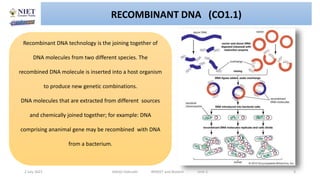
Recombinant DNA technology is the joining together of
DNA molecules from two different species. The
recombined DNA molecule is inserted into a host organism
to produce new genetic combinations.
DNA molecules that are extracted from different sources
and chemically joined together; for example: DNA
comprising ananimal gene may be recombined with DNA
from a bacterium.
2 July 2021 Abhijit Debnath BP605T and Biotech Unit-2 4
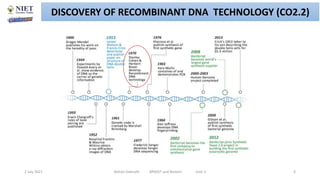
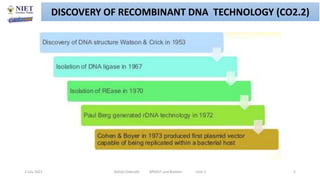
DISCOVERY OF RECOMBINANT DNA TECHNOLOGY (CO2.2)
2 July 2021 Abhijit Debnath BP605T and Biotech Unit-2 5
DISCOVERY OF RECOMBINANT DNA TECHNOLOGY (CO2.2)
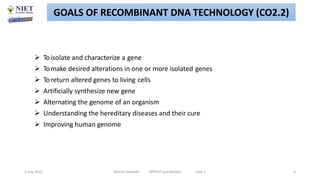
 Toisolate and characterize a gene
 Tomake desired alterations in one or more isolated genes
 Toreturn altered genes to living cells
 Artificially synthesize new gene
 Alternating the genome of an organism
 Understanding the hereditary diseases and their cure
 Improving human genome
2 July 2021 Abhijit Debnath BP605T and Biotech Unit-2 6
GOALS OF RECOMBINANT DNA TECHNOLOGY (CO2.2)
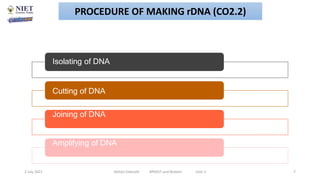
Isolating of DNA
Cutting of DNA
Joining of DNA
Amplifying of DNA
2 July 2021 Abhijit Debnath BP605T and Biotech Unit-2 7
PROCEDURE OF MAKING rDNA (CO2.2)
2 July 2021 Abhijit Debnath BP605T and Biotech Unit-2 8
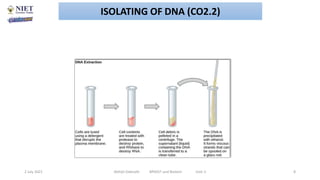
ISOLATING OF DNA (CO2.2)
 DNA can be cut into large fragments by mechanical shearing.
 Restriction enzymes are the scissors of molecular genetics.
2 July 2021 Abhijit Debnath BP605T and Biotech Unit-2 9
CUTTING OF DNA (CO2.2)
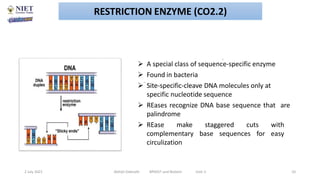
 A special class of sequence-specific enzyme
 Found in bacteria
 Site-specific-cleave DNA molecules only at
specific nucleotide sequence
 REases recognize DNA base sequence that are
palindrome
 REase make staggered cuts with
complementary base sequences for easy
circulization
2 July 2021 Abhijit Debnath BP605T and Biotech Unit-2 10
RESTRICTION ENZYME (CO2.2)
2 July 2021 Abhijit Debnath BP605T and Biotech Unit-2 11
JOINING DNA (CO2.2)
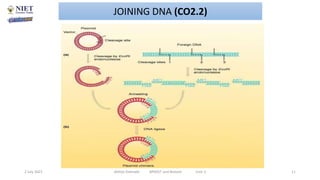
 Transforming the recombinant DNA into a bacterial host strain.
 The cells are treated with CaCl2
 DNA is added
 Cells are heat shocked at 42 C
 DNA goes into cell by a somewhat unknown mechanism.
 Once in a cell, the recombinant DNA will be replicated.
 When the cell divides, the replicated recombinant molecules go to both
daughter cells which themselves will divide later.
2 July 2021 Abhijit Debnath BP605T and Biotech Unit-2 12
AMPLIFYING THE RECOMBINANT DNA (CO2.2)
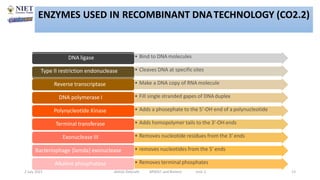
• Bind to DNA molecules
DNA ligase
• Cleaves DNA at specific sites
Type II restriction endonuclease
• Make a DNA copy of RNA molecule
Reverse transcriptase
• Fill single stranded gapes of DNAduplex
DNA polymerase I
• Adds a phosephate to the 5'-OH end of a polynucleotide
Polynycleotide Kinase
• Adds homopolymer tails to the 3'-OH ends
Terminal transferase
• Removes nucleotide residues from the 3' ends
Exonuclease III
• removes nucleotides from the 5' ends
Bacteriophage {lamda} exonuclease
• Removes terminal phosphates
Alkaline phosphatase
2 July 2021 Abhijit Debnath BP605T and Biotech Unit-2 13
ENZYMES USED IN RECOMBINANT DNATECHNOLOGY (CO2.2)
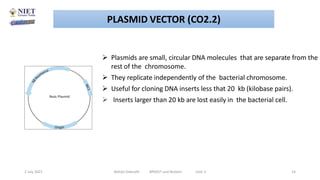
 Plasmids are small, circular DNA molecules that are separate from the
rest of the chromosome.
 They replicate independently of the bacterial chromosome.
 Useful for cloning DNA inserts less that 20 kb (kilobase pairs).
 Inserts larger than 20 kb are lost easily in the bacterial cell.
2 July 2021 Abhijit Debnath BP605T and Biotech Unit-2 14
PLASMID VECTOR (CO2.2)
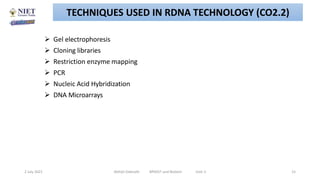
 Gel electrophoresis
 Cloning libraries
 Restriction enzyme mapping
 PCR
 Nucleic Acid Hybridization
 DNA Microarrays
2 July 2021 Abhijit Debnath BP605T and Biotech Unit-2 15
TECHNIQUES USED IN RDNA TECHNOLOGY (CO2.2)
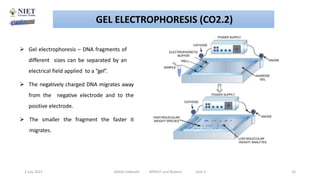
 Gel electrophoresis – DNA fragments of
different sizes can be separated by an
electrical field applied to a “gel”.
 The negatively charged DNA migrates away
from the negative electrode and to the
positive electrode.
 The smaller the fragment the faster it
migrates.
2 July 2021 Abhijit Debnath BP605T and Biotech Unit-2 16
GEL ELECTROPHORESIS (CO2.2)
• Libraries are collection of DNA clones in a certain vector.
• The goal is to have each gene represented in the library at least once.
• Genomic- made from RE DNA fragments of total genomic DNA.
• cDNA (complementary DNA) – made from DNA synthesized from mRNA.
2 July 2021 Abhijit Debnath BP605T and Biotech Unit-2 17
CLONING LIBRARIES (CO2.2)
 Agriculture: growing crops of your choice (GM food), pesticide resistant
crops, fruits with attractive colors, all being grown in artificial conditions.
 Pharmacology: artificial insulin production, drug delivery to target sites
 Medicine: gene therapy, antiviral therapy, vaccination, synthesizing
clotting factors.
 Other uses:fluorescent fishes, glowing plants etc..
 Technology Wide spectrum in improving health.
 Treat defected gene or introduce new one.
 Applications, laboratory test and parental diagnosis of genetic disease.
2 July 2021 Abhijit Debnath BP605T and Biotech Unit-2 18
APPLICATIONS OF rDNA TECHNOLOGY (CO2.2)
 Introduce live attenuated .
 Acquired immunity.
 Rdna technology can be use to clone gene for protective antigen protein.
 Hepatitis B vaccine (rDNA) , influenza ,HIV and mouth and foot disease.
2 July 2021 Abhijit Debnath BP605T and Biotech Unit-2 19
PRODUCTION OF VACCINE (CO2.2)
Insulin:
 Insulin(hormone) controls glucose level in humans.
 By rDna , done cloning of human insulin gene and put in E.coli.
 availability of insulin.
 devoid of getting by-products by animal slaughtering.
2 July 2021 Abhijit Debnath BP605T and Biotech Unit-2 20
COMMERCIAL AND PHARMACEUTICAL PRODUCTS (CO2.2)
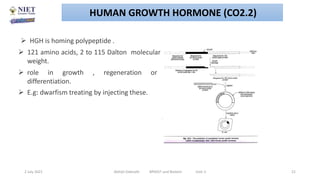
 HGH is homing polypeptide .
 121 amino acids, 2 to 115 Dalton molecular
weight.
 role in growth , regeneration or
differentiation.
 E.g: dwarfism treating by injecting these.
2 July 2021 Abhijit Debnath BP605T and Biotech Unit-2 21
HUMAN GROWTH HORMONE (CO2.2)
 Interferon are group of proteins that interfere with viral
multiplication or replication.
 By rDna,capable of making interferon.
 Alpha component of which have role in curing lymphoma and
myelogenous leukemia.
2 July 2021 Abhijit Debnath BP605T and Biotech Unit-2 22
INTERFERON (CO2.2)
 Antibodies are specific proteins produced by the immune system in response
to presence of a specific antigen.
 Monoclonal antibodies produce from singleclone of
antigen. That’s why are monospecific in nature.
 Production through hybridoma technology.
 Applications:
 mAb are used for diagnosis of disease, Pregnancy and Treatment of cancer.
.
2 July 2021 Abhijit Debnath BP605T and Biotech Unit-2 23
MONOCLONAL ANTIBODIES (CO2.2)
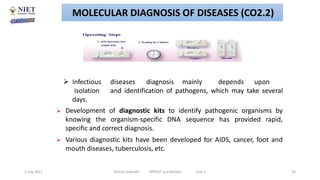
 Infectious diseases diagnosis mainly depends upon
isolation and identification of pathogens, which may take several
days.
 Development of diagnostic kits to identify pathogenic organisms by
knowing the organism-specific DNA sequence has provided rapid,
specific and correct diagnosis.
 Various diagnostic kits have been developed for AIDS, cancer, foot and
mouth diseases, tuberculosis, etc.
2 July 2021 Abhijit Debnath BP605T and Biotech Unit-2 24
MOLECULAR DIAGNOSIS OF DISEASES (CO2.2)
Dr. Alec Jeffreys developed DNA fingerprinting technique.
 Every person have its unique finger patterns that differs from other individual.
 There is possibility to alter these patterns but specific principle is unknown.
 Finger prints are detected on the basis of number of highly polymorphic genes i.e.
VNTR’s.
Applications:
 Used in criminal identification.
 For child parentage establishment.
 Helpful for deduction of racial group.
2 July 2021 Abhijit Debnath BP605T and Biotech Unit-2 25
DNA FINGERPRINTING (CO2.2)
injects functional genes into a cell to replace missing or defective genes in order to
correct genetic disorders.
 A gene that is inserted directly into a cell usually does not function. Instead, a
carrier called a vector is genetically engineered to deliver the gene.
 Gene therapy may be donein-vivo or e-vivo.
Health Risks:
toxicity, inflammation, and cancer.
2 July 2021 Abhijit Debnath BP605T and Biotech Unit-2 26
GENE THERAPY (CO2.2)
 We can use recombinant DNA technology in environment to cleanup
the environment.
 Measure the presence of hazardous compounds
2 July 2021 Abhijit Debnath BP605T and Biotech Unit-2 27
IMPORTANCE (CO2.2)
• Molecular Biology: Gene Mapping
• Genetic Disorder
• Monoclonal Ab product
• Gene Therapy
• DNA Fingerprinting
• Vaccines
• Pharma Products
APPLICATION OF GENETIC ENGINEERING (CO2.2)
2 July 2021 Abhijit Debnath BP605T and Biotech Unit-2 28
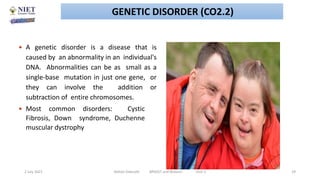
 A genetic disorder is a disease that is
caused by an abnormality in an individual's
DNA. Abnormalities can be as small as a
single-base mutation in just one gene, or
they can involve the addition or
subtraction of entire chromosomes.
 Most common disorders: Cystic
Fibrosis, Down syndrome, Duchenne
muscular dystrophy
2 July 2021 Abhijit Debnath BP605T and Biotech Unit-2 29
GENETIC DISORDER (CO2.2)
 Medical Definition of DNAfingerprinting.
:a technique used especially for
identification (as for forensic purposes) by
extracting and identifying the base-pair
pattern of an individual's DNA—called
also DNA typing, genetic fingerprinting.
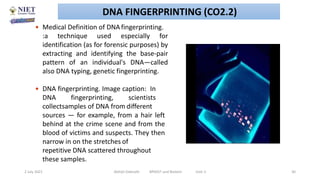
 DNA fingerprinting. Image caption: In
DNA fingerprinting, scientists
collectsamples of DNA from different
sources — for example, from a hair left
behind at the crime scene and from the
blood of victims and suspects. They then
narrow in on the stretches of
repetitive DNA scattered throughout
these samples.
2 July 2021 Abhijit Debnath BP605T and Biotech Unit-2 30
DNA FINGERPRINTING (CO2.2)

Recombinant DNA Technology

  • 1.
    Recombinant DNA Technology 2July 2021 Abhijit Debnath BP605T and Biotech Unit-1 1 CO1.1 Noida Institute of Engineering and Technology (Pharmacy Institute) Greater Noida Abhijit Debnath Asst. Professor NIET (Pharmacy Institute) Unit: 2 Subject Name: Biotechnology (BP605T) Course Details (B. Pharm 6th Sem)
  • 2.
    Recombinant DNA Technology 2 July2021 Abhijit Debnath BP605T and Biotech Unit-1 2  Recombinant DNA Technology  Discovery of Recombinant DNA Technology  Goals of Recombinant DNA Technology  Procedure of Making rDNA  Techniques Used In rDNA Technology  Applications of rDNA Technology CO1.1 Noida Institute of Engineering and Technology (Pharmacy Institute) Greater Noida
  • 3.
    2 July 2021Abhijit Debnath BP605T and Biotech Unit-1 3 RECOMBINANT DNA (CO1.1) Recombinant DNA technology is the joining together of DNA molecules from two different species. The recombined DNA molecule is inserted into a host organism to produce new genetic combinations. DNA molecules that are extracted from different sources and chemically joined together; for example: DNA comprising ananimal gene may be recombined with DNA from a bacterium.
  • 4.
    2 July 2021Abhijit Debnath BP605T and Biotech Unit-2 4 DISCOVERY OF RECOMBINANT DNA TECHNOLOGY (CO2.2)
  • 5.
    2 July 2021Abhijit Debnath BP605T and Biotech Unit-2 5 DISCOVERY OF RECOMBINANT DNA TECHNOLOGY (CO2.2)
  • 6.
     Toisolate andcharacterize a gene  Tomake desired alterations in one or more isolated genes  Toreturn altered genes to living cells  Artificially synthesize new gene  Alternating the genome of an organism  Understanding the hereditary diseases and their cure  Improving human genome 2 July 2021 Abhijit Debnath BP605T and Biotech Unit-2 6 GOALS OF RECOMBINANT DNA TECHNOLOGY (CO2.2)
  • 7.
    Isolating of DNA Cuttingof DNA Joining of DNA Amplifying of DNA 2 July 2021 Abhijit Debnath BP605T and Biotech Unit-2 7 PROCEDURE OF MAKING rDNA (CO2.2)
  • 8.
    2 July 2021Abhijit Debnath BP605T and Biotech Unit-2 8 ISOLATING OF DNA (CO2.2)
  • 9.
     DNA canbe cut into large fragments by mechanical shearing.  Restriction enzymes are the scissors of molecular genetics. 2 July 2021 Abhijit Debnath BP605T and Biotech Unit-2 9 CUTTING OF DNA (CO2.2)
  • 10.
     A specialclass of sequence-specific enzyme  Found in bacteria  Site-specific-cleave DNA molecules only at specific nucleotide sequence  REases recognize DNA base sequence that are palindrome  REase make staggered cuts with complementary base sequences for easy circulization 2 July 2021 Abhijit Debnath BP605T and Biotech Unit-2 10 RESTRICTION ENZYME (CO2.2)
  • 11.
    2 July 2021Abhijit Debnath BP605T and Biotech Unit-2 11 JOINING DNA (CO2.2)
  • 12.
     Transforming therecombinant DNA into a bacterial host strain.  The cells are treated with CaCl2  DNA is added  Cells are heat shocked at 42 C  DNA goes into cell by a somewhat unknown mechanism.  Once in a cell, the recombinant DNA will be replicated.  When the cell divides, the replicated recombinant molecules go to both daughter cells which themselves will divide later. 2 July 2021 Abhijit Debnath BP605T and Biotech Unit-2 12 AMPLIFYING THE RECOMBINANT DNA (CO2.2)
  • 13.
    • Bind toDNA molecules DNA ligase • Cleaves DNA at specific sites Type II restriction endonuclease • Make a DNA copy of RNA molecule Reverse transcriptase • Fill single stranded gapes of DNAduplex DNA polymerase I • Adds a phosephate to the 5'-OH end of a polynucleotide Polynycleotide Kinase • Adds homopolymer tails to the 3'-OH ends Terminal transferase • Removes nucleotide residues from the 3' ends Exonuclease III • removes nucleotides from the 5' ends Bacteriophage {lamda} exonuclease • Removes terminal phosphates Alkaline phosphatase 2 July 2021 Abhijit Debnath BP605T and Biotech Unit-2 13 ENZYMES USED IN RECOMBINANT DNATECHNOLOGY (CO2.2)
  • 14.
     Plasmids aresmall, circular DNA molecules that are separate from the rest of the chromosome.  They replicate independently of the bacterial chromosome.  Useful for cloning DNA inserts less that 20 kb (kilobase pairs).  Inserts larger than 20 kb are lost easily in the bacterial cell. 2 July 2021 Abhijit Debnath BP605T and Biotech Unit-2 14 PLASMID VECTOR (CO2.2)
  • 15.
     Gel electrophoresis Cloning libraries  Restriction enzyme mapping  PCR  Nucleic Acid Hybridization  DNA Microarrays 2 July 2021 Abhijit Debnath BP605T and Biotech Unit-2 15 TECHNIQUES USED IN RDNA TECHNOLOGY (CO2.2)
  • 16.
     Gel electrophoresis– DNA fragments of different sizes can be separated by an electrical field applied to a “gel”.  The negatively charged DNA migrates away from the negative electrode and to the positive electrode.  The smaller the fragment the faster it migrates. 2 July 2021 Abhijit Debnath BP605T and Biotech Unit-2 16 GEL ELECTROPHORESIS (CO2.2)
  • 17.
    • Libraries arecollection of DNA clones in a certain vector. • The goal is to have each gene represented in the library at least once. • Genomic- made from RE DNA fragments of total genomic DNA. • cDNA (complementary DNA) – made from DNA synthesized from mRNA. 2 July 2021 Abhijit Debnath BP605T and Biotech Unit-2 17 CLONING LIBRARIES (CO2.2)
  • 18.
     Agriculture: growingcrops of your choice (GM food), pesticide resistant crops, fruits with attractive colors, all being grown in artificial conditions.  Pharmacology: artificial insulin production, drug delivery to target sites  Medicine: gene therapy, antiviral therapy, vaccination, synthesizing clotting factors.  Other uses:fluorescent fishes, glowing plants etc..  Technology Wide spectrum in improving health.  Treat defected gene or introduce new one.  Applications, laboratory test and parental diagnosis of genetic disease. 2 July 2021 Abhijit Debnath BP605T and Biotech Unit-2 18 APPLICATIONS OF rDNA TECHNOLOGY (CO2.2)
  • 19.
     Introduce liveattenuated .  Acquired immunity.  Rdna technology can be use to clone gene for protective antigen protein.  Hepatitis B vaccine (rDNA) , influenza ,HIV and mouth and foot disease. 2 July 2021 Abhijit Debnath BP605T and Biotech Unit-2 19 PRODUCTION OF VACCINE (CO2.2)
  • 20.
    Insulin:  Insulin(hormone) controlsglucose level in humans.  By rDna , done cloning of human insulin gene and put in E.coli.  availability of insulin.  devoid of getting by-products by animal slaughtering. 2 July 2021 Abhijit Debnath BP605T and Biotech Unit-2 20 COMMERCIAL AND PHARMACEUTICAL PRODUCTS (CO2.2)
  • 21.
     HGH ishoming polypeptide .  121 amino acids, 2 to 115 Dalton molecular weight.  role in growth , regeneration or differentiation.  E.g: dwarfism treating by injecting these. 2 July 2021 Abhijit Debnath BP605T and Biotech Unit-2 21 HUMAN GROWTH HORMONE (CO2.2)
  • 22.
     Interferon aregroup of proteins that interfere with viral multiplication or replication.  By rDna,capable of making interferon.  Alpha component of which have role in curing lymphoma and myelogenous leukemia. 2 July 2021 Abhijit Debnath BP605T and Biotech Unit-2 22 INTERFERON (CO2.2)
  • 23.
     Antibodies arespecific proteins produced by the immune system in response to presence of a specific antigen.  Monoclonal antibodies produce from singleclone of antigen. That’s why are monospecific in nature.  Production through hybridoma technology.  Applications:  mAb are used for diagnosis of disease, Pregnancy and Treatment of cancer. . 2 July 2021 Abhijit Debnath BP605T and Biotech Unit-2 23 MONOCLONAL ANTIBODIES (CO2.2)
  • 24.
     Infectious diseasesdiagnosis mainly depends upon isolation and identification of pathogens, which may take several days.  Development of diagnostic kits to identify pathogenic organisms by knowing the organism-specific DNA sequence has provided rapid, specific and correct diagnosis.  Various diagnostic kits have been developed for AIDS, cancer, foot and mouth diseases, tuberculosis, etc. 2 July 2021 Abhijit Debnath BP605T and Biotech Unit-2 24 MOLECULAR DIAGNOSIS OF DISEASES (CO2.2)
  • 25.
    Dr. Alec Jeffreysdeveloped DNA fingerprinting technique.  Every person have its unique finger patterns that differs from other individual.  There is possibility to alter these patterns but specific principle is unknown.  Finger prints are detected on the basis of number of highly polymorphic genes i.e. VNTR’s. Applications:  Used in criminal identification.  For child parentage establishment.  Helpful for deduction of racial group. 2 July 2021 Abhijit Debnath BP605T and Biotech Unit-2 25 DNA FINGERPRINTING (CO2.2)
  • 26.
    injects functional genesinto a cell to replace missing or defective genes in order to correct genetic disorders.  A gene that is inserted directly into a cell usually does not function. Instead, a carrier called a vector is genetically engineered to deliver the gene.  Gene therapy may be donein-vivo or e-vivo. Health Risks: toxicity, inflammation, and cancer. 2 July 2021 Abhijit Debnath BP605T and Biotech Unit-2 26 GENE THERAPY (CO2.2)
  • 27.
     We canuse recombinant DNA technology in environment to cleanup the environment.  Measure the presence of hazardous compounds 2 July 2021 Abhijit Debnath BP605T and Biotech Unit-2 27 IMPORTANCE (CO2.2)
  • 28.
    • Molecular Biology:Gene Mapping • Genetic Disorder • Monoclonal Ab product • Gene Therapy • DNA Fingerprinting • Vaccines • Pharma Products APPLICATION OF GENETIC ENGINEERING (CO2.2) 2 July 2021 Abhijit Debnath BP605T and Biotech Unit-2 28
  • 29.
     A geneticdisorder is a disease that is caused by an abnormality in an individual's DNA. Abnormalities can be as small as a single-base mutation in just one gene, or they can involve the addition or subtraction of entire chromosomes.  Most common disorders: Cystic Fibrosis, Down syndrome, Duchenne muscular dystrophy 2 July 2021 Abhijit Debnath BP605T and Biotech Unit-2 29 GENETIC DISORDER (CO2.2)
  • 30.
     Medical Definitionof DNAfingerprinting. :a technique used especially for identification (as for forensic purposes) by extracting and identifying the base-pair pattern of an individual's DNA—called also DNA typing, genetic fingerprinting.  DNA fingerprinting. Image caption: In DNA fingerprinting, scientists collectsamples of DNA from different sources — for example, from a hair left behind at the crime scene and from the blood of victims and suspects. They then narrow in on the stretches of repetitive DNA scattered throughout these samples. 2 July 2021 Abhijit Debnath BP605T and Biotech Unit-2 30 DNA FINGERPRINTING (CO2.2)