Protein Engineering
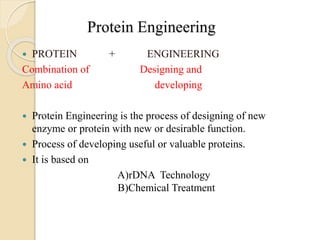
Protein Engineering
 PROTEIN + ENGINEERING
Combination of Designing and
Amino acid developing
 Protein Engineering is the process of designing of new
enzyme or protein with new or desirable function.
 Process of developing useful or valuable proteins.
 It is based on
A)rDNA Technology
B)Chemical Treatment
 EX.
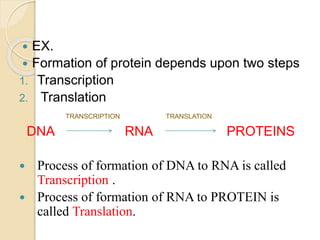
 Formation of protein depends upon two steps
1. Transcription
2. Translation
TRANSCRIPTION TRANSLATION
DNA RNA PROTEINS
 Process of formation of DNA to RNA is called
Transcription .
 Process of formation of RNA to PROTEIN is
called Translation.
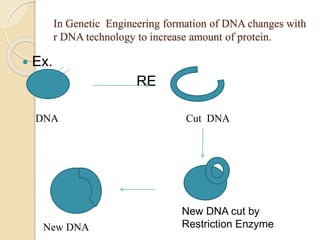
In Genetic Engineering formation of DNA changes with
r DNA technology to increase amount of protein.
 Ex.
RE
DNA Cut DNA
New DNA cut by
Restriction Enzyme
New DNA
OBJECTIVE
 Production of proteins / Enzymes in large
quantity
 To create a superior enzyme to catalyze the
production of high specific chemical.
 Thermal and pH stability should be high.
 Eliminate the need of cofactor ( non protein
molecules ).
 Changing of substrate binding site.
 Synthesizing enzyme should be stable and
active in non –aqueous solvent.
 Make isolation and purification of enzyme
simpler.
Methods of Protein Engineering
1. Mutagenesis
2. RDNA technology
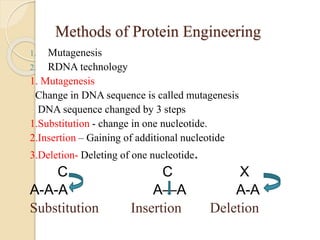
1. Mutagenesis
Change in DNA sequence is called mutagenesis
DNA sequence changed by 3 steps
1.Substitution - change in one nucleotide.
2.Insertion – Gaining of additional nucleotide
3.Deletion- Deleting of one nucleotide.
C C X
A-A-A A—A A-A
Substitution Insertion Deletion
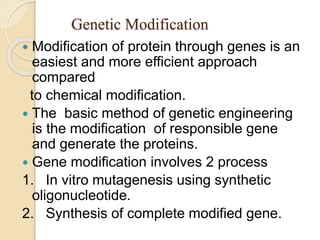
Genetic Modification
 Modification of protein through genes is an
easiest and more efficient approach
compared
to chemical modification.
 The basic method of genetic engineering
is the modification of responsible gene
and generate the proteins.
 Gene modification involves 2 process
1. In vitro mutagenesis using synthetic
oligonucleotide.
2. Synthesis of complete modified gene.
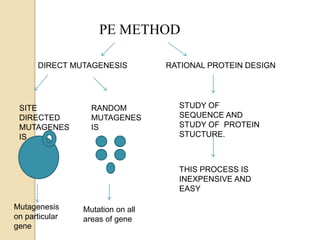
PE METHOD
DIRECT MUTAGENESIS RATIONAL PROTEIN DESIGN
SITE
DIRECTED
MUTAGENES
IS
RANDOM
MUTAGENES
IS
STUDY OF
SEQUENCE AND
STUDY OF PROTEIN
STUCTURE.
Mutagenesis
on particular
gene
Mutation on all
areas of gene
THIS PROCESS IS
INEXPENSIVE AND
EASY
WORKING OF PE
RATIONAL DESIGN APPROACH
DIRCTED EVALUATION
SITE DIRECTED
MUTAGENSIS
RANDOM MUTAGENESIS
TRANSFORMATION
TRANSFORMATION
PROTEIN EXPRESSION PROTEIN EXPRESSION
ISOLATION AND PURIFICATION
OF PROTEIN
ISOLATION AND PURIFICATION OF
PROTEIN
EVALUATION AND TESTING OF ACTIVE OR NEW ENZYME
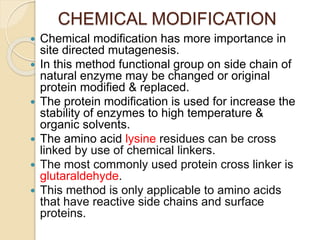
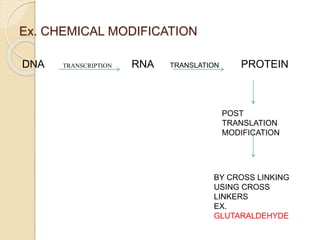
CHEMICAL MODIFICATION
 Chemical modification has more importance in
site directed mutagenesis.
 In this method functional group on side chain of
natural enzyme may be changed or original
protein modified & replaced.
 The protein modification is used for increase the
stability of enzymes to high temperature &
organic solvents.
 The amino acid lysine residues can be cross
linked by use of chemical linkers.
 The most commonly used protein cross linker is
glutaraldehyde.
 This method is only applicable to amino acids
that have reactive side chains and surface
proteins.
Ex. CHEMICAL MODIFICATION
DNA TRANSCRIPTION RNA TRANSLATION PROTEIN
POST
TRANSLATION
MODIFICATION
BY CROSS LINKING
USING CROSS
LINKERS
EX.
GLUTARALDEHYDE
APPLICATION
1. PHARMACEUTICAL OR MEDICAL APPLICATION-
I. It is used to produce therapeutic pharmaceutical
protein with high solubility & stability.
II. It is used for production of biotechnology drugs &
treatment of disease by vaccine , gene therapy.
III. It is used in cancer treatment. Novel antibodies are
used as anticancer agents.
IV. It is widely used in development of secreted protein
such as insulin , interferon , erythropoietin as
biotherapeutic agent.
2.Food & Detergent Industry
I. Wheat gluten protein is the one of the best ex. of
protein engineering in food industry.
II. Protease , Amylase & Lipase are important
enzymes for Industrial , Food , Detergent
Applications.
III. Protease are commonly used in Food Industry
as Flavors.
IV. Amylase is used for saccharification of starch (
the process of breaking a complex carbohydrate
into monosaccharide components) & bread
softness in food industry.
V. It used in Detergent Industry for removal of
starch strains.
VI. Lipases used for stability & cheese flavor .
3.Environmental Application
I. It is used for improvement in microbial
strains.
II. Oxygenase & Peroxides are used in
treatment of organic pollutant.
III. It is commonly used for modification of
enzymes for waste management and
pollution control.
4.Other Application
I. It is used to produce peptide based
biomaerial such as elastin like
polypeptides, silk like polymers etc.
II. PE methods are used to improve
physical stability of various particles.
III. Virus particles are modified by Protein
Engineering & used in medicine, as a
new vaccines, gene therapy, targeted
drug delivery vectors.
Protein Engineering.pptx

Protein Engineering.pptx

  • 1.
  • 2.
    Protein Engineering  PROTEIN+ ENGINEERING Combination of Designing and Amino acid developing  Protein Engineering is the process of designing of new enzyme or protein with new or desirable function.  Process of developing useful or valuable proteins.  It is based on A)rDNA Technology B)Chemical Treatment
  • 3.
     EX.  Formationof protein depends upon two steps 1. Transcription 2. Translation TRANSCRIPTION TRANSLATION DNA RNA PROTEINS  Process of formation of DNA to RNA is called Transcription .  Process of formation of RNA to PROTEIN is called Translation.
  • 4.
    In Genetic Engineeringformation of DNA changes with r DNA technology to increase amount of protein.  Ex. RE DNA Cut DNA New DNA cut by Restriction Enzyme New DNA
  • 5.
    OBJECTIVE  Production ofproteins / Enzymes in large quantity  To create a superior enzyme to catalyze the production of high specific chemical.  Thermal and pH stability should be high.  Eliminate the need of cofactor ( non protein molecules ).  Changing of substrate binding site.  Synthesizing enzyme should be stable and active in non –aqueous solvent.  Make isolation and purification of enzyme simpler.
  • 6.
    Methods of ProteinEngineering 1. Mutagenesis 2. RDNA technology 1. Mutagenesis Change in DNA sequence is called mutagenesis DNA sequence changed by 3 steps 1.Substitution - change in one nucleotide. 2.Insertion – Gaining of additional nucleotide 3.Deletion- Deleting of one nucleotide. C C X A-A-A A—A A-A Substitution Insertion Deletion
  • 7.
    Genetic Modification  Modificationof protein through genes is an easiest and more efficient approach compared to chemical modification.  The basic method of genetic engineering is the modification of responsible gene and generate the proteins.  Gene modification involves 2 process 1. In vitro mutagenesis using synthetic oligonucleotide. 2. Synthesis of complete modified gene.
  • 8.
    PE METHOD DIRECT MUTAGENESISRATIONAL PROTEIN DESIGN SITE DIRECTED MUTAGENES IS RANDOM MUTAGENES IS STUDY OF SEQUENCE AND STUDY OF PROTEIN STUCTURE. Mutagenesis on particular gene Mutation on all areas of gene THIS PROCESS IS INEXPENSIVE AND EASY
  • 9.
    WORKING OF PE RATIONALDESIGN APPROACH DIRCTED EVALUATION SITE DIRECTED MUTAGENSIS RANDOM MUTAGENESIS TRANSFORMATION TRANSFORMATION PROTEIN EXPRESSION PROTEIN EXPRESSION ISOLATION AND PURIFICATION OF PROTEIN ISOLATION AND PURIFICATION OF PROTEIN EVALUATION AND TESTING OF ACTIVE OR NEW ENZYME
  • 10.
    CHEMICAL MODIFICATION  Chemicalmodification has more importance in site directed mutagenesis.  In this method functional group on side chain of natural enzyme may be changed or original protein modified & replaced.  The protein modification is used for increase the stability of enzymes to high temperature & organic solvents.  The amino acid lysine residues can be cross linked by use of chemical linkers.  The most commonly used protein cross linker is glutaraldehyde.  This method is only applicable to amino acids that have reactive side chains and surface proteins.
  • 11.
    Ex. CHEMICAL MODIFICATION DNATRANSCRIPTION RNA TRANSLATION PROTEIN POST TRANSLATION MODIFICATION BY CROSS LINKING USING CROSS LINKERS EX. GLUTARALDEHYDE
  • 12.
    APPLICATION 1. PHARMACEUTICAL ORMEDICAL APPLICATION- I. It is used to produce therapeutic pharmaceutical protein with high solubility & stability. II. It is used for production of biotechnology drugs & treatment of disease by vaccine , gene therapy. III. It is used in cancer treatment. Novel antibodies are used as anticancer agents. IV. It is widely used in development of secreted protein such as insulin , interferon , erythropoietin as biotherapeutic agent.
  • 13.
    2.Food & DetergentIndustry I. Wheat gluten protein is the one of the best ex. of protein engineering in food industry. II. Protease , Amylase & Lipase are important enzymes for Industrial , Food , Detergent Applications. III. Protease are commonly used in Food Industry as Flavors. IV. Amylase is used for saccharification of starch ( the process of breaking a complex carbohydrate into monosaccharide components) & bread softness in food industry. V. It used in Detergent Industry for removal of starch strains. VI. Lipases used for stability & cheese flavor .
  • 14.
    3.Environmental Application I. Itis used for improvement in microbial strains. II. Oxygenase & Peroxides are used in treatment of organic pollutant. III. It is commonly used for modification of enzymes for waste management and pollution control.
  • 15.
    4.Other Application I. Itis used to produce peptide based biomaerial such as elastin like polypeptides, silk like polymers etc. II. PE methods are used to improve physical stability of various particles. III. Virus particles are modified by Protein Engineering & used in medicine, as a new vaccines, gene therapy, targeted drug delivery vectors.