Recombinant DNARecombinant DNA
TechnologyTechnology
Tapeshwar Yadav
(Lecturer)
BMLT, DNHE,
M.Sc. Medical Biochemistry
A – A good student is liked by teacher
G – Greets everyone with smile
O – Obedient
O – On time for college
D – Dresses neatly
S – Studies with interest
T – Treats everyone with smile
U – Understands everything
D – Does daily home work
E – Eager to know new things
N – Never misbehaves
T – Talks little in class
Biotechnology may be defined as “the
method by which a living organism or its
parts are used to change or to incorporate a
particular character to another living
organism”
It involves the application of scientific
principles to the processing of materials by
biological agents.
Genetic recombination is the exchange of
information between two DNA segments.
This is a common occurrence within the same
species.
But by artificial means, when a gene of one
species in transferred to another living organism,
it is called recombinant DNA technology.
In common, this is known as genetic
engineering.
Definition ofDefinition of
recombinant DNArecombinant DNA
• Production of a unique DNA molecule by
joining together two or more DNA
fragments not normally associated with
each other
• DNA fragments are usually derived from
different biological sources
Definition of recombinantDefinition of recombinant
DNA technologyDNA technology
• A series of procedures used to recombine
DNA segments. Under certain conditions, a
recombinant DNA molecule can enter a cell
and replicate.
History of recombinantHistory of recombinant
DNA technologyDNA technology
• Recombinant DNA technology is one
of the recent advances in
biotechnology, which was developed
by two scientists named Boyer and
Cohen in 1973.
Development ofDevelopment of
molecular biologymolecular biology
• Early research on prokaryotic genetics and
the development of molecular techniques has
led to a new discipline called MOLECULAR
BIOLOGY
• “Tools” have been developed (and still
continue to be modified/improved) to enable
scientists to examine very specific regions of
the genome or genes.
• Advances in Molecular Biology
– The combination of
restriction/modification enzymes and
hybridization techniques enable the
application of a wide variety of
procedures
TECHNIQUES and PROCEDURES
• Gene isolation/purification/synthesis
• Sequencing/Genomics/Proteomics
• Polymerase chain reaction (PCR)
• Mutagenesis (reverse genetics)
• Expression analyses (transcriptional and translational
levels)
• Restriction fragment length polymorphisms (RFLPs)
• Biochemistry/ Molecular modeling
• Gene therapy
Applications
• Quantitative preparation of biomolecules
• Recombinant Vaccines
• Antenatal diagnosis of genetic diseases
• Monoclonal antibodies
• Cell/tissue culture
• To identify mutations in genes
• Xenotransplantation
Contd…Contd…
• To detect activation of oncogenes
• Production of next generation
antibiotics
• Forensics
• Biosensors
• Genetically modified crops
• Bioterrorism detection
1.Quantitative Preparation of1.Quantitative Preparation of
BiomoleculesBiomolecules
• If molecules are isolated from higher
organisms, the availability will be greatly
limited.
• For eg.- To get 1 unit of growth hormone,
more than 1000 pituitaries from cadavers
are required.
• By means of recombinant technology, large
scale availability is now assured.
2. Risk of contamination is Eliminated2. Risk of contamination is Eliminated
• It is now possible to produce a biological
substance without any contamination.
• Hepatitis, caused by HBV, is highly contagious.
• Preparations of vaccines or clotting factors are
free from contaminants such as hepatitis B
particles.
• RD-Technology provides the answer to produce
safe antigens for vaccine production.
3. Specific probes for Diagnosis of3. Specific probes for Diagnosis of
DiseasesDiseases
Specific probes are useful for:
i. Antenatal diagnosis of genetic diseases.
For eg.- many of the single gene defects
like cystic fibrosis, phenyl ketonuria etc.
Could be identified by taking cell samples
from fetus.
ii. To identify viral particles or bacterial DNA
in suspected blood and tissue samples.
Contd…Contd…
iii. To demonstrate virus integration in
transformed cells.
iv. To detect activation of oncogenes in
cancer.
v. To pinpoint the location of a gene in a
chromosome.
vi. To identify mutations in genes.
4. Gene Therapy4. Gene Therapy
• It is an important applications of RD-Technology
• Normal genes could be introduced into the patient so
that genetic diseases can be cured.
• How to find one gene in large genome?
• A gene might be 1/1,000,000 of the genome.
Three basic approaches:
• 1. Cell-based molecular cloning: create and
isolate a bacterial strain that replicates a copy of
your gene.
• 2. Polymerase chain reaction (PCR). Make
many copies of a specific region of the DNA.
• 3. Hybridization: make DNA single stranded,
allow double strands to re-form using a labeled
(e.g. radioactive) version of your gene to make it
easy to detect.
Basic principle of recombinantBasic principle of recombinant
DNA technologyDNA technology
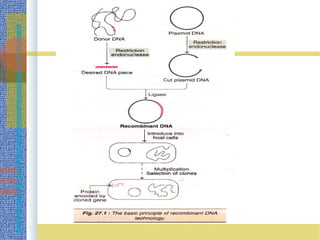
• The DNA is inserted into another DNA
molecule called ‘vector’
• The recombinant vector is then
introduced into a host cell where it
replicates itself, the gene is then
produced
Cell-Based MolecularCell-Based Molecular
CloningCloning
• The original recombinant DNA technique: 1974 by
Cohen and Boyer.
•
• Several key players:
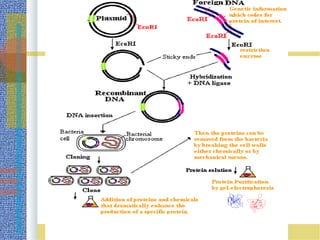
• 1. restriction enzymes. Cut DNA at specific
sequences. e.g. EcoR1 cuts at GAATTC and BamH1
cuts at GGATCC.
•
– Used by bacteria to destroy invading DNA: their own
DNA has been modified (methylated) at the
corresponding sequences by a methylase.
•
2. Plasmids: independently replicating DNA circles (only
circles replicate in bacteria). Foreign DNA can be
inserted into a plasmid and replicated.
– Plasmids for cloning carry drug resistance genes
that are used for selection.
– Spread antibiotic resistance genes between bacterial
species
3. DNA ligase. Attaches 2 pieces of DNA together.
4. transformation: DNA manipulated in vitro can be put
back into the living cells by a simple process .
– The transformed DNA replicates and expresses its
genes.
Best Way to keep COOL inBest Way to keep COOL in SUMMERSUMMER
? ! ?? ! ?
II. Restriction EndonucleasesII. Restriction Endonucleases
A. Origin and functionA. Origin and function
• Bacterial origin = enzymes that cleave foreign
DNA
• Named after the organism from which they
were derived
– EcoRI from Escherichia coli
– BamHI from Bacillus amyloliquefaciens
• Protect bacteria from bacteriophage infection
– Restricts viral replication
• Bacterium protects it’s own DNA by
methylating those specific sequence.
B. AvailabilityB. Availability
• Over 200 enzymes identified, many
available commercially from
biotechnology companies
C. ClassesC. Classes
• Type I
– Cuts the DNA on both strands but at a non-
specific location at varying distances from
the particular sequence that is recognized
by the restriction enzyme
– Therefore random/imprecise cuts
– Not very useful for rDNA applications
• Type II
– Cuts both strands of DNA within the
particular sequence recognized by the
restriction enzyme
– Used widely for molecular biology
procedures
– DNA sequence = symmetrical
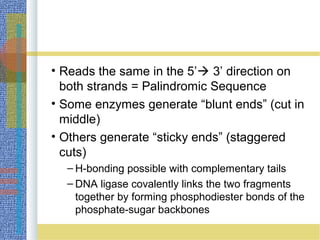
• Reads the same in the 5’ 3’ direction on
both strands = Palindromic Sequence
• Some enzymes generate “blunt ends” (cut in
middle)
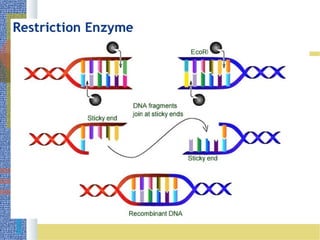
• Others generate “sticky ends” (staggered
cuts)
– H-bonding possible with complementary tails
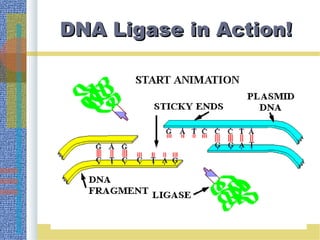
– DNA ligase covalently links the two fragments
together by forming phosphodiester bonds of the
phosphate-sugar backbones
DNA Ligase in Action!DNA Ligase in Action!
III. Vectors for GeneIII. Vectors for Gene
CloningCloning
“To be good & to do good that is the whole of religion”

Recombinant dna technology

  • 1.
    Recombinant DNARecombinant DNA TechnologyTechnology TapeshwarYadav (Lecturer) BMLT, DNHE, M.Sc. Medical Biochemistry
  • 2.
    A – Agood student is liked by teacher G – Greets everyone with smile O – Obedient O – On time for college D – Dresses neatly S – Studies with interest T – Treats everyone with smile U – Understands everything D – Does daily home work E – Eager to know new things N – Never misbehaves T – Talks little in class
  • 3.
    Biotechnology may bedefined as “the method by which a living organism or its parts are used to change or to incorporate a particular character to another living organism” It involves the application of scientific principles to the processing of materials by biological agents.
  • 4.
    Genetic recombination isthe exchange of information between two DNA segments. This is a common occurrence within the same species. But by artificial means, when a gene of one species in transferred to another living organism, it is called recombinant DNA technology. In common, this is known as genetic engineering.
  • 5.
    Definition ofDefinition of recombinantDNArecombinant DNA • Production of a unique DNA molecule by joining together two or more DNA fragments not normally associated with each other • DNA fragments are usually derived from different biological sources
  • 6.
    Definition of recombinantDefinitionof recombinant DNA technologyDNA technology • A series of procedures used to recombine DNA segments. Under certain conditions, a recombinant DNA molecule can enter a cell and replicate.
  • 7.
    History of recombinantHistoryof recombinant DNA technologyDNA technology • Recombinant DNA technology is one of the recent advances in biotechnology, which was developed by two scientists named Boyer and Cohen in 1973.
  • 8.
    Development ofDevelopment of molecularbiologymolecular biology • Early research on prokaryotic genetics and the development of molecular techniques has led to a new discipline called MOLECULAR BIOLOGY • “Tools” have been developed (and still continue to be modified/improved) to enable scientists to examine very specific regions of the genome or genes.
  • 9.
    • Advances inMolecular Biology – The combination of restriction/modification enzymes and hybridization techniques enable the application of a wide variety of procedures
  • 10.
    TECHNIQUES and PROCEDURES •Gene isolation/purification/synthesis • Sequencing/Genomics/Proteomics • Polymerase chain reaction (PCR) • Mutagenesis (reverse genetics) • Expression analyses (transcriptional and translational levels) • Restriction fragment length polymorphisms (RFLPs) • Biochemistry/ Molecular modeling • Gene therapy
  • 11.
    Applications • Quantitative preparationof biomolecules • Recombinant Vaccines • Antenatal diagnosis of genetic diseases • Monoclonal antibodies • Cell/tissue culture • To identify mutations in genes • Xenotransplantation
  • 12.
    Contd…Contd… • To detectactivation of oncogenes • Production of next generation antibiotics • Forensics • Biosensors • Genetically modified crops • Bioterrorism detection
  • 13.
    1.Quantitative Preparation of1.QuantitativePreparation of BiomoleculesBiomolecules • If molecules are isolated from higher organisms, the availability will be greatly limited. • For eg.- To get 1 unit of growth hormone, more than 1000 pituitaries from cadavers are required. • By means of recombinant technology, large scale availability is now assured.
  • 14.
    2. Risk ofcontamination is Eliminated2. Risk of contamination is Eliminated • It is now possible to produce a biological substance without any contamination. • Hepatitis, caused by HBV, is highly contagious. • Preparations of vaccines or clotting factors are free from contaminants such as hepatitis B particles. • RD-Technology provides the answer to produce safe antigens for vaccine production.
  • 15.
    3. Specific probesfor Diagnosis of3. Specific probes for Diagnosis of DiseasesDiseases Specific probes are useful for: i. Antenatal diagnosis of genetic diseases. For eg.- many of the single gene defects like cystic fibrosis, phenyl ketonuria etc. Could be identified by taking cell samples from fetus. ii. To identify viral particles or bacterial DNA in suspected blood and tissue samples.
  • 16.
    Contd…Contd… iii. To demonstratevirus integration in transformed cells. iv. To detect activation of oncogenes in cancer. v. To pinpoint the location of a gene in a chromosome. vi. To identify mutations in genes.
  • 17.
    4. Gene Therapy4.Gene Therapy • It is an important applications of RD-Technology • Normal genes could be introduced into the patient so that genetic diseases can be cured.
  • 18.
    • How tofind one gene in large genome? • A gene might be 1/1,000,000 of the genome. Three basic approaches: • 1. Cell-based molecular cloning: create and isolate a bacterial strain that replicates a copy of your gene. • 2. Polymerase chain reaction (PCR). Make many copies of a specific region of the DNA. • 3. Hybridization: make DNA single stranded, allow double strands to re-form using a labeled (e.g. radioactive) version of your gene to make it easy to detect.
  • 19.
    Basic principle ofrecombinantBasic principle of recombinant DNA technologyDNA technology • The DNA is inserted into another DNA molecule called ‘vector’ • The recombinant vector is then introduced into a host cell where it replicates itself, the gene is then produced
  • 21.
    Cell-Based MolecularCell-Based Molecular CloningCloning •The original recombinant DNA technique: 1974 by Cohen and Boyer. • • Several key players: • 1. restriction enzymes. Cut DNA at specific sequences. e.g. EcoR1 cuts at GAATTC and BamH1 cuts at GGATCC. • – Used by bacteria to destroy invading DNA: their own DNA has been modified (methylated) at the corresponding sequences by a methylase. •
  • 22.
    2. Plasmids: independentlyreplicating DNA circles (only circles replicate in bacteria). Foreign DNA can be inserted into a plasmid and replicated. – Plasmids for cloning carry drug resistance genes that are used for selection. – Spread antibiotic resistance genes between bacterial species 3. DNA ligase. Attaches 2 pieces of DNA together. 4. transformation: DNA manipulated in vitro can be put back into the living cells by a simple process . – The transformed DNA replicates and expresses its genes.
  • 24.
    Best Way tokeep COOL inBest Way to keep COOL in SUMMERSUMMER ? ! ?? ! ?
  • 25.
    II. Restriction EndonucleasesII.Restriction Endonucleases
  • 26.
    A. Origin andfunctionA. Origin and function • Bacterial origin = enzymes that cleave foreign DNA • Named after the organism from which they were derived – EcoRI from Escherichia coli – BamHI from Bacillus amyloliquefaciens • Protect bacteria from bacteriophage infection – Restricts viral replication • Bacterium protects it’s own DNA by methylating those specific sequence.
  • 27.
    B. AvailabilityB. Availability •Over 200 enzymes identified, many available commercially from biotechnology companies
  • 28.
    C. ClassesC. Classes •Type I – Cuts the DNA on both strands but at a non- specific location at varying distances from the particular sequence that is recognized by the restriction enzyme – Therefore random/imprecise cuts – Not very useful for rDNA applications
  • 29.
    • Type II –Cuts both strands of DNA within the particular sequence recognized by the restriction enzyme – Used widely for molecular biology procedures – DNA sequence = symmetrical
  • 30.
    • Reads thesame in the 5’ 3’ direction on both strands = Palindromic Sequence • Some enzymes generate “blunt ends” (cut in middle) • Others generate “sticky ends” (staggered cuts) – H-bonding possible with complementary tails – DNA ligase covalently links the two fragments together by forming phosphodiester bonds of the phosphate-sugar backbones
  • 32.
    DNA Ligase inAction!DNA Ligase in Action!
  • 33.
    III. Vectors forGeneIII. Vectors for Gene CloningCloning
  • 34.
    “To be good& to do good that is the whole of religion”