Genetic Organization of
Eukaryotes and Prokaryotes
16 July 2021 Abhijit Debnath BP605T and Biotech Unit-1 1
CO1.1
Noida Institute of Engineering and Technology
(Pharmacy Institute) Greater Noida
Abhijit Debnath
Asst. Professor
NIET, Pharmacy
Institute
Unit: 4
Subject Name: Biotechnology
(BP605T)
Course Details
(B. Pharm 6th Sem)
Genetic
Organization of
Eukaryotes and
Prokaryotes
16 July 2021 Abhijit Debnath BP605T and Biotech Unit-1 2
 Prokaryotes
 Eukaryotes
 Differences between Prokaryotes and
Eukaryotes
 Genetic Differences in
 Chromosome
 DNA
 Genome
CO1.1
Noida Institute of Engineering and Technology
(Pharmacy Institute) Greater Noida
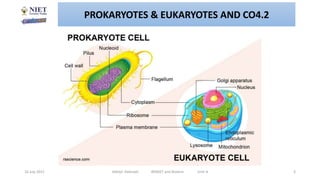
PROKARYOTES & EUKARYOTES AND CO4.2
16 July 2021 Abhijit Debnath BP605T and Biotech Unit-4 3
THE PROKARYOTIC GENOME CO4.2
16 July 2021 Abhijit Debnath BP605T and Biotech Unit-4 4
 Genome sequence data have indicated that most prokaryotic genomes consist of a single circular DNA molecule containing from 580
kbp to more than 4600 kbp of DNA.
 Extrachromosomal plasmids or Bacteria contain also may such elements as genetic bacteriophages (bacterial viruses).
 Many bacteria contain additional plasmids that range in size from several to 100 kbp. Genes on Plasmids are small genetic elements that
replicate independently of the bacterial chromosome.
 Most plasmids are circular, double-stranded DNA molecules varying from 1500 to 400,000 base pairs
 DNA circles (chromosome and plasmid), which contain genetic information necessary for their own replication, are called replicons.
 Bacteria usually have only one copy of their chromosomes (they are therefore haploid).
 Because bacteria have only one chromosome, alteration of a gene (mutation) will have a more obvious effect on the cell.
 Many plasmids carry genes that mediate their transfer from one organism to another as well as other genes associated with acquisition
or rearrangement of DNA.
 Therefore, genes with independent evolutionary origins may be assimilated by plasmids that are widely disseminated among bacterial
populations.
 Transposons are genetic elements that contain several kbp of DNA, including the information necessary for their migration from one
genetic locus to another.
THE EUKARYOTIC GENOME CO4.2
16 July 2021 Abhijit Debnath BP605T and Biotech Unit-4 5
 Multiple genomes: nuclear, plastid: mitochondria, chloroplasts
 Plastid genomes resemble prokaryotic genomes
 Multiple linear chromosomes, total size 5- 10,000 MB, 5000 to 50000 genes
 Monocistronic transcription units
 Discontinuous coding regions (introns and exons)
 Large amounts of non-coding DNA
 Transcription and translation take place in different compartments
 Variety of RNAs: Coding (mRNA, rRNA, tRNA), Non-coding (snRNA, snoRNA, microRNAs, etc).
 Often diploid genomes and obligatory sexual reproduction
 Standard mechanism of recombination: meiosis
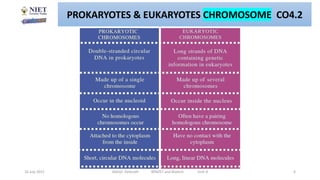
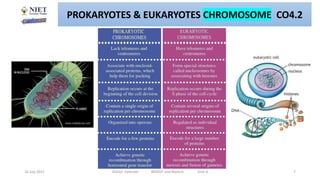
PROKARYOTES & EUKARYOTES CHROMOSOME CO4.2
16 July 2021 Abhijit Debnath BP605T and Biotech Unit-4 6
PROKARYOTES & EUKARYOTES CHROMOSOME CO4.2
16 July 2021 Abhijit Debnath BP605T and Biotech Unit-4 7
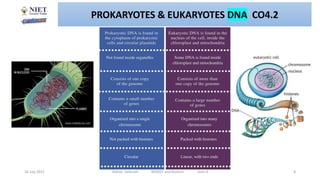
PROKARYOTES & EUKARYOTES DNA CO4.2
16 July 2021 Abhijit Debnath BP605T and Biotech Unit-4 8
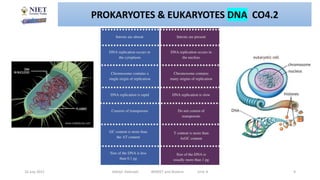
PROKARYOTES & EUKARYOTES DNA CO4.2
16 July 2021 Abhijit Debnath BP605T and Biotech Unit-4 9
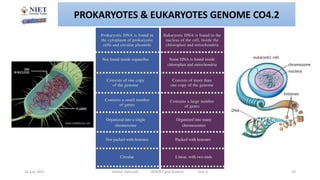
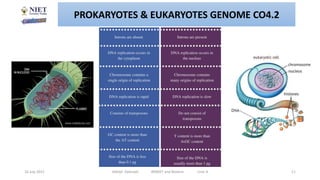
PROKARYOTES & EUKARYOTES GENOME CO4.2
16 July 2021 Abhijit Debnath BP605T and Biotech Unit-4 10
PROKARYOTES & EUKARYOTES GENOME CO4.2
16 July 2021 Abhijit Debnath BP605T and Biotech Unit-4 11
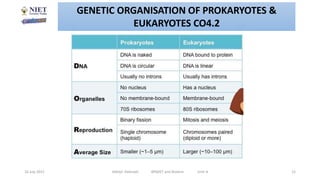
GENETIC ORGANISATION OF PROKARYOTES &
EUKARYOTES CO4.2
16 July 2021 Abhijit Debnath BP605T and Biotech Unit-4 12
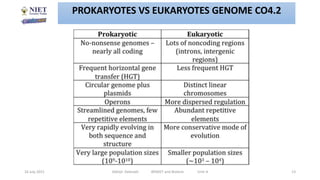
PROKARYOTES VS EUKARYOTES GENOME CO4.2
16 July 2021 Abhijit Debnath BP605T and Biotech Unit-4 13