Hybridoma Technology
20 July 2021 Abhijit Debnath BP605T and Biotech Unit-1 1
CO3.1
Noida Institute of Engineering and Technology
(Pharmacy Institute) Greater Noida
Abhijit Debnath
Asst. Professor
NIET, Pharmacy
Institute
Unit: 3
Subject Name: Biotechnology
(BP605T)
Course Details
(B. Pharm 6th Sem)
Hybridoma
Technology
20 July 2021 Abhijit Debnath BP605T and Biotech Unit-1 2
 Production
 Purification
 Applications
 Blood Products &
 Plasma Substitute
CO1.1
Noida Institute of Engineering and Technology
(Pharmacy Institute) Greater Noida
20 July 2021 Abhijit Debnath BP605T and Biotech Unit-3 3
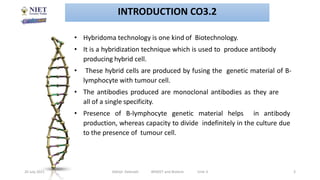
• Hybridoma technology is one kind of Biotechnology.
• It is a hybridization technique which is used to produce antibody
producing hybrid cell.
• These hybrid cells are produced by fusing the genetic material of B-
lymphocyte with tumour cell.
• The antibodies produced are monoclonal antibodies as they are
all of a single specificity.
• Presence of B-lymphocyte genetic material helps in antibody
production, whereas capacity to divide indefinitely in the culture due
to the presence of tumour cell.
INTRODUCTION CO3.2
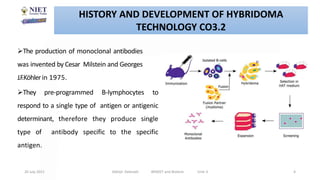
The production of monoclonal antibodies
was invented by Cesar Milstein and Georges
J.F
.Köhlerin 1975.
They pre-programmed B-lymphocytes to
respond to a single type of antigen or antigenic
determinant, therefore they produce single
type of antibody specific to the specific
antigen.
20 July 2021 Abhijit Debnath BP605T and Biotech Unit-3 4
HISTORY AND DEVELOPMENT OF HYBRIDOMA
TECHNOLOGY CO3.2
When an antigen reacts with B-lymphocyte receptors, lymphocytes divide rapidly and produce a clone
of B cells, all these B cells produce antibodies against that specific antigen and this is called as clonal
selection.
ThatisB-lymphocytesproduceonlyonetypeofantibodies whicharespecifictoonlyonetypeofantigen
orantigenicdeterminant. ButfullydifferentiatedantibodyproducingB-lymphocytecellsknown asplasma
cellsdoesnotdividewhenculturedinalaboratory.
The term hybridoma was coined by Leonard Herzenberg during his sabbatical in Cesar Milstein's
laboratoryin1976/1977.
20 July 2021 Abhijit Debnath BP605T and Biotech Unit-3 5
HISTORY AND DEVELOPMENT OF HYBRIDOMA
TECHNOLOGY CO3.2
20 July 2021 Abhijit Debnath BP605T and Biotech Unit-3 6
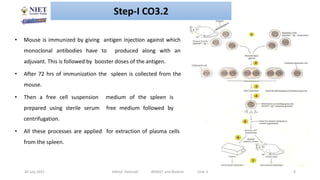
• Mouse is immunized by giving antigen injection against which
monoclonal antibodies have to produced along with an
adjuvant. This is followed by booster doses of the antigen.
• After 72 hrs of immunization the spleen is collected from the
mouse.
• Then a free cell suspension medium of the spleen is
prepared using sterile serum free medium followed by
centrifugation.
• All these processes are applied for extraction of plasma cells
from the spleen.
Step-I CO3.2
20 July 2021 Abhijit Debnath BP605T and Biotech Unit-3 7
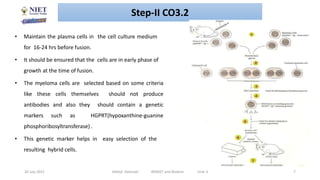
• Maintain the plasma cells in the cell culture medium
for 16-24 hrs before fusion.
• It should be ensured that the cells are in early phase of
growth at the time of fusion.
• The myeloma cells are selected based on some criteria
like these cells themselves should not produce
antibodies and also they should contain a genetic
markers such as HGPRT(hypoxanthine-guanine
phosphoribosyltransferase) .
• This genetic marker helps in easy selection of the
resulting hybrid cells.
Step-II CO3.2
20 July 2021 Abhijit Debnath BP605T and Biotech Unit-3 8
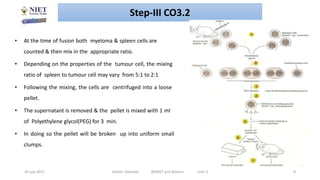
• At the time of fusion both myeloma & spleen cells are
counted & then mix in the appropriate ratio.
• Depending on the properties of the tumour cell, the mixing
ratio of spleen to tumour cell may vary from 5:1 to 2:1
• Following the mixing, the cells are centrifuged into a loose
pellet.
• The supernatant is removed & the pellet is mixed with 1 ml
of Polyethylene glycol(PEG) for 3 min.
• In doing so the pellet will be broken up into uniform small
clumps.
Step-III CO3.2
20 July 2021 Abhijit Debnath BP605T and Biotech Unit-3 9
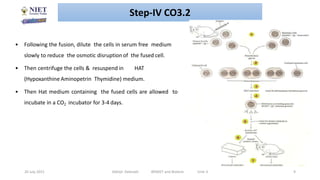
• Following the fusion, dilute the cells in serum free medium
slowly to reduce the osmotic disruption of the fused cell.
• Then centrifuge the cells & resuspend in HAT
(Hypoxanthine Aminopetrin Thymidine) medium.
• Then Hat medium containing the fused cells are allowed to
incubate in a CO2 incubator for 3-4 days.
Step-IV CO3.2
20 July 2021 Abhijit Debnath BP605T and Biotech Unit-3 10
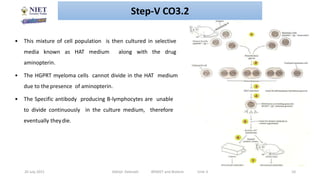
• This mixture of cell population is then cultured in selective
media known as HAT medium along with the drug
aminopterin.
• The HGPRT myeloma cells cannot divide in the HAT medium
due to the presence of aminopterin.
• The Specific antibody producing B-lymphocytes are unable
to divide continuously in the culture medium, therefore
eventually theydie.
Step-V CO3.2
20 July 2021 Abhijit Debnath BP605T and Biotech Unit-3 11
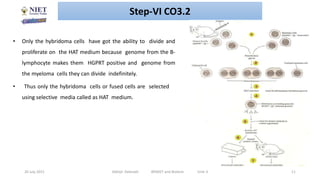
• Only the hybridoma cells have got the ability to divide and
proliferate on the HAT medium because genome from the B-
lymphocyte makes them HGPRT positive and genome from
the myeloma cells they can divide indefinitely.
• Thus only the hybridoma cells or fused cells are selected
using selective media called as HAT medium.
Step-VI CO3.2
20 July 2021 Abhijit Debnath BP605T and Biotech Unit-3 12
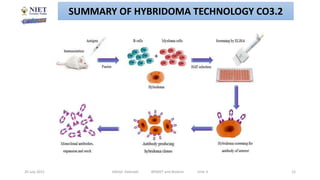
SUMMARY OF HYBRIDOMA TECHNOLOGY CO3.2

Hybridoma Technology

  • 1.
    Hybridoma Technology 20 July2021 Abhijit Debnath BP605T and Biotech Unit-1 1 CO3.1 Noida Institute of Engineering and Technology (Pharmacy Institute) Greater Noida Abhijit Debnath Asst. Professor NIET, Pharmacy Institute Unit: 3 Subject Name: Biotechnology (BP605T) Course Details (B. Pharm 6th Sem)
  • 2.
    Hybridoma Technology 20 July 2021Abhijit Debnath BP605T and Biotech Unit-1 2  Production  Purification  Applications  Blood Products &  Plasma Substitute CO1.1 Noida Institute of Engineering and Technology (Pharmacy Institute) Greater Noida
  • 3.
    20 July 2021Abhijit Debnath BP605T and Biotech Unit-3 3 • Hybridoma technology is one kind of Biotechnology. • It is a hybridization technique which is used to produce antibody producing hybrid cell. • These hybrid cells are produced by fusing the genetic material of B- lymphocyte with tumour cell. • The antibodies produced are monoclonal antibodies as they are all of a single specificity. • Presence of B-lymphocyte genetic material helps in antibody production, whereas capacity to divide indefinitely in the culture due to the presence of tumour cell. INTRODUCTION CO3.2
  • 4.
    The production ofmonoclonal antibodies was invented by Cesar Milstein and Georges J.F .Köhlerin 1975. They pre-programmed B-lymphocytes to respond to a single type of antigen or antigenic determinant, therefore they produce single type of antibody specific to the specific antigen. 20 July 2021 Abhijit Debnath BP605T and Biotech Unit-3 4 HISTORY AND DEVELOPMENT OF HYBRIDOMA TECHNOLOGY CO3.2
  • 5.
    When an antigenreacts with B-lymphocyte receptors, lymphocytes divide rapidly and produce a clone of B cells, all these B cells produce antibodies against that specific antigen and this is called as clonal selection. ThatisB-lymphocytesproduceonlyonetypeofantibodies whicharespecifictoonlyonetypeofantigen orantigenicdeterminant. ButfullydifferentiatedantibodyproducingB-lymphocytecellsknown asplasma cellsdoesnotdividewhenculturedinalaboratory. The term hybridoma was coined by Leonard Herzenberg during his sabbatical in Cesar Milstein's laboratoryin1976/1977. 20 July 2021 Abhijit Debnath BP605T and Biotech Unit-3 5 HISTORY AND DEVELOPMENT OF HYBRIDOMA TECHNOLOGY CO3.2
  • 6.
    20 July 2021Abhijit Debnath BP605T and Biotech Unit-3 6 • Mouse is immunized by giving antigen injection against which monoclonal antibodies have to produced along with an adjuvant. This is followed by booster doses of the antigen. • After 72 hrs of immunization the spleen is collected from the mouse. • Then a free cell suspension medium of the spleen is prepared using sterile serum free medium followed by centrifugation. • All these processes are applied for extraction of plasma cells from the spleen. Step-I CO3.2
  • 7.
    20 July 2021Abhijit Debnath BP605T and Biotech Unit-3 7 • Maintain the plasma cells in the cell culture medium for 16-24 hrs before fusion. • It should be ensured that the cells are in early phase of growth at the time of fusion. • The myeloma cells are selected based on some criteria like these cells themselves should not produce antibodies and also they should contain a genetic markers such as HGPRT(hypoxanthine-guanine phosphoribosyltransferase) . • This genetic marker helps in easy selection of the resulting hybrid cells. Step-II CO3.2
  • 8.
    20 July 2021Abhijit Debnath BP605T and Biotech Unit-3 8 • At the time of fusion both myeloma & spleen cells are counted & then mix in the appropriate ratio. • Depending on the properties of the tumour cell, the mixing ratio of spleen to tumour cell may vary from 5:1 to 2:1 • Following the mixing, the cells are centrifuged into a loose pellet. • The supernatant is removed & the pellet is mixed with 1 ml of Polyethylene glycol(PEG) for 3 min. • In doing so the pellet will be broken up into uniform small clumps. Step-III CO3.2
  • 9.
    20 July 2021Abhijit Debnath BP605T and Biotech Unit-3 9 • Following the fusion, dilute the cells in serum free medium slowly to reduce the osmotic disruption of the fused cell. • Then centrifuge the cells & resuspend in HAT (Hypoxanthine Aminopetrin Thymidine) medium. • Then Hat medium containing the fused cells are allowed to incubate in a CO2 incubator for 3-4 days. Step-IV CO3.2
  • 10.
    20 July 2021Abhijit Debnath BP605T and Biotech Unit-3 10 • This mixture of cell population is then cultured in selective media known as HAT medium along with the drug aminopterin. • The HGPRT myeloma cells cannot divide in the HAT medium due to the presence of aminopterin. • The Specific antibody producing B-lymphocytes are unable to divide continuously in the culture medium, therefore eventually theydie. Step-V CO3.2
  • 11.
    20 July 2021Abhijit Debnath BP605T and Biotech Unit-3 11 • Only the hybridoma cells have got the ability to divide and proliferate on the HAT medium because genome from the B- lymphocyte makes them HGPRT positive and genome from the myeloma cells they can divide indefinitely. • Thus only the hybridoma cells or fused cells are selected using selective media called as HAT medium. Step-VI CO3.2
  • 12.
    20 July 2021Abhijit Debnath BP605T and Biotech Unit-3 12 SUMMARY OF HYBRIDOMA TECHNOLOGY CO3.2