Brief Introduction to PCR
2 July 2021 Abhijit Debnath BP605T and Biotech Unit-1 1
CO1.1
Noida Institute of Engineering and Technology
(Pharmacy Institute) Greater Noida
Abhijit Debnath
Asst. Professor
NIET, Pharmacy Institute
Unit: 2
Subject Name: Biotechnology
(BP605T)
Course Details
(B. Pharm 6th Sem)
Brief Introduction
to PCR
2 July 2021 Abhijit Debnath BP605T and Biotech Unit-1 2
 What Is PCR
 Principle of PCR
 Denaturation
 Annealing
 Extension
 Cycling
 Products of Extension
 Overall Principle of PCR
 Basic Requirements for PCR Reaction
 Instrumentation
 Advantages of PCR
 Applications of PCR
CO1.1
Noida Institute of Engineering and Technology
(Pharmacy Institute) Greater Noida
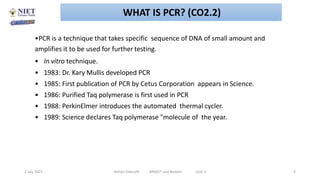
•PCR is a technique that takes specific sequence of DNA of small amount and
amplifies it to be used for further testing.
• In vitro technique.
• 1983: Dr. Kary Mullis developed PCR
• 1985: First publication of PCR by Cetus Corporation appears in Science.
• 1986: Purified Taq polymerase is first used in PCR
• 1988: PerkinElmer introduces the automated thermal cycler.
• 1989: Science declares Taq polymerase "molecule of the year.
2 July 2021 Abhijit Debnath BP605T and Biotech Unit-2 3
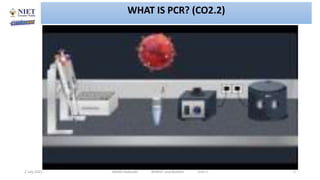
WHAT IS PCR? (CO2.2)
2 July 2021 Abhijit Debnath BP605T and Biotech Unit-1 4
WHAT IS PCR? (CO2.2)
2 July 2021 Abhijit Debnath BP605T and Biotech Unit-1 5
WHAT IS PCR? (CO2.2)
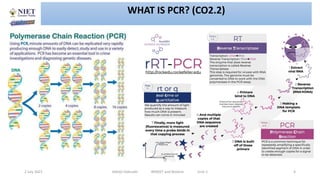
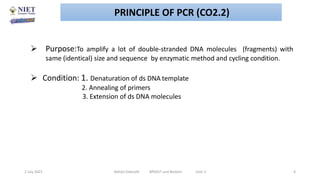
 Purpose:To amplify a lot of double-stranded DNA molecules (fragments) with
same (identical) size and sequence by enzymatic method and cycling condition.
 Condition: 1. Denaturation of ds DNA template
2. Annealing of primers
…………… …3. Extension of ds DNA molecules
2 July 2021 Abhijit Debnath BP605T and Biotech Unit-2 6
PRINCIPLE OF PCR (CO2.2)
single stranded
92C
3’
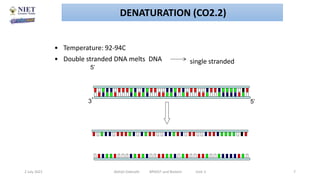
• Temperature: 92-94C
• Double stranded DNA melts DNA
5’
3’ 5’
+
5’
3’
5’ 3’
2 July 2021 Abhijit Debnath BP605T and Biotech Unit-2 7
DENATURATION (CO2.2)
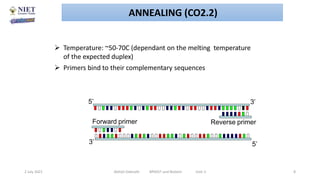
 Temperature: ~50-70C (dependant on the melting temperature
of the expected duplex)
 Primers bind to their complementary sequences
5’
3’
5’ 3’
Forward primer Reverse primer
2 July 2021 Abhijit Debnath BP605T and Biotech Unit-2 8
ANNEALING (CO2.2)
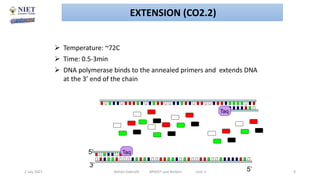
 Temperature: ~72C
 Time: 0.5-3min
 DNA polymerase binds to the annealed primers and extends DNA
at the 3’ end of the chain
Taq
5’
3’
Taq
5’
2 July 2021 Abhijit Debnath BP605T and Biotech Unit-2 9
EXTENSION (CO2.2)
2 July 2021 Abhijit Debnath BP605T and Biotech Unit-2 10
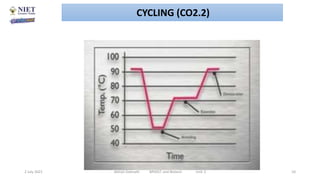
CYCLING (CO2.2)
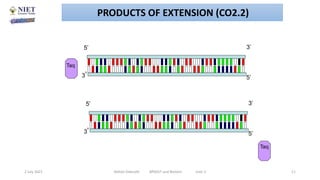
3’
5’
3’ 5’
3’
5’
3’ 5’
Taq
Taq
2 July 2021 Abhijit Debnath BP605T and Biotech Unit-2 11
PRODUCTS OF EXTENSION (CO2.2)
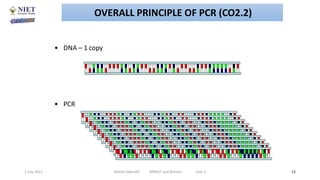
• DNA – 1 copy
• Known sequence Sequence of interest Known sequence
• PCR
2 July 2021 Abhijit Debnath BP605T and Biotech Unit-2 12
OVERALL PRINCIPLE OF PCR (CO2.2)
 Magnesium chloride: .5-2.5mM
 Buffer: pH 8.3-8.8
 dNTPs: 20-200µM
 Primers: 0.1-0.5µM
 DNA Polymerase: 1-2.5 units
 Target DNA: 1 µg
2 July 2021 Abhijit Debnath BP605T and Biotech Unit-2 13
OVERALL PRINCIPLE OF PCR (CO2.2)
 DNA sequence of target region must be known.
 Primers - typically 20-30 bases in size. These can be readily
produced by commercial companies. Can also be prepared
using a DNA synthesizer.
 Thermo-stable DNA polymerase - eg Taq polymerase
which is not inactivated by heating to 95C.
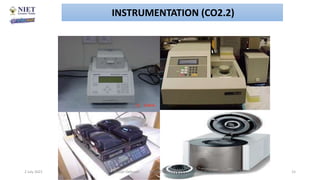
 DNA thermal cycler - machine which can be programmed to
carry out heating and cooling of samples over a number of
cycles.
2 July 2021 Abhijit Debnath BP605T and Biotech Unit-2 14
BASIC REQUIREMENTS FOR PCR REACTION (CO2.2)
2 July 2021 Abhijit Debnath BP605T and Biotech Unit-2 15
INSTRUMENTATION (CO2.2)
 Specificity
 Efficiency
 Fidelity
2 July 2021 Abhijit Debnath BP605T and Biotech Unit-2 16
THREE ASPECTS OF PCR (CO2.2)
•
If no product ( of correct size ) produced:
 Check DNA quality
 Reduce annealing temperature
 Increase magnesium concentration
 Add dimethylsulphoxide ( DMSO ) to assay ( at around 10% )
 Use different thermostable enzyme
 Throw out primers - make new stocks
If extra spurious product bands present:
 1 Increase annealing temperature
 2 Reduce magnesium concentration
 3 Reduce number of cycles
 4 Try different enzyme
2 July 2021 Abhijit Debnath BP605T and Biotech Unit-2 17
Things to try if PCR does not work (CO2.2)
 Initial denaturation : 95C for 5 mins 30
 Thermo-cycle file - cycles of 95C for 30
 Denaturation : secs 55C for 30 secs
 Annealing : 72C for 45 secs 72C
 Extension :for 5 mins
 Final extension
2 July 2021 Abhijit Debnath BP605T and Biotech Unit-2 18
EXAMPLE A PCR PROGRAMME (CO2.2)
 Small amount of DNA is required per test
 Result obtained more quickly - usually within 1 day for PCR
 Usually not necessary to use radioactive material (32P) for
PCR.
 PCR is much more precise in determining the sizes of alleles -
essential for some disorders.
 PCR can be used to detect point mutations.
2 July 2021 Abhijit Debnath BP605T and Biotech Unit-2 19
ADVANTAGES OF PCR (CO2.2)
 Neisseria gonorrhea
 Chlamydia trachomatis
 HIV-1
 Factor V Leiden
 Forensic testing and many others
2 July 2021 Abhijit Debnath BP605T and Biotech Unit-2 20
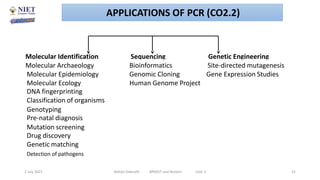
APPLICATIONS OF PCR (CO2.2)
Molecular Identification Sequencing Genetic Engineering
Molecular Archaeology Bioinformatics Site-directed mutagenesis
Molecular Epidemiology Genomic Cloning Gene Expression Studies
Molecular Ecology
DNA fingerprinting
Classification of organisms
Human Genome Project
Genotyping
Pre-natal diagnosis
Mutation screening
Drug discovery
Genetic matching
Detection of pathogens
2 July 2021 Abhijit Debnath BP605T and Biotech Unit-2 21
APPLICATIONS OF PCR (CO2.2)
 PCR is not only vital in the clinical laboratory by amplifying small amounts of DNA for
STD detection, but it is also important for genetic predisposing for defects such as
Factor V Leiden.
 The PCR technology can also be employed in law enforcement, genetic testing of animal
stocks and vegetable hybrids, and drug screening along with many more areas.
2 July 2021 Abhijit Debnath BP605T and Biotech Unit-2 22
CONCLUSION (CO2.2)
Introduction:
• Basic principle.
• Highly specific genetic manipulation of genetic material.
• Gene transfer between unrelated species.
• Applications in health, agriculture, environment, industry.
2 July 2021 Abhijit Debnath BP605T and Biotech Unit-2 23
THREE ASPECTS OF PCR (CO2.2)
Antibiotics:
• Artificially prepared antibiotics also available.
• They denature harmful living pathogens.
• pencillin in 1928.
2 July 2021 Abhijit Debnath BP605T and Biotech Unit-2 24
THREE ASPECTS OF PCR (CO2.2)

Brief Introduction to PCR

  • 1.
    Brief Introduction toPCR 2 July 2021 Abhijit Debnath BP605T and Biotech Unit-1 1 CO1.1 Noida Institute of Engineering and Technology (Pharmacy Institute) Greater Noida Abhijit Debnath Asst. Professor NIET, Pharmacy Institute Unit: 2 Subject Name: Biotechnology (BP605T) Course Details (B. Pharm 6th Sem)
  • 2.
    Brief Introduction to PCR 2July 2021 Abhijit Debnath BP605T and Biotech Unit-1 2  What Is PCR  Principle of PCR  Denaturation  Annealing  Extension  Cycling  Products of Extension  Overall Principle of PCR  Basic Requirements for PCR Reaction  Instrumentation  Advantages of PCR  Applications of PCR CO1.1 Noida Institute of Engineering and Technology (Pharmacy Institute) Greater Noida
  • 3.
    •PCR is atechnique that takes specific sequence of DNA of small amount and amplifies it to be used for further testing. • In vitro technique. • 1983: Dr. Kary Mullis developed PCR • 1985: First publication of PCR by Cetus Corporation appears in Science. • 1986: Purified Taq polymerase is first used in PCR • 1988: PerkinElmer introduces the automated thermal cycler. • 1989: Science declares Taq polymerase "molecule of the year. 2 July 2021 Abhijit Debnath BP605T and Biotech Unit-2 3 WHAT IS PCR? (CO2.2)
  • 4.
    2 July 2021Abhijit Debnath BP605T and Biotech Unit-1 4 WHAT IS PCR? (CO2.2)
  • 5.
    2 July 2021Abhijit Debnath BP605T and Biotech Unit-1 5 WHAT IS PCR? (CO2.2)
  • 6.
     Purpose:To amplifya lot of double-stranded DNA molecules (fragments) with same (identical) size and sequence by enzymatic method and cycling condition.  Condition: 1. Denaturation of ds DNA template 2. Annealing of primers …………… …3. Extension of ds DNA molecules 2 July 2021 Abhijit Debnath BP605T and Biotech Unit-2 6 PRINCIPLE OF PCR (CO2.2)
  • 7.
    single stranded 92C 3’ • Temperature:92-94C • Double stranded DNA melts DNA 5’ 3’ 5’ + 5’ 3’ 5’ 3’ 2 July 2021 Abhijit Debnath BP605T and Biotech Unit-2 7 DENATURATION (CO2.2)
  • 8.
     Temperature: ~50-70C(dependant on the melting temperature of the expected duplex)  Primers bind to their complementary sequences 5’ 3’ 5’ 3’ Forward primer Reverse primer 2 July 2021 Abhijit Debnath BP605T and Biotech Unit-2 8 ANNEALING (CO2.2)
  • 9.
     Temperature: ~72C Time: 0.5-3min  DNA polymerase binds to the annealed primers and extends DNA at the 3’ end of the chain Taq 5’ 3’ Taq 5’ 2 July 2021 Abhijit Debnath BP605T and Biotech Unit-2 9 EXTENSION (CO2.2)
  • 10.
    2 July 2021Abhijit Debnath BP605T and Biotech Unit-2 10 CYCLING (CO2.2)
  • 11.
    3’ 5’ 3’ 5’ 3’ 5’ 3’ 5’ Taq Taq 2July 2021 Abhijit Debnath BP605T and Biotech Unit-2 11 PRODUCTS OF EXTENSION (CO2.2)
  • 12.
    • DNA –1 copy • Known sequence Sequence of interest Known sequence • PCR 2 July 2021 Abhijit Debnath BP605T and Biotech Unit-2 12 OVERALL PRINCIPLE OF PCR (CO2.2)
  • 13.
     Magnesium chloride:.5-2.5mM  Buffer: pH 8.3-8.8  dNTPs: 20-200µM  Primers: 0.1-0.5µM  DNA Polymerase: 1-2.5 units  Target DNA: 1 µg 2 July 2021 Abhijit Debnath BP605T and Biotech Unit-2 13 OVERALL PRINCIPLE OF PCR (CO2.2)
  • 14.
     DNA sequenceof target region must be known.  Primers - typically 20-30 bases in size. These can be readily produced by commercial companies. Can also be prepared using a DNA synthesizer.  Thermo-stable DNA polymerase - eg Taq polymerase which is not inactivated by heating to 95C.  DNA thermal cycler - machine which can be programmed to carry out heating and cooling of samples over a number of cycles. 2 July 2021 Abhijit Debnath BP605T and Biotech Unit-2 14 BASIC REQUIREMENTS FOR PCR REACTION (CO2.2)
  • 15.
    2 July 2021Abhijit Debnath BP605T and Biotech Unit-2 15 INSTRUMENTATION (CO2.2)
  • 16.
     Specificity  Efficiency Fidelity 2 July 2021 Abhijit Debnath BP605T and Biotech Unit-2 16 THREE ASPECTS OF PCR (CO2.2)
  • 17.
    • If no product( of correct size ) produced:  Check DNA quality  Reduce annealing temperature  Increase magnesium concentration  Add dimethylsulphoxide ( DMSO ) to assay ( at around 10% )  Use different thermostable enzyme  Throw out primers - make new stocks If extra spurious product bands present:  1 Increase annealing temperature  2 Reduce magnesium concentration  3 Reduce number of cycles  4 Try different enzyme 2 July 2021 Abhijit Debnath BP605T and Biotech Unit-2 17 Things to try if PCR does not work (CO2.2)
  • 18.
     Initial denaturation: 95C for 5 mins 30  Thermo-cycle file - cycles of 95C for 30  Denaturation : secs 55C for 30 secs  Annealing : 72C for 45 secs 72C  Extension :for 5 mins  Final extension 2 July 2021 Abhijit Debnath BP605T and Biotech Unit-2 18 EXAMPLE A PCR PROGRAMME (CO2.2)
  • 19.
     Small amountof DNA is required per test  Result obtained more quickly - usually within 1 day for PCR  Usually not necessary to use radioactive material (32P) for PCR.  PCR is much more precise in determining the sizes of alleles - essential for some disorders.  PCR can be used to detect point mutations. 2 July 2021 Abhijit Debnath BP605T and Biotech Unit-2 19 ADVANTAGES OF PCR (CO2.2)
  • 20.
     Neisseria gonorrhea Chlamydia trachomatis  HIV-1  Factor V Leiden  Forensic testing and many others 2 July 2021 Abhijit Debnath BP605T and Biotech Unit-2 20 APPLICATIONS OF PCR (CO2.2)
  • 21.
    Molecular Identification SequencingGenetic Engineering Molecular Archaeology Bioinformatics Site-directed mutagenesis Molecular Epidemiology Genomic Cloning Gene Expression Studies Molecular Ecology DNA fingerprinting Classification of organisms Human Genome Project Genotyping Pre-natal diagnosis Mutation screening Drug discovery Genetic matching Detection of pathogens 2 July 2021 Abhijit Debnath BP605T and Biotech Unit-2 21 APPLICATIONS OF PCR (CO2.2)
  • 22.
     PCR isnot only vital in the clinical laboratory by amplifying small amounts of DNA for STD detection, but it is also important for genetic predisposing for defects such as Factor V Leiden.  The PCR technology can also be employed in law enforcement, genetic testing of animal stocks and vegetable hybrids, and drug screening along with many more areas. 2 July 2021 Abhijit Debnath BP605T and Biotech Unit-2 22 CONCLUSION (CO2.2)
  • 23.
    Introduction: • Basic principle. •Highly specific genetic manipulation of genetic material. • Gene transfer between unrelated species. • Applications in health, agriculture, environment, industry. 2 July 2021 Abhijit Debnath BP605T and Biotech Unit-2 23 THREE ASPECTS OF PCR (CO2.2)
  • 24.
    Antibiotics: • Artificially preparedantibiotics also available. • They denature harmful living pathogens. • pencillin in 1928. 2 July 2021 Abhijit Debnath BP605T and Biotech Unit-2 24 THREE ASPECTS OF PCR (CO2.2)