RECOMBINANT DNA
TECHNOLOGY
rDNA TECHNOLOGY
• rDNA technology/Genetic Engineering
• The process of breaking a DNA molecule at desired places,isolation
and insertion into another DNA molecule to form a new DNA known
as recombinant DNA /Hybrid DNA/Chimeric DNA
• rDNA is then inserted into a host to produce indefinite number of
copies of genes – Gene Cloning
rDNA TECHNOLOGY - TOOLS
1. Enzymes – Restriction Endonucleases (RE),Ligases
2. Vectors – Plasmids,Bacteriophages,Cosmids,Artificial chromosome
vectors
3. Hosts – Prokaryotic (E.Coli),Eukaryotic (Yeast)
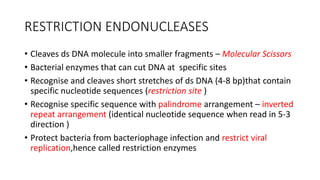
RESTRICTION ENDONUCLEASES
• Cleaves ds DNA molecule into smaller fragments – Molecular Scissors
• Bacterial enzymes that can cut DNA at specific sites
• Recognise and cleaves short stretches of ds DNA (4-8 bp)that contain
specific nucleotide sequences (restriction site )
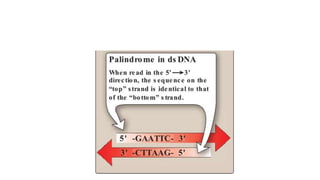
• Recognise specific sequence with palindrome arrangement – inverted
repeat arrangement (identical nucleotide sequence when read in 5-3
direction )
• Protect bacteria from bacteriophage infection and restrict viral
replication,hence called restriction enzymes
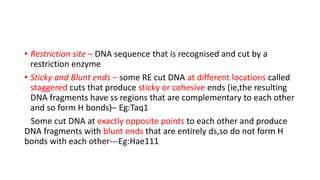
• Restriction site – DNA sequence that is recognised and cut by a
restriction enzyme
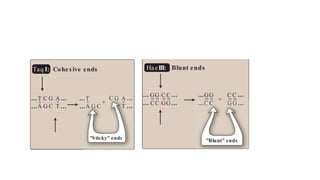
• Sticky and Blunt ends – some RE cut DNA at different locations called
staggered cuts that produce sticky or cohesive ends (ie,the resulting
DNA fragments have ss regions that are complementary to each other
and so form H bonds)– Eg:Taq1
Some cut DNA at exactly opposite points to each other and produce
DNA fragments with blunt ends that are entirely ds,so do not form H
bonds with each other---Eg:Hae111
• Role of restriction enzymes
1. Analysis of chromosomal structure
2. Sequencing very long DNA molecules
3. Isolating genes
4. Creating new DNA molecules for cloning
5. DNA finger printing
• Ligases – join the DNA fragments by forming a phosphodiester bond
between the phosphate group of 5 carbon of one deoxyribose with
the hydroxyl group of 3 carbon of another deoxy ribose
VECTORS
• A molecule of DNA to which the fragment of DNA to be cloned is
joined – cloning vehicles
• Essential properties of a vector
1. Capacity for autonomous replication within a host cell
2. Presence of atleast one specific nucleotide sequence recognised by
a RE
3. Presence of atleast one gene( eg : antibiotic resistance gene)that
confers the ability to select for the vector
I. PLASMIDS
• Most important cloning vectors
• Small, circular,extra chromosomal ds DNA molecules of bacteria
• Carry genes that convey antibiotic resistance to host bacterium and
facilitate the transfer of genetic information from one bacterium to
another
• Can be readily isolated from bacterial cells
• pBR322 of E.Coli is the most commonly used plasmid vector which
carries genes resistant for ampicillin and tetracycline
2. BACTERIOPHAGES
• Viruses that attack & replicate within the bacteria
• Accept larger DNA segments than plasmids hence more favoured
while working with human genomes
• Eg : lambda phage,phage M13
3. COSMIDS – plasmids plus bacteriophages
4. ARTIFICIAL CHROMOSOME VECTORS – synthetically produced
vector DNA possessing the characteristics of human chromosome
HOSTS
• Living systems or cells in which carrier of recombinant DNA molecule
or vector can be propagated
• Prokaryotic (E.Coli),Eukaryotic (Yeast)
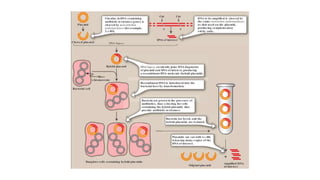
rDNA TECHNOLOGY - STEPS
1. Isolation of desired gene
2. Isolation of vector
3. Formation of chimeric DNA/recombinant DNA/hybrid DNA
4. Uptake of chimeric DNA
5. Selection of the cells containing chimeric DNA
6. Expression of the gene to produce desired effect
rDNA TECHNOLOGY - APPLICATIONS
1. For production of desired proteins that serve as therapeutic agents
in treatment of human diseases
• Eg : Insulin,Growth hormone,Interferons, Factor 8,tPA,Antibiotics,
Monoclonal antibodies
2. Production of safe antigens for vaccine production – Hep B
3. Diagnosis of diseases –
a) ELISA and Western blot techniques uses a recombinant HIV
protein to test for the presence of antibodies in HIV infection
b) Antenatal diagnosis of genetic diseases (cystic fibrosis,phenyl
ketonuria)
c. To detect activation of oncogenes in cancer
d. To pinpoint the location of a gene in a chromosome
e. To identify mutations in genes and for pedigree analysis
4. DNA Finger Printing/DNA typing
5. In gene therapy
GENE THERAPY
• Intracellular delivery of normal genes to generate a therapeutic effect
by correcting an existing abnormality due to disease causing mutation
• Normal genes can be introduced into the patient so that genetic
diseases can be cured
GENE THERAPY - PROCEDURE
1. Isolate the healthy gene along with the sequence controlling its
expression
2. Incorporate this gene into vector as an expression cassette
3. Deliver the vector to the target cells
• 3 ways of introducing genes
I. Ex vivo strategy – patients cells are cultured in the laboratory,new
genes are infused into cells,modified cells are administered back to
the patient
II. In situ strategy – expression cassette is injected to the patient iv or
directly to the tissue
III. In vivo strategy – vector is administered directly to the cell
• VECTORS
• Viral – retro viruses,Adeno viruses,Herpes simplex
• Non viral – liposomes,plasmids
• Gene therapy can be employed for the treatment of
----SCID,
----Duchenne muscular dystrophy,
----Cystic fibrosis,
----Familial hypercholesterolemia,
----Haemophilia,
----Cancer

RECOMBINANT DNA TECHNOLOGY biochemistry lecture

  • 1.
  • 2.
    rDNA TECHNOLOGY • rDNAtechnology/Genetic Engineering • The process of breaking a DNA molecule at desired places,isolation and insertion into another DNA molecule to form a new DNA known as recombinant DNA /Hybrid DNA/Chimeric DNA • rDNA is then inserted into a host to produce indefinite number of copies of genes – Gene Cloning
  • 3.
    rDNA TECHNOLOGY -TOOLS 1. Enzymes – Restriction Endonucleases (RE),Ligases 2. Vectors – Plasmids,Bacteriophages,Cosmids,Artificial chromosome vectors 3. Hosts – Prokaryotic (E.Coli),Eukaryotic (Yeast)
  • 4.
    RESTRICTION ENDONUCLEASES • Cleavesds DNA molecule into smaller fragments – Molecular Scissors • Bacterial enzymes that can cut DNA at specific sites • Recognise and cleaves short stretches of ds DNA (4-8 bp)that contain specific nucleotide sequences (restriction site ) • Recognise specific sequence with palindrome arrangement – inverted repeat arrangement (identical nucleotide sequence when read in 5-3 direction ) • Protect bacteria from bacteriophage infection and restrict viral replication,hence called restriction enzymes
  • 7.
    • Restriction site– DNA sequence that is recognised and cut by a restriction enzyme • Sticky and Blunt ends – some RE cut DNA at different locations called staggered cuts that produce sticky or cohesive ends (ie,the resulting DNA fragments have ss regions that are complementary to each other and so form H bonds)– Eg:Taq1 Some cut DNA at exactly opposite points to each other and produce DNA fragments with blunt ends that are entirely ds,so do not form H bonds with each other---Eg:Hae111
  • 8.
    • Role ofrestriction enzymes 1. Analysis of chromosomal structure 2. Sequencing very long DNA molecules 3. Isolating genes 4. Creating new DNA molecules for cloning 5. DNA finger printing
  • 9.
    • Ligases –join the DNA fragments by forming a phosphodiester bond between the phosphate group of 5 carbon of one deoxyribose with the hydroxyl group of 3 carbon of another deoxy ribose
  • 10.
    VECTORS • A moleculeof DNA to which the fragment of DNA to be cloned is joined – cloning vehicles • Essential properties of a vector 1. Capacity for autonomous replication within a host cell 2. Presence of atleast one specific nucleotide sequence recognised by a RE 3. Presence of atleast one gene( eg : antibiotic resistance gene)that confers the ability to select for the vector
  • 11.
    I. PLASMIDS • Mostimportant cloning vectors • Small, circular,extra chromosomal ds DNA molecules of bacteria • Carry genes that convey antibiotic resistance to host bacterium and facilitate the transfer of genetic information from one bacterium to another • Can be readily isolated from bacterial cells • pBR322 of E.Coli is the most commonly used plasmid vector which carries genes resistant for ampicillin and tetracycline
  • 12.
    2. BACTERIOPHAGES • Virusesthat attack & replicate within the bacteria • Accept larger DNA segments than plasmids hence more favoured while working with human genomes • Eg : lambda phage,phage M13 3. COSMIDS – plasmids plus bacteriophages
  • 13.
    4. ARTIFICIAL CHROMOSOMEVECTORS – synthetically produced vector DNA possessing the characteristics of human chromosome
  • 14.
    HOSTS • Living systemsor cells in which carrier of recombinant DNA molecule or vector can be propagated • Prokaryotic (E.Coli),Eukaryotic (Yeast)
  • 15.
    rDNA TECHNOLOGY -STEPS 1. Isolation of desired gene 2. Isolation of vector 3. Formation of chimeric DNA/recombinant DNA/hybrid DNA 4. Uptake of chimeric DNA 5. Selection of the cells containing chimeric DNA 6. Expression of the gene to produce desired effect
  • 18.
    rDNA TECHNOLOGY -APPLICATIONS 1. For production of desired proteins that serve as therapeutic agents in treatment of human diseases • Eg : Insulin,Growth hormone,Interferons, Factor 8,tPA,Antibiotics, Monoclonal antibodies 2. Production of safe antigens for vaccine production – Hep B 3. Diagnosis of diseases – a) ELISA and Western blot techniques uses a recombinant HIV protein to test for the presence of antibodies in HIV infection b) Antenatal diagnosis of genetic diseases (cystic fibrosis,phenyl ketonuria)
  • 19.
    c. To detectactivation of oncogenes in cancer d. To pinpoint the location of a gene in a chromosome e. To identify mutations in genes and for pedigree analysis 4. DNA Finger Printing/DNA typing 5. In gene therapy
  • 20.
    GENE THERAPY • Intracellulardelivery of normal genes to generate a therapeutic effect by correcting an existing abnormality due to disease causing mutation • Normal genes can be introduced into the patient so that genetic diseases can be cured
  • 21.
    GENE THERAPY -PROCEDURE 1. Isolate the healthy gene along with the sequence controlling its expression 2. Incorporate this gene into vector as an expression cassette 3. Deliver the vector to the target cells
  • 22.
    • 3 waysof introducing genes I. Ex vivo strategy – patients cells are cultured in the laboratory,new genes are infused into cells,modified cells are administered back to the patient II. In situ strategy – expression cassette is injected to the patient iv or directly to the tissue III. In vivo strategy – vector is administered directly to the cell
  • 23.
    • VECTORS • Viral– retro viruses,Adeno viruses,Herpes simplex • Non viral – liposomes,plasmids
  • 24.
    • Gene therapycan be employed for the treatment of ----SCID, ----Duchenne muscular dystrophy, ----Cystic fibrosis, ----Familial hypercholesterolemia, ----Haemophilia, ----Cancer

Editor's Notes