






Evaluation of Drugs:
WHO & ICH guidelines for the
assessment of herbal drugs stability
testing of herbal drugs
Drug Evaluation
• Evaluation means the study of drugs using organs of
senses.
• It refers to the methods of analysis like colour, odour,
taste, size, shape and special features, such as touch,
texture, etc.
• Checking the morphology, Physical, chemical and
biological aspects of the drugs.
• It is necessary for three reasons:
 Biochemical variation in the drug
 Deterioration due to improper processing and
storing
 Adulteration and Substitution
WHO Guidelines for Quality
Standardized Herbal Drug
The bioactive extract should be standardized on
the basis of active principles or major compounds
along with the chromatographic fingerprints
(TLC, HPTLC, HPLC, GC and GCMS). The
standardization of crude drug materials include
the following steps:
1.Authentication (Stage of collection, parts of the
plant collected, regional status, botanical identity
like phytomorphology, microscopical and
histological analysis, taxonomical identity, etc.
• 2.Foreign matter (herbs collected should be free from soil, insect parts or
animal excreta, etc.)
• 3.Organoleptic evaluation (sensory characters – taste, appearance, odor, feel
of the drug, etc.)
• 4. Tissues of diagnostic importance present in the drug powder (Macroscopic
evaluation,).
• 5. Ash values and extractive values (Chemical Evaluation).
• 6. Volatile matter
• 7.Moisture content determination
• 8. Determination of heavy metals – e.g. cadmium, lead, arsenic, etc.
• 9.Pesticide residue – WHO and FAO (Food and Agricultural Organization) set
limits of pesticides, which are usually present in the herbs. These pesticides are
mixed with the herbs during the time of cultivation. Mainly pesticides like
DDT-Dichlorodiphenyltrichloroethane, BHC-Benzene hexachloride, etc cause
serious side effects in human beings if the crude drugs are mixed with these
agents.
• 10.Microbial contamination – usually medicinal plants containing bacteria
and moulds are coming from soil and atmosphere. Analysis of the limits of E.
coli and molds clearly throws light towards the harvesting and production
practices.
Organoleptic or macroscopic
evaluation:
• Organic evaluation of drugs by means of organs of
sense (skin, eye, tongue, nose, and ear) or
microscopic evaluation which include evaluation of
drugs by colour, odour, taste, size, shape, and special
feature, like touch, texture, etc. it is the technique of
qualitative evaluation based on the study of
morphological and sensory profile of whole drugs.
The fractured surfaces in cinchona, is important
characteristics. Aromatic odour of umbelliferous
fruits (Coriander, Fennel, Ajwain) and sweet taste of
liquorices are the examples of this type of evaluation
where odour of drugs depends upon the type and
quality of odorous principles (volatile oils) present.
Microscopic evaluation
• It involves detailed examination of the
drug and it can be used to identify the
organized drugs by their known
histological characters. It is mostly
used for qualitative evaluation of
organized crude drugs in entire and
powder forms with help of
microscope.
• Using microscope detecting various
cellular tissues, trichomes, stomata,
starch granules, calcium oxalate
crystals and aleurone grains are some
of important parameters which play
important role in identification of
certain crude drug. Crude drug can
also be identified microscopically by
cutting the thin TS (transverse
section), LS (Longitudinal section)
especially in case of wood and by
staining them with proper staining
reagents e.g. starch and
hemicelluloses is identified by blue
colour with iodine solution.
Chemical evaluation:
• Most of drugs have definite chemical constituents
to which their biological or pharmacological
activity is attributed. Qualitative chemical test are
used to identify certain drug or to test their purity.
Isolation, purification, identification of active
constituents is based on chemical methods of
evaluation.
Evaluation test of resins : acid value, sulphated ash
Evaluation test of balsams: acid value,
saponification value, bester values.
Evaluation test of volatile oils : acetyl and ester
values.
Physical evaluation:
• Physical constants are sometimes taken into
consideration to evaluate certain drugs. These include
moisture content, melting point, viscosity and
solubility in different solvents specific gravity, optical
rotation, refractive.
• All these physical properties are useful in identification
and detecting of constituents present in plants.
Biological evaluation:
• Some drugs have
specific biological and
pharmacological
activity which is
utilized for their
evaluation. Actually
this activity is due to
specific type of
constituents present in
the plant extract. With
the help of bioassays,
strength of drug in its
preparation can be
evaluated.
ICH guidelines
• The International Conference on Harmonisation
of Technical Requirements for Registration of
Pharmaceuticals for Human Use (ICH) is a unique
project that brings together the regulatory authorities
of Europe, Japan and the United States and
experts from the pharmaceutical industry in the three
regions to discuss scientific and technical aspects of
product registration.
• ICH was established in April 1990.
AIM
• The International Conference on Harmonisation of
Technical Requirements for the Registration of
Pharmaceuticals for Human Use (ICH) was established
in April 1990 as a joint regulatory/industry project to
improve through harmonisation, the efficiency of the
process for developing and registering new medicinal
products in Europe, Japan and the United States, in
order to make these products available to patients with a
minimum of delay.
• The six parties to ICH represent the regulatory bodies
and research based industry in the three regions, Europe,
Japan and the USA, where the vast majority of new
medicines are currently developed to other countries
also.
ICH PARTIES
• European Commission - European Union (EU).
• European Federation of Pharmaceutical Industries
and Associations (EFPIA).
• Ministry of Health, Labour and Welfare, Japan
(MHLW).
• Japan Pharmaceutical Manufacturers Association
(JPMA).
• US Food and Drug Administration (FDA).
• Pharmaceutical Research and Manufacturers of
America (PhRMA).
OBECTIVES
• More economical use of human, animal, and
material resources.
• Elimination of unnecessary delay in the global
development & availability of new medicines.
• Maintaining safeguards on Quality, safety,
efficacy and regulatory obligations to protect
public health.
TOPIC OF ICH
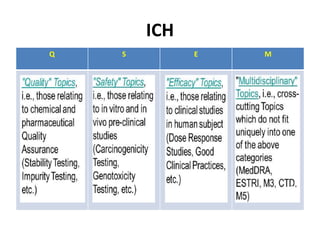
• Four Broad Categories - QSEM
• Quality (Q): Those relating to chemical and
pharmaceutical Quality Assurance (Stability Testing,
Impurity Testing, etc.)
• Safety (S): Those relating to In vitro and In vivo pre-
clinical studies (Carcinogenicity Testing, Genotoxicity
Testing, etc.)
• Efficacy (E): Those relating to clinical studies in human
subject (Dose Response Studies, Good Clinical Practices,
etc.)
• Multidisciplinary (M): Cross-cutting Topics which do
not fit uniquely into one of the above categories
(MedDRA- Medical Dictionary for Regulatory Activities,
ESTRI- Electronic Standards for the Transfer of
Regulatory Information, M3- Nonclinical Safety Studies,
CTD-Common Technical Document, M5- Data Elements
and Standards for Drug Dictionaries.
ICH
Q S E M
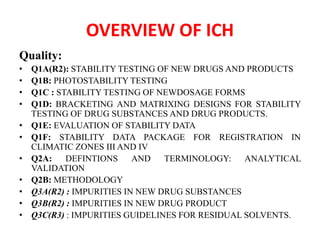
OVERVIEW OF ICH
Quality:
• Q1A(R2): STABILITY TESTING OF NEW DRUGS AND PRODUCTS
• Q1B: PHOTOSTABILITY TESTING
• Q1C : STABILITY TESTING OF NEWDOSAGE FORMS
• Q1D: BRACKETING AND MATRIXING DESIGNS FOR STABILITY
TESTING OF DRUG SUBSTANCES AND DRUG PRODUCTS.
• Q1E: EVALUATION OF STABILITY DATA
• Q1F: STABILITY DATA PACKAGE FOR REGISTRATION IN
CLIMATIC ZONES III AND IV
• Q2A: DEFINTIONS AND TERMINOLOGY: ANALYTICAL
VALIDATION
• Q2B: METHODOLOGY
• Q3A(R2) : IMPURITIES IN NEW DRUG SUBSTANCES
• Q3B(R2) : IMPURITIES IN NEW DRUG PRODUCT
• Q3C(R3) : IMPURITIES GUIDELINES FOR RESIDUAL SOLVENTS.
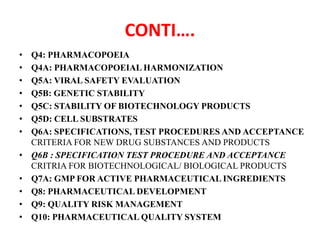
CONTI….
• Q4: PHARMACOPOEIA
• Q4A: PHARMACOPOEIAL HARMONIZATION
• Q5A: VIRAL SAFETY EVALUATION
• Q5B: GENETIC STABILITY
• Q5C: STABILITY OF BIOTECHNOLOGY PRODUCTS
• Q5D: CELL SUBSTRATES
• Q6A: SPECIFICATIONS, TEST PROCEDURES AND ACCEPTANCE
CRITERIA FOR NEW DRUG SUBSTANCES AND PRODUCTS
• Q6B : SPECIFICATION TEST PROCEDURE AND ACCEPTANCE
CRITRIA FOR BIOTECHNOLOGICAL/ BIOLOGICAL PRODUCTS
• Q7A: GMP FOR ACTIVE PHARMACEUTICAL INGREDIENTS
• Q8: PHARMACEUTICAL DEVELOPMENT
• Q9: QUALITY RISK MANAGEMENT
• Q10: PHARMACEUTICAL QUALITY SYSTEM
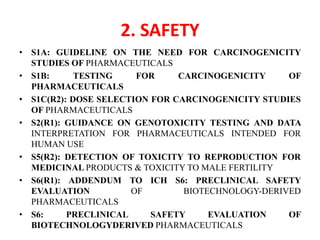
2. SAFETY
• S1A: GUIDELINE ON THE NEED FOR CARCINOGENICITY
STUDIES OF PHARMACEUTICALS
• S1B: TESTING FOR CARCINOGENICITY OF
PHARMACEUTICALS
• S1C(R2): DOSE SELECTION FOR CARCINOGENICITY STUDIES
OF PHARMACEUTICALS
• S2(R1): GUIDANCE ON GENOTOXICITY TESTING AND DATA
INTERPRETATION FOR PHARMACEUTICALS INTENDED FOR
HUMAN USE
• S5(R2): DETECTION OF TOXICITY TO REPRODUCTION FOR
MEDICINAL PRODUCTS & TOXICITY TO MALE FERTILITY
• S6(R1): ADDENDUM TO ICH S6: PRECLINICAL SAFETY
EVALUATION OF BIOTECHNOLOGY-DERIVED
PHARMACEUTICALS
• S6: PRECLINICAL SAFETY EVALUATION OF
BIOTECHNOLOGYDERIVED PHARMACEUTICALS
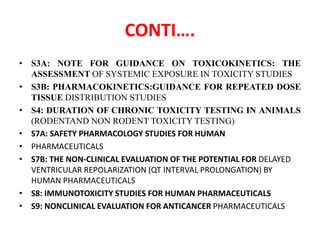
CONTI….
• S3A: NOTE FOR GUIDANCE ON TOXICOKINETICS: THE
ASSESSMENT OF SYSTEMIC EXPOSURE IN TOXICITY STUDIES
• S3B: PHARMACOKINETICS:GUIDANCE FOR REPEATED DOSE
TISSUE DISTRIBUTION STUDIES
• S4: DURATION OF CHRONIC TOXICITY TESTING IN ANIMALS
(RODENTAND NON RODENT TOXICITY TESTING)
• S7A: SAFETY PHARMACOLOGY STUDIES FOR HUMAN
• PHARMACEUTICALS
• S7B: THE NON-CLINICAL EVALUATION OF THE POTENTIAL FOR DELAYED
VENTRICULAR REPOLARIZATION (QT INTERVAL PROLONGATION) BY
HUMAN PHARMACEUTICALS
• S8: IMMUNOTOXICITY STUDIES FOR HUMAN PHARMACEUTICALS
• S9: NONCLINICAL EVALUATION FOR ANTICANCER PHARMACEUTICALS
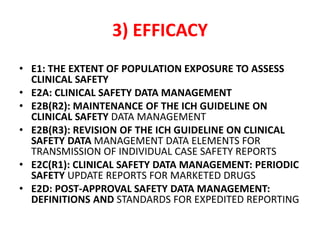
3) EFFICACY
• E1: THE EXTENT OF POPULATION EXPOSURE TO ASSESS
CLINICAL SAFETY
• E2A: CLINICAL SAFETY DATA MANAGEMENT
• E2B(R2): MAINTENANCE OF THE ICH GUIDELINE ON
CLINICAL SAFETY DATA MANAGEMENT
• E2B(R3): REVISION OF THE ICH GUIDELINE ON CLINICAL
SAFETY DATA MANAGEMENT DATA ELEMENTS FOR
TRANSMISSION OF INDIVIDUAL CASE SAFETY REPORTS
• E2C(R1): CLINICAL SAFETY DATA MANAGEMENT: PERIODIC
SAFETY UPDATE REPORTS FOR MARKETED DRUGS
• E2D: POST-APPROVAL SAFETY DATA MANAGEMENT:
DEFINITIONS AND STANDARDS FOR EXPEDITED REPORTING
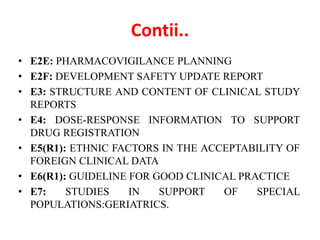
Contii..
• E2E: PHARMACOVIGILANCE PLANNING
• E2F: DEVELOPMENT SAFETY UPDATE REPORT
• E3: STRUCTURE AND CONTENT OF CLINICAL STUDY
REPORTS
• E4: DOSE-RESPONSE INFORMATION TO SUPPORT
DRUG REGISTRATION
• E5(R1): ETHNIC FACTORS IN THE ACCEPTABILITY OF
FOREIGN CLINICAL DATA
• E6(R1): GUIDELINE FOR GOOD CLINICAL PRACTICE
• E7: STUDIES IN SUPPORT OF SPECIAL
POPULATIONS:GERIATRICS.
Contii..
• E8: GENERAL CONSIDERATIONS FOR CLINICAL TRIALS
• E9: STATISTICAL PRINCIPLES FOR CLINICAL TRIALS
• E10: CHOICE OF CONTROL GROUP AND RELATED ISSUES
IN CLINICAL TRIALS
• E11: CLINICAL INVESTIGATION OF MEDICINAL PRODUCTS
IN THE PEDIATRIC POPULATION
• E12: PRINCIPLES FOR CLINICAL EVALUATION OF NEW
ANTIHYPERTENSIVE DRUGS
• E14: THE CLINICAL EVALUATION OF QT/QTC INTERVAL
PROLONGATION AND PROARRHYTHMIC POTENTIAL FOR
NON-ANTIARRHYTHMIC DRUGS
• E15: DEFINITIONS FOR GENOMIC BIOMARKERS,
PHARMACOGENOMICS, PHARMACOGENETICS, GENOMIC
DATAAND SAMPLE CODING CATEGORIES
• E16: GENOMIC BIOMARKERS RELATED TO DRUG
RESPONSE
Multidisciplinary guidelines
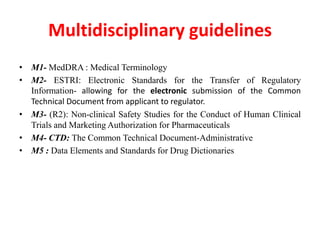
• M1- MedDRA : Medical Terminology
• M2- ESTRI: Electronic Standards for the Transfer of Regulatory
Information- allowing for the electronic submission of the Common
Technical Document from applicant to regulator.
• M3- (R2): Non-clinical Safety Studies for the Conduct of Human Clinical
Trials and Marketing Authorization for Pharmaceuticals
• M4- CTD: The Common Technical Document-Administrative
• M5 : Data Elements and Standards for Drug Dictionaries
Stability Testing of herbal products
Stability Studies
• Stability testing is an obligatory requirement in
the registration process for all medicinal
products, including Herbal Medicinal
Products (HMPs).
• The tests are performed to define storage
conditions and the product’s shelf-life.
The need for Stability Studies
1. Well-being of the patient and manufacturer
by ensuring product quality.
2. For selection of adequate formulation,
determination of shelf-life and storage
conditions.
3. Preparation and substantiation of the claimed
shelf-life for the registration dossier.
4. To provide evidence on how quality of
drug/product varies with time under influence
of environment.
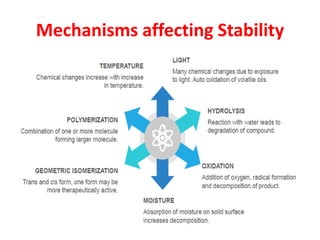
Mechanisms affecting Stability
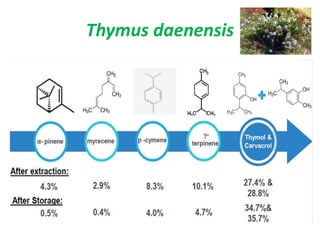
Thymus daenensis
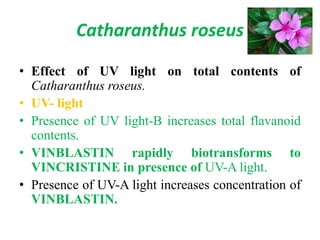
Catharanthus roseus
• Effect of UV light on total contents of
Catharanthus roseus.
• UV- light
• Presence of UV light-B increases total flavanoid
contents.
• VINBLASTIN rapidly biotransforms to
VINCRISTINE in presence of UV-A light.
• Presence of UV-A light increases concentration of
VINBLASTIN.
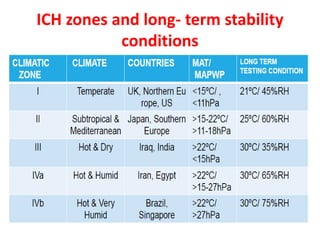
ICH zones and long- term stability
conditions
Types of Stability testing methods
• Accelerated Testing: Product subjected to high temperature,
humidity, light, etc. 40ºC/ 75% RH. At 3rd and 6th month.
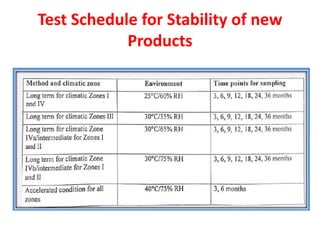
• Real Time (long-term) Testing: Longer duration. 25-30ºC &
35- 75% RH (depending on climatic zone), for 3rd, 6th, 9th,
12th, 18th, 24th, and 36th month.
• Intermediate Testing: Conducted when accelerated studies
fail. At 25ºC for longer duration of time.
• Stress Testing: Includes effects of temperature, i.e., above
40ºC and ≥75% RH.
• Forced Degradation Testing: Performed to provide intrinsic
stability –HIGH assessment of drug. is a stronger form of the
standard notion of global stability
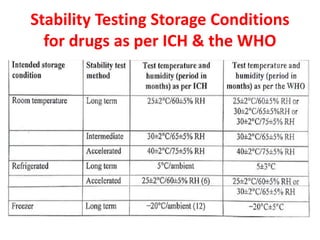
Stability Testing Storage Conditions
for drugs as per ICH & the WHO
Test Schedule for Stability of new
Products
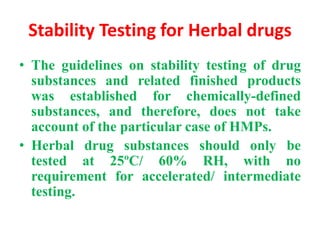
Stability Testing for Herbal drugs
• The guidelines on stability testing of drug
substances and related finished products
was established for chemically-defined
substances, and therefore, does not take
account of the particular case of HMPs.
• Herbal drug substances should only be
tested at 25ºC/ 60% RH, with no
requirement for accelerated/ intermediate
testing.
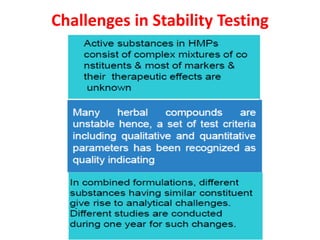
Challenges in Stability Testing
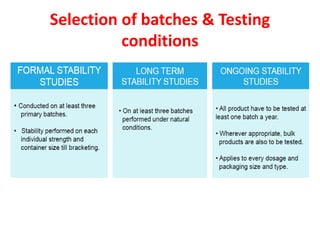
Selection of batches & Testing
conditions
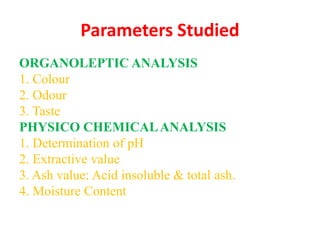
Parameters Studied
ORGANOLEPTIC ANALYSIS
1. Colour
2. Odour
3. Taste
PHYSICO CHEMICALANALYSIS
1. Determination of pH
2. Extractive value
3. Ash value: Acid insoluble & total ash.
4. Moisture Content
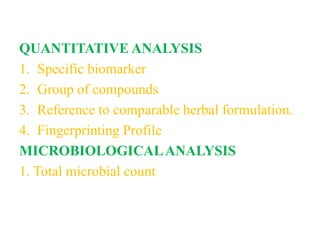
QUANTITATIVE ANALYSIS
1. Specific biomarker
2. Group of compounds
3. Reference to comparable herbal formulation.
4. Fingerprinting Profile
MICROBIOLOGICALANALYSIS
1. Total microbial count
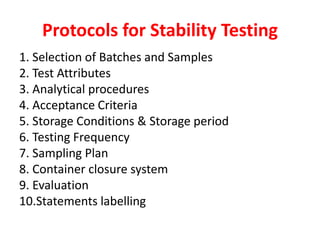
Protocols for Stability Testing
1. Selection of Batches and Samples
2. Test Attributes
3. Analytical procedures
4. Acceptance Criteria
5. Storage Conditions & Storage period
6. Testing Frequency
7. Sampling Plan
8. Container closure system
9. Evaluation
10.Statements labelling
References
• Pharmacognosy & Phytochemistry: A
Comprehensive Approach, by S.L. Deore, S.S.
Khadabadi, B. A. Baviskar.
• A review article on Stability testing of herbal
products by Anupam Kumar Sachan and
Ashutosh Kumar.
Evaluation of drugs