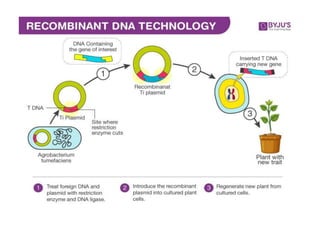
Recombinant DNA (rDNA)Technology
• A technique mainly used to change the phenotype of an organism (host)
when a genetically altered vector is introduced and integrated into the
genome of the organism. So, basically, this process involves the
introduction of a foreign piece of DNA structure into the genome which
contains our gene of interest. This gene which is introduced is the
recombinant gene and the technique is called the recombinant DNA
technology (rDNA).
• There are multiple steps, tools and other specific procedures followed in the
recombinant DNA technology, which is used for producing artificial
DNA to generate the desired product.
4.
• The technologyused for producing artificial DNA through the combination of
different genetic materials (DNA) from different sources is referred to
as Recombinant DNA Technology. Recombinant DNA technology is popularly
known as genetic engineering.
• The recombinant DNA technology emerged with the discovery of restriction
enzymes in the year 1968 by Swiss microbiologist Werner Arber,
• Inserting the desired gene into the genome of the host is not as easy as it
sounds. It involves the selection of the desired gene for administration into the
host followed by a selection of the perfect vector with which the gene has to be
integrated and recombinant DNA formed.
• Thus the recombinant DNA has to be introduced into the host. And at last, it
has to be maintained in the host and carried forward to the offspring.
6.
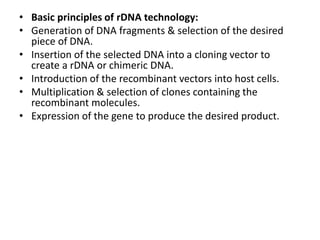
• Basic principlesof rDNA technology:
• Generation of DNA fragments & selection of the desired
piece of DNA.
• Insertion of the selected DNA into a cloning vector to
create a rDNA or chimeric DNA.
• Introduction of the recombinant vectors into host cells.
• Multiplication & selection of clones containing the
recombinant molecules.
• Expression of the gene to produce the desired product.
8.
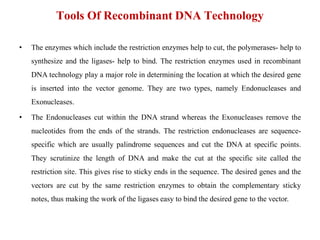
Tools Of RecombinantDNA Technology
• The enzymes which include the restriction enzymes help to cut, the polymerases- help to
synthesize and the ligases- help to bind. The restriction enzymes used in recombinant
DNA technology play a major role in determining the location at which the desired gene
is inserted into the vector genome. They are two types, namely Endonucleases and
Exonucleases.
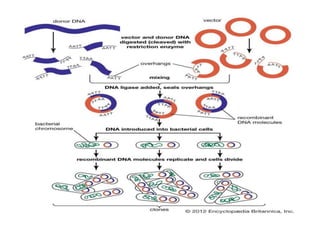
• The Endonucleases cut within the DNA strand whereas the Exonucleases remove the
nucleotides from the ends of the strands. The restriction endonucleases are sequence-
specific which are usually palindrome sequences and cut the DNA at specific points.
They scrutinize the length of DNA and make the cut at the specific site called the
restriction site. This gives rise to sticky ends in the sequence. The desired genes and the
vectors are cut by the same restriction enzymes to obtain the complementary sticky
notes, thus making the work of the ligases easy to bind the desired gene to the vector.
9.
The vectors –help in carrying and integrating the desired gene. These form a very important
part of the tools of recombinant DNA technology as they are the ultimate vehicles that carry
forward the desired gene into the host organism. Plasmids and bacteriophages are the most
common vectors in recombinant DNA technology that are used as they have a very high
copy number. The vectors are made up of an origin of replication- This is a sequence of
nucleotides from where the replication starts, a selectable marker – constitute genes which
show resistance to certain antibiotics like ampicillin; and cloning sites – the sites recognized
by the restriction enzymes where desired DNAs are inserted.
Host organism – into which the recombinant DNA is introduced. The host is the ultimate
tool of recombinant DNA technology which takes in the vector engineered with the desired
DNA with the help of the enzymes.
There are a number of ways in which these recombinant DNAs are inserted into the host,
namely – microinjection, biolistics or gene gun, alternate cooling and heating, use of calcium
ions, etc.
10.
Process of RecombinantDNA Technology
• The complete process of recombinant DNA technology includes multiple steps, maintained in
a specific sequence to generate the desired product.
• Step-1. Isolation of Genetic Material.
• The first and the initial step in Recombinant DNA technology is to isolate the desired DNA in
its pure form i.e. free from other macromolecules.
• Step-2.Cutting the gene at the recognition sites.
• The restriction enzymes play a major role in determining the location at which the desired
gene is inserted into the vector genome. These reactions are called ‘restriction enzyme
digestions’.
• Step-3. Amplifying the gene copies through Polymerase chain reaction (PCR).
• It is a process to amplify a single copy of DNA into thousands to millions of copies once the
proper gene of interest has been cut using restriction enzymes.
• Step-4. Ligation of DNA Molecules.
• In this step of Ligation, the joining of the two pieces – a cut fragment of DNA and the vector
together with the help of the enzyme DNA ligase.
• Step-5. Insertion of Recombinant DNA Into Host.
• In this step, the recombinant DNA is introduced into a recipient host cell. This process is
termed as Transformation. Once the recombinant DNA is inserted into the host cell, it
gets multiplied and is expressed in the form of the manufactured protein under optimal
conditions.
• As mentioned in Tools of recombinant DNA technology, there are various ways in which this
can be achieved.
11.
Application of RecombinantDNA Technology
1. DNA technology is also used to detect the presence of HIV in a person.
2. Gene Therapy – It is used as an attempt to correct the gene defects which give rise
to heredity diseases.
3. Clinical diagnosis – ELISA is an example where the application of recombinant
DNA technology is used.
4. Recombinant DNA technology is widely used in Agriculture to produce genetically-
modified organisms such as Flavr Savr tomatoes, golden rice rich in proteins, and
Bt-cotton to protect the plant against ball worms and a lot more.
5. In the field of medicines, Recombinant DNA technology is used for the production
of Insulin.
Applications of recombinant DNA in genetic engineering are:
• For the production of vaccines like the hepatitis B vaccine.
• Production of transgenic plants with improved qualities like insect and drought
resistance and nutritional enrichment.
• Therapeutic protein production like insulin.
• Gene therapy in diseases like cancer, SCID etc.
• Production of transgenic animals with improved quality of milk and egg.
12.
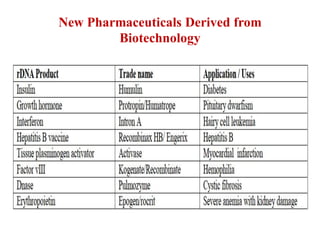
New Pharmaceuticals Derivedfrom Biotechnology
Based on biotechnological processes, new substances with different therapeutic applications,
with a central focus on quality of life and public health, have been developed and
produced on a large scale. The application of these techniques covers a wide range of
drug classes such as antibiotics, blood factors, hormones, hematopoietic growth factors
cytokines, enzymes, vaccines and monoclonal antibodies.
Drugs produced by recombinant DNA technology:
Recombinant DNA technology involves using microorganisms, macroscopic organisms, or
hybrids of tumor cells and leukocytes:
1. To create new pharmaceuticals;
2. To create safer and/or more effective versions of conventionally produced
pharmaceuticals;
3. To produce substances identical to conventionally made pharmaceuticals more cost-
effectively than the latter pharmaceuticals are produced.
13.
Types of PharmaceuticalsProduced
The pharmaceutical products of rDNA
technology are broadly divided into following
four types
1. Human protein replacements (Hormones,
clotting factors, tPA, enzymes)
2. Antibiotics/Anticancer (MAb, IFN)/
Autoimmune diseases (MAb)
3. Vaccines
4. Diagnostic kits for infectious diseases
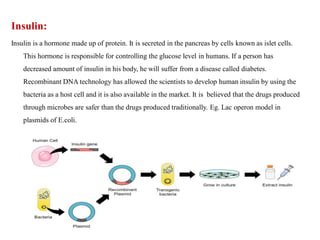
Insulin:
Insulin is ahormone made up of protein. It is secreted in the pancreas by cells known as islet cells.
This hormone is responsible for controlling the glucose level in humans. If a person has
decreased amount of insulin in his body, he will suffer from a disease called diabetes.
Recombinant DNA technology has allowed the scientists to develop human insulin by using the
bacteria as a host cell and it is also available in the market. It is believed that the drugs produced
through microbes are safer than the drugs produced traditionally. Eg. Lac operon model in
plasmids of E.coli.
16.
Human Growth Hormones:
Humangrowth hormone is a polypeptide hormone. It is responsible for growth, reproduction of the cells
and regeneration in humans as well as animals. It is secreted by somatotrophin cells present in the pituitary
glands. In recent years, scientists have developed many growth hormones using recombinant DNA
technology. The disease of dwarfism is treated with this hormone.
Erythropoietin:
It is produced by interstitial fibroblasts in the kidney in close association with peritubular capillary and
tubular epithelial cells. It is also produced in perisinusoidal cells in the liver. While liver production
predominates in the fetal and perinatal period, renal production is predominant during adulthood.
EPO binds to the erythropoietin receptor on the red cell progenitor surface and activates a JAK2
signaling cascade. Erythropoietin receptor expression is found in a number of tissues, such as bone
marrow and peripheral/central nervous tissue. In the bloodstream, red cells themselves do not
express erythropoietin receptor, so cannot respond to EPO.
17.
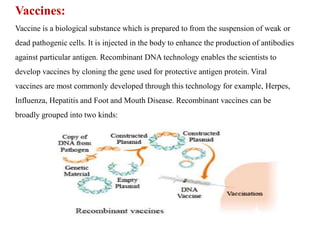
Vaccines:
Vaccine is abiological substance which is prepared to from the suspension of weak or
dead pathogenic cells. It is injected in the body to enhance the production of antibodies
against particular antigen. Recombinant DNA technology enables the scientists to
develop vaccines by cloning the gene used for protective antigen protein. Viral
vaccines are most commonly developed through this technology for example, Herpes,
Influenza, Hepatitis and Foot and Mouth Disease. Recombinant vaccines can be
broadly grouped into two kinds:
18.
(i) Recombinant proteinvaccines: This is based on production of recombinant DNA which
is expressed to release the specific protein used in vaccine preparation. Eg – cholera
vaccine
(ii) DNA vaccines: Here the gene encoding for immunogenic protein is isolated and used
to produce recombinant DNA which acts as vaccine to be injected into the individual.
The mode of delivery of DNA vaccines include: direct injection into muscle; use of
vectors like adenovirus, retrovirus etc; invitro transfer of the gene into autologous cells
and reimplantation of the same and particle gun delivery of the DNA. Eg: vaccinia
virus.
Advantages:
(i) Since it does not involve actual pathogen, recombinant vaccines is considered to be safe
than the conventional vaccines.
(ii) It induces both humoral and cellular immune response resulting in effective
vaccination.
19.
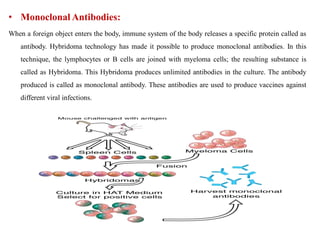
• Monoclonal Antibodies:
Whena foreign object enters the body, immune system of the body releases a specific protein called as
antibody. Hybridoma technology has made it possible to produce monoclonal antibodies. In this
technique, the lymphocytes or B cells are joined with myeloma cells; the resulting substance is
called as Hybridoma. This Hybridoma produces unlimited antibodies in the culture. The antibody
produced is called as monoclonal antibody. These antibodies are used to produce vaccines against
different viral infections.
20.
Antibiotics:
Antibiotics are thechemical substances which are used against bacterial infections. They can be
produced by microorganisms as well as in the laboratory. They have the ability to destroy bacteria
or other harmful microbes which cause infections in the body. Alexander Fleming discovered
penicillin for the first time in 1928 using recombinant DNA technology. Other biotechnological
techniques are also being used to produce antibiotics. Penicillin (P. chrysogenum) and
cephalosporins.
Infectious Diseases:
Many diseases are diagnosed by conducting certain tests. Recombinant DNA technology has allowed
the development of many tests which are being used to diagnose diseases like TB and cancer.
Other diseases like measles, small pox and hepatitis are also diagnosed through tests and if they
are not diagnosed properly, they can be a threat to human health. In the diagnosis process, certain
pathogens are isolated and identified, and then diagnostic kits are produced when the genome of
the specific pathogen is known to kill it or block its pathogenic activity.






![Polymer [ बहुलक ] Chemistry Notes PDF - Irfanullah Mehar - JJ Sir Chemistry.pdf](https://cdn.slidesharecdn.com/ss_thumbnails/polymerchemistrynotespdf-irfanullahmehar-jjsirchemistry-260210172118-3f9b37f7-thumbnail.jpg?width=640&height=640&fit=bounds)


