PHARMACEUTICAL
BIOTECHNOLOGY
TOPIC : Introduction to Biotechnology with reference to
Pharmaceutical Sciences.
Presented By
Mr.K.Jebastin Annapushpam,B.Sc.,M.Pharm.,
Assistant Professor
Department of Pharmaceutics
Dhanalakshmi Srinivasan College of Pharmacy
Perambalur - 621 212
INTRODUCTION
INTRODUCTION
 Biotechnology is the broad area of biology, involving living systems
and organisms to develop or make products, or "any technological
application that uses biological systems, living organisms, or
derivatives thereof, to make or modify products or processes for
specific use"
 Depending on the tools and applications, it often overlaps with the
(related) fields of molecular biology, bio-engineering, biomedical
engineering, biomanufacturing, molecular engineering, etc.
 The wide concept of "Biotech" or "biotechnology" encompasses a
wide range of procedures for modifying living organisms according
to human purposes, Modern usage also includes genetic
engineering as well as cell and tissue culture technologies.
INTRODUCTION
Historical Background
 BC 2,000 - Egyptians and Sumerians specialize in butter making and
brewing.
 BC 300 - Greeks learn the method of grafting techniques for plant
breeding.
 AD 100 - Chinese find the first pesticide from powdered
chrysanthemum.
 1663 - Robert Hooke's discovery of the cell.
 1675 - Bacterial discovery of Anton van Leuwenhook.
 1830 - Discovery of proteins.
 1835 - Matthias Scheiden and Theodor Schwann publish the theory
that all living things are made of tissue; Viichow declares that only
one tissue can be made from one tissue.
 1865 - John Gregor Mendel invents the Law of Heridity.
INTRODUCTION
Historical Background
 1870-1890 - Creation of several varieties of hybrid plants. Farmers
start using nitrogenous bacteria.
 1928 - Sir Alexander Fleming's discovery of penicillin antibiotic.
 1953 - James Watson and Francis Crick first describe the double helix
structure of DNA.
 1968 - Marshall W. Nirenberg and Har Gobind Khurana receive the
Nobel Prize for discovering genetic codes for generating 20 amino
acids.
 1970 - American microbiologist Daniel Nathans invents the first
restriction enzyme. Restriction enzyme's are useful for research
purposes by helping to cut the genetic material that gives the genetic
material.
 1972 - DNA ligase first used to bind DNA fragments.
INTRODUCTION
Historical Background
 1973 - Stanley Cohen and Herbert Boyer invent the recombinant DNA
technology. The event is considered to be a breakthrough for
modern biotechnology.
 1978 - Recombinant human insulin is first developed.
 1980 - Paul Berg, Walter Gilbert and Fredrick Sanger were awarded
the Nobel Prize in Chemistry for creating the first synthetic
recombinant DNA molecule.
 1981 - The first transgenic animal, the golden carp, is cloned by
Chinese scientists.
 1982 - Development of the first recombinant DNA vaccine for
livestock. Kary Mullis invents the polymerase chain reaction (PCR),
which enables the rapid amplification of small DNA fragments.
INTRODUCTION
Historical Background
 1998 - First 'model human genome' announcement defining the
location of nearly 30,000 genes. (First Draft of Human Genome)
 2000 - American scientists Craig Venter and Francis Collins
announce to the world the first complete human genome.
Branches of Biotehnology
2.Gold biotechnology(Bioinformatics)
 Bioinformatics is a combination of computers and
biotechnology. It helps in finding the analysis of data related to
Biotechnology.
 It is used for various purposes like drugs, for the development of
medicines.
 Bioinformatics is known and referred by the term computational
biology.
 It plays an important and vital role in areas like Functional
genomics, structural genomics, and proteomics. These areas
contribute a lot and become a key contributor to the
Biotechnology and pharma sector.
Branches of Biotehnology
3.Green Biotechnology
 Green Biotechnology is the term used for the agricultural
sector.
 Also, with the help of Transgenic plants (plants whose DNA is
modified), this design of transgenic plants helps to grow in a
specified environment with the help of certain chemicals.
4.Red biotechnology
 Red biotechnology is referred to as Medical Biotechnology. It
is used for the production of drugs and antibiotic medicines.
Inter-discipline of Red biotechnology
 Pharmaceutical biotechnology- principles of biotechnology,
applied for the development of drugs.
Branches of Biotehnology
5. White Biotechnology
 White Biotechnology is also called and known by the name
Industry Biotechnology.
 This kind of biotechnology is used and applied in industries
6.Yellow biotechnology
 It refers to the use of biotechnology in food production, for
example in making wine, cheese, and beer by fermentation.
 It has also been used to refer to biotechnology applied to
insects.
7.Gray biotechnology
 Deals with environmental applications, and focused on the
maintenance of biodiversity and the remotion of pollutants.
Branches of Biotehnology
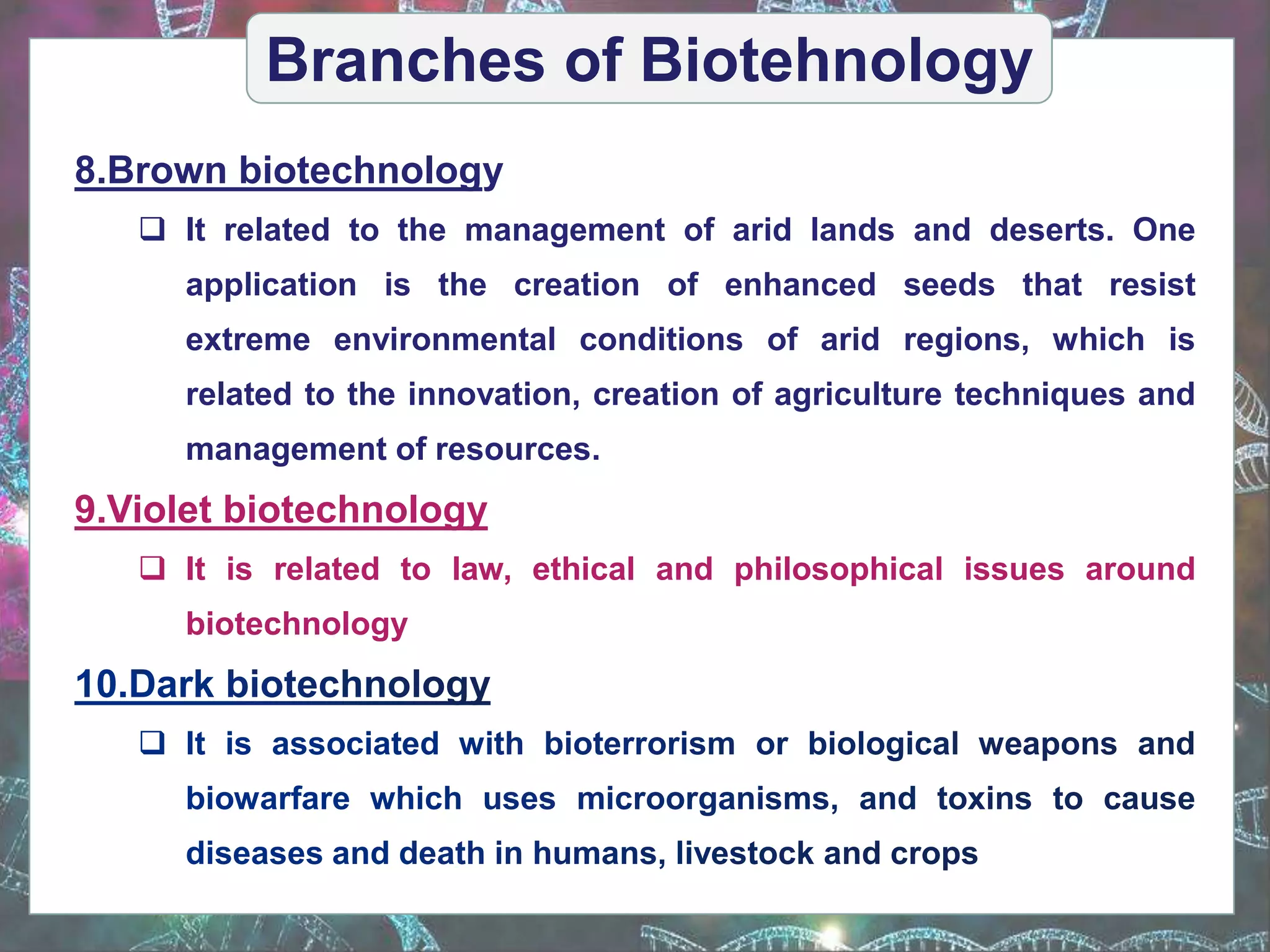
8.Brown biotechnology
 It related to the management of arid lands and deserts. One
application is the creation of enhanced seeds that resist
extreme environmental conditions of arid regions, which is
related to the innovation, creation of agriculture techniques and
management of resources.
9.Violet biotechnology
 It is related to law, ethical and philosophical issues around
biotechnology
INTRODUCTION
Pharmaceutical Biotechnology
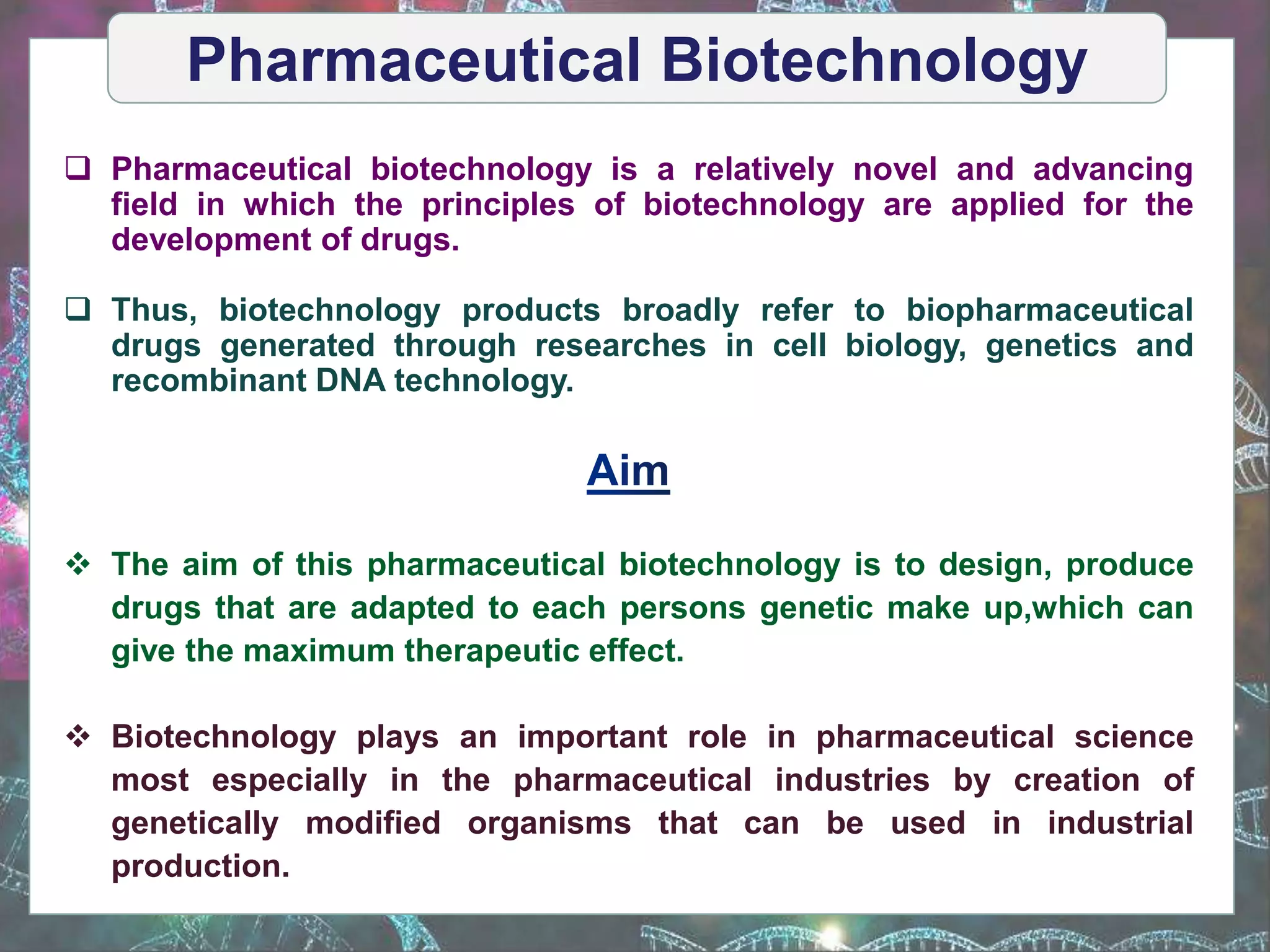
 Pharmaceutical biotechnology is a relatively novel and advancing
field in which the principles of biotechnology are applied for the
development of drugs.
 Thus, biotechnology products broadly refer to biopharmaceutical
drugs generated through researches in cell biology, genetics and
recombinant DNA technology.
 The aim of this pharmaceutical biotechnology is to design, produce
drugs that are adapted to each persons genetic make up,which can
give the maximum therapeutic effect.
 Biotechnology plays an important role in pharmaceutical science
most especially in the pharmaceutical industries by creation of
genetically modified organisms that can be used in industrial
production.
INTRODUCTION
ADVANTAGES
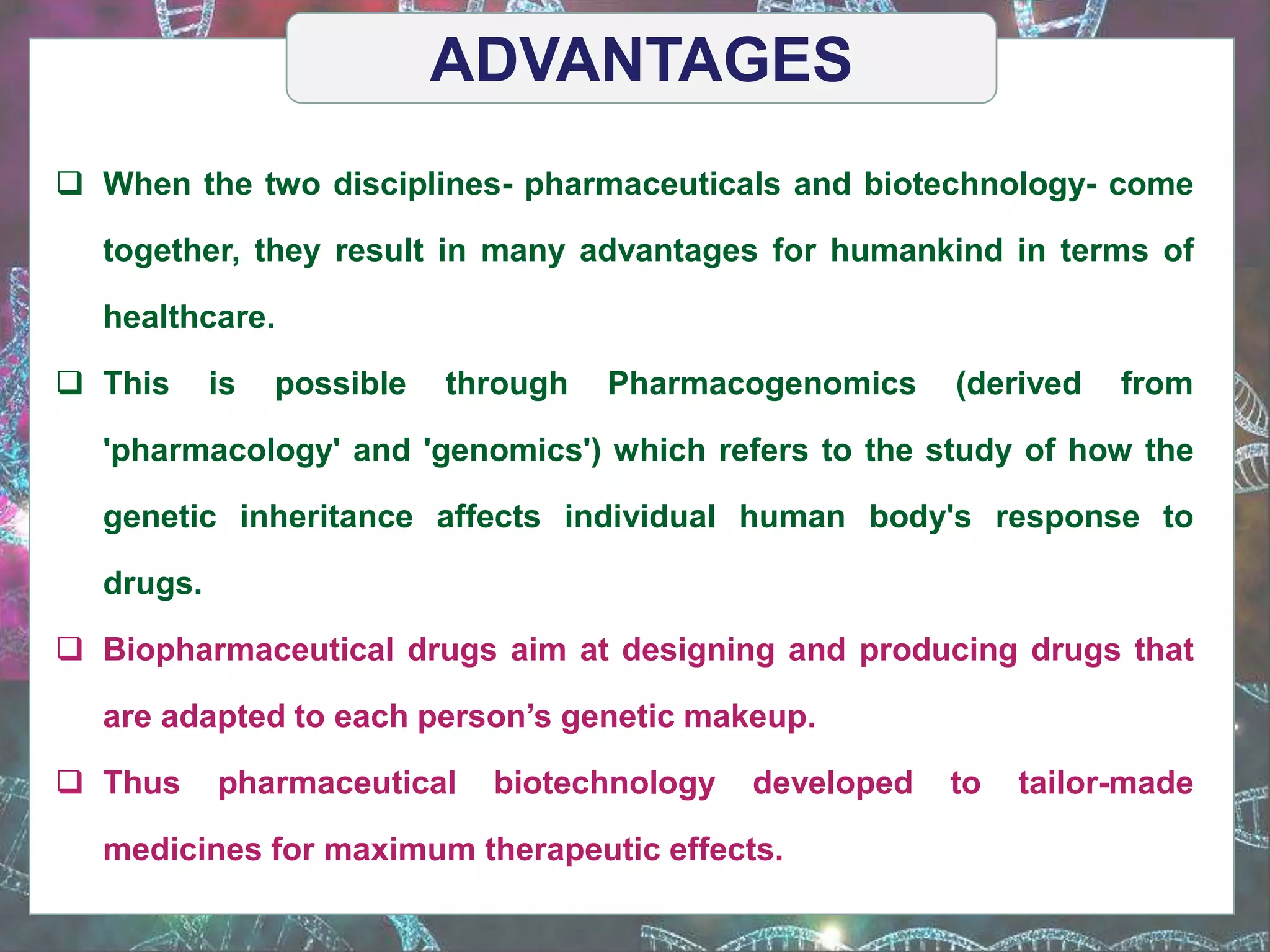
 When the two disciplines- pharmaceuticals and biotechnology- come
together, they result in many advantages for humankind in terms of
healthcare.
 This is possible through Pharmacogenomics (derived from
'pharmacology' and 'genomics') which refers to the study of how the
genetic inheritance affects individual human body's response to
drugs.
 Biopharmaceutical drugs aim at designing and producing drugs that
are adapted to each person’s genetic makeup.
 Thus pharmaceutical biotechnology developed to tailor-made
medicines for maximum therapeutic effects.
INTRODUCTION
 Recombinant DNA (rDNA) and monoclonal antibody (MAb) are
providing exciting opportunities for new pharmaceuticals
development as well as new approaches to drug delivery.
 Recombinant DNA technology, which entails genetic manipulation of
cells, or a monoclonal antibody for making biotechnological products.
ADVANTAGES
INTRODUCTION
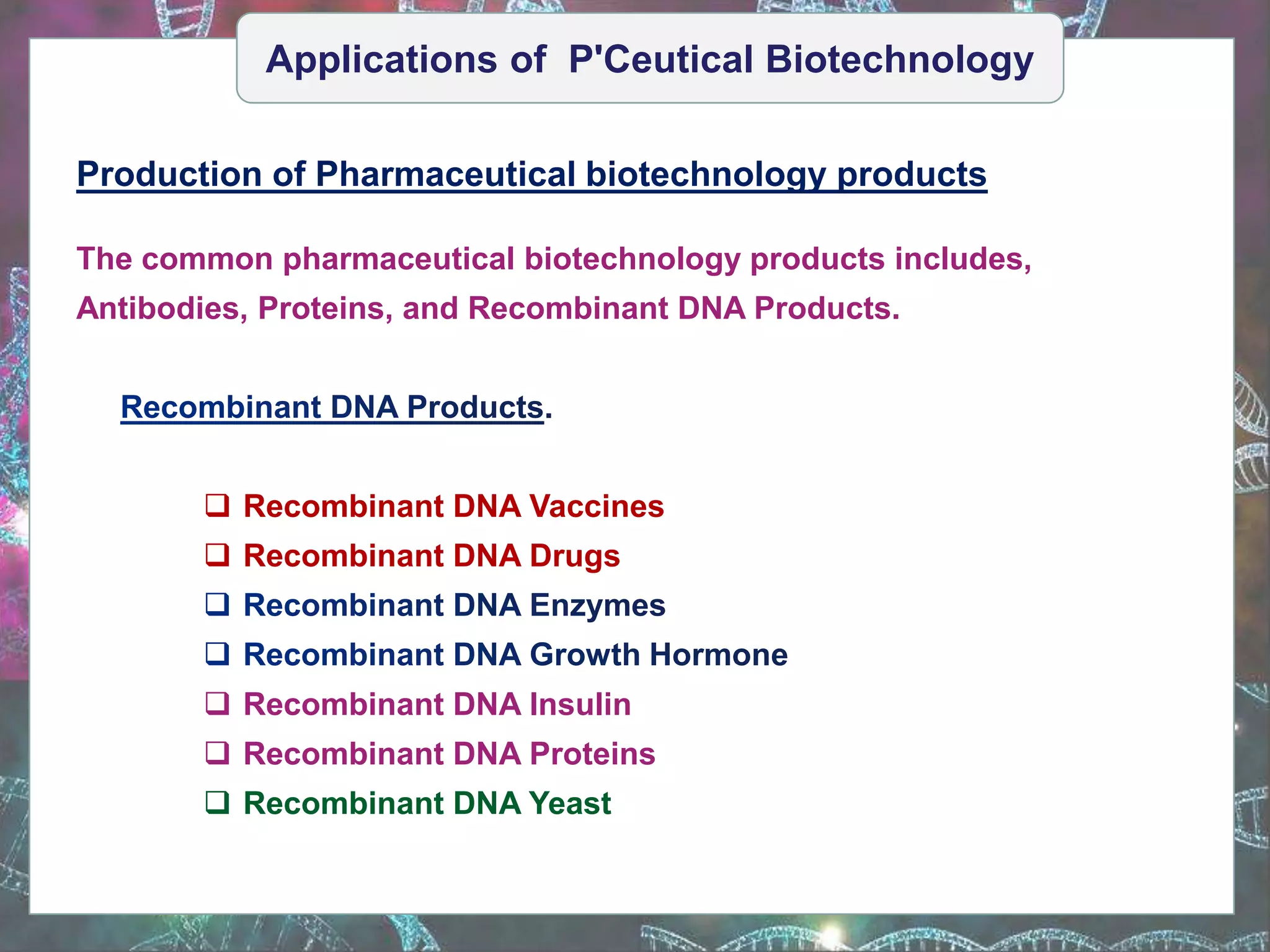
Applications of P'Ceutical Biotechnology
Production of Pharmaceutical biotechnology products
The common pharmaceutical biotechnology products includes,
Antibodies, Proteins, and Recombinant DNA Products.
 Recombinant DNA Vaccines
 Recombinant DNA Drugs
 Recombinant DNA Insulin
 Recombinant DNA Proteins
 Recombinant DNA Yeast
INTRODUCTION
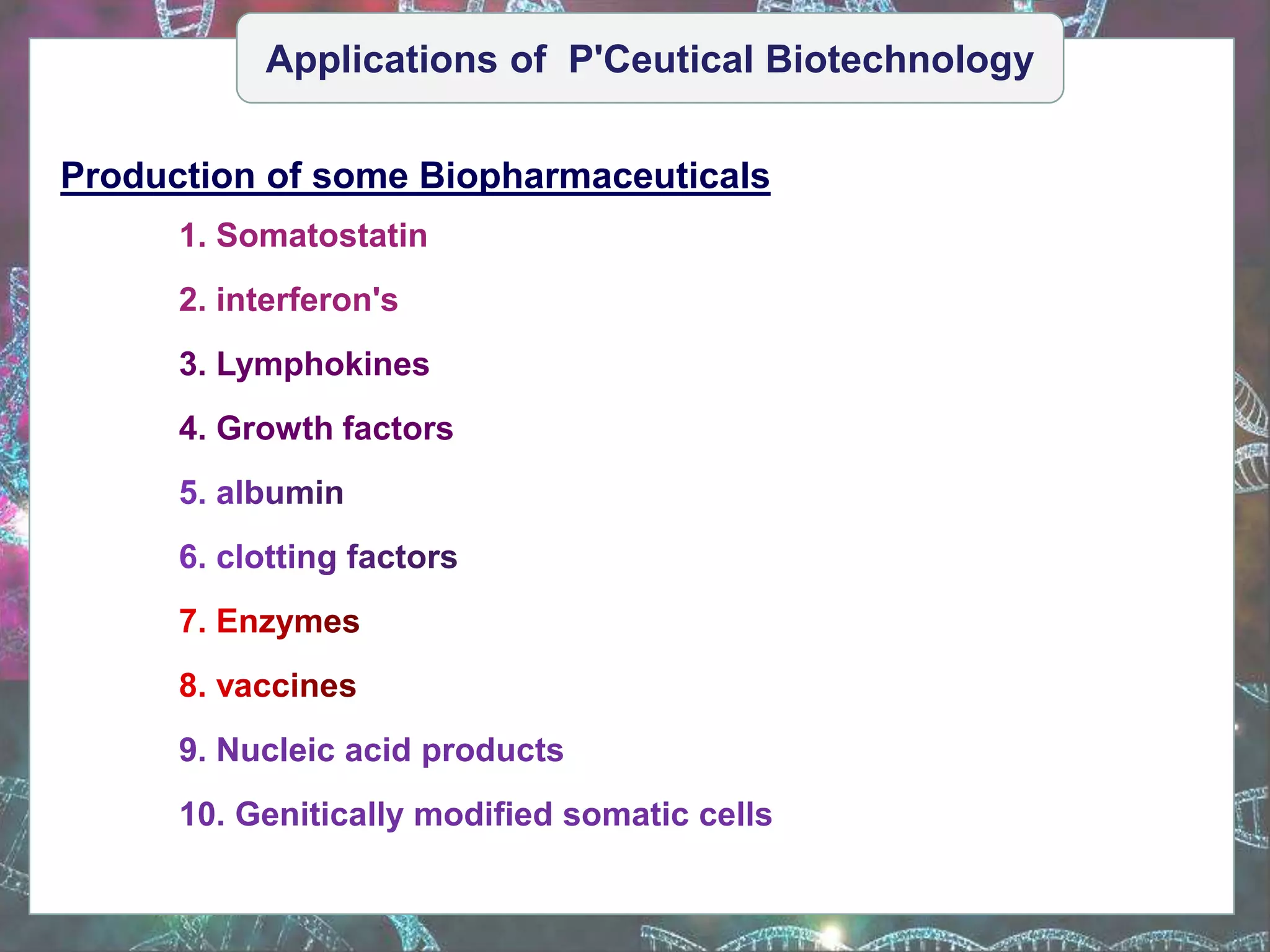
Applications of P'Ceutical Biotechnology
1. Somatostatin
2. interferon's
3. Lymphokines
4. Growth factors
9. Nucleic acid products
10. Genitically modified somatic cells
Production of some Biopharmaceuticals
INTRODUCTION
Therapeutic uses of P'Ceutical
Biotechnological products
Detection of Genetic Diseases
Gene Therapy
Genetic Counseling
Pre-implantation Genetic Diagnosis
Cancer therapy
AIDS and AIDS-related and autoimmune diseases
In diagnostic investigations
INTRODUCTION
REFERENCES
1. Pharmaceutical-biotechnology-journals-articles-
IMED publication
2. Pharmaceutical manufacturers/pharmaceutical-
biotechnology
3. http://www.yourarticlelibrary.com/biotechnology/
contribution-of-biotechnology-to-medical-
science/29361
4. Assessment of biotechnology products for
therapeutic use. by Jennifer Sims
5. Wikipedia
THANK
YOU !
THANK YOU !

Pharmaceutical Biotechnology

  • 1.
    PHARMACEUTICAL BIOTECHNOLOGY TOPIC : Introductionto Biotechnology with reference to Pharmaceutical Sciences. Presented By Mr.K.Jebastin Annapushpam,B.Sc.,M.Pharm., Assistant Professor Department of Pharmaceutics Dhanalakshmi Srinivasan College of Pharmacy Perambalur - 621 212
  • 2.
    INTRODUCTION INTRODUCTION  Biotechnology isthe broad area of biology, involving living systems and organisms to develop or make products, or "any technological application that uses biological systems, living organisms, or derivatives thereof, to make or modify products or processes for specific use"  Depending on the tools and applications, it often overlaps with the (related) fields of molecular biology, bio-engineering, biomedical engineering, biomanufacturing, molecular engineering, etc.  The wide concept of "Biotech" or "biotechnology" encompasses a wide range of procedures for modifying living organisms according to human purposes, Modern usage also includes genetic engineering as well as cell and tissue culture technologies.
  • 3.
    INTRODUCTION Historical Background  BC2,000 - Egyptians and Sumerians specialize in butter making and brewing.  BC 300 - Greeks learn the method of grafting techniques for plant breeding.  AD 100 - Chinese find the first pesticide from powdered chrysanthemum.  1663 - Robert Hooke's discovery of the cell.  1675 - Bacterial discovery of Anton van Leuwenhook.  1830 - Discovery of proteins.  1835 - Matthias Scheiden and Theodor Schwann publish the theory that all living things are made of tissue; Viichow declares that only one tissue can be made from one tissue.  1865 - John Gregor Mendel invents the Law of Heridity.
  • 4.
    INTRODUCTION Historical Background  1870-1890- Creation of several varieties of hybrid plants. Farmers start using nitrogenous bacteria.  1928 - Sir Alexander Fleming's discovery of penicillin antibiotic.  1953 - James Watson and Francis Crick first describe the double helix structure of DNA.  1968 - Marshall W. Nirenberg and Har Gobind Khurana receive the Nobel Prize for discovering genetic codes for generating 20 amino acids.  1970 - American microbiologist Daniel Nathans invents the first restriction enzyme. Restriction enzyme's are useful for research purposes by helping to cut the genetic material that gives the genetic material.  1972 - DNA ligase first used to bind DNA fragments.
  • 5.
    INTRODUCTION Historical Background  1973- Stanley Cohen and Herbert Boyer invent the recombinant DNA technology. The event is considered to be a breakthrough for modern biotechnology.  1978 - Recombinant human insulin is first developed.  1980 - Paul Berg, Walter Gilbert and Fredrick Sanger were awarded the Nobel Prize in Chemistry for creating the first synthetic recombinant DNA molecule.  1981 - The first transgenic animal, the golden carp, is cloned by Chinese scientists.  1982 - Development of the first recombinant DNA vaccine for livestock. Kary Mullis invents the polymerase chain reaction (PCR), which enables the rapid amplification of small DNA fragments.
  • 6.
    INTRODUCTION Historical Background  1998- First 'model human genome' announcement defining the location of nearly 30,000 genes. (First Draft of Human Genome)  2000 - American scientists Craig Venter and Francis Collins announce to the world the first complete human genome.
  • 7.
    Branches of Biotehnology 2.Goldbiotechnology(Bioinformatics)  Bioinformatics is a combination of computers and biotechnology. It helps in finding the analysis of data related to Biotechnology.  It is used for various purposes like drugs, for the development of medicines.  Bioinformatics is known and referred by the term computational biology.  It plays an important and vital role in areas like Functional genomics, structural genomics, and proteomics. These areas contribute a lot and become a key contributor to the Biotechnology and pharma sector.
  • 8.
    Branches of Biotehnology 3.GreenBiotechnology  Green Biotechnology is the term used for the agricultural sector.  Also, with the help of Transgenic plants (plants whose DNA is modified), this design of transgenic plants helps to grow in a specified environment with the help of certain chemicals. 4.Red biotechnology  Red biotechnology is referred to as Medical Biotechnology. It is used for the production of drugs and antibiotic medicines. Inter-discipline of Red biotechnology  Pharmaceutical biotechnology- principles of biotechnology, applied for the development of drugs.
  • 9.
    Branches of Biotehnology 5.White Biotechnology  White Biotechnology is also called and known by the name Industry Biotechnology.  This kind of biotechnology is used and applied in industries 6.Yellow biotechnology  It refers to the use of biotechnology in food production, for example in making wine, cheese, and beer by fermentation.  It has also been used to refer to biotechnology applied to insects. 7.Gray biotechnology  Deals with environmental applications, and focused on the maintenance of biodiversity and the remotion of pollutants.
  • 10.
    Branches of Biotehnology 8.Brownbiotechnology  It related to the management of arid lands and deserts. One application is the creation of enhanced seeds that resist extreme environmental conditions of arid regions, which is related to the innovation, creation of agriculture techniques and management of resources. 9.Violet biotechnology  It is related to law, ethical and philosophical issues around biotechnology
  • 11.
    INTRODUCTION Pharmaceutical Biotechnology  Pharmaceuticalbiotechnology is a relatively novel and advancing field in which the principles of biotechnology are applied for the development of drugs.  Thus, biotechnology products broadly refer to biopharmaceutical drugs generated through researches in cell biology, genetics and recombinant DNA technology.  The aim of this pharmaceutical biotechnology is to design, produce drugs that are adapted to each persons genetic make up,which can give the maximum therapeutic effect.  Biotechnology plays an important role in pharmaceutical science most especially in the pharmaceutical industries by creation of genetically modified organisms that can be used in industrial production.
  • 12.
    INTRODUCTION ADVANTAGES  When thetwo disciplines- pharmaceuticals and biotechnology- come together, they result in many advantages for humankind in terms of healthcare.  This is possible through Pharmacogenomics (derived from 'pharmacology' and 'genomics') which refers to the study of how the genetic inheritance affects individual human body's response to drugs.  Biopharmaceutical drugs aim at designing and producing drugs that are adapted to each person’s genetic makeup.  Thus pharmaceutical biotechnology developed to tailor-made medicines for maximum therapeutic effects.
  • 13.
    INTRODUCTION  Recombinant DNA(rDNA) and monoclonal antibody (MAb) are providing exciting opportunities for new pharmaceuticals development as well as new approaches to drug delivery.  Recombinant DNA technology, which entails genetic manipulation of cells, or a monoclonal antibody for making biotechnological products. ADVANTAGES
  • 14.
    INTRODUCTION Applications of P'CeuticalBiotechnology Production of Pharmaceutical biotechnology products The common pharmaceutical biotechnology products includes, Antibodies, Proteins, and Recombinant DNA Products.  Recombinant DNA Vaccines  Recombinant DNA Drugs  Recombinant DNA Insulin  Recombinant DNA Proteins  Recombinant DNA Yeast
  • 15.
    INTRODUCTION Applications of P'CeuticalBiotechnology 1. Somatostatin 2. interferon's 3. Lymphokines 4. Growth factors 9. Nucleic acid products 10. Genitically modified somatic cells Production of some Biopharmaceuticals
  • 16.
    INTRODUCTION Therapeutic uses ofP'Ceutical Biotechnological products Detection of Genetic Diseases Gene Therapy Genetic Counseling Pre-implantation Genetic Diagnosis Cancer therapy AIDS and AIDS-related and autoimmune diseases In diagnostic investigations
  • 17.
    INTRODUCTION REFERENCES 1. Pharmaceutical-biotechnology-journals-articles- IMED publication 2.Pharmaceutical manufacturers/pharmaceutical- biotechnology 3. http://www.yourarticlelibrary.com/biotechnology/ contribution-of-biotechnology-to-medical- science/29361 4. Assessment of biotechnology products for therapeutic use. by Jennifer Sims 5. Wikipedia
  • 18.