

Molecular
Modeling
Abhijit Debnath
Asst. Professor
NIET, Pharmacy Institute
Thursday, May 13, 2021
Unit:
Abhijit Debnath | BP807ET-CADD | Unit-1
Subject Name: CADD (Elective)
(BP 807 ET)
Course Details
(B. Pharm 8th Sem)
Noida Institute of Engineering and Technology
(Pharmacy Institute) Greater Noida
1
SYLLABUS
Thursday, May 13, 2021 Abhijit Debnath | BP807ET-CADD | Unit-1 2
CONTENT
Thursday, May 13, 2021 Abhijit Debnath | BP807ET-CADD | Unit-1 3
• Molecular Modeling: Introduction to molecular mechanics and quantum mechanics.
• Energy Minimization methods and Conformational Analysis, global conformational minima determination.
COURSE OBJECTIVE
Thursday, May 13, 2021 Abhijit Debnath | BP807ET-CADD | Unit-1 4
Objectives: Upon completion of the subject student shall be able to;
1. Molecular Modeling
2. Molecular mechanics
3. Quantum mechanics
COURSE OUTCOME (CO)
Thursday, May 13, 2021 Abhijit Debnath | BP807ET-CADD | Unit-1 5
CO Statement Domain Bloom’s level
CO5.1 Apply Molecular Modeling in Drug Discovery. Cognitive L3
• After completion of this unit it is expected that students will be able to
5
PROGRAMME OUTCOMES (POs)
PO 1 Pharmacy Knowledge
PO 2 Planning Abilities
PO 3 Problem analysis
PO 4 Modern tool usage
PO 5 Leadership skills
PO 6 Professional Identity
Thursday, May 13, 2021 Abhijit Debnath | BP807ET-CADD | Unit-1 6
PO 7 Pharmaceutical Ethics
PO 8 Communication
PO 9 The Pharmacist and
society
PO 10 Environment and
sustainability
PO 11 Life-long learning
6
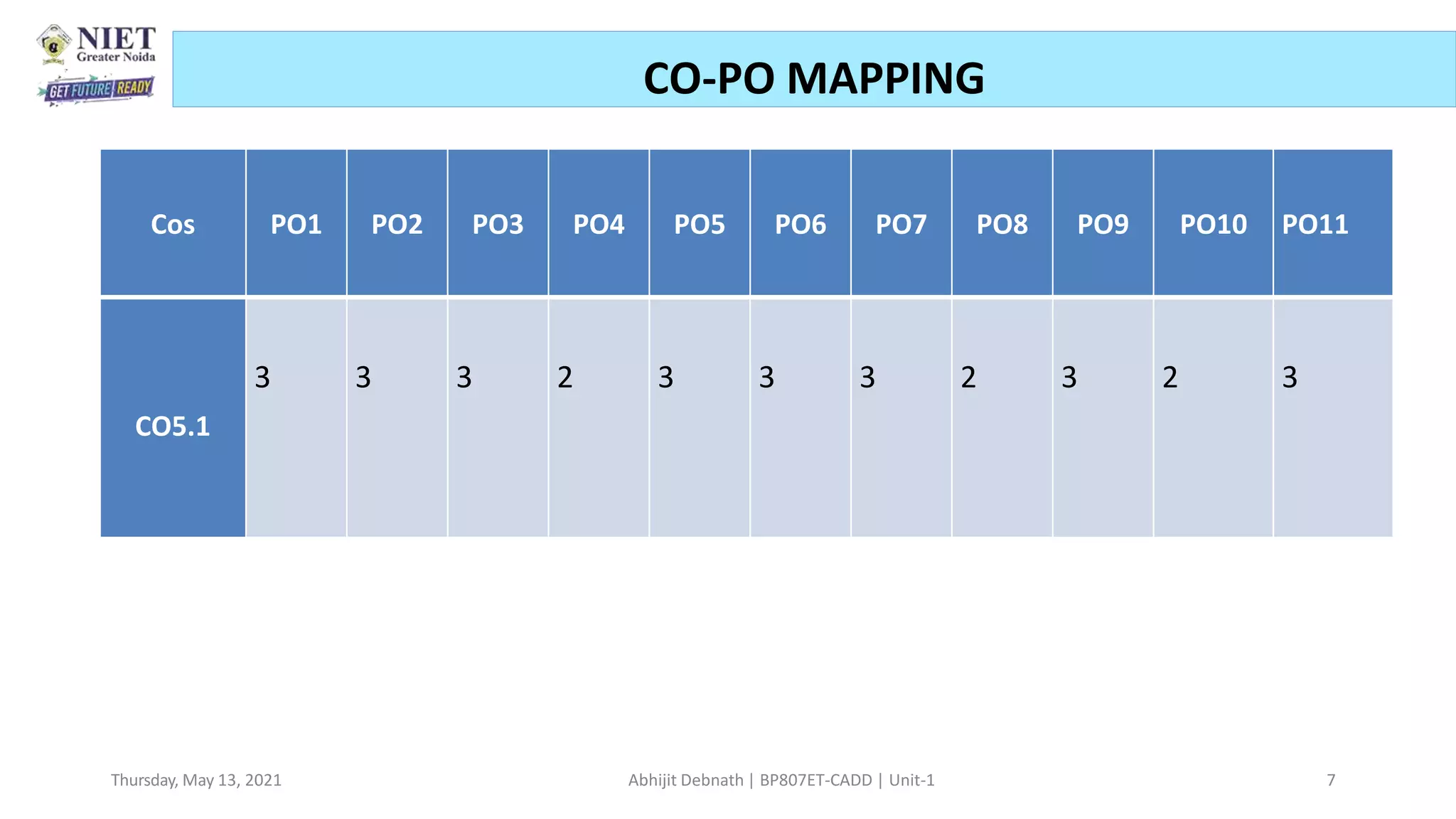
CO-PO MAPPING
Thursday, May 13, 2021 Abhijit Debnath | BP807ET-CADD | Unit-1 7
Cos PO1 PO2 PO3 PO4 PO5 PO6 PO7 PO8 PO9 PO10 PO11
CO5.1
3 3 3 2 3 3 3 2 3 2 3
TOPIC OBJECTIVE
• Learning of Molecular Modelling to enhance productivity in Computer
Aided Drug Design.
8
Tuesday, July 20, 2021 Abhijit Debnath | BP807ET-CADD | Unit-5
Thursday, May 13, 2021 Abhijit Debnath | BP807ET-CADD | Unit-1 9
TOPIC MAPPING WITH COURSE OUTCOME
Unit Topic Mapping with
CO5.1
Unit 5:
Molecular Modeling
Molecular Mechanics 3
Quantum Mechanics 3
Energy Minimization 2
Tuesday, July 20, 2021 Abhijit Debnath | BP807ET-CADD | Unit-5 9
Thursday, May 13, 2021 Abhijit Debnath | BP807ET-CADD | Unit-1 1
0
TOPIC OBJECTIVE MAPPING WITH COURSE OUTCOME
Topics Topic Objective Mapping with CO
Molecular Mechanics To know about Hartree-Fock Approximation
Density Functional Theory, Semi Empirical
function of Molecular Modelling
CO5.1
Quantum Mechanics To know about the various force field and their
applications
CO5.1
Energy Minimization To understand the Energy Minimization Process
used in Molecular Dynamics Simulations.
CO5.1
PREREQUISITE AND RECAP
Thursday, May 13, 2021 Abhijit Debnath | BP807ET-CADD | Unit-1 11
• Students must have basic knowledge of Biochemistry and Medicinal Chemistry
• Students must have basic knowledge of Physics, Quantum Chemistry
• Students must have basic knowledge of QSAR, Atomic arrangement of atoms.
Tuesday, July 20, 2021 Abhijit Debnath | BP807ET-CADD | Unit-5 11
Tuesday, July 20, 2021 Abhijit Debnath | BP807ET-CADD | Unit-5 12
Introduction to Molecular Mechanics
and
Quantum Mechanics. CO5.1
Noida Institute of Engineering and Technology
(Pharmacy Institute) Greater Noida
Tuesday, July 20, 2021 Abhijit Debnath | BP807ET-CADD | Unit-5 13
 Introduction to Molecular Modeling
 Types of Molecular Modeling Methods
 -Quantum Mechanics
 -Molecular Mechanics
 Discreteness between both QM & MM
 Applications
Introduction to
Molecular Mechanics
and Quantum
Mechanics.
Noida Institute of Engineering and Technology
(Pharmacy Institute) Greater Noida
CO5.1
What is Molecular Modelling ???
Tuesday, July 20, 2021 Abhijit Debnath | BP807ET-CADD | Unit-5 14
CO5.1
The Potential Energy Surface (PES) is a central concept in computational chemistry. A PES is the
mathematical relationship between the energy of a molecule and its geometry
What is Molecular Modelling ???
CO1
Tuesday, July 20, 2021 Abhijit Debnath | BP807ET-CADD | Unit-5 15
CO5.1
Molecular Modeling Quantam
Mechanics
Molecular Modelling Quantum
Mechanics
CO1
Tuesday, July 20, 2021 Abhijit Debnath | BP807ET-CADD | Unit-5 16
CO5.1
 The word quantum comes from Latin { Quantus, “how much?" }
 Born-Oppenheimer Approximation Nuclei of Molecule is Stationary with respect to the electrons.“
Electronic Schrödinger Equation
Molecular Modeling Quantam
Mechanics
Molecular Modelling Quantum
Mechanics
CO1
Tuesday, July 20, 2021 Abhijit Debnath | BP807ET-CADD | Unit-5 17
CO5.1
 Types of QM
 ab initio Methods
 Semi- empirical Methods
Molecular Modeling Quantam
Mechanics
Molecular Modelling Quantum
Mechanics
CO1
Tuesday, July 20, 2021 Abhijit Debnath | BP807ET-CADD | Unit-5 18
CO5.1
 ab initio Methods
 Hartree-Fock Approximation
 Density Functional Theory
Molecular Modeling Quantam
Mechanics
Molecular Modelling Quantum
Mechanics
CO1
Tuesday, July 20, 2021 Abhijit Debnath | BP807ET-CADD | Unit-5 19
CO5.1
 Hartree-Fock Approximation
 The central field approximation means Coulombic electron- electron repulsion is taken into account.
 The energies are calculated in units called Hartrees (1 Hartree. 27.2116 eV).
 Advantages of this method is that it breaks the many- electron Schrodinger equation into many simpler
one- electron equations.
 Hartree's method to write a plausible approximate polyelectronic wavefunction (a “guess”) for an atom as
the product of one-electron wavefunctions.
 Advantages-
• Does not depend on experimental data
• Small systems
• System requiring high accuracy Disadvantages-
• Computationally expensive and time consuming
Molecular Modeling Quantam
Mechanics
Molecular Modelling Quantum
Mechanics
CO1
Tuesday, July 20, 2021 Abhijit Debnath | BP807ET-CADD | Unit-5 20
CO5.1
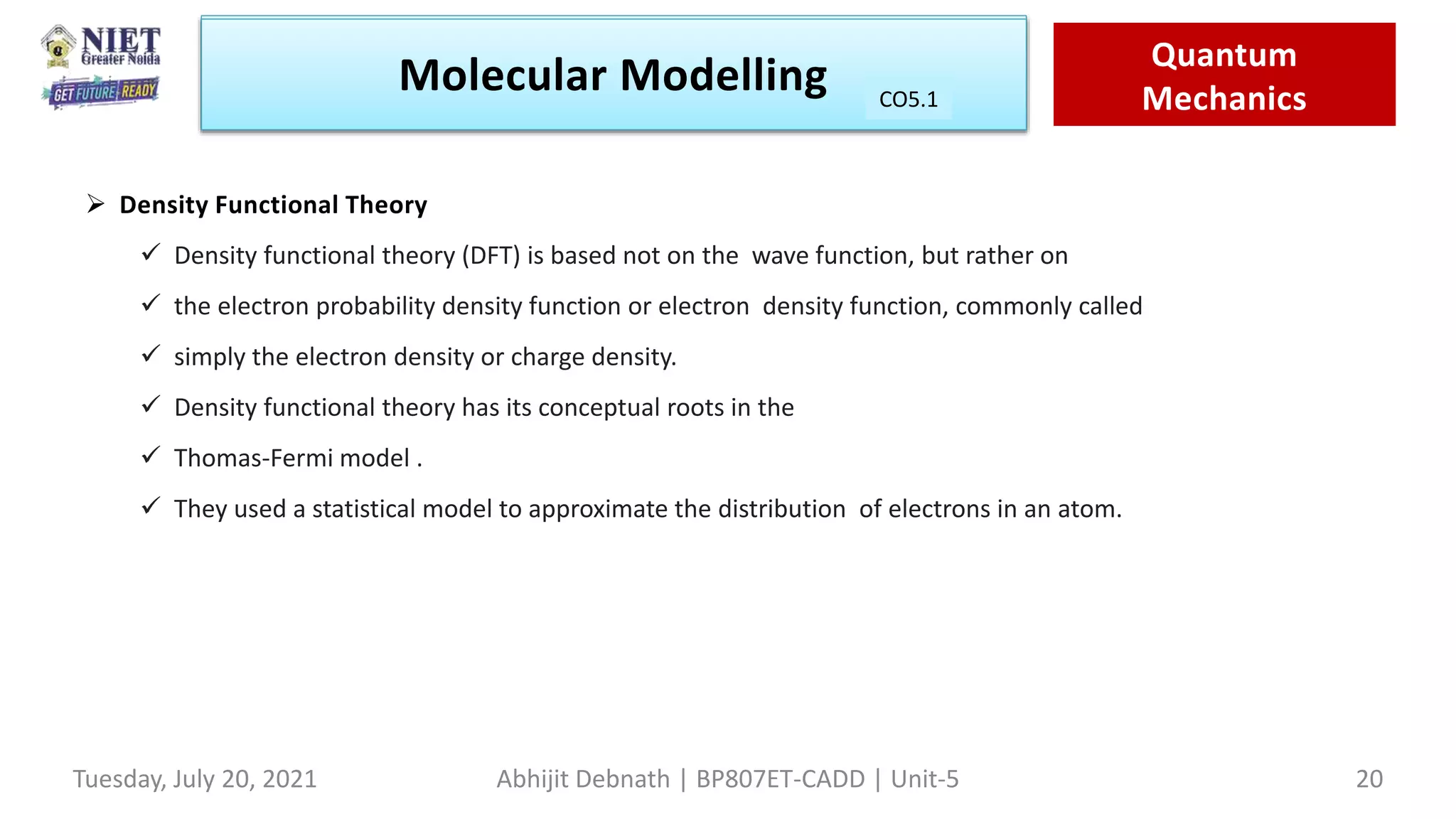
 Density Functional Theory
 Density functional theory (DFT) is based not on the wave function, but rather on
 the electron probability density function or electron density function, commonly called
 simply the electron density or charge density.
 Density functional theory has its conceptual roots in the
 Thomas-Fermi model .
 They used a statistical model to approximate the distribution of electrons in an atom.
Molecular Modeling Quantam
Mechanics
Molecular Modelling Quantum
Mechanics
CO1
Tuesday, July 20, 2021 Abhijit Debnath | BP807ET-CADD | Unit-5 21
CO5.1
 Density Functional Theory
 Kohn-Sham Equations and Density Functional Models: The density functional theory of Hohenberg, Kohn
and Sham is based on the fact that the sum of the exchange and correlation energies of a uniform electron
gas can be calculated exactly knowing only its density. The electron density is the square of wave function
and integrated over electron coordinates.
 In the Kohn-Sham formalism, the ground-state electronic energy, (E) is written as a sum of the kinetic
energy, (ET) the electron nuclear interaction energy, (EV) the Coulomb energy,(EJ) and the exchange
energy,(Exc).
E = ET + EV + EJ + EXC
 Except for ET, all components depend on the Total Electron Density.
Molecular Modeling Quantam
Mechanics
Molecular Modelling Quantum
Mechanics
CO1
Tuesday, July 20, 2021 Abhijit Debnath | BP807ET-CADD | Unit-5 22
CO5.1
 Density Functional Theory
 Advantages:
• Does not depend on experimental data
• Small systems
• System requiring high accuracy
 Disadvantages-
• There are difficulties in using density functional theory to properly describe intermolecular
interactions, especially van der Waals forces (dispersion); charge transfer excitations; transition
states, global potential energy surfaces and some other strongly correlated systems.
Molecular Modeling Quantam
Mechanics
Molecular Modelling Quantum
Mechanics
CO1
Tuesday, July 20, 2021 Abhijit Debnath | BP807ET-CADD | Unit-5 23
CO5.1
 Types of QM
 ab initio Methods
 Semi- empirical Methods
Molecular Modeling Quantam
Mechanics
Molecular Modelling Quantum
Mechanics
CO1
Tuesday, July 20, 2021 Abhijit Debnath | BP807ET-CADD | Unit-5 24
CO5.1
 Semi- empirical Methods
 Semi-empirical quantum chemistry method is based on the Hartree-Fock formalism, but make many
approximations and obtain some parameters from empirical (Experimental) data.
 They are very important in computational chemistry for treating large molecules where the full Hartree-
Fock method without the approximations is too expensive.
 The use of empirical parameters appears to allow some inclusion of electron correlation effects into the
methods.
Molecular Modeling Quantam
Mechanics
Molecular Modelling Quantum
Mechanics
CO1
Tuesday, July 20, 2021 Abhijit Debnath | BP807ET-CADD | Unit-5 25
CO5.1
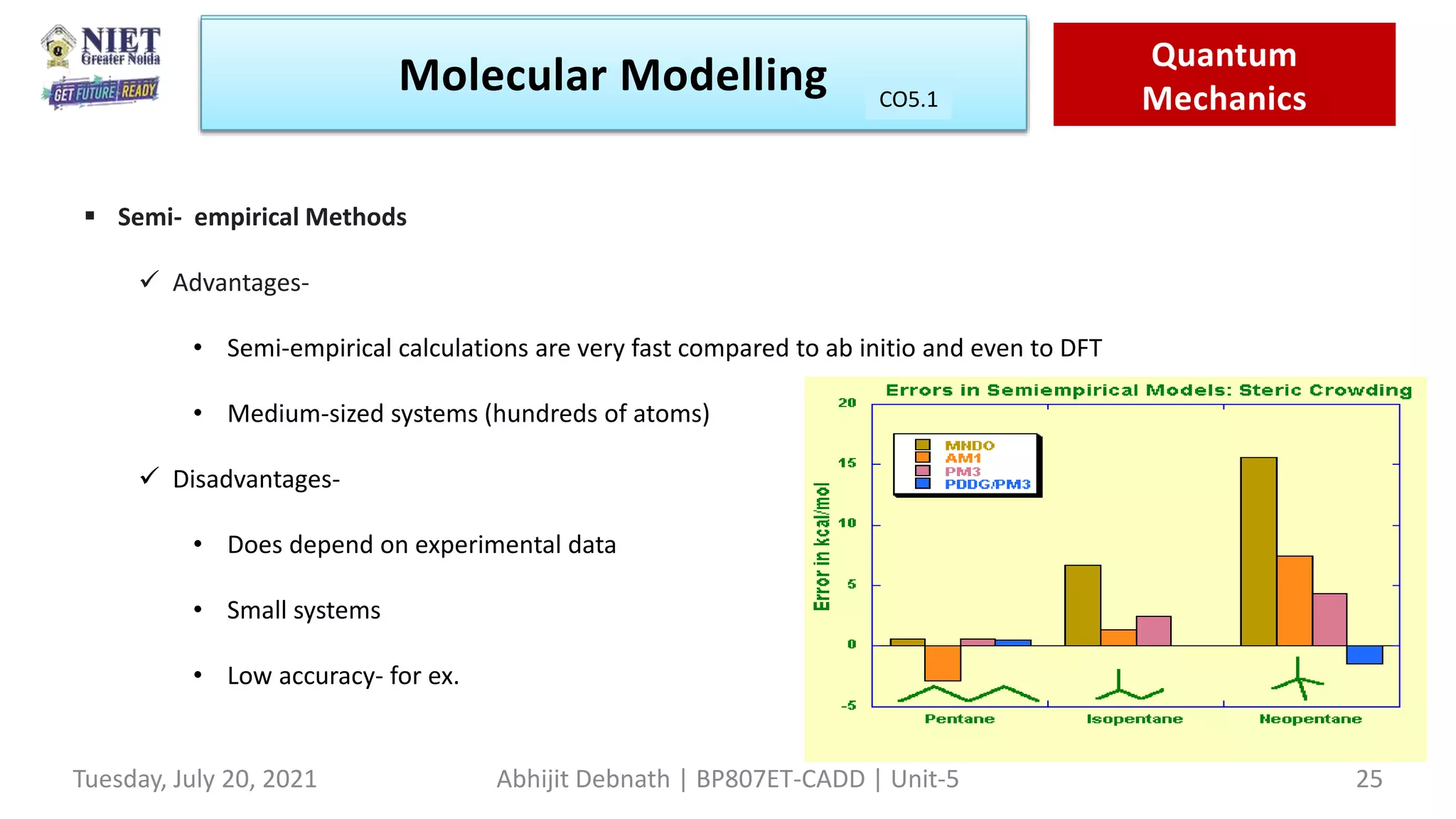
 Semi- empirical Methods
 Advantages-
• Semi-empirical calculations are very fast compared to ab initio and even to DFT
• Medium-sized systems (hundreds of atoms)
 Disadvantages-
• Does depend on experimental data
• Small systems
• Low accuracy- for ex.
There are a number of situations when quantum mechanics is superior to molecular
mechanics:
Modeling Systems With Metal Atoms
Increased Accuracy
Computing Reaction Paths
Modeling Charge Transfer
Predicting Spectra
Modeling Covalently Bound Inhibitors
Computing Enthalpies Of Covalent Bond Formation Or Breaking
Molecular Modelling
Quantam Mechanics
Semi-empirical Methods
CO1
Tuesday, July 20, 2021 Abhijit Debnath | BP807ET-CADD | Unit-5 26
CO5.1
What is Molecular Modelling ???
CO1
Tuesday, July 20, 2021 Abhijit Debnath | BP807ET-CADD | Unit-5 27
CO5.1
Molecular Modeling Quantam
Mechanics
Molecular Modelling Molecular
Mechanics
CO1
Tuesday, July 20, 2021 Abhijit Debnath | BP807ET-CADD | Unit-5 28
CO5.1
 Molecular Mechanics is a computational method
that computes the potential energy surface for a
particular arrangement of atoms using potential
functions that are derived using classical physics.
 Molecular mechanics (Force field) methods
ignores the electronic motions and calculate the
potential energy of a system as a function of
nuclear position only.
Molecular Modeling Quantam
Mechanics
Molecular Modelling Molecular
Mechanics
CO1
Tuesday, July 20, 2021 Abhijit Debnath | BP807ET-CADD | Unit-5 29
CO5.1
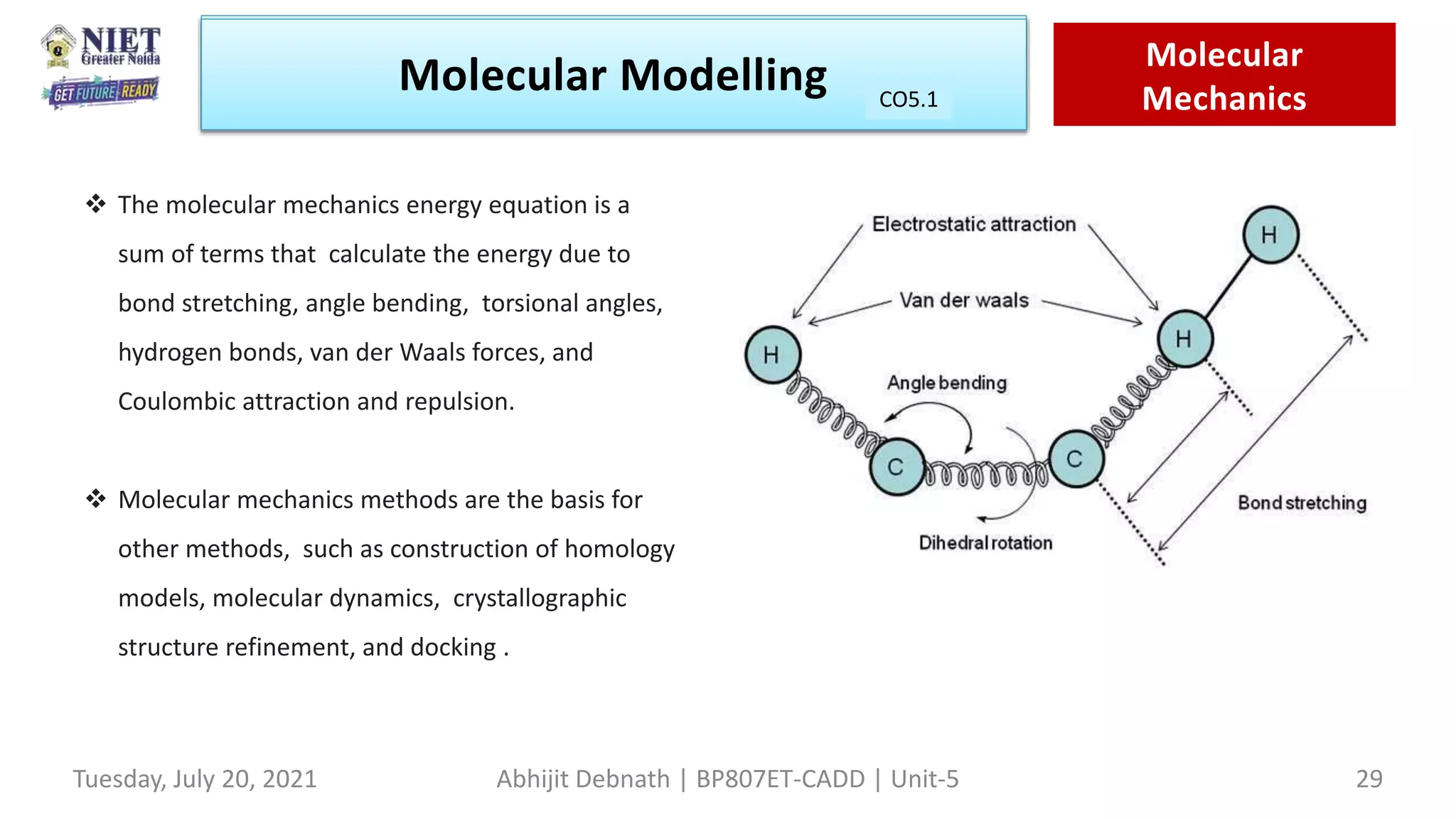
 The molecular mechanics energy equation is a
sum of terms that calculate the energy due to
bond stretching, angle bending, torsional angles,
hydrogen bonds, van der Waals forces, and
Coulombic attraction and repulsion.
 Molecular mechanics methods are the basis for
other methods, such as construction of homology
models, molecular dynamics, crystallographic
structure refinement, and docking .
Molecular Modeling Quantam
Mechanics
Molecular Modelling Molecular
Mechanics
CO1
Tuesday, July 20, 2021 Abhijit Debnath | BP807ET-CADD | Unit-5 30
CO5.1
 The molecular mechanics energy equation is a sum of terms that calculate the energy due to bond
stretching. The basic functional form of an inter-atomic potential encapsulates both bonded terms
relating to atoms that are linked by covalent bonds, and non-bonded.
 The specific decomposition of the terms depends on the force field, but a general form for the total
energy in an additive force field can be written as angle bending, torsional angles, hydrogen bonds,
van der Waals forces, and Coulombic attraction and repulsion.
Molecular Modeling Quantam
Mechanics
Molecular Modelling Molecular
Mechanics
CO1
Tuesday, July 20, 2021 Abhijit Debnath | BP807ET-CADD | Unit-5 31
CO5.1
 Molecular mechanics methods are the basis for other methods, such as construction of homology
models, molecular dynamics, crystallographic structure refinement, and docking .
Etotal = Ebonded + Enonbonded
where the components of the covalent and non-covalent contributions are
given by the following summations:
Ebonded = Ebond + Eangle + Edihedral
Enon-bonded = Eelectrostatic + Evan der Waals
Molecular Modeling Quantam
Mechanics
Molecular Modelling Molecular
Mechanics
CO1
Tuesday, July 20, 2021 Abhijit Debnath | BP807ET-CADD | Unit-5 32
CO5.1
 Molecular mechanics Models:
 AMBER (Assisted Model Building and Energy Refinement)
 CHARMM (Chemistry at Harvard Molecular Mechanics)
 GROMOS (Groningen Molecular Simulation package)
 OPLS (Optimized Potential for Liquid Simulations)
 CFF (Consistent Force Field)
 COMPASS (Condensed-phase Optimized Molecular Potentials for Atomistic Simulation Studies)
 MMFF (Merck Molecular Force Field)
Molecular Modeling
Molecular Modelling Molecular
Mechanics
CO1
Tuesday, July 20, 2021 Abhijit Debnath | BP807ET-CADD | Unit-5 33
CO5.1
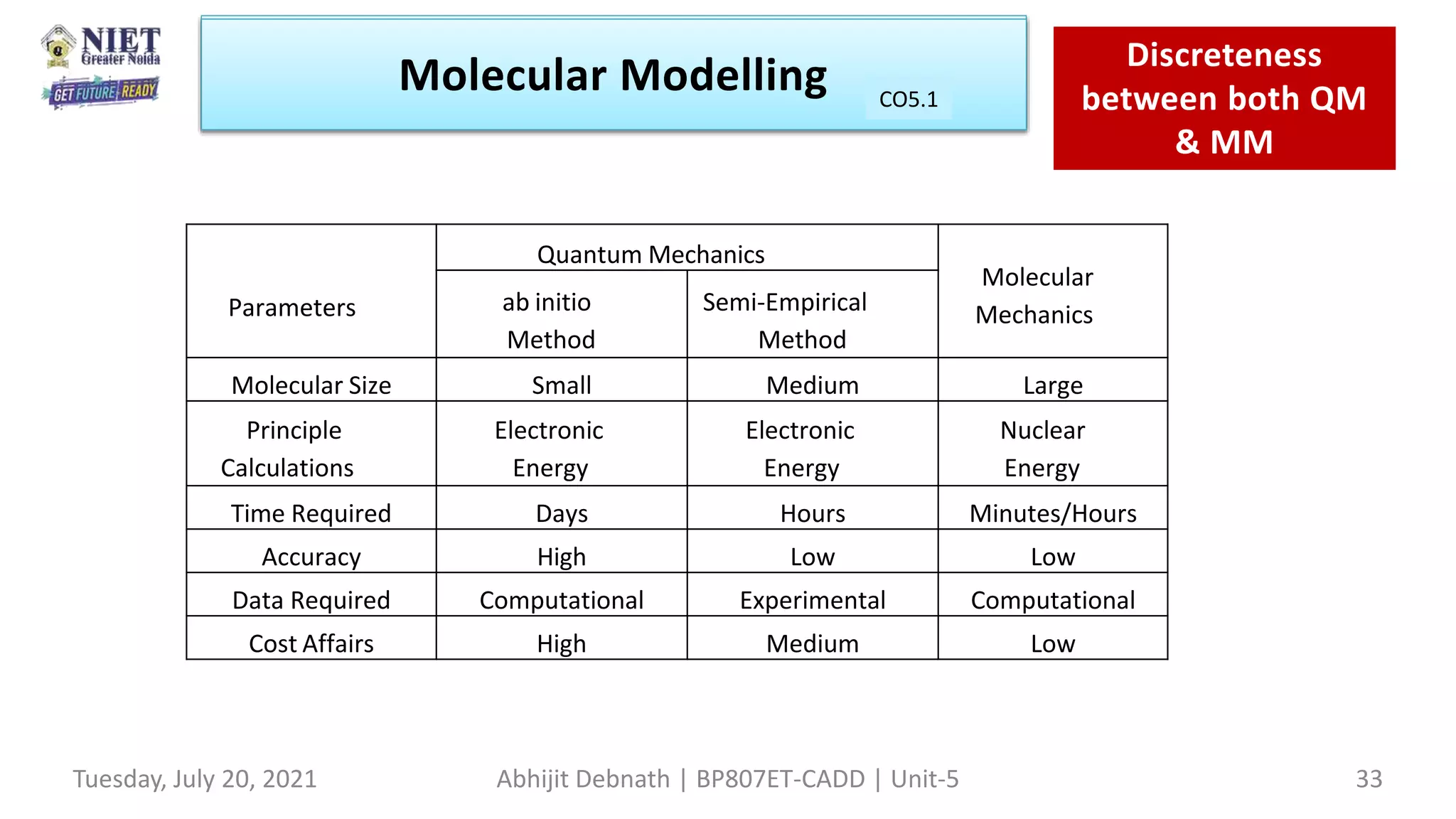
Parameters
Quantum Mechanics
Molecular
Mechanics
ab initio
Method
Semi-Empirical
Method
Molecular Size Small Medium Large
Principle
Calculations
Electronic
Energy
Electronic
Energy
Nuclear
Energy
Time Required Days Hours Minutes/Hours
Accuracy High Low Low
Data Required Computational Experimental Computational
Cost Affairs High Medium Low
Discreteness
between both QM
& MM
QM/MM-
 This is the ‘Hybrid’ of quantum and molecular mechanics
 The QM/MM procedure is applicable when the system can be partitioned into two regions;
 one region (the ‘active site’) requires an accurate QM calculation of its potential and
 the second region (the rest of the system) acts as a perturbation on the active site and can be treated with an
approximate and fast MM calculation of its potential.
 By using a quantum mechanical calculation, we can treat bond- breaking and bond-forming accurately at the active
site yet still take into account the role of the surrounding atoms using MM.
Molecular Modelling Discreteness
between both QM
& MM
CO1
Tuesday, July 20, 2021 Abhijit Debnath | BP807ET-CADD | Unit-5 34
CO5.1
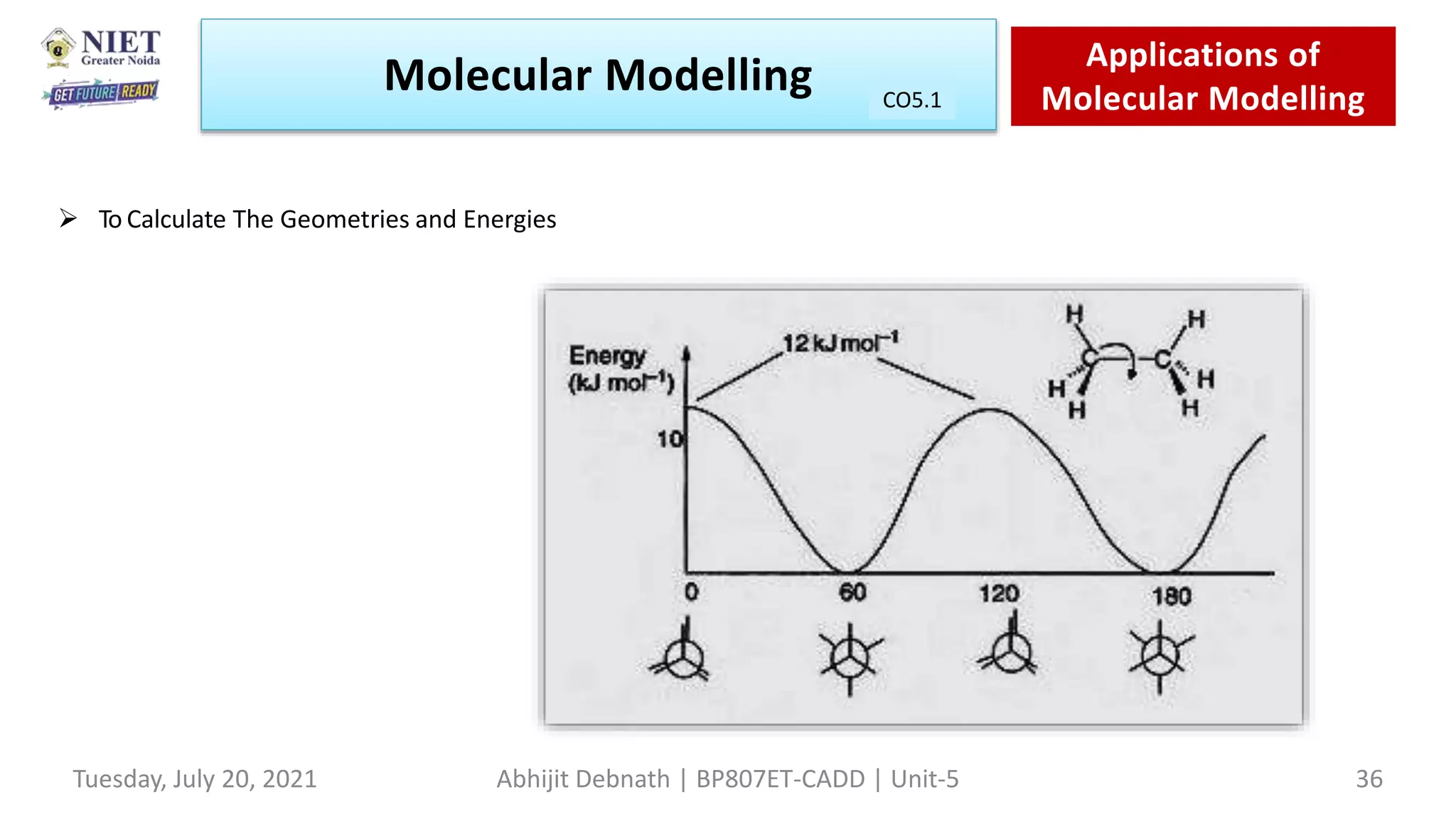
 To Calculate The Geometries and Energies
 Computing Enthalpies of Bond Formation or Breaking
 In Structure Based Drug Designing (Docking Studies)
 To Monitor Reaction Path
Molecular Modelling Applications of
Molecular Modelling
CO1
Tuesday, July 20, 2021 Abhijit Debnath | BP807ET-CADD | Unit-5 35
CO5.1
 To Calculate The Geometries and Energies
Molecular Modelling Applications of
Molecular Modelling
CO1
Tuesday, July 20, 2021 Abhijit Debnath | BP807ET-CADD | Unit-5 36
CO5.1
 Computing Enthalpies of Bond Formation or Breaking
 In Structure Based Drug Designing (Docking Studies)
 To Monitor Reaction Path
Molecular Modelling Applications of
Molecular Modelling
CO1
Tuesday, July 20, 2021 Abhijit Debnath | BP807ET-CADD | Unit-5 37
CO5.1
Molecular Modelling Applications of
Molecular Modelling
CO1
Tuesday, July 20, 2021 Abhijit Debnath | BP807ET-CADD | Unit-5 38
CO5.1
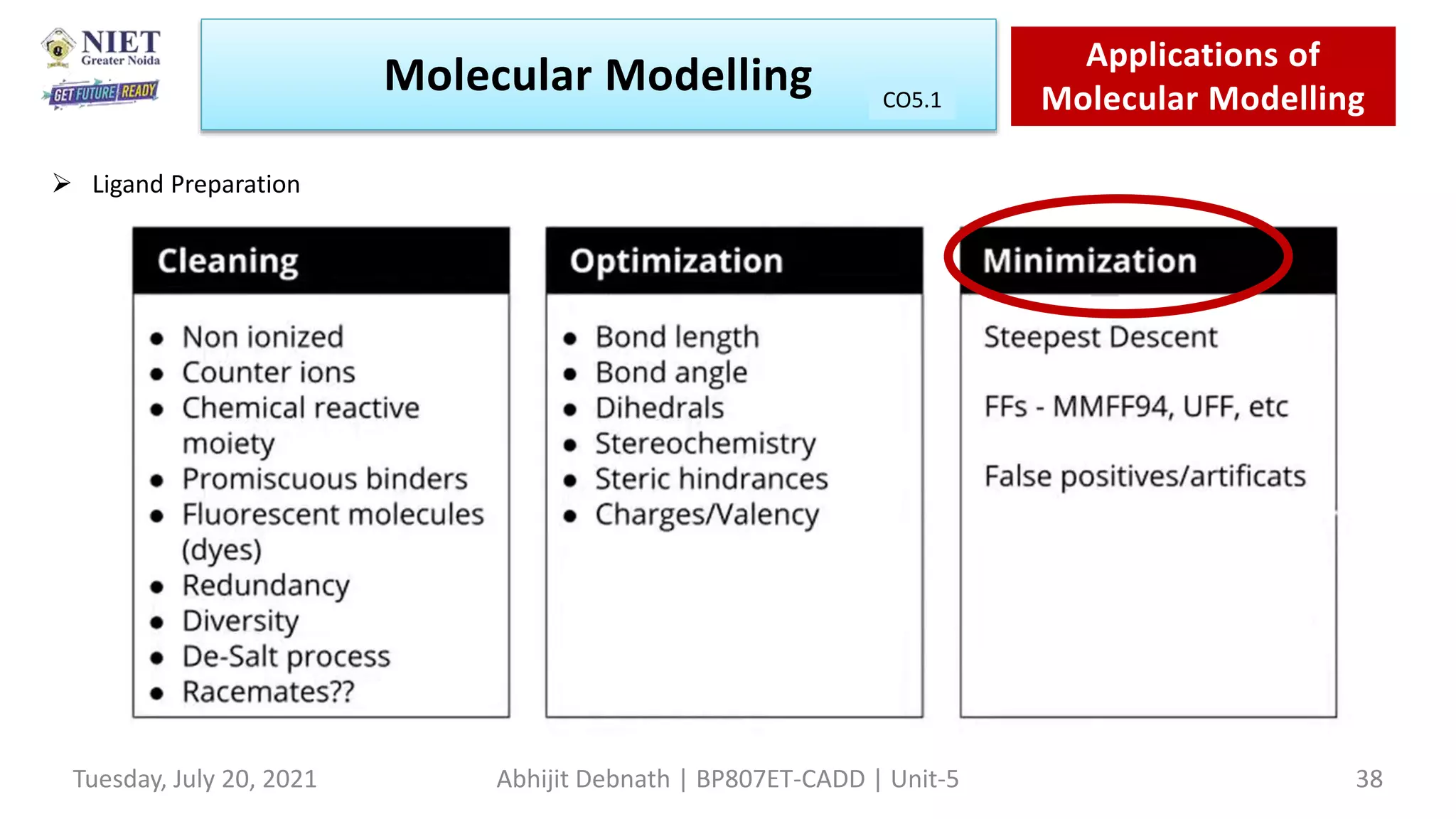
 Ligand Preparation
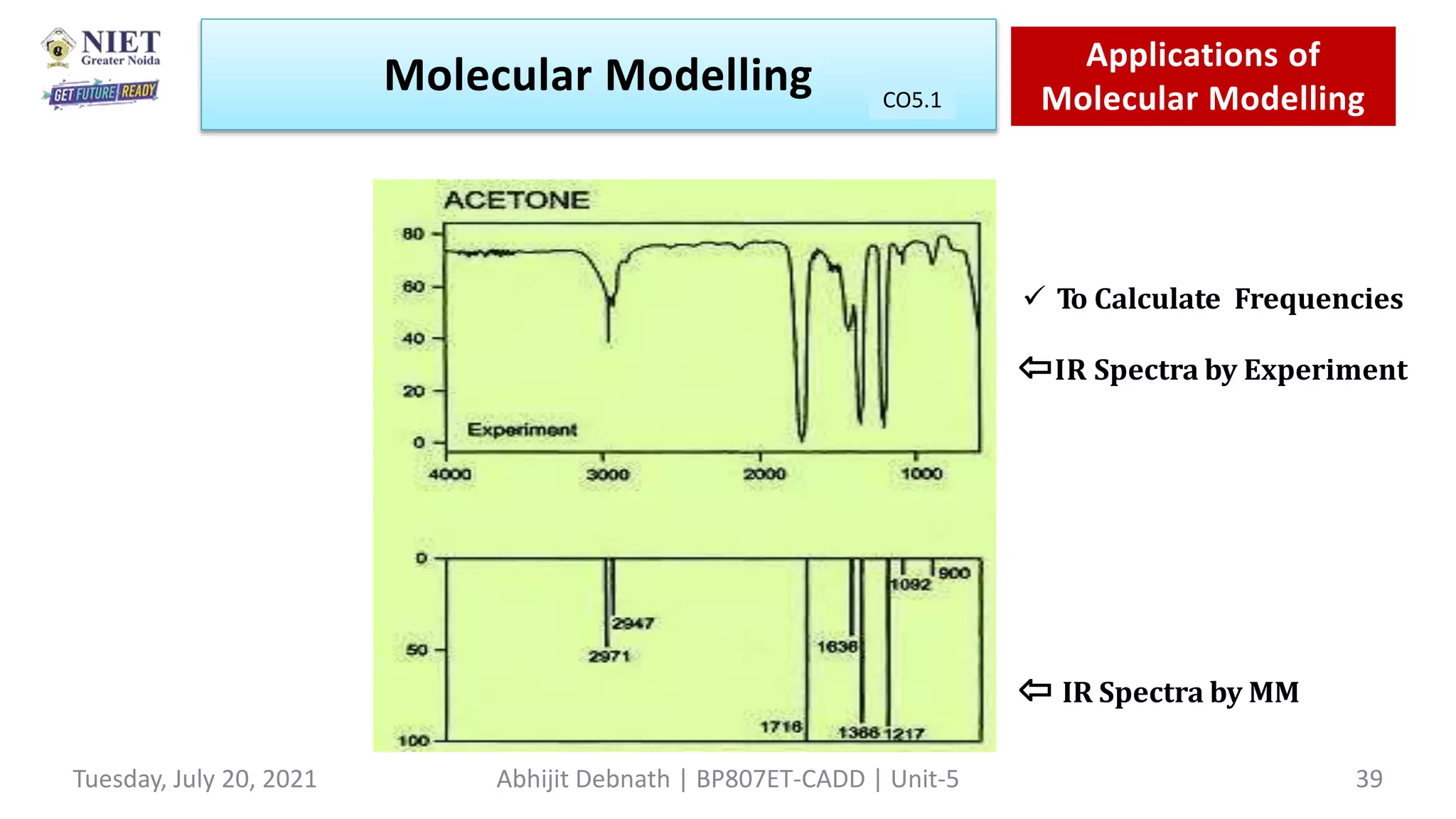
 To Calculate Frequencies
⇦IR Spectra by Experiment
⇦ IR Spectra by MM
Molecular Modelling Applications of
Molecular Modelling
CO1
Tuesday, July 20, 2021 Abhijit Debnath | BP807ET-CADD | Unit-5 39
CO5.1
Molecular Modelling Suggest Publications
CO1
Tuesday, July 20, 2021 Abhijit Debnath | BP807ET-CADD | Unit-5 40
CO5.1
Molecular Modelling Suggest Publications
CO1
Tuesday, July 20, 2021 Abhijit Debnath | BP807ET-CADD | Unit-5 41
CO5.1
Tuesday, July 20, 2021 Abhijit Debnath | BP807ET-CADD | Unit-5 42
Energy
Minimization
 Introduction
 Molecular mechanics
 Energy minimization
 Energy minimization method
 First order minimization : Steepest descent,
Conjugate gradient minimization
 Second derivative methods : Newton Raphson
method.
 Example
CO5.1
Noida Institute of Engineering and Technology
(Pharmacy Institute) Greater Noida
Molecular mechanics:
It’s a approach of energy minimization that find stable, low energy conformation by
changing the geometry of structure identifying a point in the configuration space at the force on
each atom vanishes.
Molecular mechanics depend on three parameter:
I.Force field ,
II.Parameter set,
III.Minimizing algorithm.
Energy Minimization Introduction to
Molecular mechanics
CO1
Tuesday, July 20, 2021 Abhijit Debnath | BP807ET-CADD | Unit-5 43
CO5.1
It is set of function & constant used to described potential energy of the molecule.
General form of force field equation ;
Epot = ∑Ebon+ ∑Eang+ ∑Etor + ∑Eoop+ ∑ Enb + ∑Eel
Where;
Epot : The total steric energy
Ebon : The energy resulting from changing the bond length from it’s initial value calculated by Hook’s law for
deformation spring E=1/2kb(b-b0)2
[ kb-force constant for bond, b0-equilibrium bond length ,b-current bond length]
Eang: The energy resulting from deforming a bond angle from it’s original val.
Etor : Deforming the torsinal or dihydral angle
Eoop: Is the out of plane bending component of the steric energy
Enb : Energy arising from non-bonded interaction
Eel : Energy arising from coulombic forces
4
Energy Minimization
I ) Force field
CO1
Tuesday, July 20, 2021 Abhijit Debnath | BP807ET-CADD | Unit-5 44
CO5.1
Energy Minimization
CO1
Tuesday, July 20, 2021 Abhijit Debnath | BP807ET-CADD | Unit-5 45
CO5.1
II) Parameter set:
In which atomic mass, vanderwaal radii, bond angle, dihydral angle with defines point.
III) Minimizing algorithm :
To calculate new geometric position are called minimiser or optimizer.
4
6
It is a systematic modification of the atomic coordinates of a model resulting in a 3-dimensional arrangement of
atoms in the model representing an energy minimum (a stable molecular geometry to be found without crossing a
conformational energy barrier) is called energy minimization and geometry optimization .
EM used for : Locating a stable conformation
Locating global & local energy minima Locating saddle point
Energy minimization
Energy Minimization
CO1
Tuesday, July 20, 2021 Abhijit Debnath | BP807ET-CADD | Unit-5
CO5.1
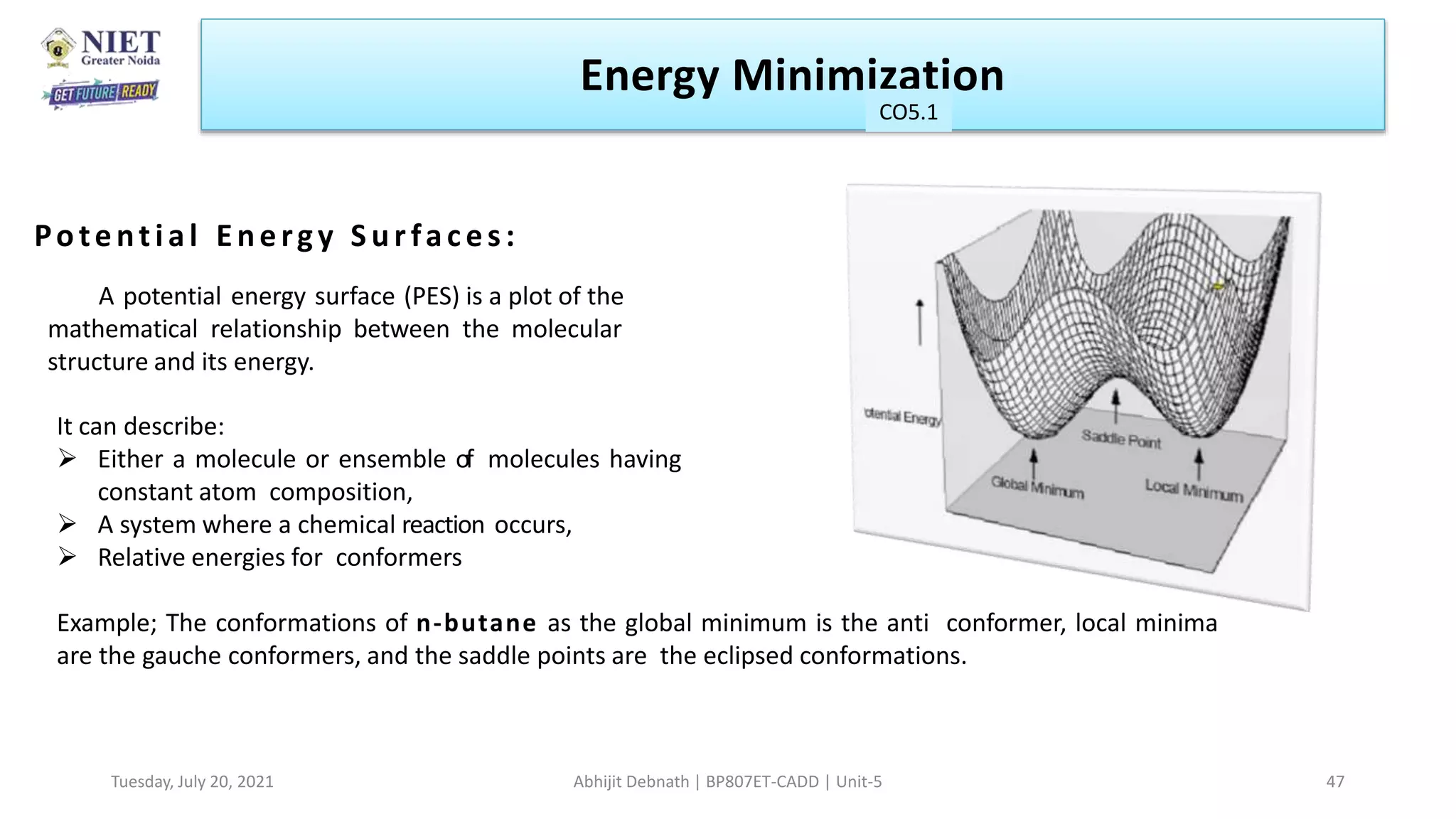
Potential Energy Surfaces:
A potential energy surface (PES) is a plot of the
mathematical relationship between the molecular
structure and its energy.
It can describe:
 Either a molecule or ensemble of molecules having
constant atom composition,
 A system where a chemical reaction occurs,
 Relative energies for conformers
Example; The conformations of n-butane as the global minimum is the anti conformer, local minima
are the gauche conformers, and the saddle points are the eclipsed conformations.
Energy Minimization
CO1
Tuesday, July 20, 2021 Abhijit Debnath | BP807ET-CADD | Unit-5 47
CO5.1
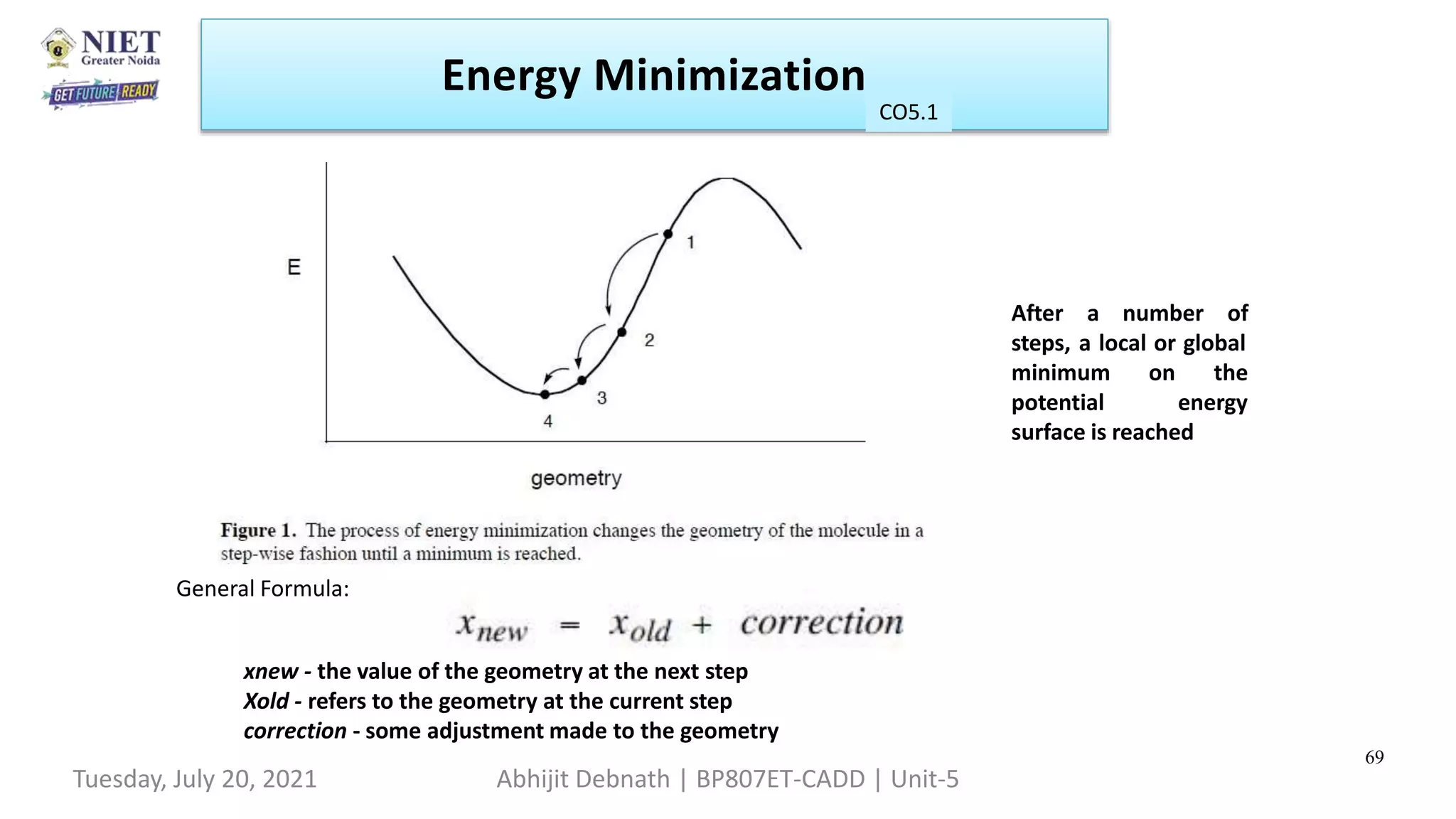
EM is an numerical procedure for find a minimum on the potential
energy surface starting from a higher energy initial structure labelled
"1" as illustrated in Figure .
During EM the geometry is change in a stepwise fashion; energy of molecule is reduced from step 2 to 3 to 4
shown in figure .
Energy Minimization
CO1
Tuesday, July 20, 2021 Abhijit Debnath | BP807ET-CADD | Unit-5 48
CO5.1
Most of EMM proceed by determining the energy & the slope of function at point 1.
- if slope is positive : it indicate the coordinate is too large (point 1)
- if slope is negative : the coordinate is too small &
The numerical minimization technique then adjust the coordinate:
- if slope is positive : it indicate the value of coordinate is reduced (point2)
- if the slope is zero : a minimum has been reached ,
- if slope is still positive: coordinate reduced further (point 3)
Energy Minimization
CO1
Tuesday, July 20, 2021 Abhijit Debnath | BP807ET-CADD | Unit-5 49
CO5.1
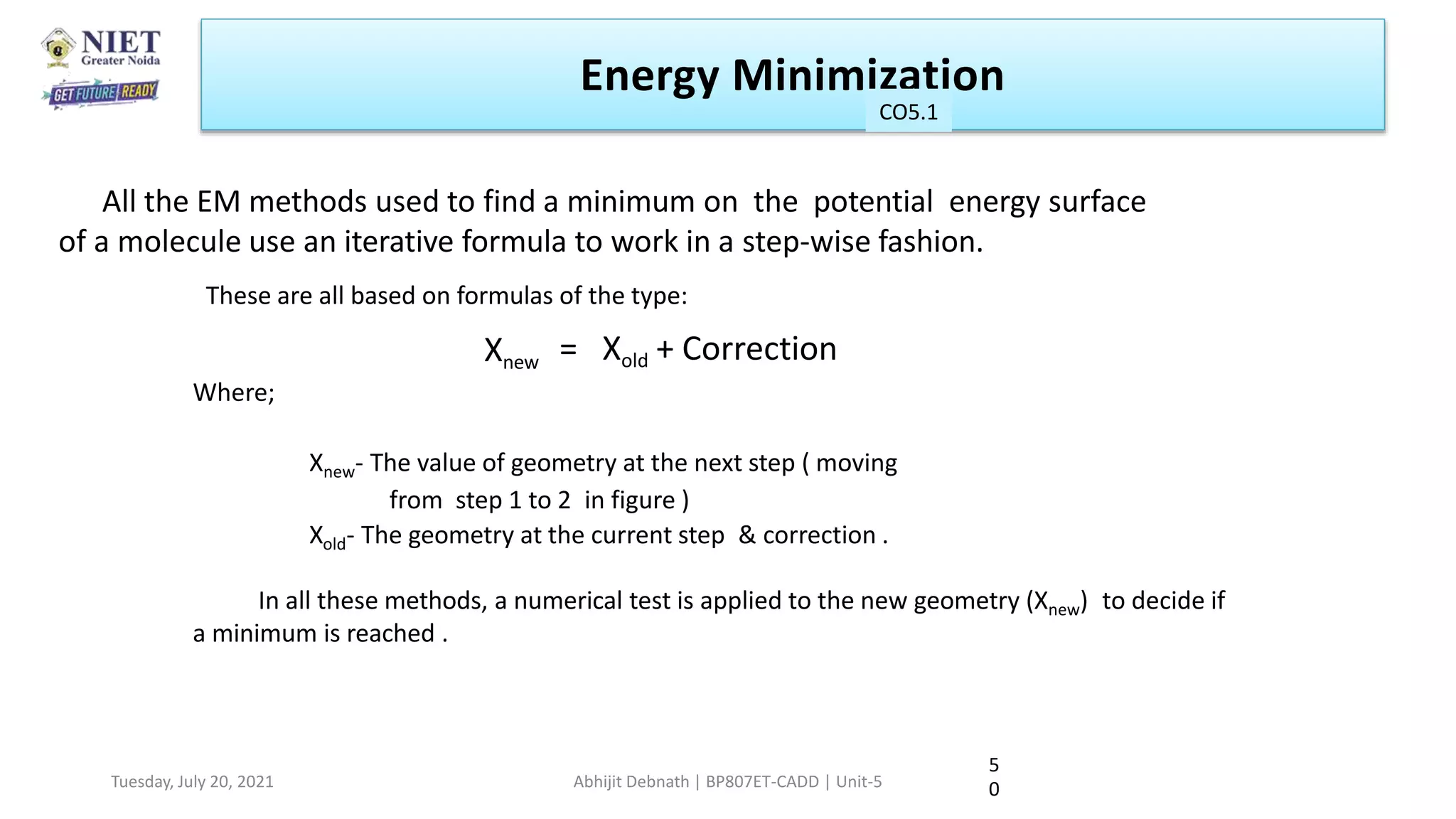
All the EM methods used to find a minimum on the potential energy surface
of a molecule use an iterative formula to work in a step-wise fashion.
5
0
These are all based on formulas of the type:
Xnew = Xold + Correction
Where;
Xnew- The value of geometry at the next step ( moving
from step 1 to 2 in figure )
Xold- The geometry at the current step & correction .
In all these methods, a numerical test is applied to the new geometry (Xnew) to decide if
a minimum is reached .
Energy Minimization
CO1
Tuesday, July 20, 2021 Abhijit Debnath | BP807ET-CADD | Unit-5
CO5.1
I. First-order minimization:
 Steepest descent
 Conjugate gradient
Energy Minimization
II. Second derivative methods :
 Newton-Raphson
CO1
Tuesday, July 20, 2021 Abhijit Debnath | BP807ET-CADD | Unit-5 51
CO5.1
Types of energy Minimization Method:
The second derivative is assumed to be constant , the equation to update the geometry
becomes
Xnew = Xold − Y E’ (Xold) Where ;
Y is a constant
In these method;
- gradient at each point calculated
- not required second derivative calculated
- the method is much faster per step
- relies on an approximation but not as efficient & more steps require to find minimum .
The method is named Steepest Descent because the direction in which the geometry is first minimized in
opposite to the direction in which the gradient is largest (i.e., steepest) at the initial point.
 Steepest descent
Energy Minimization Energy Minimization
Method
I. First-order minimization:
CO1
Tuesday, July 20, 2021 Abhijit Debnath | BP807ET-CADD | Unit-5 52
CO5.1
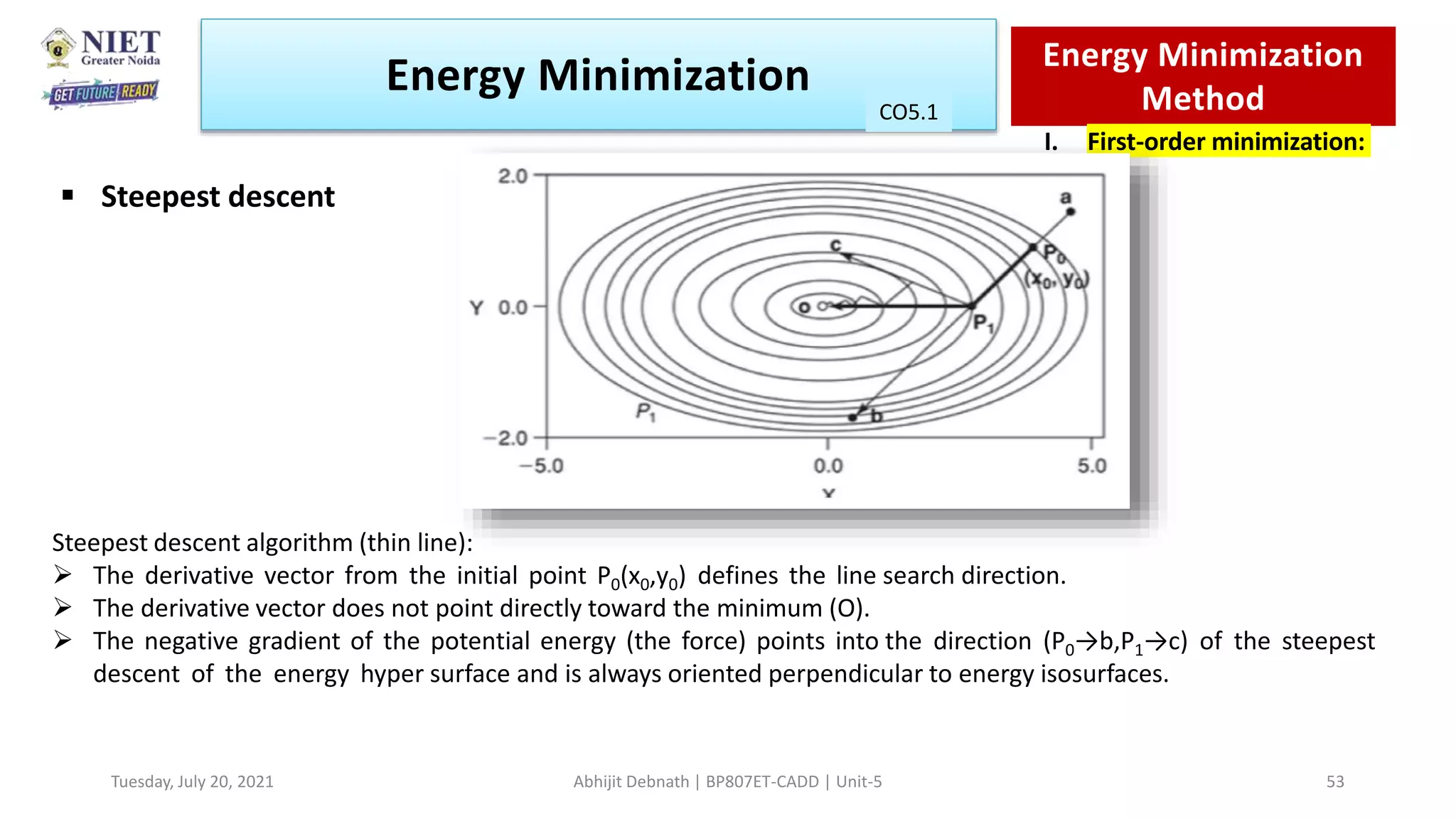
Steepest descent algorithm (thin line):
 The derivative vector from the initial point P0(x0,y0) defines the line search direction.
 The derivative vector does not point directly toward the minimum (O).
 The negative gradient of the potential energy (the force) points into the direction (P0→b,P1→c) of the steepest
descent of the energy hyper surface and is always oriented perpendicular to energy isosurfaces.
Energy Minimization Energy Minimization
Method
I. First-order minimization:
 Steepest descent
CO1
Tuesday, July 20, 2021 Abhijit Debnath | BP807ET-CADD | Unit-5 53
CO5.1
 Advantage of method is easy with which force field can be changed.
 The main problem with the steepest descent method is determining the appropriate
step size for atom movement during the derivative estimation steps and the atom
movement steps .
Energy Minimization Energy Minimization
Method
I. First-order minimization:
 Steepest descent
CO1
Tuesday, July 20, 2021 Abhijit Debnath | BP807ET-CADD | Unit-5 54
CO5.1
Energy Minimization Energy Minimization
Method
 It is a first-order minimization technique
 It uses for both current gradient & the previous search direction to drive the minimization.
 The number of computing cycles required for a conjugated gradient calculation is approximately
proportional to the number of atoms (N), and the time per cycle is proportional to N2.
I. First-order minimization:
 Conjugate gradient
CO1
Tuesday, July 20, 2021 Abhijit Debnath | BP807ET-CADD | Unit-5 55
CO5.1
 Improves the step efficiency
 The method takes the next search direction to be a linear combination of the current
gradient and the previous ones.
 Require fewer energy evaluations and gradient calculations.
 Convergence characterizations are better than with steepest descent
Energy Minimization Energy Minimization
Method
I. First-order minimization:
 Conjugate gradient
CO1
Tuesday, July 20, 2021 Abhijit Debnath | BP807ET-CADD | Unit-5 56
CO5.1
 The method is the most computationally expensive per step of a
l
lthe methods utilized to perform EM.
 It is based on Taylor series expansion of the potential energy surface at the current geometry.
 The equation for updating the geometry is
Xnew = Xold – E’(Xold)/ E”(Xold)
- Is a powerful & convergent minimization procedure
- Based on the assumption the energy is quadratically dependent like a classical spring.
II. Second derivative methods :
Energy Minimization Energy Minimization
Method
 Newton-Raphson minimization method:
CO1
Tuesday, July 20, 2021 Abhijit Debnath | BP807ET-CADD | Unit-5 57
CO5.1
The advantage of the Newton-Raphson procedure that the minimization could converge in one or two steps.
 The major drawback is that this method requires the calculation o
f
the second derivatives.
 The minimization can then become unstable when a structure is far from the minimum (or the energy surface is an harmonic).
Advantage :
• Only one iteration for quadratic functions
• Efficient (relative to first -order methods)N/N-1 = (N-1/N-2)2
• Better energy estimate
Disadvantages :
N2 storage requirements (compared to N for conjugate gradient)N3 Involves calculating Hessian (~10 times time for gradient calculation) It used in
transition-structure searches (saddle point locator)
II. Second derivative methods :
Energy Minimization Energy Minimization
Method
 Newton-Raphson minimization method:
CO1
Tuesday, July 20, 2021 Abhijit Debnath | BP807ET-CADD | Unit-5 58
CO5.1
The geometry of lactic acid was optimized using the Newton-Raphson, Steepest Descent, and Conjugate Gradient
methods.
Lactic acid is a relatively small organic molecule
 Example of the Use of Energy Minimization Methods:
Energy Minimization
CO1
Tuesday, July 20, 2021 Abhijit Debnath | BP807ET-CADD | Unit-5 59
CO5.1
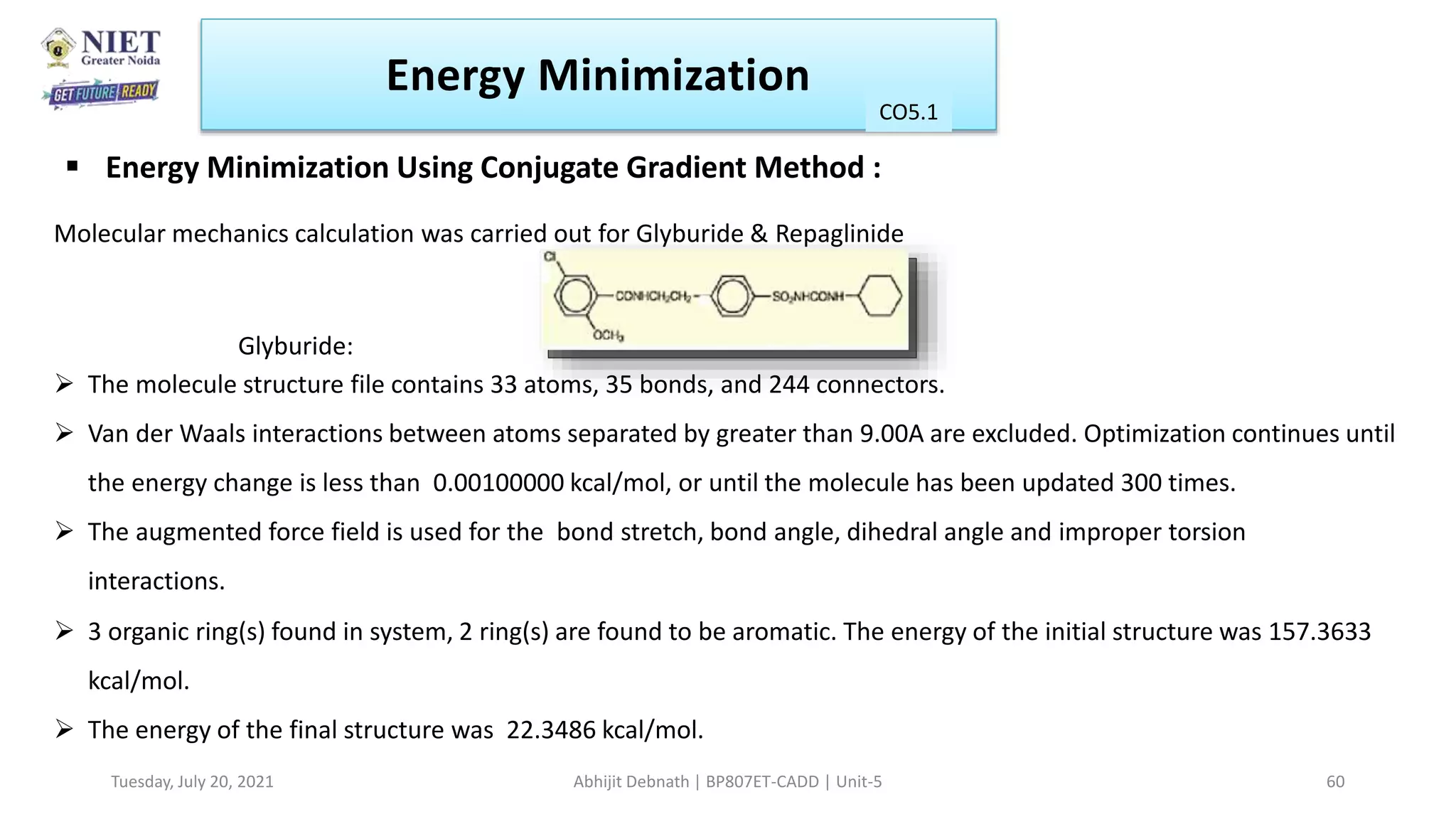
Molecular mechanics calculation was carried out for Glyburide & Repaglinide
Glyburide:
 The molecule structure file contains 33 atoms, 35 bonds, and 244 connectors.
 Van der Waals interactions between atoms separated by greater than 9.00A are excluded. Optimization continues until
the energy change is less than 0.00100000 kcal/mol, or until the molecule has been updated 300 times.
 The augmented force field is used for the bond stretch, bond angle, dihedral angle and improper torsion
interactions.
 3 organic ring(s) found in system, 2 ring(s) are found to be aromatic. The energy of the initial structure was 157.3633
kcal/mol.
 The energy of the final structure was 22.3486 kcal/mol.
 Energy Minimization Using Conjugate Gradient Method :
Energy Minimization
CO1
Tuesday, July 20, 2021 Abhijit Debnath | BP807ET-CADD | Unit-5 60
CO5.1
Repaglinide:
The molecule structure file contains 33 atoms, 35 bonds, and 243 connectors
Vander Waals interactions between atoms separated by greater than 9.00A will be
excluded. Optimization continues until the energy change was less than
0.00100000kcal/mol, or until the molecule has been updated 300 times.
The augmented force field was used for the bond stretch, bond angle, dihedral angle
and improper torsion interactions.
3 organic ring(s) found in system, 1 ring(s) are found to be aromatic The
energy of the initial structure was 75.9242 kcal/mol.
The energy of the final structure was 16.0877 kcal/mol.
 Energy Minimization Using Conjugate Gradient Method :
Energy Minimization
CO1
Tuesday, July 20, 2021 Abhijit Debnath | BP807ET-CADD | Unit-5 61
CO5.1
Energy Minimization Algorithms Displaying Energy States of Five Molecules before and after Minimization
Steps Using Conjugate Gradient Method :
 Energy Minimization Using Conjugate Gradient Method :
Energy Minimization
CO1
Tuesday, July 20, 2021 Abhijit Debnath | BP807ET-CADD | Unit-5 62
CO5.1
I. Comparison of structures/properties
II. Template forcing
III. Systematic mapping of E space
IV. Binding energies
V. Docking
VI. Harmonic analysis
VII. Comparing/Fitting force fields.
 Why Minimization is Important :
Energy Minimization
CO1
Tuesday, July 20, 2021 Abhijit Debnath | BP807ET-CADD | Unit-5 63
CO5.1
Tuesday, July 20, 2021 Abhijit Debnath | BP807ET-CADD | Unit-5 64
Global Conformational
minima determination CO5.1
Noida Institute of Engineering and Technology
(Pharmacy Institute) Greater Noida
Energy Minimization:
● Local minima – relative
● Global minima - absolute
Energy Minimization
CO1
Tuesday, July 20, 2021 Abhijit Debnath | BP807ET-CADD | Unit-5
CO5.1
Local minima
 This is a relative minimum
 Confimed in a smaller place, i.e. with limited amount of atoms
 Has same neighbourhood which can be (not be) a part of global energy calculations
Energy Minimization
Local
minima
CO1
Tuesday, July 20, 2021 Abhijit Debnath | BP807ET-CADD | Unit-5
CO5.1
67
Energy Minimization Global
minima
Global minima
CO1
Tuesday, July 20, 2021 Abhijit Debnath | BP807ET-CADD | Unit-5
CO5.1
 This is the absolute minima
 Includes the entire energy balance of a molecule
 It is a overall value of a set or function of a energy calculation
Energy Minimization
 Theoritically – QM calculations are enough for energy calculations
 But it is not possible to be accurate in QM
 As it has number of atoms in consideration
 And that includes as many wave functions
 Also the inaccuracy in approximation is a problem
 Hence Molecular mechanics is preffered over QM
 Molecules have
 Number of degree of freedom
 And multiple global minimas
 Hence difficult for larger molecules
 So, we can take multiple local minimas and join the results to get a global minima
CO1
Tuesday, July 20, 2021 Abhijit Debnath | BP807ET-CADD | Unit-5
68
CO5.1
After a number of
steps, a local or global
minimum on
potential
the
energy
surface is reached
General Formula:
xnew - the value of the geometry at the next step
Xold - refers to the geometry at the current step
correction - some adjustment made to the geometry
Energy Minimization
CO1
Tuesday, July 20, 2021 Abhijit Debnath | BP807ET-CADD | Unit-5
69
CO5.1
Criteria to start minimization
1. Starting set of atomic coordinates
2. Parameters for various terms of the potential energy function
3. Description of molecular topology
Energy Minimization – The Problem
E = f(x)
E - function of coordinates Cartesian /internal At minimum the first
derivatives are zero and
the second derivatives are all positive
Derivatives of the energy with respect to the coordinates provide information about the shape of energy surface and
also enhances the efficiency of the minimization.
70
Energy Minimization
CO1
Tuesday, July 20, 2021 Abhijit Debnath | BP807ET-CADD | Unit-5
CO5.1
71
Non Derivative Methods
– Require energy evaluation only and may require
many energy evaluations
–– Simplex Method
Simplex is a geometrical figure with M+1
interconnected vertices, where M is the
dimensionality of the energy function
It does not rely on the calculation of the
gradients at all. As a result, it is the least
expensive in CPU time per step. However, it also
often requires the most steps.
Energy Minimization
CO1
Tuesday, July 20, 2021 Abhijit Debnath | BP807ET-CADD | Unit-5
CO5.1
Youtube /other Video Links
https://www.youtube.com/watch?v=-k8msfqMI6Y
https://www.youtube.com/watch?v=3Tvdf2AUekg
https://www.youtube.com/watch?v=tCEQesj50gg
Tuesday, July 20, 2021 Abhijit Debnath | BP807ET-CADD | Unit-5 72
Faculty Video Links/ Youtube & NPTEL Video Links
and Online Courses Details (if any)
Tuesday, July 20, 2021 Abhijit Debnath | BP807ET-CADD | Unit-5 73
SUMMARY
Since its first appearance in 1976, the quantum mechanics/molecular mechanics (QM/MM) approach has
mostly been used to study the chemical reactions of enzymes, which are frequently the target of drug
discovery programs. Without quantam Mechanics it is impossible to imagine a new world of Drug Discovery.
From Molecular Docking to Molecular Dynamics Simulations, everywhere QM/MM is being used
Tuesday, July 20, 2021 Abhijit Debnath | BP807ET-CADD | Unit-5 74
DAILY QUIZ
Q.1 Which of the following terms refers to the molecular modelling computational method that uses equations obeying the
laws of classical physics?
a) Quantum mechanics
b) Molecular calculations
c) Molecular mechanics
d) Quantum theory
Q. 2 Which of the following terms refers to the molecular modelling computational method that uses quantum physics?
a) Quantum mechanics
b) Molecular calculations
c) Molecular mechanics
d) Quantum theory
Q.3. Which of the following statements is true?
a) Energy minimisation is carried out using quantum mechanics.
b) Energy minimisation is used to find a stable conformation for a molecule.
c) Energy minimisation is carried out by varying only bond angles and bond lengths.
d) Energy minimisation stops when a structure is formed with a much greater stability than the previous one in the process
Tuesday, July 20, 2021 Abhijit Debnath | BP807ET-CADD | Unit-5 75
DAILY QUIZ
Q.4. Which of the following statements is true?
a) The most stable conformation of a drug is also the active conformation.
b) The active conformation is the most reactive conformation of a structure.
c) The active conformation is the conformation adopted by a drug when it binds to its target binding site.
d) The active conformation can be determined by conformational analysis.
Q.5. Which of the following statements is not true of cyclic structures?
a) They are normally more rigid than acyclic structures.
b) They are locked into the active conformation.
c) They are useful in determining the active conformation of a series of related compounds.
d) They are normally more difficult to synthesise than acyclic molecules
Q6. What happens when an obese person is given with a lipophilic drug?
a) Drug aggregation will begin
b) He cannot absorb lipophilic drugs
c) High adipose tissue take up most of the lipophilic drug
d) A large amount of drug is needed as the person’s weight is more
Tuesday, July 20, 2021 Abhijit Debnath | BP807ET-CADD | Unit-5 76
DAILY QUIZ
Q.7. Who has higher fat content?
a) Adults of age above 70
b) Adults of age more than 20
c) Infants and elders
d) Children at puberty
Q.8. Who has more intracellular and extracellular water more in their body?
a) Aged
b) Adults Of age more than 20
c) Infants
d) Children at puberty
Q.9 Which one of the following bonds is not generally a bond through which a drug will bind in our body?
a) Hydrogen bond
b) Hydrophobic bond
c) Ionic bond
d) Covalent bond
Tuesday, July 20, 2021 Abhijit Debnath | BP807ET-CADD | Unit-5 77
DAILY QUIZ
Q.10. Which of the following needs to be known before two drugs can be overlaid to compare their structures?
a) The pharmacophore of each drug
b) The active conformation of each drug
c) Both of the above
d) Neither of the above
Tuesday, July 20, 2021 Abhijit Debnath | BP807ET-CADD | Unit-5 78
WEEKLY ASSIGNMENT
Q.1. What is molecular mechanics?
Q.2. Write the applications of molecular mechanics in Drug Discovery.
Q.3. Describe the quantum mechanics.
Q.4. What is Energy Minimization
Q.5. What is Conformational changes?
Q.6. Describe global conformational minima
Q.7. How quantum mechanics is used Drug Discovery
Q.8. What is Conformation of a Molecule?
Q.9. Differentiate between Molecular Dynamics and Monte Carlo Simulations
Q.10. What's the link between Monte Carlo and molecular dynamics methods?
Tuesday, July 20, 2021 Abhijit Debnath | BP807ET-CADD | Unit-5 79
MCQ s
Q.1 Binding of drugs falls into 2 components those are _______________
a) Binding of drugs to blood components and to extravascular tissue
b) Binding of drugs to blood components and to other cells
c) Binding of drugs to cells and blood cells
d) Binding of drugs to blood components to bones and cells
Q.2. What is the molecular weight of human serum albumin?
a) 5000 Dalton
b) 65,000 Dalton
c) 60,000 Dalton
d) 75,000 Dalton
Q.3 Molecular Mechanics is a computational method that computes the potential energy surface for a
particular arrangement of atoms using potential functions that are derived using classical physics. These
equations are known as a force-field.
(a) True
(b) False
(C) Incomplete Definition
(D) None of the Above
Tuesday, July 20, 2021 Abhijit Debnath | BP807ET-CADD | Unit-5 80
MCQ s
Q.4 Which of the following terms refers to the molecular modelling computational method that uses
equations obeying the laws of classical physics?
a) Quantum mechanics
b) Molecular calculations
c) Molecular mechanics
d) Quantum theory
Q.5 Which of the following terms refers to the molecular modelling computational method that uses
quantum physics?
a) Quantum mechanics
b) Molecular calculations
c) Molecular mechanics
d) Quantum theory
Tuesday, July 20, 2021 Abhijit Debnath | BP807ET-CADD | Unit-5 81
MCQ s
Q.6 The particle loses energy when it collides with the wall.
a) True
b) False
Q.7 The wave function of the particle lies in which region?
a) x > 0
b) x < 0
c) 0 < X < L
d) x > L
Q.8 The concept of matter wave was suggested by_________
(a) Heisenberg
(b) de Broglie
(c ) Schrodinger
(d) Laplace
Tuesday, July 20, 2021 Abhijit Debnath | BP807ET-CADD | Unit-5 82
MCQ s
Q.9. The walls of a particle in a box are supposed to be ____________
a) Small but infinitely hard
b) Infinitely large but soft
c) Soft and Small
d) Infinitely hard and infinitely large
Q10 energy minimization is the process of finding an arrangement in space of a collection of atoms where, according to
some computational model of chemical bonding, the net inter-atomic force on each atom is acceptably close to zero and
the position on the potential energy surface (PES) is a stationary point (described later).
(a) True
(b) False
Tuesday, July 20, 2021 Abhijit Debnath | BP807ET-CADD | Unit-5 83
MCQ s
Q.11 The concept of matter wave was suggested by_________
(a) Heisenberg
(b) de Broglie
(c ) Schrodinger
(d) Laplace
Q.12 The total probability of finding the particle in space must be __________
(a) zero
(b) unity
(c ) infinity
(d) double
Q.13. The Non-normalized wave function must have ________ norm
(a) infinite
(b) zero
(c ) finite
(d) complex
Tuesday, July 20, 2021 Abhijit Debnath | BP807ET-CADD | Unit-5 84
EXPECTED QUESTIONS FOR UNIVERSITY EXAM
.
Q.1. Write the need of Molecular Modeling.
Q.2 Write the Applications of quantum mechanics
Q.3 Write about the Energy Minimization methods
Q.4 Discuss about the Conformational Analysis
Q.5 Write about the global conformational minima determination
PREVIOUS YEAR QUESTION PAPER
Thursday, May 13, 2021 Abhijit Debnath | BP807ET-CADD | Unit-1 85
Tuesday, July 20, 2021 Abhijit Debnath | BP807ET-CADD | Unit-5
Tuesday, July 20, 2021 Abhijit Debnath | BP807ET-CADD | Unit-5 86
REFERENCES AND BOOKS TO BE FOLLOWED
• Delgado JN, Remers WA eds “Wilson & Gisvold’s Text Book of Organic Medicinal & Pharmaceutical Chemistry”
Lippincott, New York.
• Foye WO “Principles of Medicinal chemistry ‘Lea & Febiger.
• Koro lkovas A, Burckhalter JH. “Essentials of Medicinal Chemistry” Wiley Interscience.
• Wolf ME, ed “The Basis of Medicinal Chemistry, Burger’s Medicinal Chemistry” John Wiley & Sons, New York.
Tuesday, July 20, 2021 Abhijit Debnath | BP807ET-CADD | Unit-5 87
Noida Institute of Engineering and Technology
(Pharmacy Institute) Greater Noida

Molecular Modeling

  • 1.
    Molecular Modeling Abhijit Debnath Asst. Professor NIET,Pharmacy Institute Thursday, May 13, 2021 Unit: Abhijit Debnath | BP807ET-CADD | Unit-1 Subject Name: CADD (Elective) (BP 807 ET) Course Details (B. Pharm 8th Sem) Noida Institute of Engineering and Technology (Pharmacy Institute) Greater Noida 1
  • 2.
    SYLLABUS Thursday, May 13,2021 Abhijit Debnath | BP807ET-CADD | Unit-1 2
  • 3.
    CONTENT Thursday, May 13,2021 Abhijit Debnath | BP807ET-CADD | Unit-1 3 • Molecular Modeling: Introduction to molecular mechanics and quantum mechanics. • Energy Minimization methods and Conformational Analysis, global conformational minima determination.
  • 4.
    COURSE OBJECTIVE Thursday, May13, 2021 Abhijit Debnath | BP807ET-CADD | Unit-1 4 Objectives: Upon completion of the subject student shall be able to; 1. Molecular Modeling 2. Molecular mechanics 3. Quantum mechanics
  • 5.
    COURSE OUTCOME (CO) Thursday,May 13, 2021 Abhijit Debnath | BP807ET-CADD | Unit-1 5 CO Statement Domain Bloom’s level CO5.1 Apply Molecular Modeling in Drug Discovery. Cognitive L3 • After completion of this unit it is expected that students will be able to 5
  • 6.
    PROGRAMME OUTCOMES (POs) PO1 Pharmacy Knowledge PO 2 Planning Abilities PO 3 Problem analysis PO 4 Modern tool usage PO 5 Leadership skills PO 6 Professional Identity Thursday, May 13, 2021 Abhijit Debnath | BP807ET-CADD | Unit-1 6 PO 7 Pharmaceutical Ethics PO 8 Communication PO 9 The Pharmacist and society PO 10 Environment and sustainability PO 11 Life-long learning 6
  • 7.
    CO-PO MAPPING Thursday, May13, 2021 Abhijit Debnath | BP807ET-CADD | Unit-1 7 Cos PO1 PO2 PO3 PO4 PO5 PO6 PO7 PO8 PO9 PO10 PO11 CO5.1 3 3 3 2 3 3 3 2 3 2 3
  • 8.
    TOPIC OBJECTIVE • Learningof Molecular Modelling to enhance productivity in Computer Aided Drug Design. 8 Tuesday, July 20, 2021 Abhijit Debnath | BP807ET-CADD | Unit-5
  • 9.
    Thursday, May 13,2021 Abhijit Debnath | BP807ET-CADD | Unit-1 9 TOPIC MAPPING WITH COURSE OUTCOME Unit Topic Mapping with CO5.1 Unit 5: Molecular Modeling Molecular Mechanics 3 Quantum Mechanics 3 Energy Minimization 2 Tuesday, July 20, 2021 Abhijit Debnath | BP807ET-CADD | Unit-5 9
  • 10.
    Thursday, May 13,2021 Abhijit Debnath | BP807ET-CADD | Unit-1 1 0 TOPIC OBJECTIVE MAPPING WITH COURSE OUTCOME Topics Topic Objective Mapping with CO Molecular Mechanics To know about Hartree-Fock Approximation Density Functional Theory, Semi Empirical function of Molecular Modelling CO5.1 Quantum Mechanics To know about the various force field and their applications CO5.1 Energy Minimization To understand the Energy Minimization Process used in Molecular Dynamics Simulations. CO5.1
  • 11.
    PREREQUISITE AND RECAP Thursday,May 13, 2021 Abhijit Debnath | BP807ET-CADD | Unit-1 11 • Students must have basic knowledge of Biochemistry and Medicinal Chemistry • Students must have basic knowledge of Physics, Quantum Chemistry • Students must have basic knowledge of QSAR, Atomic arrangement of atoms. Tuesday, July 20, 2021 Abhijit Debnath | BP807ET-CADD | Unit-5 11
  • 12.
    Tuesday, July 20,2021 Abhijit Debnath | BP807ET-CADD | Unit-5 12 Introduction to Molecular Mechanics and Quantum Mechanics. CO5.1 Noida Institute of Engineering and Technology (Pharmacy Institute) Greater Noida
  • 13.
    Tuesday, July 20,2021 Abhijit Debnath | BP807ET-CADD | Unit-5 13  Introduction to Molecular Modeling  Types of Molecular Modeling Methods  -Quantum Mechanics  -Molecular Mechanics  Discreteness between both QM & MM  Applications Introduction to Molecular Mechanics and Quantum Mechanics. Noida Institute of Engineering and Technology (Pharmacy Institute) Greater Noida CO5.1
  • 14.
    What is MolecularModelling ??? Tuesday, July 20, 2021 Abhijit Debnath | BP807ET-CADD | Unit-5 14 CO5.1 The Potential Energy Surface (PES) is a central concept in computational chemistry. A PES is the mathematical relationship between the energy of a molecule and its geometry
  • 15.
    What is MolecularModelling ??? CO1 Tuesday, July 20, 2021 Abhijit Debnath | BP807ET-CADD | Unit-5 15 CO5.1
  • 16.
    Molecular Modeling Quantam Mechanics MolecularModelling Quantum Mechanics CO1 Tuesday, July 20, 2021 Abhijit Debnath | BP807ET-CADD | Unit-5 16 CO5.1  The word quantum comes from Latin { Quantus, “how much?" }  Born-Oppenheimer Approximation Nuclei of Molecule is Stationary with respect to the electrons.“ Electronic Schrödinger Equation
  • 17.
    Molecular Modeling Quantam Mechanics MolecularModelling Quantum Mechanics CO1 Tuesday, July 20, 2021 Abhijit Debnath | BP807ET-CADD | Unit-5 17 CO5.1  Types of QM  ab initio Methods  Semi- empirical Methods
  • 18.
    Molecular Modeling Quantam Mechanics MolecularModelling Quantum Mechanics CO1 Tuesday, July 20, 2021 Abhijit Debnath | BP807ET-CADD | Unit-5 18 CO5.1  ab initio Methods  Hartree-Fock Approximation  Density Functional Theory
  • 19.
    Molecular Modeling Quantam Mechanics MolecularModelling Quantum Mechanics CO1 Tuesday, July 20, 2021 Abhijit Debnath | BP807ET-CADD | Unit-5 19 CO5.1  Hartree-Fock Approximation  The central field approximation means Coulombic electron- electron repulsion is taken into account.  The energies are calculated in units called Hartrees (1 Hartree. 27.2116 eV).  Advantages of this method is that it breaks the many- electron Schrodinger equation into many simpler one- electron equations.  Hartree's method to write a plausible approximate polyelectronic wavefunction (a “guess”) for an atom as the product of one-electron wavefunctions.  Advantages- • Does not depend on experimental data • Small systems • System requiring high accuracy Disadvantages- • Computationally expensive and time consuming
  • 20.
    Molecular Modeling Quantam Mechanics MolecularModelling Quantum Mechanics CO1 Tuesday, July 20, 2021 Abhijit Debnath | BP807ET-CADD | Unit-5 20 CO5.1  Density Functional Theory  Density functional theory (DFT) is based not on the wave function, but rather on  the electron probability density function or electron density function, commonly called  simply the electron density or charge density.  Density functional theory has its conceptual roots in the  Thomas-Fermi model .  They used a statistical model to approximate the distribution of electrons in an atom.
  • 21.
    Molecular Modeling Quantam Mechanics MolecularModelling Quantum Mechanics CO1 Tuesday, July 20, 2021 Abhijit Debnath | BP807ET-CADD | Unit-5 21 CO5.1  Density Functional Theory  Kohn-Sham Equations and Density Functional Models: The density functional theory of Hohenberg, Kohn and Sham is based on the fact that the sum of the exchange and correlation energies of a uniform electron gas can be calculated exactly knowing only its density. The electron density is the square of wave function and integrated over electron coordinates.  In the Kohn-Sham formalism, the ground-state electronic energy, (E) is written as a sum of the kinetic energy, (ET) the electron nuclear interaction energy, (EV) the Coulomb energy,(EJ) and the exchange energy,(Exc). E = ET + EV + EJ + EXC  Except for ET, all components depend on the Total Electron Density.
  • 22.
    Molecular Modeling Quantam Mechanics MolecularModelling Quantum Mechanics CO1 Tuesday, July 20, 2021 Abhijit Debnath | BP807ET-CADD | Unit-5 22 CO5.1  Density Functional Theory  Advantages: • Does not depend on experimental data • Small systems • System requiring high accuracy  Disadvantages- • There are difficulties in using density functional theory to properly describe intermolecular interactions, especially van der Waals forces (dispersion); charge transfer excitations; transition states, global potential energy surfaces and some other strongly correlated systems.
  • 23.
    Molecular Modeling Quantam Mechanics MolecularModelling Quantum Mechanics CO1 Tuesday, July 20, 2021 Abhijit Debnath | BP807ET-CADD | Unit-5 23 CO5.1  Types of QM  ab initio Methods  Semi- empirical Methods
  • 24.
    Molecular Modeling Quantam Mechanics MolecularModelling Quantum Mechanics CO1 Tuesday, July 20, 2021 Abhijit Debnath | BP807ET-CADD | Unit-5 24 CO5.1  Semi- empirical Methods  Semi-empirical quantum chemistry method is based on the Hartree-Fock formalism, but make many approximations and obtain some parameters from empirical (Experimental) data.  They are very important in computational chemistry for treating large molecules where the full Hartree- Fock method without the approximations is too expensive.  The use of empirical parameters appears to allow some inclusion of electron correlation effects into the methods.
  • 25.
    Molecular Modeling Quantam Mechanics MolecularModelling Quantum Mechanics CO1 Tuesday, July 20, 2021 Abhijit Debnath | BP807ET-CADD | Unit-5 25 CO5.1  Semi- empirical Methods  Advantages- • Semi-empirical calculations are very fast compared to ab initio and even to DFT • Medium-sized systems (hundreds of atoms)  Disadvantages- • Does depend on experimental data • Small systems • Low accuracy- for ex.
  • 26.
    There are anumber of situations when quantum mechanics is superior to molecular mechanics: Modeling Systems With Metal Atoms Increased Accuracy Computing Reaction Paths Modeling Charge Transfer Predicting Spectra Modeling Covalently Bound Inhibitors Computing Enthalpies Of Covalent Bond Formation Or Breaking Molecular Modelling Quantam Mechanics Semi-empirical Methods CO1 Tuesday, July 20, 2021 Abhijit Debnath | BP807ET-CADD | Unit-5 26 CO5.1
  • 27.
    What is MolecularModelling ??? CO1 Tuesday, July 20, 2021 Abhijit Debnath | BP807ET-CADD | Unit-5 27 CO5.1
  • 28.
    Molecular Modeling Quantam Mechanics MolecularModelling Molecular Mechanics CO1 Tuesday, July 20, 2021 Abhijit Debnath | BP807ET-CADD | Unit-5 28 CO5.1  Molecular Mechanics is a computational method that computes the potential energy surface for a particular arrangement of atoms using potential functions that are derived using classical physics.  Molecular mechanics (Force field) methods ignores the electronic motions and calculate the potential energy of a system as a function of nuclear position only.
  • 29.
    Molecular Modeling Quantam Mechanics MolecularModelling Molecular Mechanics CO1 Tuesday, July 20, 2021 Abhijit Debnath | BP807ET-CADD | Unit-5 29 CO5.1  The molecular mechanics energy equation is a sum of terms that calculate the energy due to bond stretching, angle bending, torsional angles, hydrogen bonds, van der Waals forces, and Coulombic attraction and repulsion.  Molecular mechanics methods are the basis for other methods, such as construction of homology models, molecular dynamics, crystallographic structure refinement, and docking .
  • 30.
    Molecular Modeling Quantam Mechanics MolecularModelling Molecular Mechanics CO1 Tuesday, July 20, 2021 Abhijit Debnath | BP807ET-CADD | Unit-5 30 CO5.1  The molecular mechanics energy equation is a sum of terms that calculate the energy due to bond stretching. The basic functional form of an inter-atomic potential encapsulates both bonded terms relating to atoms that are linked by covalent bonds, and non-bonded.  The specific decomposition of the terms depends on the force field, but a general form for the total energy in an additive force field can be written as angle bending, torsional angles, hydrogen bonds, van der Waals forces, and Coulombic attraction and repulsion.
  • 31.
    Molecular Modeling Quantam Mechanics MolecularModelling Molecular Mechanics CO1 Tuesday, July 20, 2021 Abhijit Debnath | BP807ET-CADD | Unit-5 31 CO5.1  Molecular mechanics methods are the basis for other methods, such as construction of homology models, molecular dynamics, crystallographic structure refinement, and docking . Etotal = Ebonded + Enonbonded where the components of the covalent and non-covalent contributions are given by the following summations: Ebonded = Ebond + Eangle + Edihedral Enon-bonded = Eelectrostatic + Evan der Waals
  • 32.
    Molecular Modeling Quantam Mechanics MolecularModelling Molecular Mechanics CO1 Tuesday, July 20, 2021 Abhijit Debnath | BP807ET-CADD | Unit-5 32 CO5.1  Molecular mechanics Models:  AMBER (Assisted Model Building and Energy Refinement)  CHARMM (Chemistry at Harvard Molecular Mechanics)  GROMOS (Groningen Molecular Simulation package)  OPLS (Optimized Potential for Liquid Simulations)  CFF (Consistent Force Field)  COMPASS (Condensed-phase Optimized Molecular Potentials for Atomistic Simulation Studies)  MMFF (Merck Molecular Force Field)
  • 33.
    Molecular Modeling Molecular ModellingMolecular Mechanics CO1 Tuesday, July 20, 2021 Abhijit Debnath | BP807ET-CADD | Unit-5 33 CO5.1 Parameters Quantum Mechanics Molecular Mechanics ab initio Method Semi-Empirical Method Molecular Size Small Medium Large Principle Calculations Electronic Energy Electronic Energy Nuclear Energy Time Required Days Hours Minutes/Hours Accuracy High Low Low Data Required Computational Experimental Computational Cost Affairs High Medium Low Discreteness between both QM & MM
  • 34.
    QM/MM-  This isthe ‘Hybrid’ of quantum and molecular mechanics  The QM/MM procedure is applicable when the system can be partitioned into two regions;  one region (the ‘active site’) requires an accurate QM calculation of its potential and  the second region (the rest of the system) acts as a perturbation on the active site and can be treated with an approximate and fast MM calculation of its potential.  By using a quantum mechanical calculation, we can treat bond- breaking and bond-forming accurately at the active site yet still take into account the role of the surrounding atoms using MM. Molecular Modelling Discreteness between both QM & MM CO1 Tuesday, July 20, 2021 Abhijit Debnath | BP807ET-CADD | Unit-5 34 CO5.1
  • 35.
     To CalculateThe Geometries and Energies  Computing Enthalpies of Bond Formation or Breaking  In Structure Based Drug Designing (Docking Studies)  To Monitor Reaction Path Molecular Modelling Applications of Molecular Modelling CO1 Tuesday, July 20, 2021 Abhijit Debnath | BP807ET-CADD | Unit-5 35 CO5.1
  • 36.
     To CalculateThe Geometries and Energies Molecular Modelling Applications of Molecular Modelling CO1 Tuesday, July 20, 2021 Abhijit Debnath | BP807ET-CADD | Unit-5 36 CO5.1
  • 37.
     Computing Enthalpiesof Bond Formation or Breaking  In Structure Based Drug Designing (Docking Studies)  To Monitor Reaction Path Molecular Modelling Applications of Molecular Modelling CO1 Tuesday, July 20, 2021 Abhijit Debnath | BP807ET-CADD | Unit-5 37 CO5.1
  • 38.
    Molecular Modelling Applicationsof Molecular Modelling CO1 Tuesday, July 20, 2021 Abhijit Debnath | BP807ET-CADD | Unit-5 38 CO5.1  Ligand Preparation
  • 39.
     To CalculateFrequencies ⇦IR Spectra by Experiment ⇦ IR Spectra by MM Molecular Modelling Applications of Molecular Modelling CO1 Tuesday, July 20, 2021 Abhijit Debnath | BP807ET-CADD | Unit-5 39 CO5.1
  • 40.
    Molecular Modelling SuggestPublications CO1 Tuesday, July 20, 2021 Abhijit Debnath | BP807ET-CADD | Unit-5 40 CO5.1
  • 41.
    Molecular Modelling SuggestPublications CO1 Tuesday, July 20, 2021 Abhijit Debnath | BP807ET-CADD | Unit-5 41 CO5.1
  • 42.
    Tuesday, July 20,2021 Abhijit Debnath | BP807ET-CADD | Unit-5 42 Energy Minimization  Introduction  Molecular mechanics  Energy minimization  Energy minimization method  First order minimization : Steepest descent, Conjugate gradient minimization  Second derivative methods : Newton Raphson method.  Example CO5.1 Noida Institute of Engineering and Technology (Pharmacy Institute) Greater Noida
  • 43.
    Molecular mechanics: It’s aapproach of energy minimization that find stable, low energy conformation by changing the geometry of structure identifying a point in the configuration space at the force on each atom vanishes. Molecular mechanics depend on three parameter: I.Force field , II.Parameter set, III.Minimizing algorithm. Energy Minimization Introduction to Molecular mechanics CO1 Tuesday, July 20, 2021 Abhijit Debnath | BP807ET-CADD | Unit-5 43 CO5.1
  • 44.
    It is setof function & constant used to described potential energy of the molecule. General form of force field equation ; Epot = ∑Ebon+ ∑Eang+ ∑Etor + ∑Eoop+ ∑ Enb + ∑Eel Where; Epot : The total steric energy Ebon : The energy resulting from changing the bond length from it’s initial value calculated by Hook’s law for deformation spring E=1/2kb(b-b0)2 [ kb-force constant for bond, b0-equilibrium bond length ,b-current bond length] Eang: The energy resulting from deforming a bond angle from it’s original val. Etor : Deforming the torsinal or dihydral angle Eoop: Is the out of plane bending component of the steric energy Enb : Energy arising from non-bonded interaction Eel : Energy arising from coulombic forces 4 Energy Minimization I ) Force field CO1 Tuesday, July 20, 2021 Abhijit Debnath | BP807ET-CADD | Unit-5 44 CO5.1
  • 45.
    Energy Minimization CO1 Tuesday, July20, 2021 Abhijit Debnath | BP807ET-CADD | Unit-5 45 CO5.1 II) Parameter set: In which atomic mass, vanderwaal radii, bond angle, dihydral angle with defines point. III) Minimizing algorithm : To calculate new geometric position are called minimiser or optimizer.
  • 46.
    4 6 It is asystematic modification of the atomic coordinates of a model resulting in a 3-dimensional arrangement of atoms in the model representing an energy minimum (a stable molecular geometry to be found without crossing a conformational energy barrier) is called energy minimization and geometry optimization . EM used for : Locating a stable conformation Locating global & local energy minima Locating saddle point Energy minimization Energy Minimization CO1 Tuesday, July 20, 2021 Abhijit Debnath | BP807ET-CADD | Unit-5 CO5.1
  • 47.
    Potential Energy Surfaces: Apotential energy surface (PES) is a plot of the mathematical relationship between the molecular structure and its energy. It can describe:  Either a molecule or ensemble of molecules having constant atom composition,  A system where a chemical reaction occurs,  Relative energies for conformers Example; The conformations of n-butane as the global minimum is the anti conformer, local minima are the gauche conformers, and the saddle points are the eclipsed conformations. Energy Minimization CO1 Tuesday, July 20, 2021 Abhijit Debnath | BP807ET-CADD | Unit-5 47 CO5.1
  • 48.
    EM is annumerical procedure for find a minimum on the potential energy surface starting from a higher energy initial structure labelled "1" as illustrated in Figure . During EM the geometry is change in a stepwise fashion; energy of molecule is reduced from step 2 to 3 to 4 shown in figure . Energy Minimization CO1 Tuesday, July 20, 2021 Abhijit Debnath | BP807ET-CADD | Unit-5 48 CO5.1
  • 49.
    Most of EMMproceed by determining the energy & the slope of function at point 1. - if slope is positive : it indicate the coordinate is too large (point 1) - if slope is negative : the coordinate is too small & The numerical minimization technique then adjust the coordinate: - if slope is positive : it indicate the value of coordinate is reduced (point2) - if the slope is zero : a minimum has been reached , - if slope is still positive: coordinate reduced further (point 3) Energy Minimization CO1 Tuesday, July 20, 2021 Abhijit Debnath | BP807ET-CADD | Unit-5 49 CO5.1
  • 50.
    All the EMmethods used to find a minimum on the potential energy surface of a molecule use an iterative formula to work in a step-wise fashion. 5 0 These are all based on formulas of the type: Xnew = Xold + Correction Where; Xnew- The value of geometry at the next step ( moving from step 1 to 2 in figure ) Xold- The geometry at the current step & correction . In all these methods, a numerical test is applied to the new geometry (Xnew) to decide if a minimum is reached . Energy Minimization CO1 Tuesday, July 20, 2021 Abhijit Debnath | BP807ET-CADD | Unit-5 CO5.1
  • 51.
    I. First-order minimization: Steepest descent  Conjugate gradient Energy Minimization II. Second derivative methods :  Newton-Raphson CO1 Tuesday, July 20, 2021 Abhijit Debnath | BP807ET-CADD | Unit-5 51 CO5.1 Types of energy Minimization Method:
  • 52.
    The second derivativeis assumed to be constant , the equation to update the geometry becomes Xnew = Xold − Y E’ (Xold) Where ; Y is a constant In these method; - gradient at each point calculated - not required second derivative calculated - the method is much faster per step - relies on an approximation but not as efficient & more steps require to find minimum . The method is named Steepest Descent because the direction in which the geometry is first minimized in opposite to the direction in which the gradient is largest (i.e., steepest) at the initial point.  Steepest descent Energy Minimization Energy Minimization Method I. First-order minimization: CO1 Tuesday, July 20, 2021 Abhijit Debnath | BP807ET-CADD | Unit-5 52 CO5.1
  • 53.
    Steepest descent algorithm(thin line):  The derivative vector from the initial point P0(x0,y0) defines the line search direction.  The derivative vector does not point directly toward the minimum (O).  The negative gradient of the potential energy (the force) points into the direction (P0→b,P1→c) of the steepest descent of the energy hyper surface and is always oriented perpendicular to energy isosurfaces. Energy Minimization Energy Minimization Method I. First-order minimization:  Steepest descent CO1 Tuesday, July 20, 2021 Abhijit Debnath | BP807ET-CADD | Unit-5 53 CO5.1
  • 54.
     Advantage ofmethod is easy with which force field can be changed.  The main problem with the steepest descent method is determining the appropriate step size for atom movement during the derivative estimation steps and the atom movement steps . Energy Minimization Energy Minimization Method I. First-order minimization:  Steepest descent CO1 Tuesday, July 20, 2021 Abhijit Debnath | BP807ET-CADD | Unit-5 54 CO5.1
  • 55.
    Energy Minimization EnergyMinimization Method  It is a first-order minimization technique  It uses for both current gradient & the previous search direction to drive the minimization.  The number of computing cycles required for a conjugated gradient calculation is approximately proportional to the number of atoms (N), and the time per cycle is proportional to N2. I. First-order minimization:  Conjugate gradient CO1 Tuesday, July 20, 2021 Abhijit Debnath | BP807ET-CADD | Unit-5 55 CO5.1
  • 56.
     Improves thestep efficiency  The method takes the next search direction to be a linear combination of the current gradient and the previous ones.  Require fewer energy evaluations and gradient calculations.  Convergence characterizations are better than with steepest descent Energy Minimization Energy Minimization Method I. First-order minimization:  Conjugate gradient CO1 Tuesday, July 20, 2021 Abhijit Debnath | BP807ET-CADD | Unit-5 56 CO5.1
  • 57.
     The methodis the most computationally expensive per step of a l lthe methods utilized to perform EM.  It is based on Taylor series expansion of the potential energy surface at the current geometry.  The equation for updating the geometry is Xnew = Xold – E’(Xold)/ E”(Xold) - Is a powerful & convergent minimization procedure - Based on the assumption the energy is quadratically dependent like a classical spring. II. Second derivative methods : Energy Minimization Energy Minimization Method  Newton-Raphson minimization method: CO1 Tuesday, July 20, 2021 Abhijit Debnath | BP807ET-CADD | Unit-5 57 CO5.1
  • 58.
    The advantage ofthe Newton-Raphson procedure that the minimization could converge in one or two steps.  The major drawback is that this method requires the calculation o f the second derivatives.  The minimization can then become unstable when a structure is far from the minimum (or the energy surface is an harmonic). Advantage : • Only one iteration for quadratic functions • Efficient (relative to first -order methods)N/N-1 = (N-1/N-2)2 • Better energy estimate Disadvantages : N2 storage requirements (compared to N for conjugate gradient)N3 Involves calculating Hessian (~10 times time for gradient calculation) It used in transition-structure searches (saddle point locator) II. Second derivative methods : Energy Minimization Energy Minimization Method  Newton-Raphson minimization method: CO1 Tuesday, July 20, 2021 Abhijit Debnath | BP807ET-CADD | Unit-5 58 CO5.1
  • 59.
    The geometry oflactic acid was optimized using the Newton-Raphson, Steepest Descent, and Conjugate Gradient methods. Lactic acid is a relatively small organic molecule  Example of the Use of Energy Minimization Methods: Energy Minimization CO1 Tuesday, July 20, 2021 Abhijit Debnath | BP807ET-CADD | Unit-5 59 CO5.1
  • 60.
    Molecular mechanics calculationwas carried out for Glyburide & Repaglinide Glyburide:  The molecule structure file contains 33 atoms, 35 bonds, and 244 connectors.  Van der Waals interactions between atoms separated by greater than 9.00A are excluded. Optimization continues until the energy change is less than 0.00100000 kcal/mol, or until the molecule has been updated 300 times.  The augmented force field is used for the bond stretch, bond angle, dihedral angle and improper torsion interactions.  3 organic ring(s) found in system, 2 ring(s) are found to be aromatic. The energy of the initial structure was 157.3633 kcal/mol.  The energy of the final structure was 22.3486 kcal/mol.  Energy Minimization Using Conjugate Gradient Method : Energy Minimization CO1 Tuesday, July 20, 2021 Abhijit Debnath | BP807ET-CADD | Unit-5 60 CO5.1
  • 61.
    Repaglinide: The molecule structurefile contains 33 atoms, 35 bonds, and 243 connectors Vander Waals interactions between atoms separated by greater than 9.00A will be excluded. Optimization continues until the energy change was less than 0.00100000kcal/mol, or until the molecule has been updated 300 times. The augmented force field was used for the bond stretch, bond angle, dihedral angle and improper torsion interactions. 3 organic ring(s) found in system, 1 ring(s) are found to be aromatic The energy of the initial structure was 75.9242 kcal/mol. The energy of the final structure was 16.0877 kcal/mol.  Energy Minimization Using Conjugate Gradient Method : Energy Minimization CO1 Tuesday, July 20, 2021 Abhijit Debnath | BP807ET-CADD | Unit-5 61 CO5.1
  • 62.
    Energy Minimization AlgorithmsDisplaying Energy States of Five Molecules before and after Minimization Steps Using Conjugate Gradient Method :  Energy Minimization Using Conjugate Gradient Method : Energy Minimization CO1 Tuesday, July 20, 2021 Abhijit Debnath | BP807ET-CADD | Unit-5 62 CO5.1
  • 63.
    I. Comparison ofstructures/properties II. Template forcing III. Systematic mapping of E space IV. Binding energies V. Docking VI. Harmonic analysis VII. Comparing/Fitting force fields.  Why Minimization is Important : Energy Minimization CO1 Tuesday, July 20, 2021 Abhijit Debnath | BP807ET-CADD | Unit-5 63 CO5.1
  • 64.
    Tuesday, July 20,2021 Abhijit Debnath | BP807ET-CADD | Unit-5 64 Global Conformational minima determination CO5.1 Noida Institute of Engineering and Technology (Pharmacy Institute) Greater Noida
  • 65.
    Energy Minimization: ● Localminima – relative ● Global minima - absolute Energy Minimization CO1 Tuesday, July 20, 2021 Abhijit Debnath | BP807ET-CADD | Unit-5 CO5.1
  • 66.
    Local minima  Thisis a relative minimum  Confimed in a smaller place, i.e. with limited amount of atoms  Has same neighbourhood which can be (not be) a part of global energy calculations Energy Minimization Local minima CO1 Tuesday, July 20, 2021 Abhijit Debnath | BP807ET-CADD | Unit-5 CO5.1
  • 67.
    67 Energy Minimization Global minima Globalminima CO1 Tuesday, July 20, 2021 Abhijit Debnath | BP807ET-CADD | Unit-5 CO5.1  This is the absolute minima  Includes the entire energy balance of a molecule  It is a overall value of a set or function of a energy calculation
  • 68.
    Energy Minimization  Theoritically– QM calculations are enough for energy calculations  But it is not possible to be accurate in QM  As it has number of atoms in consideration  And that includes as many wave functions  Also the inaccuracy in approximation is a problem  Hence Molecular mechanics is preffered over QM  Molecules have  Number of degree of freedom  And multiple global minimas  Hence difficult for larger molecules  So, we can take multiple local minimas and join the results to get a global minima CO1 Tuesday, July 20, 2021 Abhijit Debnath | BP807ET-CADD | Unit-5 68 CO5.1
  • 69.
    After a numberof steps, a local or global minimum on potential the energy surface is reached General Formula: xnew - the value of the geometry at the next step Xold - refers to the geometry at the current step correction - some adjustment made to the geometry Energy Minimization CO1 Tuesday, July 20, 2021 Abhijit Debnath | BP807ET-CADD | Unit-5 69 CO5.1
  • 70.
    Criteria to startminimization 1. Starting set of atomic coordinates 2. Parameters for various terms of the potential energy function 3. Description of molecular topology Energy Minimization – The Problem E = f(x) E - function of coordinates Cartesian /internal At minimum the first derivatives are zero and the second derivatives are all positive Derivatives of the energy with respect to the coordinates provide information about the shape of energy surface and also enhances the efficiency of the minimization. 70 Energy Minimization CO1 Tuesday, July 20, 2021 Abhijit Debnath | BP807ET-CADD | Unit-5 CO5.1
  • 71.
    71 Non Derivative Methods –Require energy evaluation only and may require many energy evaluations –– Simplex Method Simplex is a geometrical figure with M+1 interconnected vertices, where M is the dimensionality of the energy function It does not rely on the calculation of the gradients at all. As a result, it is the least expensive in CPU time per step. However, it also often requires the most steps. Energy Minimization CO1 Tuesday, July 20, 2021 Abhijit Debnath | BP807ET-CADD | Unit-5 CO5.1
  • 72.
    Youtube /other VideoLinks https://www.youtube.com/watch?v=-k8msfqMI6Y https://www.youtube.com/watch?v=3Tvdf2AUekg https://www.youtube.com/watch?v=tCEQesj50gg Tuesday, July 20, 2021 Abhijit Debnath | BP807ET-CADD | Unit-5 72 Faculty Video Links/ Youtube & NPTEL Video Links and Online Courses Details (if any)
  • 73.
    Tuesday, July 20,2021 Abhijit Debnath | BP807ET-CADD | Unit-5 73 SUMMARY Since its first appearance in 1976, the quantum mechanics/molecular mechanics (QM/MM) approach has mostly been used to study the chemical reactions of enzymes, which are frequently the target of drug discovery programs. Without quantam Mechanics it is impossible to imagine a new world of Drug Discovery. From Molecular Docking to Molecular Dynamics Simulations, everywhere QM/MM is being used
  • 74.
    Tuesday, July 20,2021 Abhijit Debnath | BP807ET-CADD | Unit-5 74 DAILY QUIZ Q.1 Which of the following terms refers to the molecular modelling computational method that uses equations obeying the laws of classical physics? a) Quantum mechanics b) Molecular calculations c) Molecular mechanics d) Quantum theory Q. 2 Which of the following terms refers to the molecular modelling computational method that uses quantum physics? a) Quantum mechanics b) Molecular calculations c) Molecular mechanics d) Quantum theory Q.3. Which of the following statements is true? a) Energy minimisation is carried out using quantum mechanics. b) Energy minimisation is used to find a stable conformation for a molecule. c) Energy minimisation is carried out by varying only bond angles and bond lengths. d) Energy minimisation stops when a structure is formed with a much greater stability than the previous one in the process
  • 75.
    Tuesday, July 20,2021 Abhijit Debnath | BP807ET-CADD | Unit-5 75 DAILY QUIZ Q.4. Which of the following statements is true? a) The most stable conformation of a drug is also the active conformation. b) The active conformation is the most reactive conformation of a structure. c) The active conformation is the conformation adopted by a drug when it binds to its target binding site. d) The active conformation can be determined by conformational analysis. Q.5. Which of the following statements is not true of cyclic structures? a) They are normally more rigid than acyclic structures. b) They are locked into the active conformation. c) They are useful in determining the active conformation of a series of related compounds. d) They are normally more difficult to synthesise than acyclic molecules Q6. What happens when an obese person is given with a lipophilic drug? a) Drug aggregation will begin b) He cannot absorb lipophilic drugs c) High adipose tissue take up most of the lipophilic drug d) A large amount of drug is needed as the person’s weight is more
  • 76.
    Tuesday, July 20,2021 Abhijit Debnath | BP807ET-CADD | Unit-5 76 DAILY QUIZ Q.7. Who has higher fat content? a) Adults of age above 70 b) Adults of age more than 20 c) Infants and elders d) Children at puberty Q.8. Who has more intracellular and extracellular water more in their body? a) Aged b) Adults Of age more than 20 c) Infants d) Children at puberty Q.9 Which one of the following bonds is not generally a bond through which a drug will bind in our body? a) Hydrogen bond b) Hydrophobic bond c) Ionic bond d) Covalent bond
  • 77.
    Tuesday, July 20,2021 Abhijit Debnath | BP807ET-CADD | Unit-5 77 DAILY QUIZ Q.10. Which of the following needs to be known before two drugs can be overlaid to compare their structures? a) The pharmacophore of each drug b) The active conformation of each drug c) Both of the above d) Neither of the above
  • 78.
    Tuesday, July 20,2021 Abhijit Debnath | BP807ET-CADD | Unit-5 78 WEEKLY ASSIGNMENT Q.1. What is molecular mechanics? Q.2. Write the applications of molecular mechanics in Drug Discovery. Q.3. Describe the quantum mechanics. Q.4. What is Energy Minimization Q.5. What is Conformational changes? Q.6. Describe global conformational minima Q.7. How quantum mechanics is used Drug Discovery Q.8. What is Conformation of a Molecule? Q.9. Differentiate between Molecular Dynamics and Monte Carlo Simulations Q.10. What's the link between Monte Carlo and molecular dynamics methods?
  • 79.
    Tuesday, July 20,2021 Abhijit Debnath | BP807ET-CADD | Unit-5 79 MCQ s Q.1 Binding of drugs falls into 2 components those are _______________ a) Binding of drugs to blood components and to extravascular tissue b) Binding of drugs to blood components and to other cells c) Binding of drugs to cells and blood cells d) Binding of drugs to blood components to bones and cells Q.2. What is the molecular weight of human serum albumin? a) 5000 Dalton b) 65,000 Dalton c) 60,000 Dalton d) 75,000 Dalton Q.3 Molecular Mechanics is a computational method that computes the potential energy surface for a particular arrangement of atoms using potential functions that are derived using classical physics. These equations are known as a force-field. (a) True (b) False (C) Incomplete Definition (D) None of the Above
  • 80.
    Tuesday, July 20,2021 Abhijit Debnath | BP807ET-CADD | Unit-5 80 MCQ s Q.4 Which of the following terms refers to the molecular modelling computational method that uses equations obeying the laws of classical physics? a) Quantum mechanics b) Molecular calculations c) Molecular mechanics d) Quantum theory Q.5 Which of the following terms refers to the molecular modelling computational method that uses quantum physics? a) Quantum mechanics b) Molecular calculations c) Molecular mechanics d) Quantum theory
  • 81.
    Tuesday, July 20,2021 Abhijit Debnath | BP807ET-CADD | Unit-5 81 MCQ s Q.6 The particle loses energy when it collides with the wall. a) True b) False Q.7 The wave function of the particle lies in which region? a) x > 0 b) x < 0 c) 0 < X < L d) x > L Q.8 The concept of matter wave was suggested by_________ (a) Heisenberg (b) de Broglie (c ) Schrodinger (d) Laplace
  • 82.
    Tuesday, July 20,2021 Abhijit Debnath | BP807ET-CADD | Unit-5 82 MCQ s Q.9. The walls of a particle in a box are supposed to be ____________ a) Small but infinitely hard b) Infinitely large but soft c) Soft and Small d) Infinitely hard and infinitely large Q10 energy minimization is the process of finding an arrangement in space of a collection of atoms where, according to some computational model of chemical bonding, the net inter-atomic force on each atom is acceptably close to zero and the position on the potential energy surface (PES) is a stationary point (described later). (a) True (b) False
  • 83.
    Tuesday, July 20,2021 Abhijit Debnath | BP807ET-CADD | Unit-5 83 MCQ s Q.11 The concept of matter wave was suggested by_________ (a) Heisenberg (b) de Broglie (c ) Schrodinger (d) Laplace Q.12 The total probability of finding the particle in space must be __________ (a) zero (b) unity (c ) infinity (d) double Q.13. The Non-normalized wave function must have ________ norm (a) infinite (b) zero (c ) finite (d) complex
  • 84.
    Tuesday, July 20,2021 Abhijit Debnath | BP807ET-CADD | Unit-5 84 EXPECTED QUESTIONS FOR UNIVERSITY EXAM . Q.1. Write the need of Molecular Modeling. Q.2 Write the Applications of quantum mechanics Q.3 Write about the Energy Minimization methods Q.4 Discuss about the Conformational Analysis Q.5 Write about the global conformational minima determination
  • 85.
    PREVIOUS YEAR QUESTIONPAPER Thursday, May 13, 2021 Abhijit Debnath | BP807ET-CADD | Unit-1 85 Tuesday, July 20, 2021 Abhijit Debnath | BP807ET-CADD | Unit-5
  • 86.
    Tuesday, July 20,2021 Abhijit Debnath | BP807ET-CADD | Unit-5 86 REFERENCES AND BOOKS TO BE FOLLOWED • Delgado JN, Remers WA eds “Wilson & Gisvold’s Text Book of Organic Medicinal & Pharmaceutical Chemistry” Lippincott, New York. • Foye WO “Principles of Medicinal chemistry ‘Lea & Febiger. • Koro lkovas A, Burckhalter JH. “Essentials of Medicinal Chemistry” Wiley Interscience. • Wolf ME, ed “The Basis of Medicinal Chemistry, Burger’s Medicinal Chemistry” John Wiley & Sons, New York.
  • 87.
    Tuesday, July 20,2021 Abhijit Debnath | BP807ET-CADD | Unit-5 87 Noida Institute of Engineering and Technology (Pharmacy Institute) Greater Noida