



RATING
SCALE
By: Anajean Jandayan
What is a Rating
Scale?
A rating scale is a
series of
numerical or
descriptive ratings
on a continuum.
[ [
Rating scales are for…
• Assessing or judging specific levels of
performance.
• Indicating the:
degree a characteristic is present
the frequency of occurrence of
behaviour.
types of
Rating
Scales
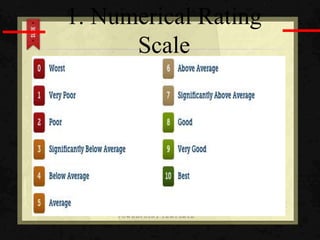
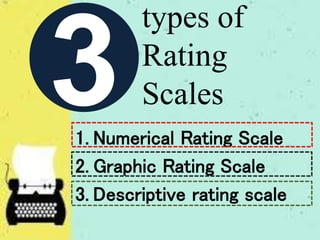
1. Numerical Rating Scale
2. Graphic Rating Scale
3. Descriptive rating scale
1. Numerical Rating
Scale
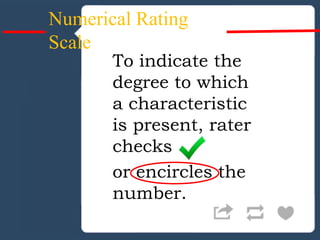
Numerical Rating
Scale
To indicate the
degree to which
a characteristic
is present, rater
checks
or encircles the
number.
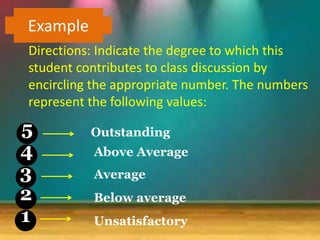
Example
Directions: Indicate the degree to which this
student contributes to class discussion by
encircling the appropriate number. The numbers
represent the following values:
5
4
3
2
1
Outstanding
Above Average
Average
Below average
Unsatisfactory
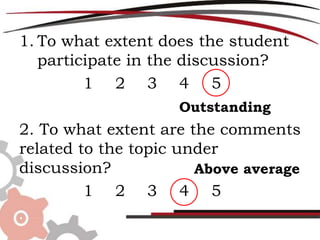
1. To what extent does the student
participate in the discussion?
1 2 3 4 5
2. To what extent are the comments
related to the topic under
discussion?
1 2 3 4 5
Outstanding
Above average
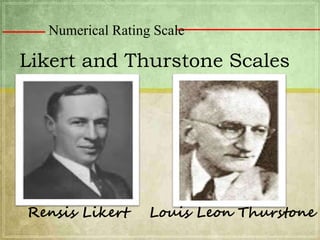
Likert and Thurstone Scales
Numerical Rating Scale
Rensis Likert Louis Leon Thurstone

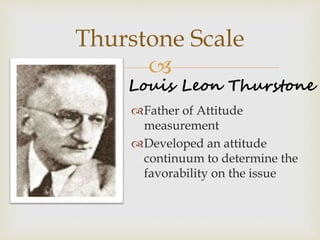
Father of Attitude
measurement
Developed an attitude
continuum to determine the
favorability on the issue
Thurstone Scale
Louis Leon Thurstone

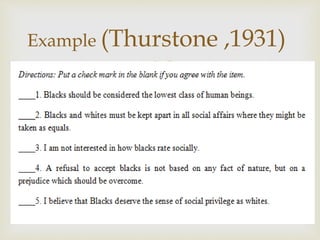
Example (Thurstone ,1931)
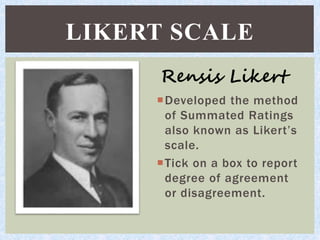
Developed the method
of Summated Ratings
also known as Likert’s
scale.
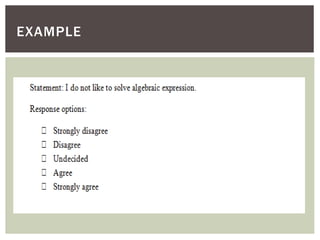
Tick on a box to report
degree of agreement
or disagreement.
LIKERT SCALE
Rensis Likert
EXAMPLE
Likert and Thurstone Scale
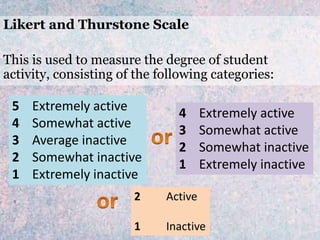
This is used to measure the degree of student
activity, consisting of the following categories:
5 Extremely active
4 Somewhat active
3 Average inactive
2 Somewhat inactive
1 Extremely inactive
2 Active
1 Inactive
4 Extremely active
3 Somewhat active
2 Somewhat inactive
1 Extremely inactive
Numerical Rating Scale
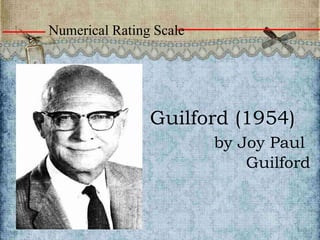
Guilford (1954)
by Joy Paul
Guilford
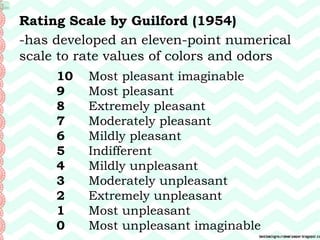
Rating Scale by Guilford (1954)
-has developed an eleven-point numerical
scale to rate values of colors and odors
10 Most pleasant imaginable
9 Most pleasant
8 Extremely pleasant
7 Moderately pleasant
6 Mildly pleasant
5 Indifferent
4 Mildly unpleasant
3 Moderately unpleasant
2 Extremely unpleasant
1 Most unpleasant
0 Most unpleasant imaginable
types of
Rating
Scales
1. Numerical Rating Scale
2. Graphic Rating Scale
3. Descriptive rating scale
2. Graphic
Rating Scale
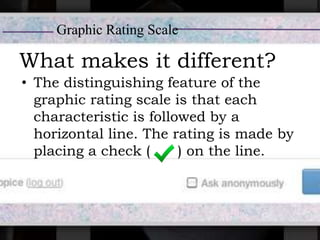
What makes it different?
• The distinguishing feature of the
graphic rating scale is that each
characteristic is followed by a
horizontal line. The rating is made by
placing a check ( ) on the line.
Graphic Rating Scale
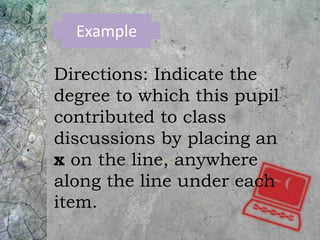
Directions: Indicate the
degree to which this pupil
contributed to class
discussions by placing an
x on the line, anywhere
along the line under each
item.
Example
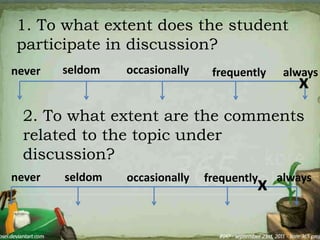
1. To what extent does the student
participate in discussion?
never seldom occasionally frequently always
x
2. To what extent are the comments
related to the topic under
discussion?
never seldom occasionally frequently always
x
types of
Rating
Scales
1. Numerical Rating Scale
2. Graphic Rating Scale
3. Descriptive rating scale
3.
Descriptive
Rating Scale
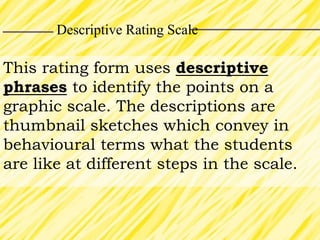
This rating form uses descriptive
phrases to identify the points on a
graphic scale. The descriptions are
thumbnail sketches which convey in
behavioural terms what the students
are like at different steps in the scale.
Descriptive Rating Scale
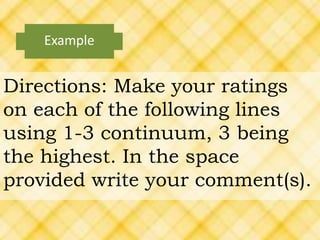
Directions: Make your ratings
on each of the following lines
using 1-3 continuum, 3 being
the highest. In the space
provided write your comment(s).
Example
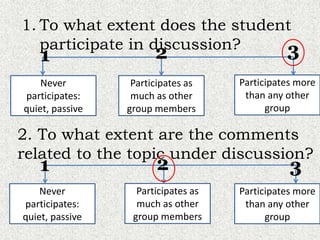
1. To what extent does the student
participate in discussion?
Never
participates:
quiet, passive
Participates as
much as other
group members
Participates more
than any other
group
2. To what extent are the comments
related to the topic under discussion?
Never
participates:
quiet, passive
Participates as
much as other
group members
Participates more
than any other
group
21 3
21 3
RATING ERRORS
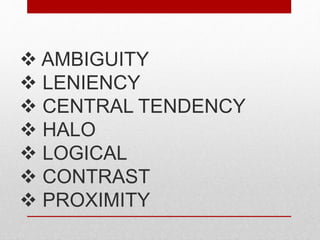
 AMBIGUITY
 LENIENCY
 CENTRAL TENDENCY
 HALO
 LOGICAL
 CONTRAST
 PROXIMITY
Ambiguity
The tendency to have different
raters interpret rating terms in
different ways.
Leniency
“ easy raters” try to concentrate
on higher end of the scale.
Central
TendencyThe reluctance to give extreme
ratings.
Halo
A gross undifferentiated rating on
a specific trait or behaviour which
is biased on an overall or total
general attitude.
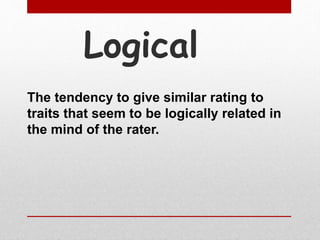
Logical
The tendency to give similar rating to
traits that seem to be logically related in
the mind of the rater.
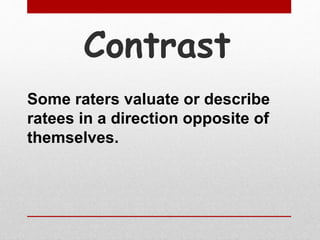
Contrast
Some raters valuate or describe
ratees in a direction opposite of
themselves.
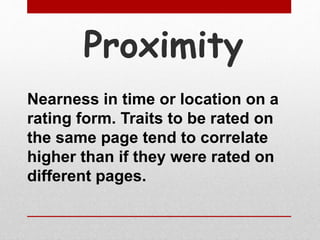
Proximity
Nearness in time or location on a
rating form. Traits to be rated on
the same page tend to correlate
higher than if they were rated on
different pages.
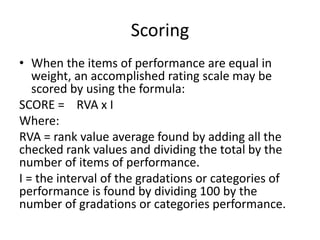
Scoring
• When the items of performance are equal in
weight, an accomplished rating scale may be
scored by using the formula:
SCORE = RVA x I
Where:
RVA = rank value average found by adding all the
checked rank values and dividing the total by the
number of items of performance.
I = the interval of the gradations or categories of
performance is found by dividing 100 by the
number of gradations or categories performance.

Rating scale

  • 4.
  • 5.
    What is aRating Scale? A rating scale is a series of numerical or descriptive ratings on a continuum. [ [
  • 6.
    Rating scales arefor… • Assessing or judging specific levels of performance. • Indicating the: degree a characteristic is present the frequency of occurrence of behaviour.
  • 7.
    types of Rating Scales 1. NumericalRating Scale 2. Graphic Rating Scale 3. Descriptive rating scale
  • 8.
  • 9.
    Numerical Rating Scale To indicatethe degree to which a characteristic is present, rater checks or encircles the number.
  • 10.
    Example Directions: Indicate thedegree to which this student contributes to class discussion by encircling the appropriate number. The numbers represent the following values: 5 4 3 2 1 Outstanding Above Average Average Below average Unsatisfactory
  • 11.
    1. To whatextent does the student participate in the discussion? 1 2 3 4 5 2. To what extent are the comments related to the topic under discussion? 1 2 3 4 5 Outstanding Above average
  • 12.
    Likert and ThurstoneScales Numerical Rating Scale Rensis Likert Louis Leon Thurstone
  • 13.
     Father of Attitude measurement Developedan attitude continuum to determine the favorability on the issue Thurstone Scale Louis Leon Thurstone
  • 14.
  • 15.
    Developed the method ofSummated Ratings also known as Likert’s scale. Tick on a box to report degree of agreement or disagreement. LIKERT SCALE Rensis Likert
  • 16.
  • 17.
    Likert and ThurstoneScale This is used to measure the degree of student activity, consisting of the following categories: 5 Extremely active 4 Somewhat active 3 Average inactive 2 Somewhat inactive 1 Extremely inactive 2 Active 1 Inactive 4 Extremely active 3 Somewhat active 2 Somewhat inactive 1 Extremely inactive
  • 18.
    Numerical Rating Scale Guilford(1954) by Joy Paul Guilford
  • 19.
    Rating Scale byGuilford (1954) -has developed an eleven-point numerical scale to rate values of colors and odors 10 Most pleasant imaginable 9 Most pleasant 8 Extremely pleasant 7 Moderately pleasant 6 Mildly pleasant 5 Indifferent 4 Mildly unpleasant 3 Moderately unpleasant 2 Extremely unpleasant 1 Most unpleasant 0 Most unpleasant imaginable
  • 20.
    types of Rating Scales 1. NumericalRating Scale 2. Graphic Rating Scale 3. Descriptive rating scale
  • 21.
  • 22.
    What makes itdifferent? • The distinguishing feature of the graphic rating scale is that each characteristic is followed by a horizontal line. The rating is made by placing a check ( ) on the line. Graphic Rating Scale
  • 23.
    Directions: Indicate the degreeto which this pupil contributed to class discussions by placing an x on the line, anywhere along the line under each item. Example
  • 24.
    1. To whatextent does the student participate in discussion? never seldom occasionally frequently always x 2. To what extent are the comments related to the topic under discussion? never seldom occasionally frequently always x
  • 25.
    types of Rating Scales 1. NumericalRating Scale 2. Graphic Rating Scale 3. Descriptive rating scale
  • 26.
  • 27.
    This rating formuses descriptive phrases to identify the points on a graphic scale. The descriptions are thumbnail sketches which convey in behavioural terms what the students are like at different steps in the scale. Descriptive Rating Scale
  • 28.
    Directions: Make yourratings on each of the following lines using 1-3 continuum, 3 being the highest. In the space provided write your comment(s). Example
  • 29.
    1. To whatextent does the student participate in discussion? Never participates: quiet, passive Participates as much as other group members Participates more than any other group 2. To what extent are the comments related to the topic under discussion? Never participates: quiet, passive Participates as much as other group members Participates more than any other group 21 3 21 3
  • 30.
  • 31.
     AMBIGUITY  LENIENCY CENTRAL TENDENCY  HALO  LOGICAL  CONTRAST  PROXIMITY
  • 32.
    Ambiguity The tendency tohave different raters interpret rating terms in different ways.
  • 33.
    Leniency “ easy raters”try to concentrate on higher end of the scale.
  • 34.
    Central TendencyThe reluctance togive extreme ratings.
  • 35.
    Halo A gross undifferentiatedrating on a specific trait or behaviour which is biased on an overall or total general attitude.
  • 36.
    Logical The tendency togive similar rating to traits that seem to be logically related in the mind of the rater.
  • 37.
    Contrast Some raters valuateor describe ratees in a direction opposite of themselves.
  • 38.
    Proximity Nearness in timeor location on a rating form. Traits to be rated on the same page tend to correlate higher than if they were rated on different pages.
  • 40.
    Scoring • When theitems of performance are equal in weight, an accomplished rating scale may be scored by using the formula: SCORE = RVA x I Where: RVA = rank value average found by adding all the checked rank values and dividing the total by the number of items of performance. I = the interval of the gradations or categories of performance is found by dividing 100 by the number of gradations or categories performance.

Editor's Notes

  • #5 It is not uncommon for someone to ask us to rate something "from 1 to 10" with 10 being the highest score. Rating scale is one of the evalutive techniques used to adequately assss the afeective domain of learning.
  • #6 What is it? A rating scale is a series of numerical or descriptive ratings on a continuum
  • #7 What is the use? It is used to assess or judge specific levels of performance. It provides an opportunity to indicate the degree a characteristic is present (the degree to which a student exhibits a specified behavior) or the frequency of occurrence of behaviour (the number of times a behaviour occurs). It can help evaluate the quality of the behaviour of one student or many students. Generally rating scales help evaluate the quality of the behavior of the student or many students.
  • #9 One of the more common, more convenient and simplest types of rating scale. As you can see, its gradations, degrees, categories are implied and symbolized by numbers. Numerical scales generally take the form of a sequence of defined numbers. The definitions of the numbers may be in terms of degree of favourableness, frequency, pleasantness, or agreement with a statement.
  • #10 In numerical rating scales, the rater can indicate the degree to which a characteristic is present by checking or encircling the number.
  • #11 To better illustrate what rating scales are, here is an example. (Read the directions). In numerical rating scale, each number is given a verbal description which remains constant from one characteristic to another. Now in this case, the numbers represent the following values.
  • #12 For example, these are the questions. Let’s say your student is John Lloyd Cruz. Question number 1 asks, “To what extent does the student participate in discussion?”. As instructed, you are to encircle the appropriate number that best indicates the students’ participation. Let’s say Mr. John Lloyd always actively engages in class discussions, thus, taking it into consideration, we encircled 5. And by encircling 5 would mean you gave Mr. John Lloyd an Outstanding rating in this matter. For question no. 2 “It asked “To what extent are the comments related to the topic under discussion?”. Let’s say Mr. John Lloyd is a wide reader and thus provides relevant input to the discussion. But then the teacher encircled four because there is still something he needs to improve. Encircling 4 would mean the teacher gave Mr. John Lloyd an above average rating for ts question.
  • #13 Some common numerical rating scales that exist today is the Likert and Thurstone Scale. The Likert Scale is a popular format of questionnaire that is used in educational research.  It was invented by Rensis Likert, an educator and psychologist. The Likert scale can be four-point, five-point, six-point, and so on. The even-numbered scale usually forces a respondent to choose while the odd-numbered scale provides an option for indecision or neutrality. Below are the two Likert scales, the four-point and the five-point. Thurstone scale on the other hand, was developed by psychologist Loius Leon Thurstone.
  • #19 Guilford Rating scale is devised by Joy Paul Guilford (March 7, 1897 – November 26, 1987) was an American psychologist. He is well remembered for his psychometric studies of human intelligence and creativity. 
  • #23 This scale consist of a line by which a rater indicates with a mark the one most nearly representing his rating of a student.