EXAMINATION AS A TOOL
FOR ASSESSMENT
Garima Bhati
Assistant Professor
Institute of Teacher’s Education
Source: google
WHAT IS ASSESSMENT?
 "Assessment should be deliberately designed to
improve and educate student performance, not
merely to audit as most school tests currently do." -
Grant Wiggins, EdD., president and director of
programs, Relearning by Design, Ewing, New
Jersey
MEANING OF ASSESSMENT
 Assessment is the systematic basis for making inferences
about the learning and development of students. It is the
process of defining, selecting, designing, collecting, analyzing,
interpreting, and using information to increase students'
learning and development
 Assessment is the process of gathering and discussing
information from multiple and diverse sources in order to
develop a deep understanding of what students know,
understand, and can do with their knowledge as a result of
their educational experiences; the process culminates when
assessment results are used to improve subsequent learning.
FUNDAMENTAL COMPONENTS OF
ASSESSMENT
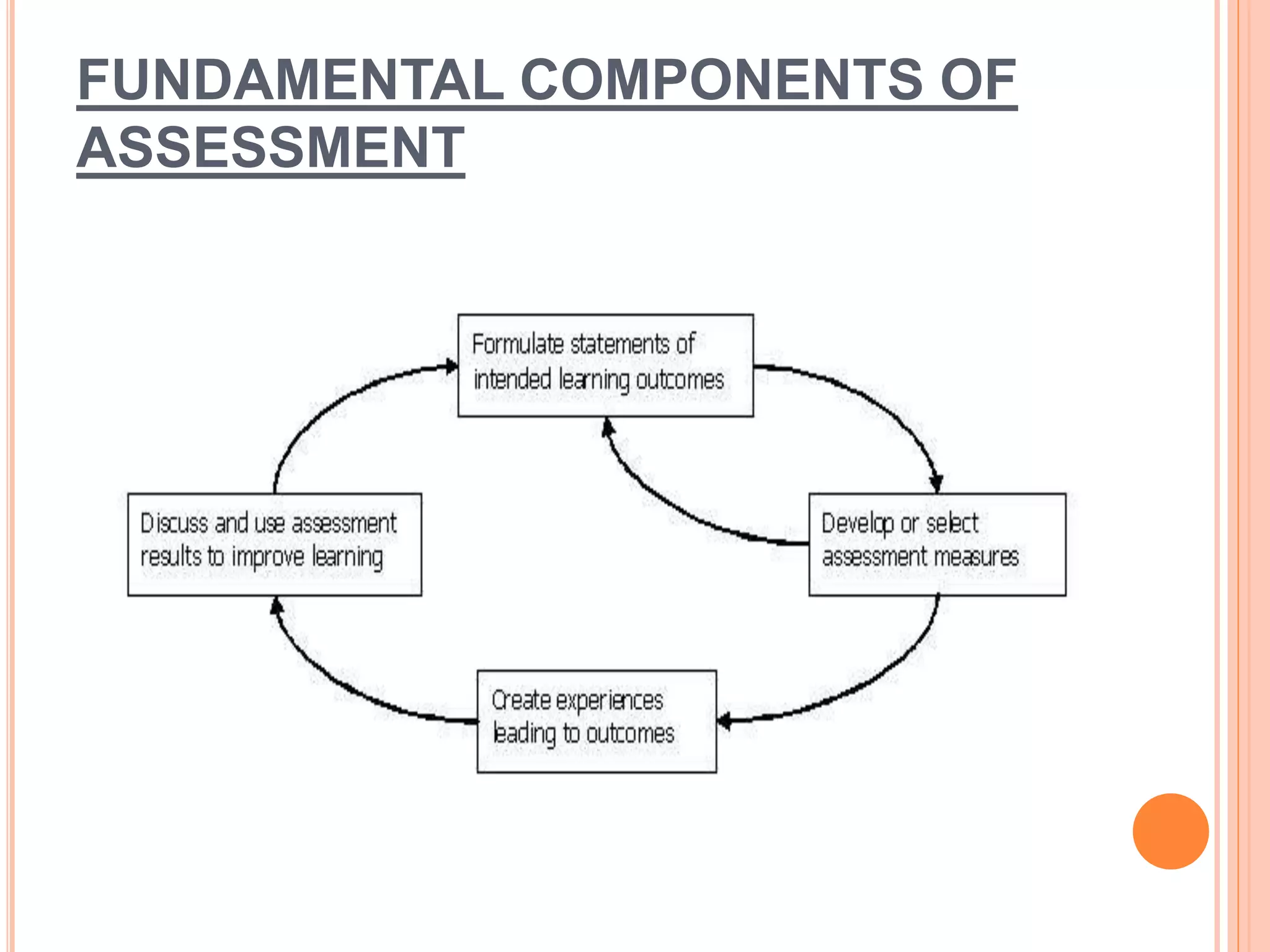
FOUR FUNDAMENTAL ELEMENTS OF LEARNER-
CENTERED ASSESSMENT:
 Formulating Statements of Intended Learning Outcomes - statements
describing intentions about what students should know, understand, and
be able to do with their knowledge when they graduate.
 Developing or Selecting Assessment Measures - designing or selecting
data gathering measures to assess whether or not our intended learning
outcomes have been achieved. Includes
 Direct assessments - projects, products, papers/theses, exhibitions,
performances, case studies, clinical evaluations, portfolios,
interviews, and oral exams - which ask students to demonstrate what
they know or can do with their knowledge.
 Indirect assessments - self-report measures such as surveys - in
which respondents share their perceptions about what graduates
know or can do with their knowledge.
 Creating Experiences Leading to Outcomes - ensuring that students
have experiences both in and outside their courses that help them
achieve the intended learning outcomes.
 Discussing and Using Assessment Results to Improve Teaching and
Learning - using the results to improve individual student performance.
THE ASSESSMENT CYCLE
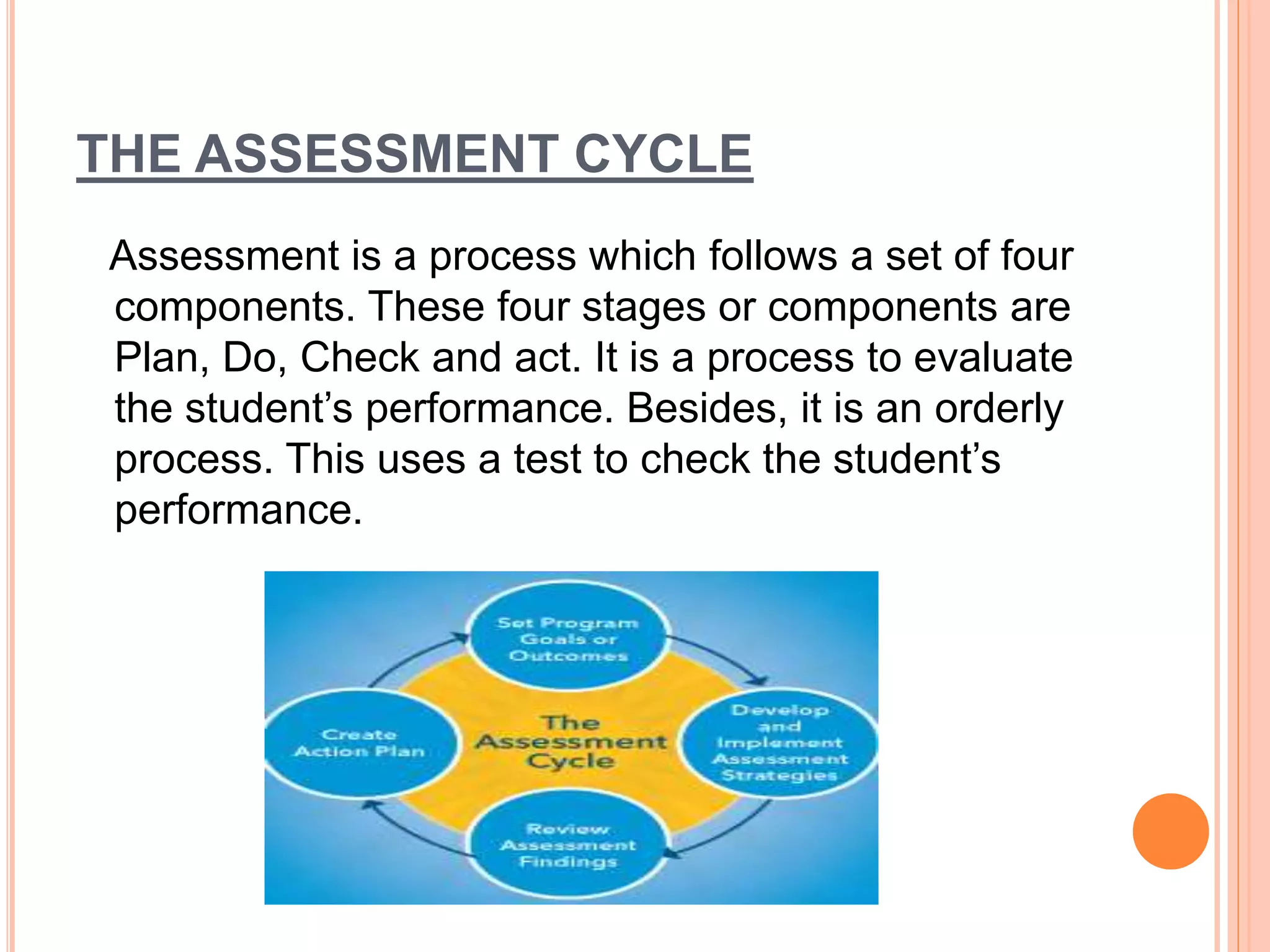
Assessment is a process which follows a set of four
components. These four stages or components are
Plan, Do, Check and act. It is a process to evaluate
the student’s performance. Besides, it is an orderly
process. This uses a test to check the student’s
performance.
THE ASSESSMENT CYCLE
 Plan - What do I want students to learn?
This stage includes the first fundamental component of
assessment: Formulating Statements of Intended
Learning Outcomes
 Do - How do I teach effectively?
This stage includes the second and third fundamental
components: Developing or Selecting Assessment
Measures & Creating Experiences Leading to
Outcomes.
 Check - Are my outcomes being met?
This stage involves evaluation of assessment data (part
of the fourth component).
 Act - How do I use what I've learned?
This stage involves reinforcing successful practices and
making revisions to enhance student learning (part of
the fourth component).
TYPES OF ASSESSMENT
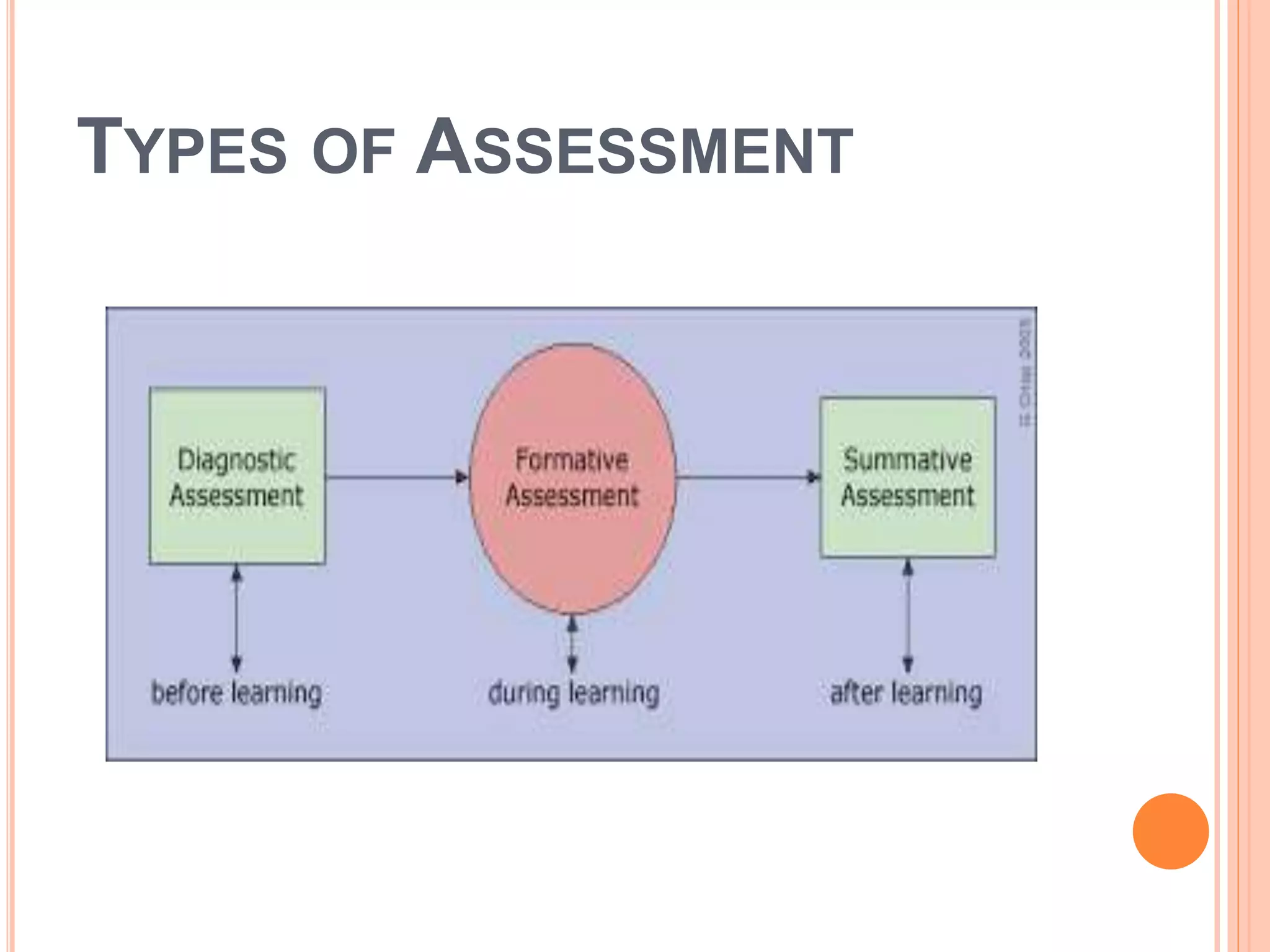
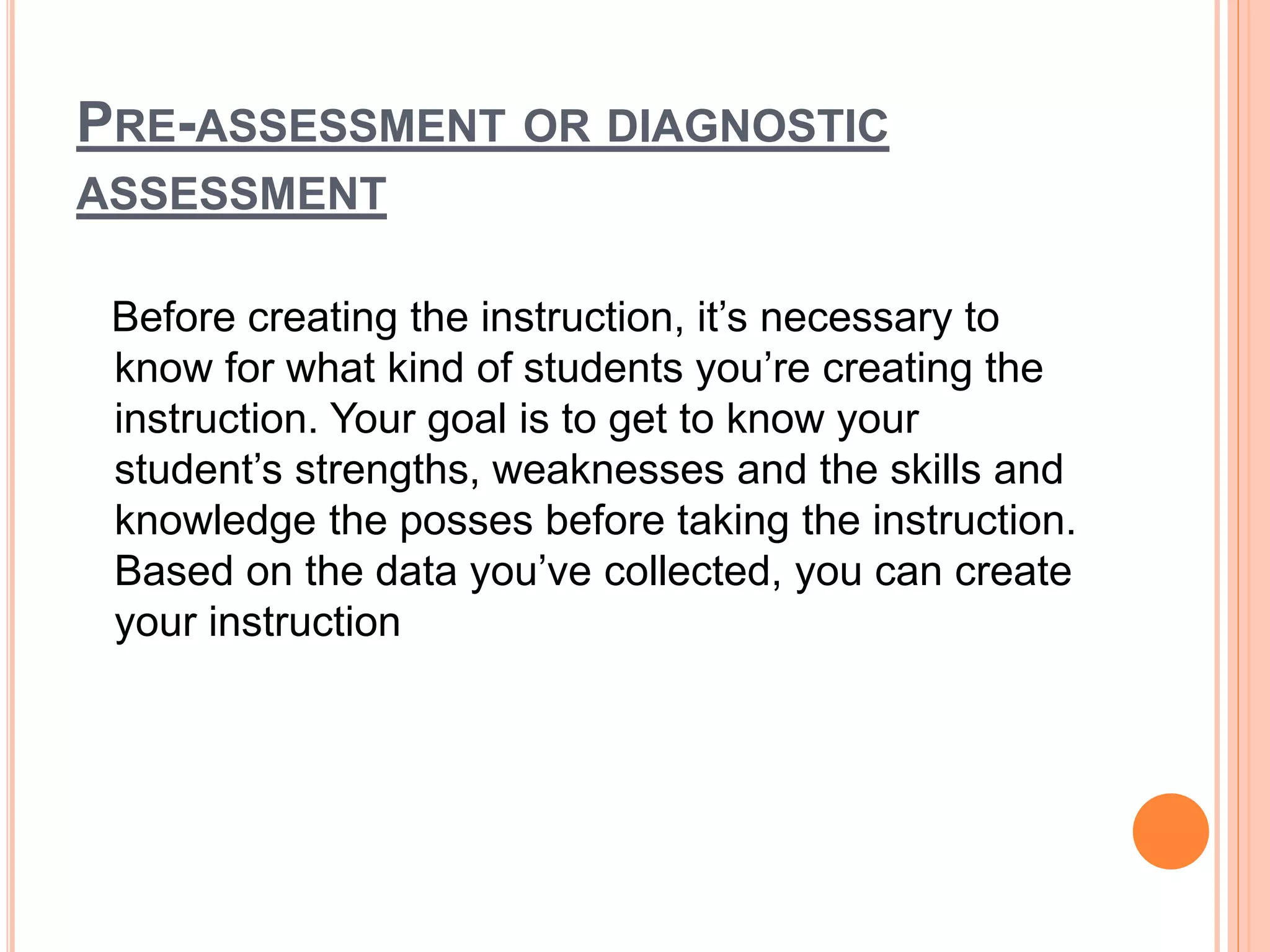
PRE-ASSESSMENT OR DIAGNOSTIC
ASSESSMENT
Before creating the instruction, it’s necessary to
know for what kind of students you’re creating the
instruction. Your goal is to get to know your
student’s strengths, weaknesses and the skills and
knowledge the posses before taking the instruction.
Based on the data you’ve collected, you can create
your instruction
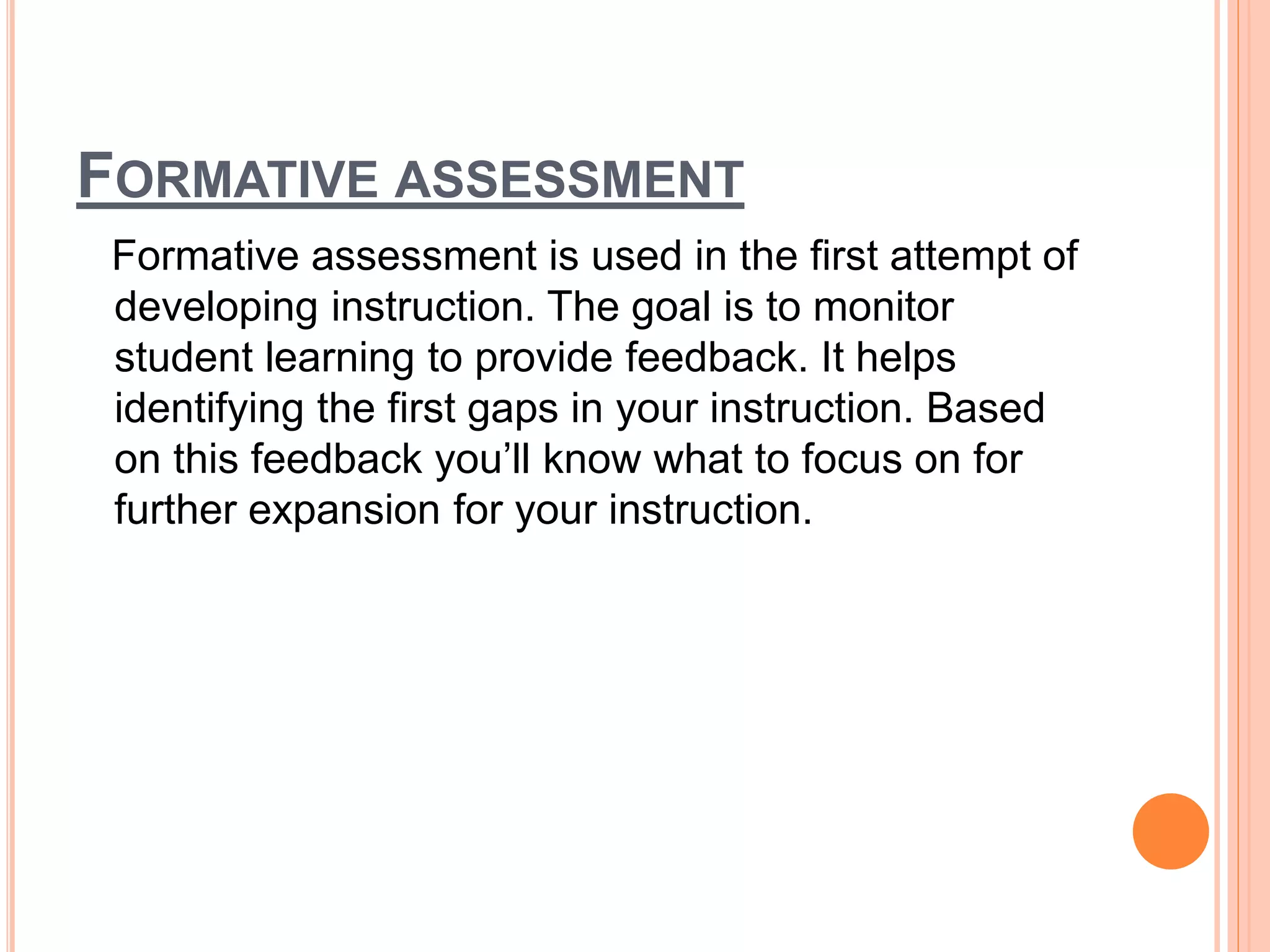
FORMATIVE ASSESSMENT
Formative assessment is used in the first attempt of
developing instruction. The goal is to monitor
student learning to provide feedback. It helps
identifying the first gaps in your instruction. Based
on this feedback you’ll know what to focus on for
further expansion for your instruction.
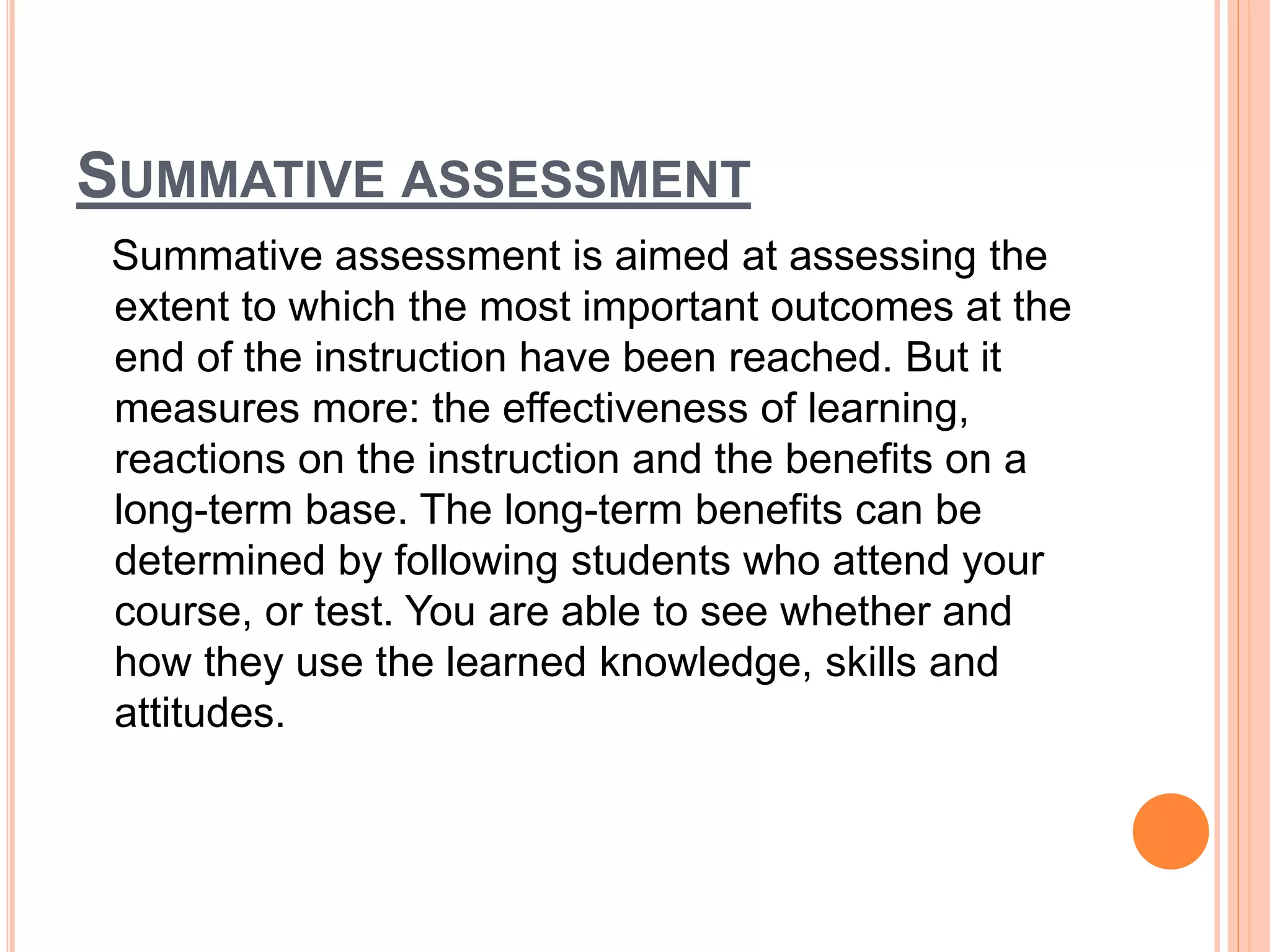
SUMMATIVE ASSESSMENT
Summative assessment is aimed at assessing the
extent to which the most important outcomes at the
end of the instruction have been reached. But it
measures more: the effectiveness of learning,
reactions on the instruction and the benefits on a
long-term base. The long-term benefits can be
determined by following students who attend your
course, or test. You are able to see whether and
how they use the learned knowledge, skills and
attitudes.
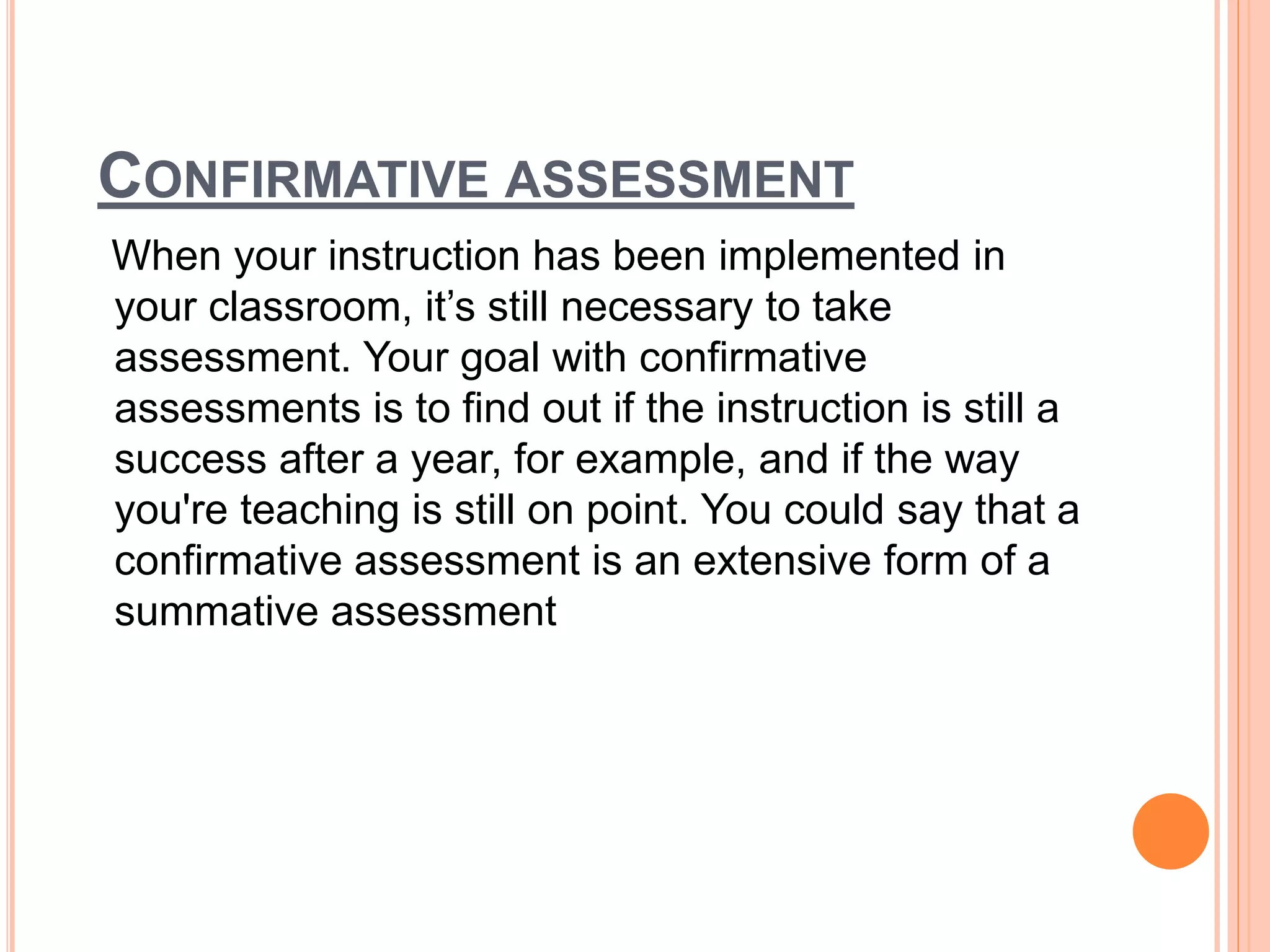
CONFIRMATIVE ASSESSMENT
When your instruction has been implemented in
your classroom, it’s still necessary to take
assessment. Your goal with confirmative
assessments is to find out if the instruction is still a
success after a year, for example, and if the way
you're teaching is still on point. You could say that a
confirmative assessment is an extensive form of a
summative assessment
NORM-REFERENCED ASSESSMENT
This compares a student’s performance against an
average norm. This could be the average national
norm for the subject History, for example. Other
example is when the teacher compares the average
grade of his or her students against the average
grade of the entire school.
CRITERION-REFERENCED
ASSESSMENT
It measures student’s performances against a fixed
set of predetermined criteria or learning standards.
It checks what students are expected to know and
be able to do at a specific stage of their education.
Criterion-referenced tests are used to evaluate a
specific body of knowledge or skill set, it’s a test to
evaluate the curriculum taught in a course.
IPSATIVE ASSESSMENT
It measures the performance of a student against
previous performances from that student. With this
method you’re trying to improve yourself by
comparing previous results. You’re not comparing
yourself against other students, which may be not
so good for your self-confidence.
WORK INTEGRATED ASSESSMENT
This type of assessment is where the tasks and
situations are closely associated with what you
experience. It helps to develop student’s skills and
capabilities along with educational
development.Also, this helps and support
educational staff to design genuine assessments. It
designs according to the need of the teacher.
DYNAMIC ASSESSMENT
It measures what students can achieve when
teaches about unfamiliar topic or field. An example
can be teaching students Spanish for a short while.
It helps to see how students who do not have any
prior knowledge adopt it.It can be helpful to review
the potential for students who have a mainly
underprivileged backdrop. Frequently it is used in
advance of the main body of teaching.
SYNOPTIC ASSESSMENT
It gives confidence students to unite elements of
their learning from different parts of a plan and to
show their build up knowledge and thoughtful of a
topic or subject area.It basically enables students to
show their talents and skills. And it shows how in-
depth knowledge they have about the subject.
Basically, it helps in measuring the capacity to
apply knowledge to understand the subject.
IMPORTANCE OF ASSESMENT
PROVIDES DIAGNOSTIC FEEDBACK
 What is the student's knowledge base?
 What is the student's performance base?
 What are the student's needs?
 What has to be taught?
HELPS EDUCATORS SET STANDARDS
 What performance demonstrates understanding?
 What performance demonstrates knowledge?
 What performance demonstrates mastery?
EVALUATES PROGRESS
 How is the student doing?
 What teaching methods or approaches are most
effective?
 What changes or modifications to a lesson are
needed to help the student?
RELATES TO A STUDENT'S PROGRESS
 What has the student learned?
 Can the student talk about the new knowledge?
 Can the student demonstrate and use the new skills
in other projects?
MOTIVATES PERFORMANCE
For student self-evaluation:
 Now that I'm in charge of my learning, how am I
doing?
 Now that I know how I'm doing, how can I do
better?
 What else would I like to learn?
For teacher self-evaluation:
 What is working for the students?
 What can I do to help the students more?
 In what direction should we go next?
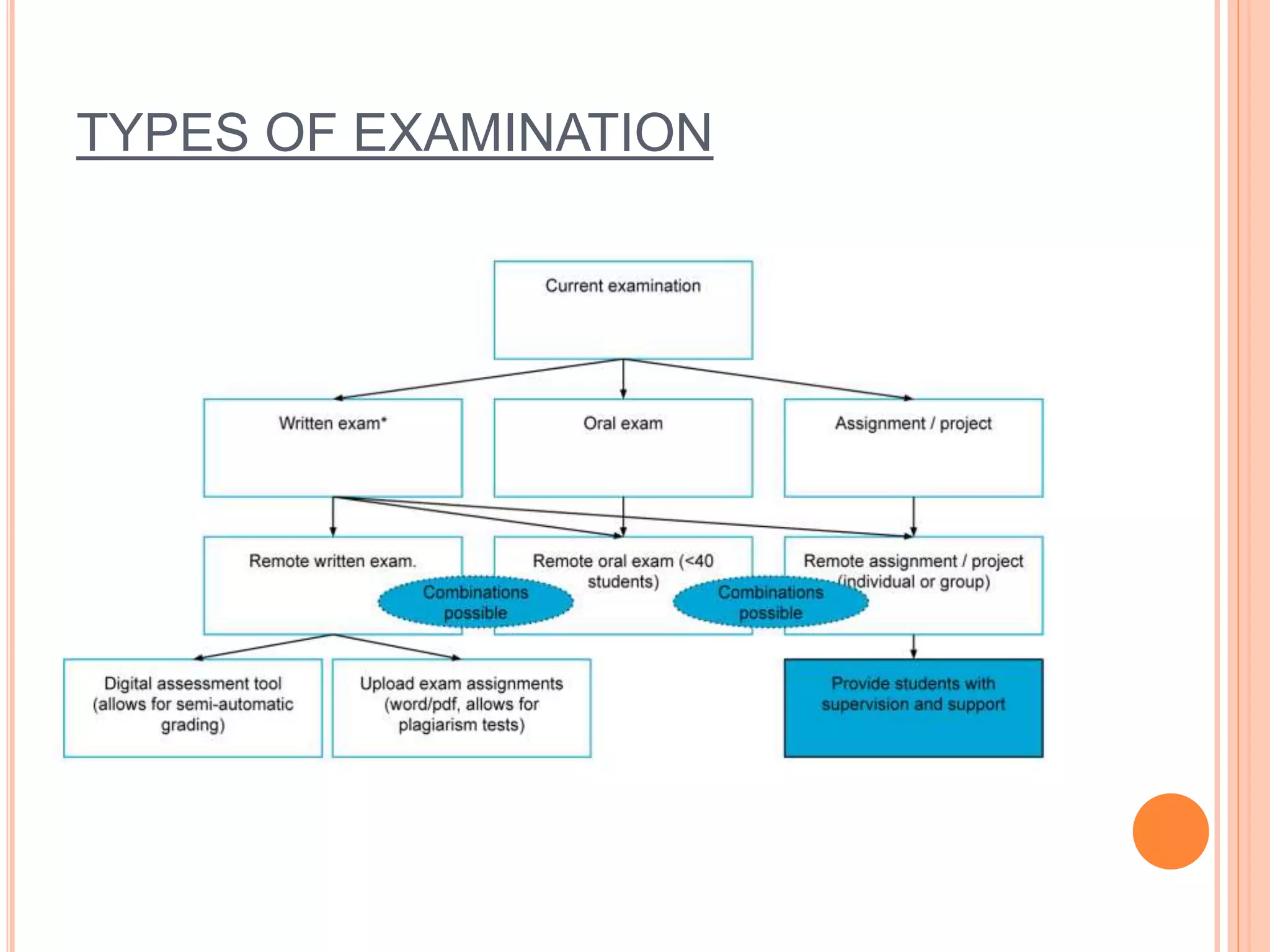
TYPES OF EXAMINATION
WRITTEN EXAMINATION
 This type of exam is old school; your great
granddad most likely had to do these exams, so
they have been around for a while. The first thing to
mention to anyone about to sit an exam like this in
university is that you should have some idea of the
structure and the content of the essay before you
begin to write it.
ORAL EXAMS
The oral exam (also oral test or viva voce;
Rigorosum in German-speaking nations) is a
practice in many schools and disciplines in which
an examiner poses questions to the student in
spoken form. The student has to answer the
question in such a way as to demonstrate sufficient
knowledge of the subject to pass the exam.
OPEN-BOOK AND TAKE-HOME EXAMS
Open book and take home exams are slightly more unusual
as they don’t require you to revise in the same way as a more
traditional exam. However, because you have access to your
notes and to your text books the examiners are obviously
going to expect much more detail and content than they would
in a closed book exam. A good idea before you start an exam
like this would be to have all your relevant notes and texts
organized, all in one place before you begin the exam. As
there is no point in having an open book exam if you can’t find
the right book on the day of the exam!
PROBLEM OR CASE-BASED EXAMS
 Problem or cased based exams are really designed
to test your analytical skills, and how well you can
evaluate, respond and deal with certain problem or
situation. These types of exams are supposed to be
simulations of a possible real life situation.In some
regards this type of exam is really testing how well
you can think on your feet, and how skilled you are
at applying your knowledge to a specific set of
circumstances. If you just write down everything
you know in a list, you will fail this type of exam, as
that is not what examiners in this type of exam are
looking for.
MULTIPLE-CHOICE EXAMS
Another common type of exam that you may have
to complete comprises of multiple choice questions
or MCQ’s as they are known. These exams really
test your ability to recall and connect the correct
information to the question. As you usually have to
pick the correct answer from a series of statements
it simulates a more real life situation where you
would have a number of choices and need to
choose the correct one.
Examination as a tool for Assessment

Examination as a tool for Assessment

  • 1.
    EXAMINATION AS ATOOL FOR ASSESSMENT Garima Bhati Assistant Professor Institute of Teacher’s Education Source: google
  • 2.
    WHAT IS ASSESSMENT? "Assessment should be deliberately designed to improve and educate student performance, not merely to audit as most school tests currently do." - Grant Wiggins, EdD., president and director of programs, Relearning by Design, Ewing, New Jersey
  • 3.
    MEANING OF ASSESSMENT Assessment is the systematic basis for making inferences about the learning and development of students. It is the process of defining, selecting, designing, collecting, analyzing, interpreting, and using information to increase students' learning and development  Assessment is the process of gathering and discussing information from multiple and diverse sources in order to develop a deep understanding of what students know, understand, and can do with their knowledge as a result of their educational experiences; the process culminates when assessment results are used to improve subsequent learning.
  • 4.
  • 5.
    FOUR FUNDAMENTAL ELEMENTSOF LEARNER- CENTERED ASSESSMENT:  Formulating Statements of Intended Learning Outcomes - statements describing intentions about what students should know, understand, and be able to do with their knowledge when they graduate.  Developing or Selecting Assessment Measures - designing or selecting data gathering measures to assess whether or not our intended learning outcomes have been achieved. Includes  Direct assessments - projects, products, papers/theses, exhibitions, performances, case studies, clinical evaluations, portfolios, interviews, and oral exams - which ask students to demonstrate what they know or can do with their knowledge.  Indirect assessments - self-report measures such as surveys - in which respondents share their perceptions about what graduates know or can do with their knowledge.  Creating Experiences Leading to Outcomes - ensuring that students have experiences both in and outside their courses that help them achieve the intended learning outcomes.  Discussing and Using Assessment Results to Improve Teaching and Learning - using the results to improve individual student performance.
  • 6.
    THE ASSESSMENT CYCLE Assessmentis a process which follows a set of four components. These four stages or components are Plan, Do, Check and act. It is a process to evaluate the student’s performance. Besides, it is an orderly process. This uses a test to check the student’s performance.
  • 7.
    THE ASSESSMENT CYCLE Plan - What do I want students to learn? This stage includes the first fundamental component of assessment: Formulating Statements of Intended Learning Outcomes  Do - How do I teach effectively? This stage includes the second and third fundamental components: Developing or Selecting Assessment Measures & Creating Experiences Leading to Outcomes.  Check - Are my outcomes being met? This stage involves evaluation of assessment data (part of the fourth component).  Act - How do I use what I've learned? This stage involves reinforcing successful practices and making revisions to enhance student learning (part of the fourth component).
  • 8.
  • 9.
    PRE-ASSESSMENT OR DIAGNOSTIC ASSESSMENT Beforecreating the instruction, it’s necessary to know for what kind of students you’re creating the instruction. Your goal is to get to know your student’s strengths, weaknesses and the skills and knowledge the posses before taking the instruction. Based on the data you’ve collected, you can create your instruction
  • 10.
    FORMATIVE ASSESSMENT Formative assessmentis used in the first attempt of developing instruction. The goal is to monitor student learning to provide feedback. It helps identifying the first gaps in your instruction. Based on this feedback you’ll know what to focus on for further expansion for your instruction.
  • 11.
    SUMMATIVE ASSESSMENT Summative assessmentis aimed at assessing the extent to which the most important outcomes at the end of the instruction have been reached. But it measures more: the effectiveness of learning, reactions on the instruction and the benefits on a long-term base. The long-term benefits can be determined by following students who attend your course, or test. You are able to see whether and how they use the learned knowledge, skills and attitudes.
  • 12.
    CONFIRMATIVE ASSESSMENT When yourinstruction has been implemented in your classroom, it’s still necessary to take assessment. Your goal with confirmative assessments is to find out if the instruction is still a success after a year, for example, and if the way you're teaching is still on point. You could say that a confirmative assessment is an extensive form of a summative assessment
  • 13.
    NORM-REFERENCED ASSESSMENT This comparesa student’s performance against an average norm. This could be the average national norm for the subject History, for example. Other example is when the teacher compares the average grade of his or her students against the average grade of the entire school.
  • 14.
    CRITERION-REFERENCED ASSESSMENT It measures student’sperformances against a fixed set of predetermined criteria or learning standards. It checks what students are expected to know and be able to do at a specific stage of their education. Criterion-referenced tests are used to evaluate a specific body of knowledge or skill set, it’s a test to evaluate the curriculum taught in a course.
  • 15.
    IPSATIVE ASSESSMENT It measuresthe performance of a student against previous performances from that student. With this method you’re trying to improve yourself by comparing previous results. You’re not comparing yourself against other students, which may be not so good for your self-confidence.
  • 16.
    WORK INTEGRATED ASSESSMENT Thistype of assessment is where the tasks and situations are closely associated with what you experience. It helps to develop student’s skills and capabilities along with educational development.Also, this helps and support educational staff to design genuine assessments. It designs according to the need of the teacher.
  • 17.
    DYNAMIC ASSESSMENT It measureswhat students can achieve when teaches about unfamiliar topic or field. An example can be teaching students Spanish for a short while. It helps to see how students who do not have any prior knowledge adopt it.It can be helpful to review the potential for students who have a mainly underprivileged backdrop. Frequently it is used in advance of the main body of teaching.
  • 18.
    SYNOPTIC ASSESSMENT It givesconfidence students to unite elements of their learning from different parts of a plan and to show their build up knowledge and thoughtful of a topic or subject area.It basically enables students to show their talents and skills. And it shows how in- depth knowledge they have about the subject. Basically, it helps in measuring the capacity to apply knowledge to understand the subject.
  • 19.
  • 20.
    PROVIDES DIAGNOSTIC FEEDBACK What is the student's knowledge base?  What is the student's performance base?  What are the student's needs?  What has to be taught?
  • 21.
    HELPS EDUCATORS SETSTANDARDS  What performance demonstrates understanding?  What performance demonstrates knowledge?  What performance demonstrates mastery?
  • 22.
    EVALUATES PROGRESS  Howis the student doing?  What teaching methods or approaches are most effective?  What changes or modifications to a lesson are needed to help the student?
  • 23.
    RELATES TO ASTUDENT'S PROGRESS  What has the student learned?  Can the student talk about the new knowledge?  Can the student demonstrate and use the new skills in other projects?
  • 24.
    MOTIVATES PERFORMANCE For studentself-evaluation:  Now that I'm in charge of my learning, how am I doing?  Now that I know how I'm doing, how can I do better?  What else would I like to learn? For teacher self-evaluation:  What is working for the students?  What can I do to help the students more?  In what direction should we go next?
  • 25.
  • 26.
    WRITTEN EXAMINATION  Thistype of exam is old school; your great granddad most likely had to do these exams, so they have been around for a while. The first thing to mention to anyone about to sit an exam like this in university is that you should have some idea of the structure and the content of the essay before you begin to write it.
  • 27.
    ORAL EXAMS The oralexam (also oral test or viva voce; Rigorosum in German-speaking nations) is a practice in many schools and disciplines in which an examiner poses questions to the student in spoken form. The student has to answer the question in such a way as to demonstrate sufficient knowledge of the subject to pass the exam.
  • 28.
    OPEN-BOOK AND TAKE-HOMEEXAMS Open book and take home exams are slightly more unusual as they don’t require you to revise in the same way as a more traditional exam. However, because you have access to your notes and to your text books the examiners are obviously going to expect much more detail and content than they would in a closed book exam. A good idea before you start an exam like this would be to have all your relevant notes and texts organized, all in one place before you begin the exam. As there is no point in having an open book exam if you can’t find the right book on the day of the exam!
  • 29.
    PROBLEM OR CASE-BASEDEXAMS  Problem or cased based exams are really designed to test your analytical skills, and how well you can evaluate, respond and deal with certain problem or situation. These types of exams are supposed to be simulations of a possible real life situation.In some regards this type of exam is really testing how well you can think on your feet, and how skilled you are at applying your knowledge to a specific set of circumstances. If you just write down everything you know in a list, you will fail this type of exam, as that is not what examiners in this type of exam are looking for.
  • 30.
    MULTIPLE-CHOICE EXAMS Another commontype of exam that you may have to complete comprises of multiple choice questions or MCQ’s as they are known. These exams really test your ability to recall and connect the correct information to the question. As you usually have to pick the correct answer from a series of statements it simulates a more real life situation where you would have a number of choices and need to choose the correct one.