Tools of Assessment
RATING SCALE
Assessment tools are a range of tools
and guidelines available to assist the
process of creating effective formal
assessment like observation,
discussion, questioning to asses where
learners are at in their progress along
learning continuum.
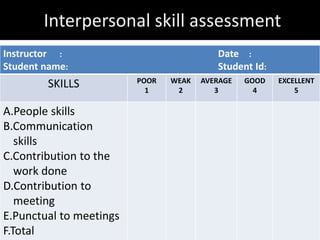
IInterpersonal skill assessment
Instructor : Date :
Student name: Student Id:
SKILLS POOR
1
WEAK
2
AVERAGE
3
GOOD
4
EXCELLENT
5
A.People skills
B.Communication
skills
C.Contribution to the
work done
D.Contribution to
meeting
E.Punctual to meetings
F.Total
Practicum performance assessment
PERFORMANCE AREA NEEDS
IMPROVEMENT
AVERAGE ABOVE
AVERAGE
REMARKS
A.Attitude
Punctuality
Respectful of
equipment
Conscientions
in work
 B.Quality of
work done.
RATING SCALE
 A rating scale is a tool used for assessing the
performance of tasks, skill levels, procedures,
processes, qualities, quantities or end products,
such as reports, drawings, computer programmes.
Similar to checklists but indicates the degree of
accomplishment rather than just ‘YES’ or ‘NO’.
 Lists the performance statement in one column
and the range of accomplishment in descriptive
words, with or without numbers, in other columns.
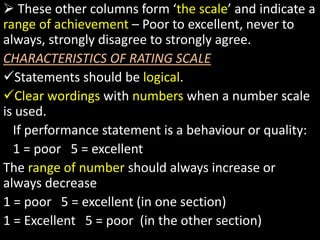
 These other columns form ‘the scale’ and indicate a
range of achievement – Poor to excellent, never to
always, strongly disagree to strongly agree.
CHARACTERISTICS OF RATING SCALE
Statements should be logical.
Clear wordings with numbers when a number scale
is used.
If performance statement is a behaviour or quality:
1 = poor 5 = excellent
The range of number should always increase or
always decrease
1 = poor 5 = excellent (in one section)
1 = Excellent 5 = poor (in the other section)
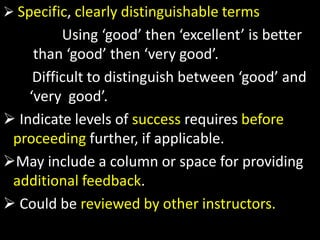
 Specific, clearly distinguishable terms
Using ‘good’ then ‘excellent’ is better
than ‘good’ then ‘very good’.
Difficult to distinguish between ‘good’ and
‘very good’.
 Indicate levels of success requires before
proceeding further, if applicable.
May include a column or space for providing
additional feedback.
 Could be reviewed by other instructors.
TYPES OF RATING SCALE.
(1) NUMERICAL SCALE:
 If the rating scale contains numbers, then it is
called numerical scale.
 Numeric values can change the meaning of scale
description.
Schwarz et al., found that the responses of German
adults to the question of “How successful would
you say you have been in life?”
Scale range 0 (not at all successful) – 10
(extremely successful).
34% selected values between 0 & 5
When the scale went from -5 (not at all
successful) to +5 (extremely successful).
13% selected the values -5 to 0.
Indicates that use of the ‘right’ description for a
scale is not enough.
Results can be affected by the numeric values
attached to the descriptors.
(2) A GRAPHIC RATING:
 Any rating scale consisting of points on a
continuum, is a generic label given to a broad
category of rating formats.
CHECKLIST FOR DEVELOPING A RATING SCALE.
 Determine the scale to use (words or words with
number) to represent the levels of success.
 Write a description for the meanings of each points
on the scale as needed.
 List the categories of performance to be needed.
 Clearly describe each skill.
 Arrange the skill in logical order.
 Write clear instructions for the observer.
 Ask for the feedback from other instructors before
using it with students.
MERITS OF RATING SCALE
 To evaluate skills product outcomes, activities,
interests, attitude etc..
 Easy to administer and score.
 Graphic rating scale is easier to make and less time
consuming.
Also used for quantitative methods.
 May also be used for assessment of interest,
attitude and personal characteristics.
 Adaptable and flexible research instrument.
Easy comparison.
 Reduce rate of bias and subjectivity.
DISADVANTAGES OF RATING SCALE
 Difficult to fix up rating about many aspects of an
individual.
 Can be misused.
 Sometimes it is unscientific and unreliable.
 Lack of uniformity with which terms are
interpreted by evaluators.
 Error can be occurred due to ambiguity, personality
of the rater (bias, logical error, attitude) etc.
RELEVANCE IN THE FIELD OF RESEARCH.
Clinical research:
 In psychiatric medicine, for the assessment of
severity of a patient’s conditions
 To assist with diagonostics and classification, and for
comparison of results.
Ergonomics research:
 Employs either an analogue or a category type of
scale.
Statistical research:
 Observations can be precisely noted when standard
instruments are unavailable.
CONCLUSION
Rating scale is an
important technique for evaluation. It
is the expression of opinion or
judgment regarding some situation,
object or character. Rating scale is an
improvement over checklist. There are
different types of rating scales.

Rating scale

  • 1.
    Tools of Assessment RATINGSCALE Assessment tools are a range of tools and guidelines available to assist the process of creating effective formal assessment like observation, discussion, questioning to asses where learners are at in their progress along learning continuum.
  • 2.
    IInterpersonal skill assessment Instructor: Date : Student name: Student Id: SKILLS POOR 1 WEAK 2 AVERAGE 3 GOOD 4 EXCELLENT 5 A.People skills B.Communication skills C.Contribution to the work done D.Contribution to meeting E.Punctual to meetings F.Total
  • 3.
    Practicum performance assessment PERFORMANCEAREA NEEDS IMPROVEMENT AVERAGE ABOVE AVERAGE REMARKS A.Attitude Punctuality Respectful of equipment Conscientions in work  B.Quality of work done.
  • 4.
    RATING SCALE  Arating scale is a tool used for assessing the performance of tasks, skill levels, procedures, processes, qualities, quantities or end products, such as reports, drawings, computer programmes. Similar to checklists but indicates the degree of accomplishment rather than just ‘YES’ or ‘NO’.  Lists the performance statement in one column and the range of accomplishment in descriptive words, with or without numbers, in other columns.
  • 5.
     These othercolumns form ‘the scale’ and indicate a range of achievement – Poor to excellent, never to always, strongly disagree to strongly agree. CHARACTERISTICS OF RATING SCALE Statements should be logical. Clear wordings with numbers when a number scale is used. If performance statement is a behaviour or quality: 1 = poor 5 = excellent The range of number should always increase or always decrease 1 = poor 5 = excellent (in one section) 1 = Excellent 5 = poor (in the other section)
  • 6.
     Specific, clearlydistinguishable terms Using ‘good’ then ‘excellent’ is better than ‘good’ then ‘very good’. Difficult to distinguish between ‘good’ and ‘very good’.  Indicate levels of success requires before proceeding further, if applicable. May include a column or space for providing additional feedback.  Could be reviewed by other instructors.
  • 7.
    TYPES OF RATINGSCALE. (1) NUMERICAL SCALE:  If the rating scale contains numbers, then it is called numerical scale.  Numeric values can change the meaning of scale description. Schwarz et al., found that the responses of German adults to the question of “How successful would you say you have been in life?”
  • 8.
    Scale range 0(not at all successful) – 10 (extremely successful). 34% selected values between 0 & 5 When the scale went from -5 (not at all successful) to +5 (extremely successful). 13% selected the values -5 to 0. Indicates that use of the ‘right’ description for a scale is not enough. Results can be affected by the numeric values attached to the descriptors.
  • 9.
    (2) A GRAPHICRATING:  Any rating scale consisting of points on a continuum, is a generic label given to a broad category of rating formats. CHECKLIST FOR DEVELOPING A RATING SCALE.  Determine the scale to use (words or words with number) to represent the levels of success.  Write a description for the meanings of each points on the scale as needed.  List the categories of performance to be needed.  Clearly describe each skill.  Arrange the skill in logical order.
  • 10.
     Write clearinstructions for the observer.  Ask for the feedback from other instructors before using it with students. MERITS OF RATING SCALE  To evaluate skills product outcomes, activities, interests, attitude etc..  Easy to administer and score.  Graphic rating scale is easier to make and less time consuming. Also used for quantitative methods.  May also be used for assessment of interest, attitude and personal characteristics.
  • 11.
     Adaptable andflexible research instrument. Easy comparison.  Reduce rate of bias and subjectivity. DISADVANTAGES OF RATING SCALE  Difficult to fix up rating about many aspects of an individual.  Can be misused.  Sometimes it is unscientific and unreliable.  Lack of uniformity with which terms are interpreted by evaluators.  Error can be occurred due to ambiguity, personality of the rater (bias, logical error, attitude) etc.
  • 12.
    RELEVANCE IN THEFIELD OF RESEARCH. Clinical research:  In psychiatric medicine, for the assessment of severity of a patient’s conditions  To assist with diagonostics and classification, and for comparison of results. Ergonomics research:  Employs either an analogue or a category type of scale. Statistical research:  Observations can be precisely noted when standard instruments are unavailable.
  • 13.
    CONCLUSION Rating scale isan important technique for evaluation. It is the expression of opinion or judgment regarding some situation, object or character. Rating scale is an improvement over checklist. There are different types of rating scales.