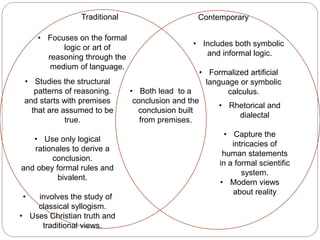
Traditional Contemporary
• Focuses on the formal
logic or art of
reasoning through the
medium of language.
• Includes both symbolic
and informal logic.
• Formalized artificial
language or symbolic
calculus.
• Studies the structural
patterns of reasoning.
and starts with premises
that are assumed to be
true.
• Use only logical
rationales to derive a
conclusion.
and obey formal rules and
bivalent.
• involves the study of
classical syllogism.
• Uses Christian truth and
traditional views.
• Rhetorical and
dialectal
• Capture the
intricacies of
human statements
in a formal scientific
system.
• Modern views
about reality
• Both lead to a
conclusion and the
conclusion built
from premises.

Logic: Definition and Benefits

  • 12.
    Traditional Contemporary • Focuseson the formal logic or art of reasoning through the medium of language. • Includes both symbolic and informal logic. • Formalized artificial language or symbolic calculus. • Studies the structural patterns of reasoning. and starts with premises that are assumed to be true. • Use only logical rationales to derive a conclusion. and obey formal rules and bivalent. • involves the study of classical syllogism. • Uses Christian truth and traditional views. • Rhetorical and dialectal • Capture the intricacies of human statements in a formal scientific system. • Modern views about reality • Both lead to a conclusion and the conclusion built from premises.