Oral, Written and
Performance Evaluation
Suresh Babu G
Assistant Professor
CTE CPAS Paippad, Kottayam
Oral Assessment
• Oral assessment is a direct means of assessing
students learning outcomes by questioning
them.
• Unlike interviews which usually have a
structured question list, oral assessment does
not usually have a structured list of questions,
assessors ask questions and request responses
depending on the circumstances
Types of Oral Assessment
• Oral assessment after a direct observation
assessment :- An oral assessment often used as
part of a de-briefing session after a practical has
been observed. Time duration 3-5 minutes and no
formal structure.
• Oral in the form of a viva voce :- A viva voice is
the Latin name for oral examination, often given
for a university examination with spoken questions
and answers. It has no set time limit.
• Oral/Aural in a language setting :- Test for
assessing a student’s level of speaking
proficiency. It is a listening test.
Structure of Oral Assessment
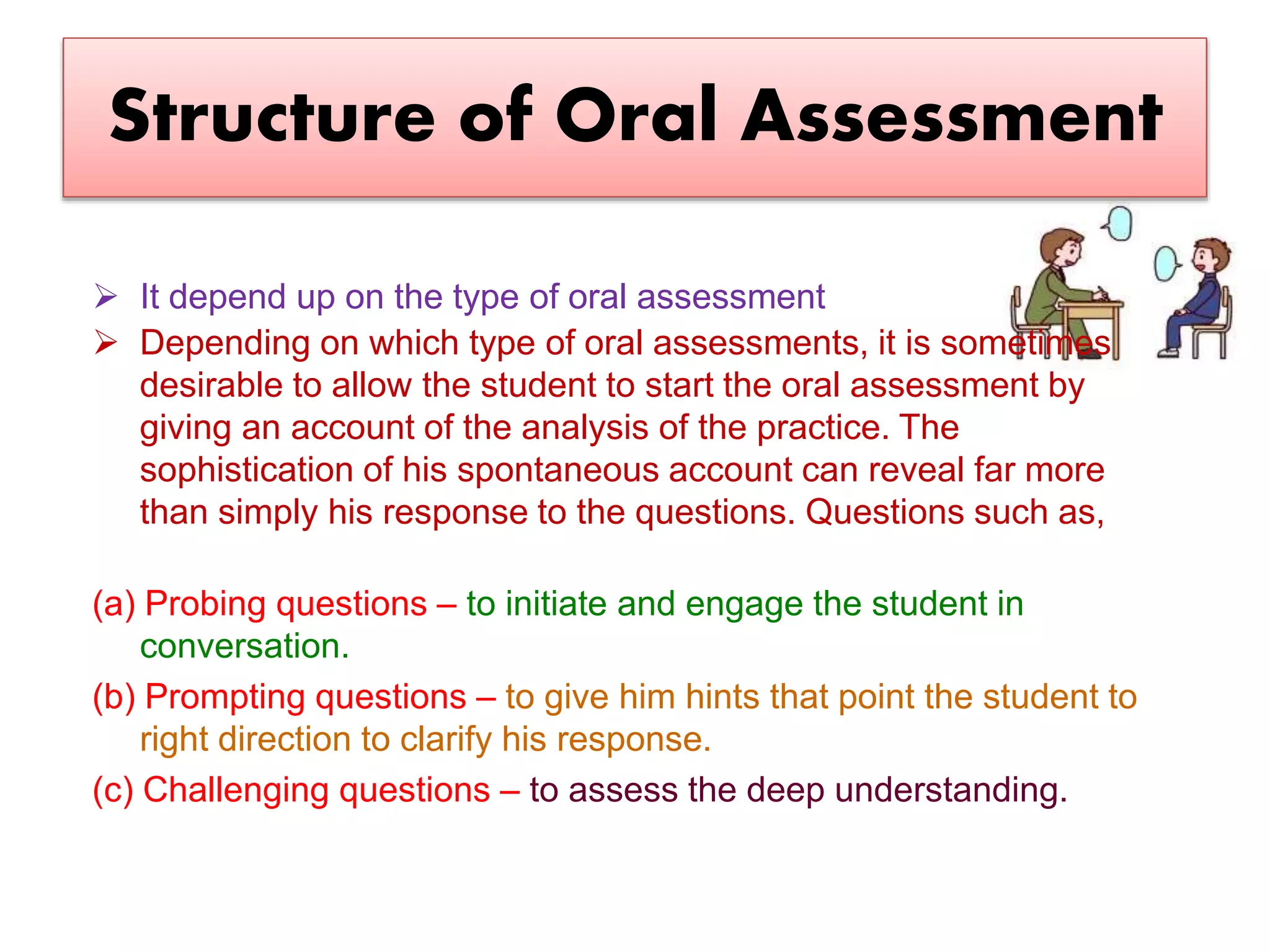
 It depend up on the type of oral assessment
 Depending on which type of oral assessments, it is sometimes
desirable to allow the student to start the oral assessment by
giving an account of the analysis of the practice. The
sophistication of his spontaneous account can reveal far more
than simply his response to the questions. Questions such as,
(a) Probing questions – to initiate and engage the student in
conversation.
(b) Prompting questions – to give him hints that point the student to
right direction to clarify his response.
(c) Challenging questions – to assess the deep understanding.
Advantages of Oral
Assessment
There can be no plagiarism or false reports.
Assessors receive immediate reactions and
response.
It complements perfectly with practical
assessments.
Disadvantage of Oral
Assessment
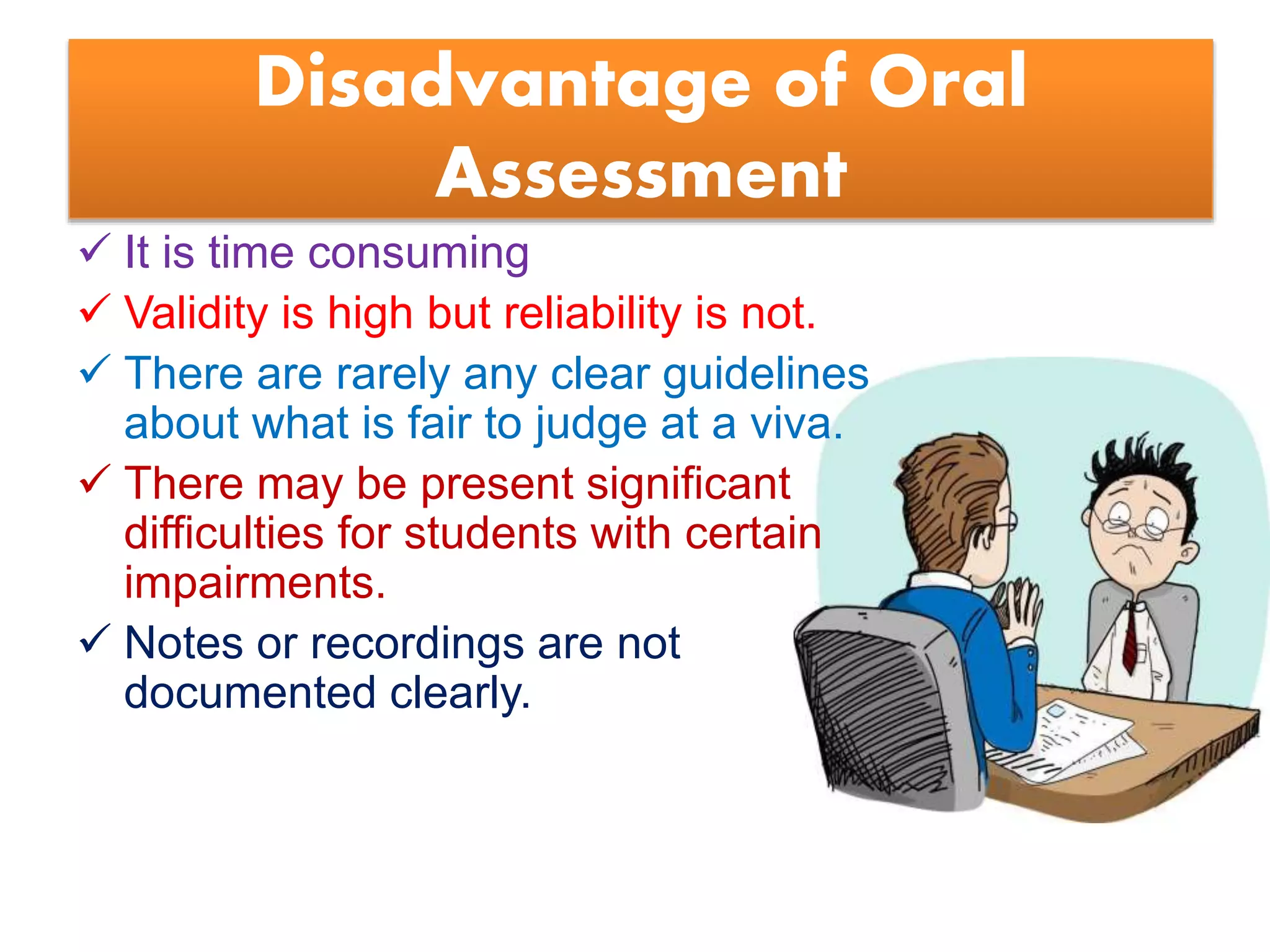
 It is time consuming
 Validity is high but reliability is not.
 There are rarely any clear guidelines
about what is fair to judge at a viva.
 There may be present significant
difficulties for students with certain
impairments.
 Notes or recordings are not
documented clearly.
Written Assessment
 It refers to an area of study that contains
theories and practices that guide the
evaluation of a writer’s performance or
potential through a writing task.
 Writing assessment can be considered a
combination of scholarship from composition
studies and measurement theory within
educational assessment.
 Writing assessment can also refer to the
technologies and practices used to evaluate
student writing and learning.
 It can be one questions, several questions or
many questions
Advantages Written
Assessment
Students are forced to demonstrate the extent
of their knowledge.
Articulation is part of the assessment.
Students cab explain their thinking.
Less time need to create.
Teachers can provide better feedback an
answers.
Performance Evaluation
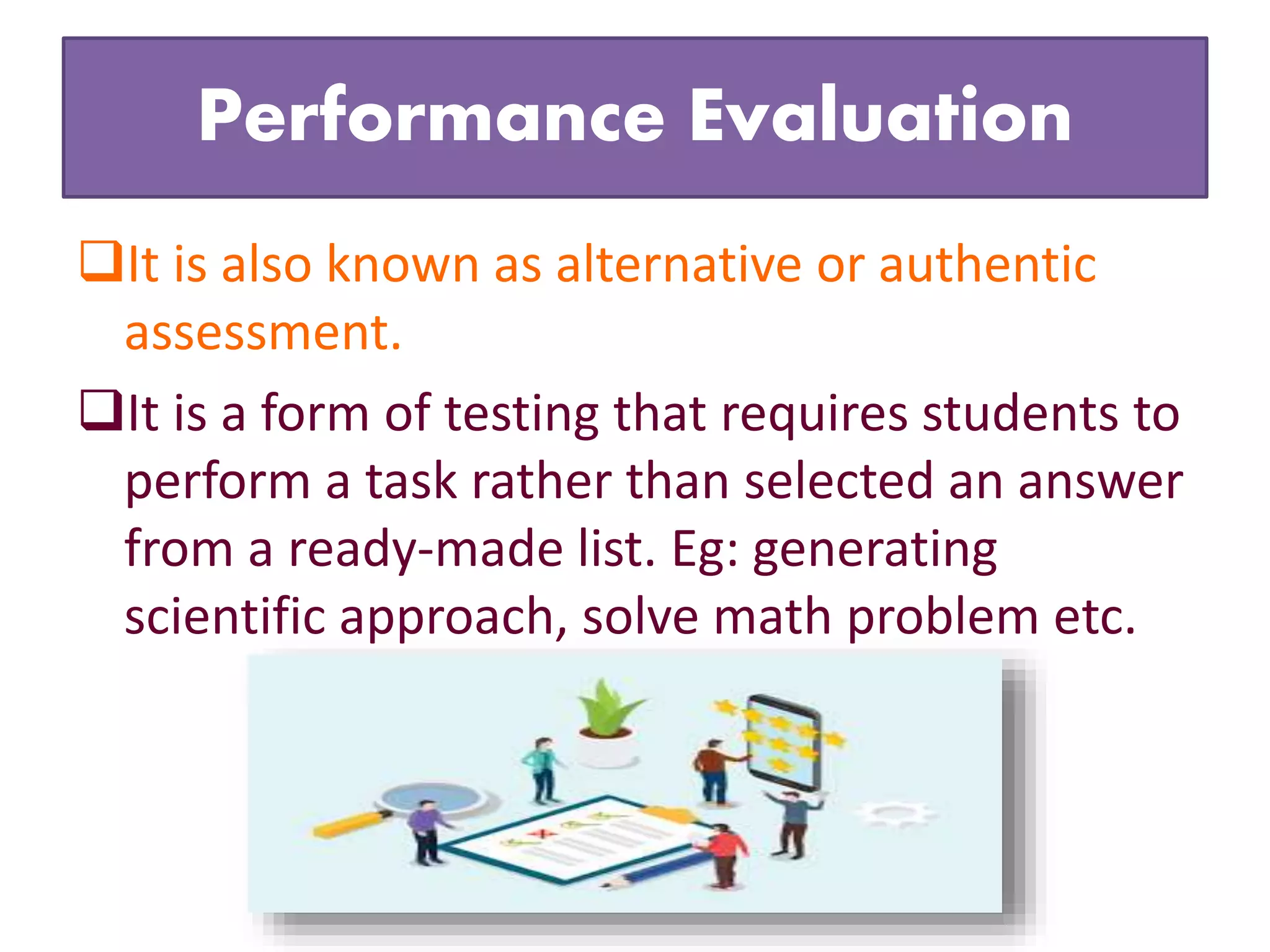
It is also known as alternative or authentic
assessment.
It is a form of testing that requires students to
perform a task rather than selected an answer
from a ready-made list. Eg: generating
scientific approach, solve math problem etc.
Features of Performance
Evaluation
 Real-world scenario.
 Authentic, complex
process.
 Higher-order thinking.
 Authentic performance.
 Transparent evaluation
criteria.
Significance of Performance
Evaluation
• Personalized learning.
• Formative –to check.
• Provides Competency education.
• Leads to Standards-based education
Advantages of Performance
Evaluation
Performance evaluation prompt students to use
higher-order thinking skills such as analysis,
synthesis, and evaluation. The more
opportunities students are given to practice
these skills, the more proficient they become at
using them.
A question for you
Which test do you prefer for your student?
Oral, Written and Performance Evaluation in Education

  • 1.
    Oral, Written and PerformanceEvaluation Suresh Babu G Assistant Professor CTE CPAS Paippad, Kottayam
  • 2.
    Oral Assessment • Oralassessment is a direct means of assessing students learning outcomes by questioning them. • Unlike interviews which usually have a structured question list, oral assessment does not usually have a structured list of questions, assessors ask questions and request responses depending on the circumstances
  • 3.
    Types of OralAssessment • Oral assessment after a direct observation assessment :- An oral assessment often used as part of a de-briefing session after a practical has been observed. Time duration 3-5 minutes and no formal structure. • Oral in the form of a viva voce :- A viva voice is the Latin name for oral examination, often given for a university examination with spoken questions and answers. It has no set time limit. • Oral/Aural in a language setting :- Test for assessing a student’s level of speaking proficiency. It is a listening test.
  • 4.
    Structure of OralAssessment  It depend up on the type of oral assessment  Depending on which type of oral assessments, it is sometimes desirable to allow the student to start the oral assessment by giving an account of the analysis of the practice. The sophistication of his spontaneous account can reveal far more than simply his response to the questions. Questions such as, (a) Probing questions – to initiate and engage the student in conversation. (b) Prompting questions – to give him hints that point the student to right direction to clarify his response. (c) Challenging questions – to assess the deep understanding.
  • 5.
    Advantages of Oral Assessment Therecan be no plagiarism or false reports. Assessors receive immediate reactions and response. It complements perfectly with practical assessments.
  • 6.
    Disadvantage of Oral Assessment It is time consuming  Validity is high but reliability is not.  There are rarely any clear guidelines about what is fair to judge at a viva.  There may be present significant difficulties for students with certain impairments.  Notes or recordings are not documented clearly.
  • 7.
    Written Assessment  Itrefers to an area of study that contains theories and practices that guide the evaluation of a writer’s performance or potential through a writing task.  Writing assessment can be considered a combination of scholarship from composition studies and measurement theory within educational assessment.  Writing assessment can also refer to the technologies and practices used to evaluate student writing and learning.  It can be one questions, several questions or many questions
  • 8.
    Advantages Written Assessment Students areforced to demonstrate the extent of their knowledge. Articulation is part of the assessment. Students cab explain their thinking. Less time need to create. Teachers can provide better feedback an answers.
  • 9.
    Performance Evaluation It isalso known as alternative or authentic assessment. It is a form of testing that requires students to perform a task rather than selected an answer from a ready-made list. Eg: generating scientific approach, solve math problem etc.
  • 10.
    Features of Performance Evaluation Real-world scenario.  Authentic, complex process.  Higher-order thinking.  Authentic performance.  Transparent evaluation criteria.
  • 11.
    Significance of Performance Evaluation •Personalized learning. • Formative –to check. • Provides Competency education. • Leads to Standards-based education
  • 12.
    Advantages of Performance Evaluation Performanceevaluation prompt students to use higher-order thinking skills such as analysis, synthesis, and evaluation. The more opportunities students are given to practice these skills, the more proficient they become at using them.
  • 13.
    A question foryou Which test do you prefer for your student?