CHAPTER 6:
Development of Affective
Assessment
CONSTRUCTED- RESPONSE FORMAT
 It is a straight forward approach asking
students about their affect by responding to
simple statement or question.
 Another way to implement the constructed-
response format is by means of an essay.
 There are three ways of implanting the
selected- response format in assessing affective
learning outcomes. These are the following:
* Rating Scale * Semantic Scale
* Differential Scale * Checklist
SELECTED- RESPONSE FORMAT
 Anonymity
* It is an important aspect when
considering the traits that are personal such
as values and self-concept.
ADVANTAGE OF
SELECTED- RESPONSE FORMAT
 Checklist for using student's Self-Report to
Assess Affect (McMillan, 2007):
❶ Keep measures focused on specific traits.
SELECTED- RESPONSE FORMAT
 Checklist for using student's Self-Report to
Assess Affect (McMillan, 2007):
❷ Establish trust with students.
SELECTED- RESPONSE FORMAT
 Checklist for using student's Self-Report to
Assess Affect (McMillan, 2007):
❸ Match response format to the trait being
assessed.
SELECTED- RESPONSE FORMAT
 Checklist for using student's Self-Report to
Assess Affect (McMillan, 2007):
❹ Ensure anonymity if possible.
SELECTED- RESPONSE FORMAT
 Checklist for using student's Self-Report to
Assess Affect (McMillan, 2007):
❺ Keep questionnaires brief.
SELECTED- RESPONSE FORMAT
 Checklist for using student's Self-Report to
Assess Affect (McMillan, 2007):
❻ Keep items short and simple.
SELECTED- RESPONSE FORMAT
 Checklist for using student's Self-Report to
Assess Affect (McMillan, 2007):
❼ Avoid negatives and absolute.
SELECTED- RESPONSE FORMAT
 Checklist for using student's Self-Report to
Assess Affect (McMillan, 2007):
❽ Write items in present tense.
SELECTED- RESPONSE FORMAT
 Checklist for using student's Self-Report to
Assess Affect (McMillan, 2007):
❾ Avoid double-barreled items.
SELECTED- RESPONSE FORMAT
 Peer ratings or appraisal is the least common
method among the three methods of assessing
affect.
PEER RATINGS
Because of the nature of learners, they do not
always take this activity seriously and most often
than not they are subjective in conducting this
peer rating.
PEER RATINGS
Thus, peer rating is seen as relatively inefficient
in terms of nature of conducting, scoring, and
interpreting peer ratings.
PEER RATINGS
 The two methods of conducting peer ratings
are the following:
❶ Guess-who approach
PEER RATINGS
 The two methods of conducting peer ratings
are the following:
❷ Socio-metric approach
PEER RATINGS
Each of the three methods (observation, self-
report, peer ratings) has its own advantage and
disadvantages.
UTILIZING THE DIFFERENT METHODS
 In choosing for which method or methods to
used, consider the following factors:
❶ Type of affect that needs to be assessed.
UTILIZING THE DIFFERENT METHODS
 In choosing for which method or methods to
used, consider the following factors:
❷ If the information needed if from grouped or
individual responses.
UTILIZING THE DIFFERENT METHODS
 In choosing for which method or methods to
used, consider the following factors:
❸ The use of information.
UTILIZING THE DIFFERENT METHODS
 To sum it up, the choice of method or
combining these methods, is independent upon
the context, targets, and the level of comfort in
utilizing any particular method or combination
of methods.
UTILIZING THE DIFFERENT METHODS
Affective domain encompasses behaviors in
terms of attitudes, beliefs, and feelings comprise
one value.
AFFECTIVE ASSESSMENT TOOL
 There are various assessment tools that can be
used to measure affect. These are the following:
❶ Checklist
AFFECTIVE ASSESSMENT TOOL
 There are various assessment tools that can be
used to measure affect. These are the following:
❷ Rating Scale
AFFECTIVE ASSESSMENT TOOL
 There are various assessment tools that can be
used to measure affect. These are the following:
❸ Likert Scale
AFFECTIVE ASSESSMENT TOOL
 There are various assessment tools that can be
used to measure affect. These are the following:
❹ Semantic Differential Scale
AFFECTIVE ASSESSMENT TOOL
Checklist is one of the effective formative
assessment strategies to monitor specific skills,
behaviors, or dispositions of individual or group
of students (Bruke, 2009).
CHECKLIST
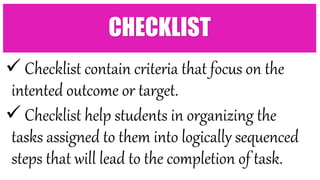
 Checklist contain criteria that focus on the
intented outcome or target.
 Checklist help students in organizing the
tasks assigned to them into logically sequenced
steps that will lead to the completion of task.
CHECKLIST
CHECKLIST
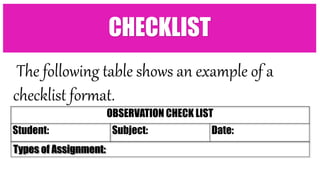
OBSERVATION CHECK LIST
Student: Subject: Date:
Types of Assignment:
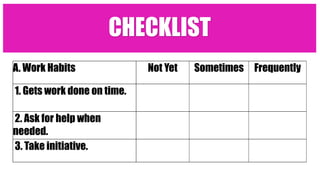
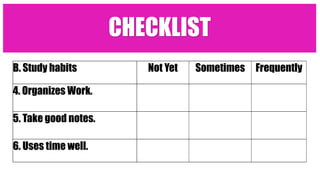
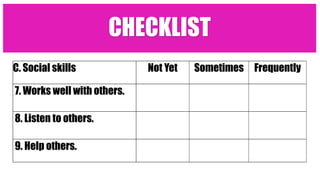
The following table shows an example of a
checklist format.
CHECKLIST
A. Work Habits Not Yet Sometimes Frequently
1. Gets work done on time.
2. Ask for help when
needed.
3. Take initiative.
CHECKLIST
B. Study habits Not Yet Sometimes Frequently
4. Organizes Work.
5. Take good notes.
6. Uses time well.
CHECKLIST
C. Social skills Not Yet Sometimes Frequently
7. Works well with others.
8. Listen to others.
9. Help others.
CHECKLIST
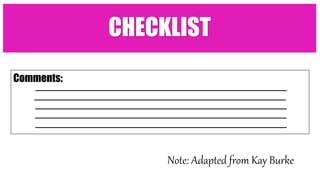
Comments:
Note: Adapted from Kay Burke
 In planning for criteria that will be used in
checklist, the criteria must be aligned with the
outcomes that needs to be observed and
measured.
CRITERIA FOR CHECKLIST
 Popham (1999) explains that when the
teachers set criteria, the main emphasis is to use
these criteria in making judgement regarding on
the adequacy of student responses and the
criteria will influence the way the response is
scored.
CRITERIA FOR CHECKLIST
 Checklist should be utilized because these:
❶ Make a quick and easy way to observe and
record skills, criteria, and behaviors prior to
final test or summative evaluation.
WHY USE CHECKLIST
 Checklist should be utilized because these:
❷ Provide information to teachers if there are
students who need help so as to avoid failing.
WHY USE CHECKLIST
 Checklist should be utilized because these:
❸ Provide formative assessment for students'
learning and help teachers monitor if students
are on track with the desired outcomes.
WHY USE CHECKLIST
 According to Nitko (2001), rating scales can be
used for teaching purposes and assessment.
❶ Rating scales help students understand the
learning target/outcomes and to focus student's
attention to performance.
RATING SCALE
 According to Nitko (2001), rating scales can be
used for teaching purposes and assessment.
❷ Completed rating scale gives specific
feedback to students as far as their strengths and
weaknesses with respect to the targets.
RATING SCALE
 According to Nitko (2001), rating scales can be
used for teaching purposes and assessment.
❸ Students not only learn the standards but
also may internalize the set standards.
RATING SCALE
 According to Nitko (2001), rating scales can be
used for teaching purposes and assessment.
❹ Ratings help to show each students' growth
and progress.
RATING SCALE
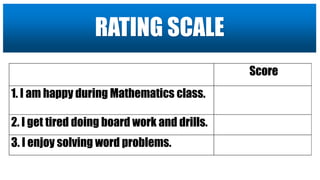
 Example: Attitude towards Mathematics
Directions: Put the score on the column for each
of the statement as it applies to you. Use 1 to 5, 1
being the lowest and 5 the highest possible score.
RATING SCALE
RATING SCALE
Score
1. I am happy during Mathematics class.
2. I get tired doing board work and drills.
3. I enjoy solving word problems.
 The most commonly used type of rating scales
are the following:
❶ Numerical Rating Scales
❷ Graphic Rating Scales
TYPES OF RATING SCALE
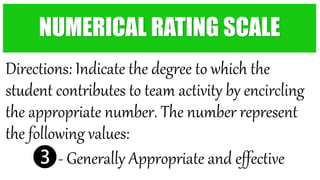
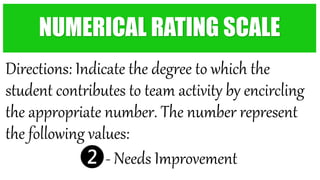
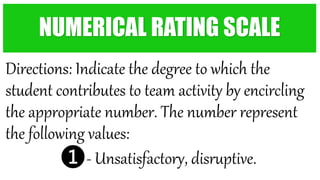
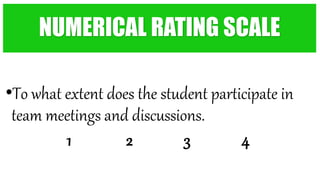
 A numerical rating scale translates the
judgement of quality or degree into numbers.
 To increase the objectivity and consistency of
results from numerical rating scales, a short
verbal description may be provided on each
NUMERICAL RATING SCALE
Directions: Indicate the degree to which the
student contributes to team activity by encircling
the appropriate number. The number represent
the following values:
❹- Constantly Appropriate and effective
NUMERICAL RATING SCALE
Directions: Indicate the degree to which the
student contributes to team activity by encircling
the appropriate number. The number represent
the following values:
❸- Generally Appropriate and effective
NUMERICAL RATING SCALE
Directions: Indicate the degree to which the
student contributes to team activity by encircling
the appropriate number. The number represent
the following values:
❷- Needs Improvement
NUMERICAL RATING SCALE
Directions: Indicate the degree to which the
student contributes to team activity by encircling
the appropriate number. The number represent
the following values:
❶- Unsatisfactory, disruptive.
NUMERICAL RATING SCALE
•To what extent does the student participate in
team meetings and discussions.
1 2 3 4
NUMERICAL RATING SCALE
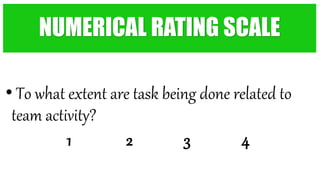
• To what extent are task being done related to
team activity?
1 2 3 4
NUMERICAL RATING SCALE
Reference:
Cajigal, Ronan M., MA.Ed; Mantuano, Maria
Leoflor D., MA.Ed; Assessment of Learning 2;
2014.
THANK YOU!

ASSESSMENT ON AFFECTIVE LEARNING

  • 1.
    CHAPTER 6: Development ofAffective Assessment
  • 2.
    CONSTRUCTED- RESPONSE FORMAT It is a straight forward approach asking students about their affect by responding to simple statement or question.  Another way to implement the constructed- response format is by means of an essay.
  • 3.
     There arethree ways of implanting the selected- response format in assessing affective learning outcomes. These are the following: * Rating Scale * Semantic Scale * Differential Scale * Checklist SELECTED- RESPONSE FORMAT
  • 4.
     Anonymity * Itis an important aspect when considering the traits that are personal such as values and self-concept. ADVANTAGE OF SELECTED- RESPONSE FORMAT
  • 5.
     Checklist forusing student's Self-Report to Assess Affect (McMillan, 2007): ❶ Keep measures focused on specific traits. SELECTED- RESPONSE FORMAT
  • 6.
     Checklist forusing student's Self-Report to Assess Affect (McMillan, 2007): ❷ Establish trust with students. SELECTED- RESPONSE FORMAT
  • 7.
     Checklist forusing student's Self-Report to Assess Affect (McMillan, 2007): ❸ Match response format to the trait being assessed. SELECTED- RESPONSE FORMAT
  • 8.
     Checklist forusing student's Self-Report to Assess Affect (McMillan, 2007): ❹ Ensure anonymity if possible. SELECTED- RESPONSE FORMAT
  • 9.
     Checklist forusing student's Self-Report to Assess Affect (McMillan, 2007): ❺ Keep questionnaires brief. SELECTED- RESPONSE FORMAT
  • 10.
     Checklist forusing student's Self-Report to Assess Affect (McMillan, 2007): ❻ Keep items short and simple. SELECTED- RESPONSE FORMAT
  • 11.
     Checklist forusing student's Self-Report to Assess Affect (McMillan, 2007): ❼ Avoid negatives and absolute. SELECTED- RESPONSE FORMAT
  • 12.
     Checklist forusing student's Self-Report to Assess Affect (McMillan, 2007): ❽ Write items in present tense. SELECTED- RESPONSE FORMAT
  • 13.
     Checklist forusing student's Self-Report to Assess Affect (McMillan, 2007): ❾ Avoid double-barreled items. SELECTED- RESPONSE FORMAT
  • 14.
     Peer ratingsor appraisal is the least common method among the three methods of assessing affect. PEER RATINGS
  • 15.
    Because of thenature of learners, they do not always take this activity seriously and most often than not they are subjective in conducting this peer rating. PEER RATINGS
  • 16.
    Thus, peer ratingis seen as relatively inefficient in terms of nature of conducting, scoring, and interpreting peer ratings. PEER RATINGS
  • 17.
     The twomethods of conducting peer ratings are the following: ❶ Guess-who approach PEER RATINGS
  • 18.
     The twomethods of conducting peer ratings are the following: ❷ Socio-metric approach PEER RATINGS
  • 19.
    Each of thethree methods (observation, self- report, peer ratings) has its own advantage and disadvantages. UTILIZING THE DIFFERENT METHODS
  • 20.
     In choosingfor which method or methods to used, consider the following factors: ❶ Type of affect that needs to be assessed. UTILIZING THE DIFFERENT METHODS
  • 21.
     In choosingfor which method or methods to used, consider the following factors: ❷ If the information needed if from grouped or individual responses. UTILIZING THE DIFFERENT METHODS
  • 22.
     In choosingfor which method or methods to used, consider the following factors: ❸ The use of information. UTILIZING THE DIFFERENT METHODS
  • 23.
     To sumit up, the choice of method or combining these methods, is independent upon the context, targets, and the level of comfort in utilizing any particular method or combination of methods. UTILIZING THE DIFFERENT METHODS
  • 24.
    Affective domain encompassesbehaviors in terms of attitudes, beliefs, and feelings comprise one value. AFFECTIVE ASSESSMENT TOOL
  • 25.
     There arevarious assessment tools that can be used to measure affect. These are the following: ❶ Checklist AFFECTIVE ASSESSMENT TOOL
  • 26.
     There arevarious assessment tools that can be used to measure affect. These are the following: ❷ Rating Scale AFFECTIVE ASSESSMENT TOOL
  • 27.
     There arevarious assessment tools that can be used to measure affect. These are the following: ❸ Likert Scale AFFECTIVE ASSESSMENT TOOL
  • 28.
     There arevarious assessment tools that can be used to measure affect. These are the following: ❹ Semantic Differential Scale AFFECTIVE ASSESSMENT TOOL
  • 29.
    Checklist is oneof the effective formative assessment strategies to monitor specific skills, behaviors, or dispositions of individual or group of students (Bruke, 2009). CHECKLIST
  • 30.
     Checklist containcriteria that focus on the intented outcome or target.  Checklist help students in organizing the tasks assigned to them into logically sequenced steps that will lead to the completion of task. CHECKLIST
  • 31.
    CHECKLIST OBSERVATION CHECK LIST Student:Subject: Date: Types of Assignment: The following table shows an example of a checklist format.
  • 32.
    CHECKLIST A. Work HabitsNot Yet Sometimes Frequently 1. Gets work done on time. 2. Ask for help when needed. 3. Take initiative.
  • 33.
    CHECKLIST B. Study habitsNot Yet Sometimes Frequently 4. Organizes Work. 5. Take good notes. 6. Uses time well.
  • 34.
    CHECKLIST C. Social skillsNot Yet Sometimes Frequently 7. Works well with others. 8. Listen to others. 9. Help others.
  • 35.
  • 36.
     In planningfor criteria that will be used in checklist, the criteria must be aligned with the outcomes that needs to be observed and measured. CRITERIA FOR CHECKLIST
  • 37.
     Popham (1999)explains that when the teachers set criteria, the main emphasis is to use these criteria in making judgement regarding on the adequacy of student responses and the criteria will influence the way the response is scored. CRITERIA FOR CHECKLIST
  • 38.
     Checklist shouldbe utilized because these: ❶ Make a quick and easy way to observe and record skills, criteria, and behaviors prior to final test or summative evaluation. WHY USE CHECKLIST
  • 39.
     Checklist shouldbe utilized because these: ❷ Provide information to teachers if there are students who need help so as to avoid failing. WHY USE CHECKLIST
  • 40.
     Checklist shouldbe utilized because these: ❸ Provide formative assessment for students' learning and help teachers monitor if students are on track with the desired outcomes. WHY USE CHECKLIST
  • 41.
     According toNitko (2001), rating scales can be used for teaching purposes and assessment. ❶ Rating scales help students understand the learning target/outcomes and to focus student's attention to performance. RATING SCALE
  • 42.
     According toNitko (2001), rating scales can be used for teaching purposes and assessment. ❷ Completed rating scale gives specific feedback to students as far as their strengths and weaknesses with respect to the targets. RATING SCALE
  • 43.
     According toNitko (2001), rating scales can be used for teaching purposes and assessment. ❸ Students not only learn the standards but also may internalize the set standards. RATING SCALE
  • 44.
     According toNitko (2001), rating scales can be used for teaching purposes and assessment. ❹ Ratings help to show each students' growth and progress. RATING SCALE
  • 45.
     Example: Attitudetowards Mathematics Directions: Put the score on the column for each of the statement as it applies to you. Use 1 to 5, 1 being the lowest and 5 the highest possible score. RATING SCALE
  • 46.
    RATING SCALE Score 1. Iam happy during Mathematics class. 2. I get tired doing board work and drills. 3. I enjoy solving word problems.
  • 47.
     The mostcommonly used type of rating scales are the following: ❶ Numerical Rating Scales ❷ Graphic Rating Scales TYPES OF RATING SCALE
  • 48.
     A numericalrating scale translates the judgement of quality or degree into numbers.  To increase the objectivity and consistency of results from numerical rating scales, a short verbal description may be provided on each NUMERICAL RATING SCALE
  • 49.
    Directions: Indicate thedegree to which the student contributes to team activity by encircling the appropriate number. The number represent the following values: ❹- Constantly Appropriate and effective NUMERICAL RATING SCALE
  • 50.
    Directions: Indicate thedegree to which the student contributes to team activity by encircling the appropriate number. The number represent the following values: ❸- Generally Appropriate and effective NUMERICAL RATING SCALE
  • 51.
    Directions: Indicate thedegree to which the student contributes to team activity by encircling the appropriate number. The number represent the following values: ❷- Needs Improvement NUMERICAL RATING SCALE
  • 52.
    Directions: Indicate thedegree to which the student contributes to team activity by encircling the appropriate number. The number represent the following values: ❶- Unsatisfactory, disruptive. NUMERICAL RATING SCALE
  • 53.
    •To what extentdoes the student participate in team meetings and discussions. 1 2 3 4 NUMERICAL RATING SCALE
  • 54.
    • To whatextent are task being done related to team activity? 1 2 3 4 NUMERICAL RATING SCALE
  • 55.
    Reference: Cajigal, Ronan M.,MA.Ed; Mantuano, Maria Leoflor D., MA.Ed; Assessment of Learning 2; 2014. THANK YOU!