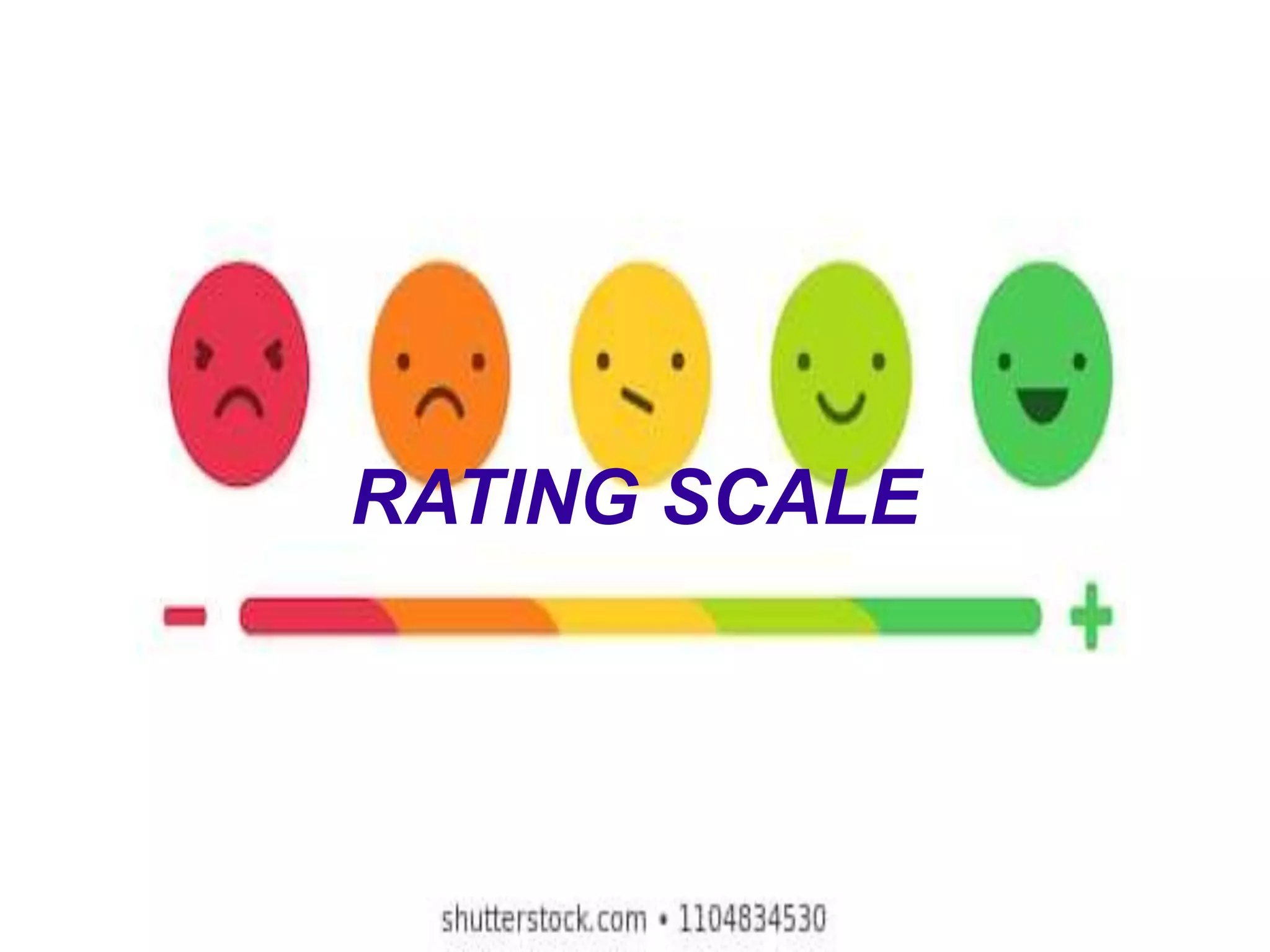
RATING SCALE
Definition
 Rating scales can help to evaluate the quality of
the behaviour of one student or many students.
 It also measure the degree to which the student
exhibits a specified behaviour.
Characteristics
 These are the value judgements about
attributes of one person by another person.
 These are the most commonly used tools to
carry out structured observations.
 These are generally developed to make
qualitative attributes.
 Provide more flexibility to judge the level of
performance.
Uses
1. Gain relative information about a particular
subject.
2. Compare & analyse data.
3. Measure one important product / service
element.
Types
1. Descriptive Rating Scale
2. Numerical Rating Scale
3. Graphical Rating Scale
4. Comparative Rating Scale
Descriptive Rating Scale
Each answer option is elaborately explained
for the respondents.
Excellent
Good
Average
Below Average
Poor
Numerical Rating Scale
It has numbers as answer options and not each
number corresponds to a characteristics or
meaning.
Graphical Rating Scale
A straight line may be represented by
descriptive phrases at various points.
To rate the subject for a particular trait a check
mark is made at the particular point.
Comparative Rating Scale
It expects respondents to answer a particular
question in terms of comparison.
Advantages
1. Easy to administer and score.
2. Its easy to make & less time consuming.
3. Easily used for large group.
4. Also used for quantitative methods.
5. May also be used for assessment of interest,
attitude, personal characteristics.
6. Used to evaluate performance & skills.
Disadvantages
1. Difficult to fix up rate.
2. Chances for subjective evaluation,
thus the scales may become
unscientific.
Rating Scale

Rating Scale

  • 1.
  • 2.
    Definition  Rating scalescan help to evaluate the quality of the behaviour of one student or many students.  It also measure the degree to which the student exhibits a specified behaviour.
  • 3.
    Characteristics  These arethe value judgements about attributes of one person by another person.  These are the most commonly used tools to carry out structured observations.  These are generally developed to make qualitative attributes.  Provide more flexibility to judge the level of performance.
  • 4.
    Uses 1. Gain relativeinformation about a particular subject. 2. Compare & analyse data. 3. Measure one important product / service element.
  • 5.
    Types 1. Descriptive RatingScale 2. Numerical Rating Scale 3. Graphical Rating Scale 4. Comparative Rating Scale
  • 6.
    Descriptive Rating Scale Eachanswer option is elaborately explained for the respondents. Excellent Good Average Below Average Poor
  • 7.
    Numerical Rating Scale Ithas numbers as answer options and not each number corresponds to a characteristics or meaning.
  • 9.
    Graphical Rating Scale Astraight line may be represented by descriptive phrases at various points. To rate the subject for a particular trait a check mark is made at the particular point.
  • 11.
    Comparative Rating Scale Itexpects respondents to answer a particular question in terms of comparison.
  • 13.
    Advantages 1. Easy toadminister and score. 2. Its easy to make & less time consuming. 3. Easily used for large group. 4. Also used for quantitative methods. 5. May also be used for assessment of interest, attitude, personal characteristics. 6. Used to evaluate performance & skills.
  • 14.
    Disadvantages 1. Difficult tofix up rate. 2. Chances for subjective evaluation, thus the scales may become unscientific.