



RATING SCALE AND
CHECKLIST
Avantika Gupta
MSc Nursing 1st
year
RATING SCALE
Rating is the term used to express the opinion judgement
regarding some performance of a person , object , situation or
character.
DEFINITION :- Ration Scale refers to a scale with a set of
opinion ,which describes varying degree of the dimensions
of an attitude being observed.
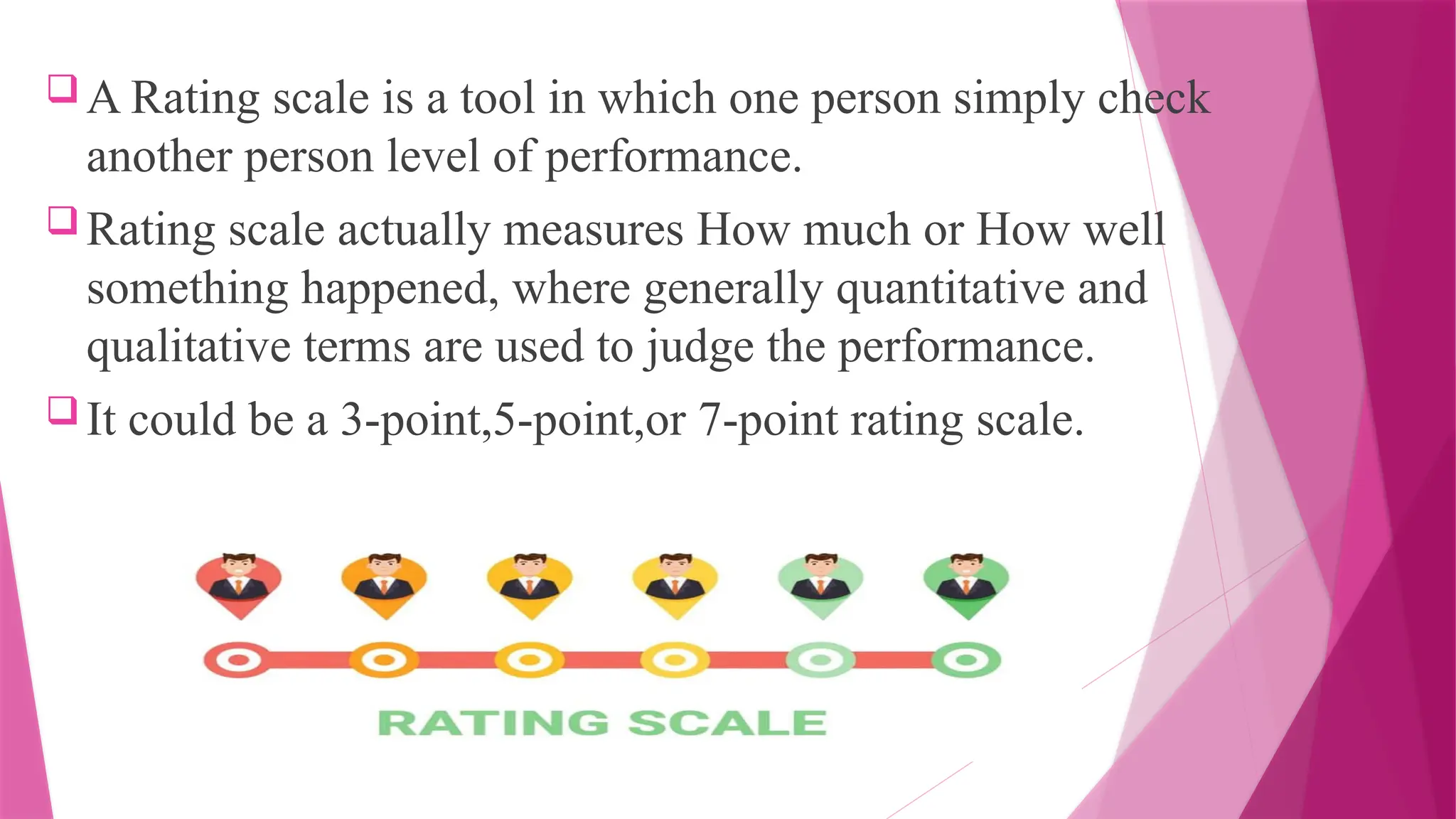
 A Rating scale is a tool in which one person simply check
another person level of performance.
 Rating scale actually measures How much or How well
something happened, where generally quantitative and
qualitative terms are used to judge the performance.
 It could be a 3-point,5-point,or 7-point rating scale.
TYPES OF RATING SCALE
 GRAPHIC RATING SCALE
 DESCRIPTIVE RATING SCALE
 NUMERICAL SCALE
 COMPARATIVE RATING SCALE
 CUMULATIVE OR GUTTMANN RATING
POINTS
 FORCED CHOICE RATING SCALE
GRAPHIC RATING SCALE
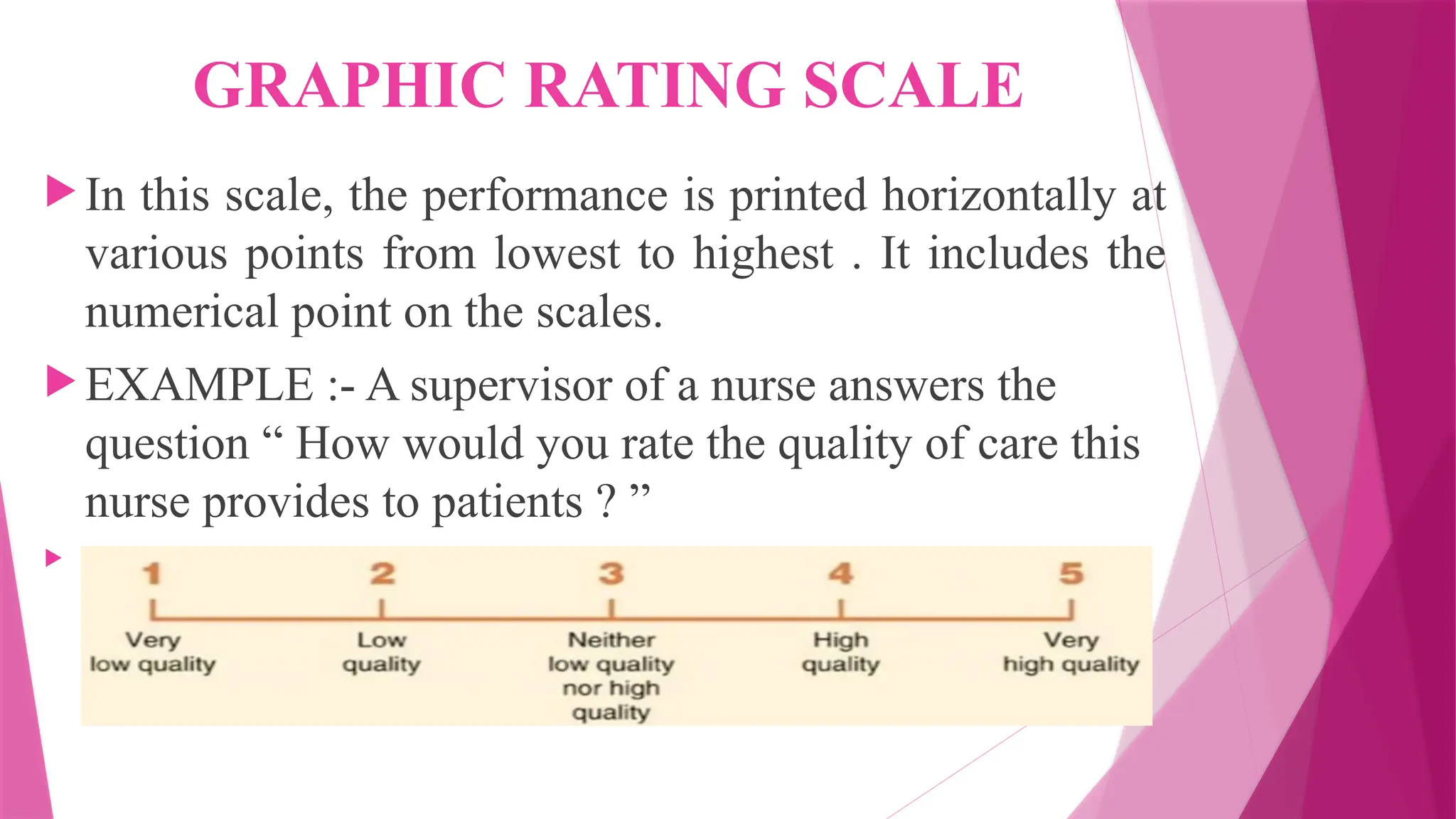
 In this scale, the performance is printed horizontally at
various points from lowest to highest . It includes the
numerical point on the scales.
 EXAMPLE :- A supervisor of a nurse answers the
question “ How would you rate the quality of care this
nurse provides to patients ? ”

DESCRIPTIVE RATING SCALE
 This type of Rating scale does not use numbers but
divides the assessment into series of verbal phrases to
indicate the level of performance.
In which descriptive phrases or terms assigned to each
trait. The rater enters the appropriate phrase after each
name to indicate judgement of the person.
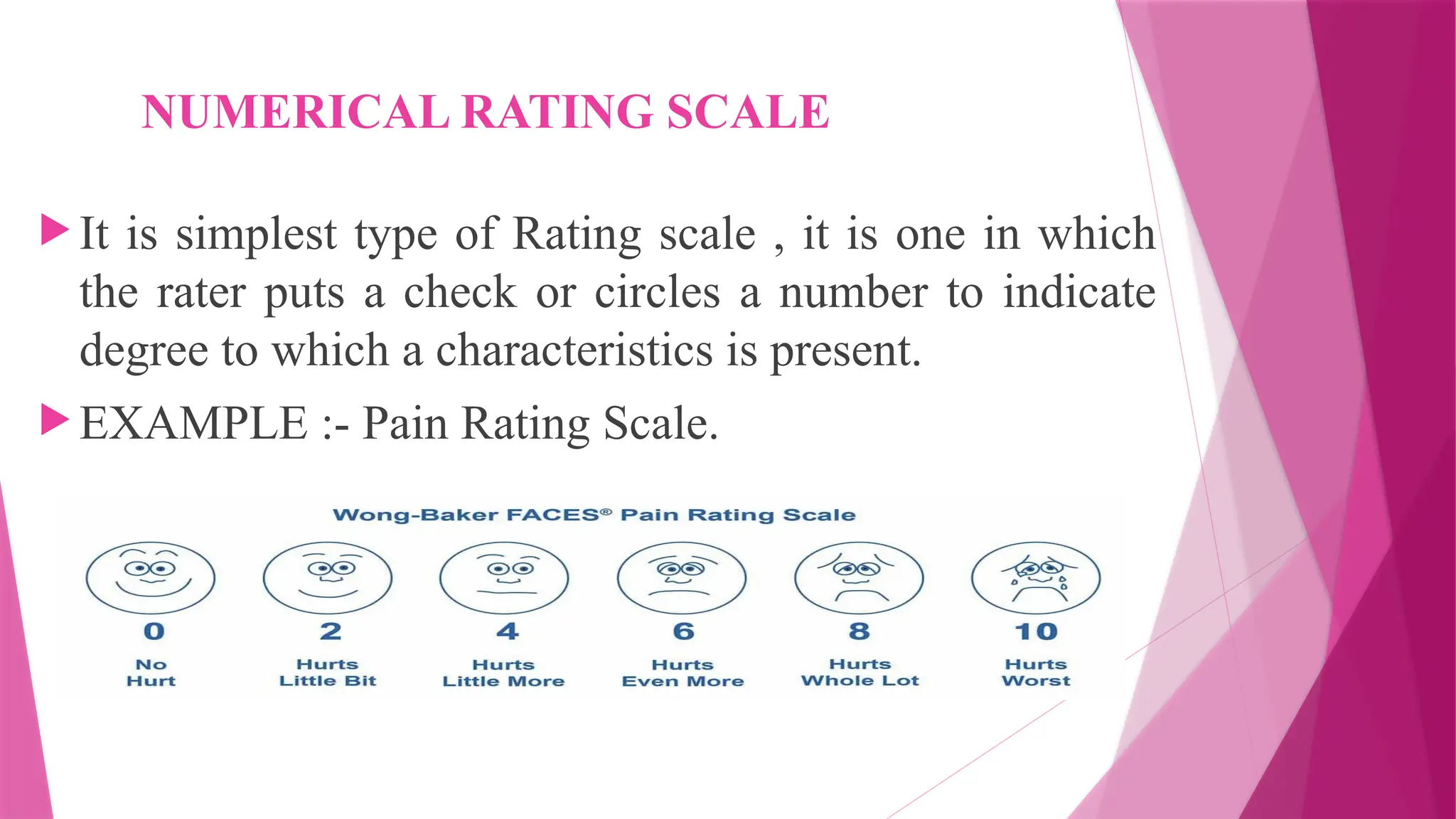
NUMERICAL RATING SCALE
 It is simplest type of Rating scale , it is one in which
the rater puts a check or circles a number to indicate
degree to which a characteristics is present.
 EXAMPLE :- Pain Rating Scale.
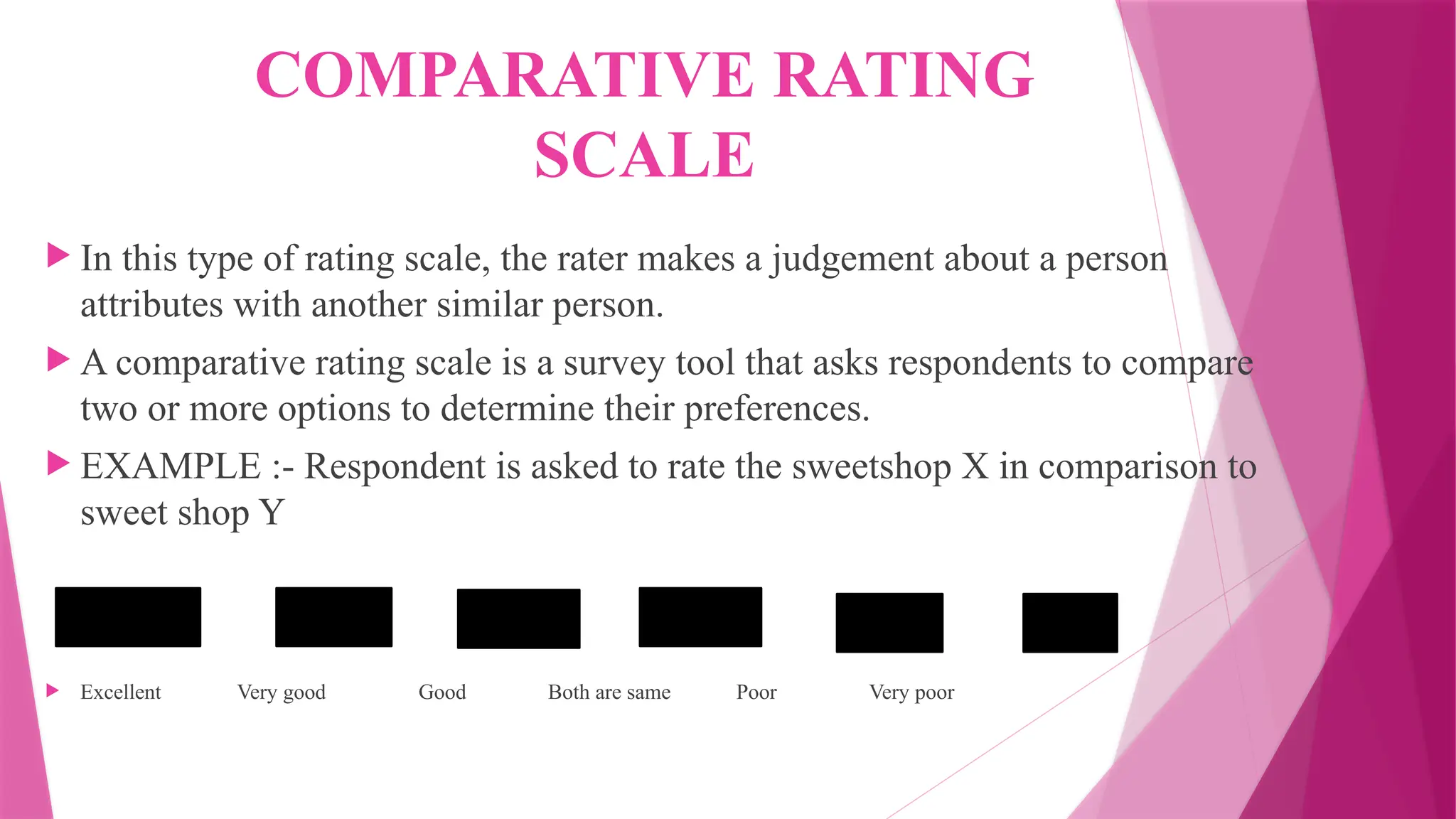
COMPARATIVE RATING
SCALE
 In this type of rating scale, the rater makes a judgement about a person
attributes with another similar person.
 A comparative rating scale is a survey tool that asks respondents to compare
two or more options to determine their preferences.
 EXAMPLE :- Respondent is asked to rate the sweetshop X in comparison to
sweet shop Y
 Excellent Very good Good Both are same Poor Very poor
CUMULATIVE OR GUTTMANN
RATING POINT
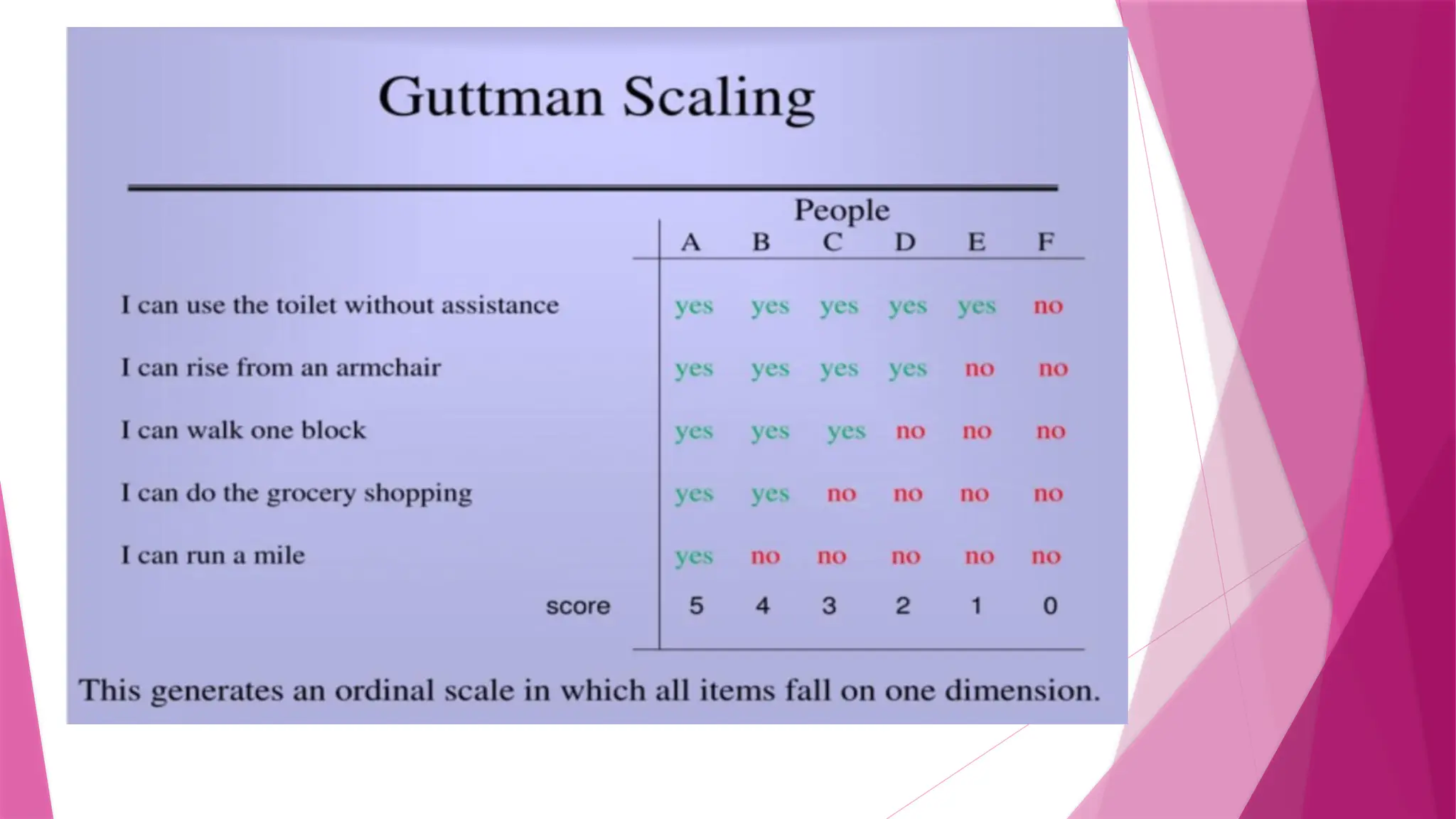
It is an ordinary scale with a number of statements
placed in a hierarchial order. This order is arranged so
that if a respondent agrees with a statement , they will
also agree with all of the statements that fall below it
in extremity.
Guttman scale questions allow respondents to answer
a large number of questions in a short amount of time
due to the agree/disagree or yes/no answer.
FORCED CHOICE RATING
Forced choice questions are usually written in the
form of an agree/disagree statement or consist of
statements where respondents select the one closest to
their true feelings.
EXAMPLE OF FORCED
CHOICE
MOBILEPHONES REPUTATION PRICE
APPLE 1 5
SAMSUNG 3 3
OPPO 5 2
VIVO 4 1
ONEPLUS 2 4
CHARACTERISTICS OF
RATING SCALE
 CLARITY :- Before making rating scale, we remember that
statement are always short and concise.
 VARIETY:- When we develop rating scale that statement
should not be Monotomy.
 OBJECTIVITY :- Statement must be objective nature.
 UNIQUENESS :- Statement is always unique, not collapse
with other statement.
 RELEVANCE:- The statement should be relevant.
ADVANTAGES OF RATING
SCALE
 Easy to administer.
 Easy to construct.
 Can be used for large groups.
 Mainly used in Quantity Research method.
 Clarity of feedback to students.
 They are used to evaluate performance, skills, and product
outcomes.
 It is easier to make and less time consuming.
 Monitor brand loyalty
DISADVANTAGES OF RATING
SCALE
 If we misuse then may be objectivity decrease.
 Chance of subject evaluation.
 There is a lack of uniformity with which terms are
interpreted by evaluators.
 There is several common sources of errors in Rating
scale.
 Ambiguity
 Attitude of the Rater.
LIMITATIONS OF RATING
SCALE
 SUBJECTIVITY :- Different raters may have different
perspective and assign different ratings.
 CONTEXT DEPENDENCE:- Rating can be influenced by the
timing ,environment , or rater mood.
 LIMITED SCOPE:- Rating scale may not capture all relevant
aspects of the subject being assessed.
 MAY NOT PROVIDE ACCURATE RANKINGS.
 LACK OF SPECIFICITY IN ANSWERS.
 LIMITED INSIGHTS:- Rating scale do not allow
respondent to explain their answers in detail.
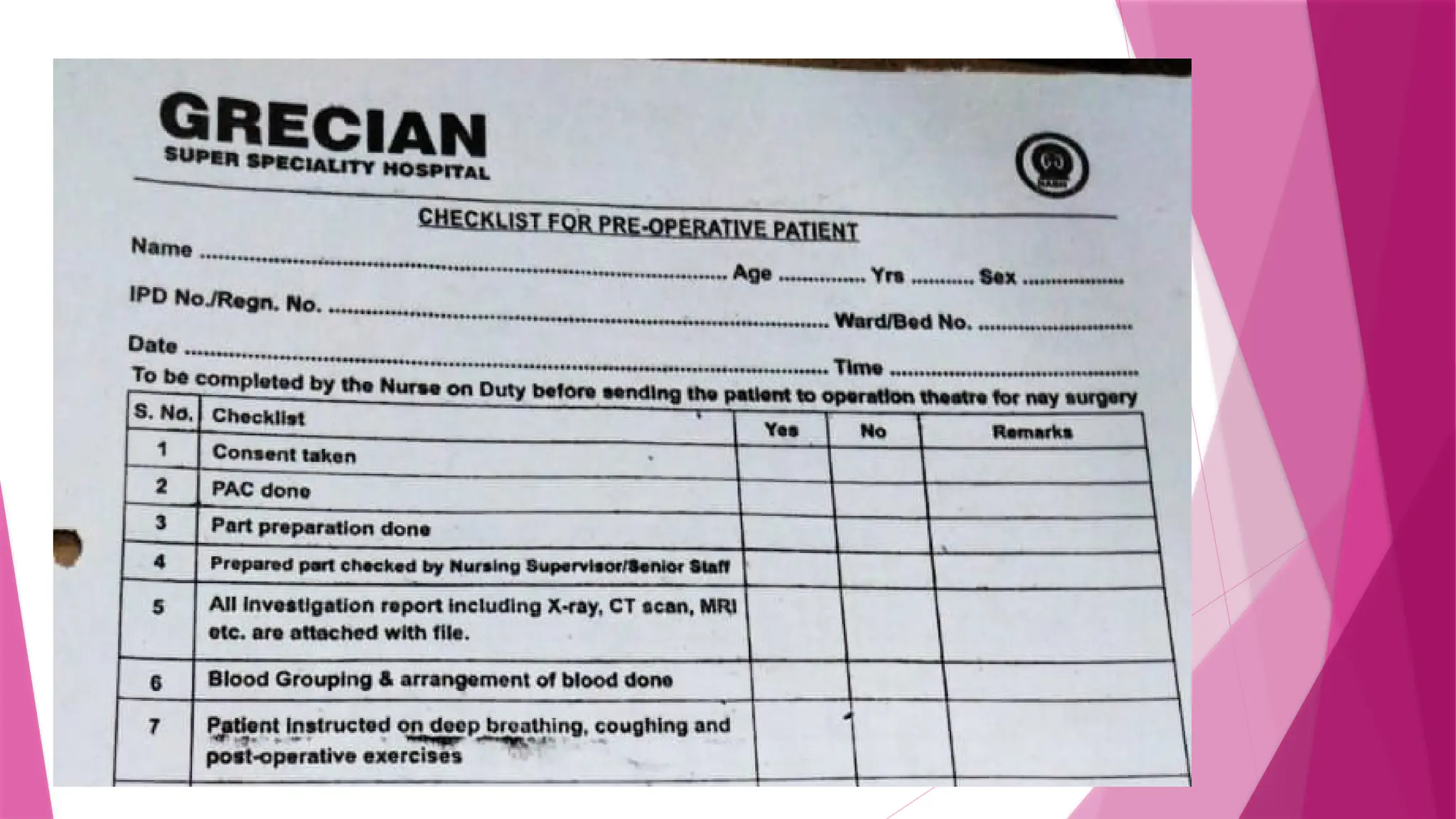
CHECKLIST
 Checklist widely used in Instrument / tool for
performance evaluation that means widely used in
Hospitals, School , Colleges.
 DEFINITION :- It is a simple instrument consisting
prepared list of expected items of performance or
attributes , which are checked by a Researcher for their
presence or absence.
NEEDS OF CHECKLIST
 To better organize assignments.
 To verify most important tasks easily.
 To reduce errors.
 To ensure consistency and completeness in working.
 To move quickly be more efficient and save time.
CHARACTERISTICS OF
CHECKLIST
 It is precise.
 It is simple and easy to use.
 It eliminate mistakes.
 It prevents forgetting something important.
STEPS FOR PREPARATION A
CHECKLIST
 Use proper format.
 Take knowledge of all aspects before preparing a
checklist.
 Categorise the checklist.
 Avoid making errors.
 Focus on quality not length of the checklist.
ADVANTAGES OF CHECKLIST
 Easy to construct and use.
 Effective for self and peer assessment.
 Save time.
 It provide a simple method to record observation.
 Helpful in evaluating procedural work.
DISADVANTAGES OF
CHECKLIST
 Provide limited information about how to improve
performance.
 It assures only presence or absence of behaviour.
 Its usefulness is limited.
 Does not include the quality of performance, so
usefulness of checklist is limited.
CONCLUSION
 At the end of the topic I conclude my topic with the help of
these different scales as Rating scale describes the observed
skills and performance. Rating scale are of great use when
used for helping teachers to evaluate students behavior.
 Checklist is a selected list of words, phrases, sentences and
paragraphs following which an observer records a check mark
to denote a presence or absence of whatever is being
observed.
BIBLIOGRAPHY
 BHASKAR NIMA , “ A TEXT BOOK OF NURSING EDUCATION ”EMMESS PUBLICATIONS ,
PAGE NO :254-257
 Balasubramanian N , “A TEXT BOOK OF NURSING EDUCATION”, PAGE NO:309-312
 Neeraja KP, “ A TEXTBOOK OF NURSING EDUCATION”, PAGE NO:
https://www.slideshare.net/slideshow/checklist-238550180/238550180
https://www.slideshare.net/slideshow/rating-scale-57713062/57713062?from_search=0
https://www.yogiraj.co.in/define-rating-scale-and-its-characteristics
This Photo by Unknown Author is licensed under
CC BY-SA-NC

RATING SCALE AND CHECKLIST. [NURSING EDUCATION]

  • 1.
    RATING SCALE AND CHECKLIST AvantikaGupta MSc Nursing 1st year
  • 2.
    RATING SCALE Rating isthe term used to express the opinion judgement regarding some performance of a person , object , situation or character. DEFINITION :- Ration Scale refers to a scale with a set of opinion ,which describes varying degree of the dimensions of an attitude being observed.
  • 3.
     A Ratingscale is a tool in which one person simply check another person level of performance.  Rating scale actually measures How much or How well something happened, where generally quantitative and qualitative terms are used to judge the performance.  It could be a 3-point,5-point,or 7-point rating scale.
  • 4.
    TYPES OF RATINGSCALE  GRAPHIC RATING SCALE  DESCRIPTIVE RATING SCALE  NUMERICAL SCALE  COMPARATIVE RATING SCALE  CUMULATIVE OR GUTTMANN RATING POINTS  FORCED CHOICE RATING SCALE
  • 5.
    GRAPHIC RATING SCALE In this scale, the performance is printed horizontally at various points from lowest to highest . It includes the numerical point on the scales.  EXAMPLE :- A supervisor of a nurse answers the question “ How would you rate the quality of care this nurse provides to patients ? ” 
  • 6.
    DESCRIPTIVE RATING SCALE This type of Rating scale does not use numbers but divides the assessment into series of verbal phrases to indicate the level of performance. In which descriptive phrases or terms assigned to each trait. The rater enters the appropriate phrase after each name to indicate judgement of the person.
  • 7.
    NUMERICAL RATING SCALE It is simplest type of Rating scale , it is one in which the rater puts a check or circles a number to indicate degree to which a characteristics is present.  EXAMPLE :- Pain Rating Scale.
  • 8.
    COMPARATIVE RATING SCALE  Inthis type of rating scale, the rater makes a judgement about a person attributes with another similar person.  A comparative rating scale is a survey tool that asks respondents to compare two or more options to determine their preferences.  EXAMPLE :- Respondent is asked to rate the sweetshop X in comparison to sweet shop Y  Excellent Very good Good Both are same Poor Very poor
  • 9.
    CUMULATIVE OR GUTTMANN RATINGPOINT It is an ordinary scale with a number of statements placed in a hierarchial order. This order is arranged so that if a respondent agrees with a statement , they will also agree with all of the statements that fall below it in extremity. Guttman scale questions allow respondents to answer a large number of questions in a short amount of time due to the agree/disagree or yes/no answer.
  • 11.
    FORCED CHOICE RATING Forcedchoice questions are usually written in the form of an agree/disagree statement or consist of statements where respondents select the one closest to their true feelings.
  • 12.
    EXAMPLE OF FORCED CHOICE MOBILEPHONESREPUTATION PRICE APPLE 1 5 SAMSUNG 3 3 OPPO 5 2 VIVO 4 1 ONEPLUS 2 4
  • 13.
    CHARACTERISTICS OF RATING SCALE CLARITY :- Before making rating scale, we remember that statement are always short and concise.  VARIETY:- When we develop rating scale that statement should not be Monotomy.  OBJECTIVITY :- Statement must be objective nature.  UNIQUENESS :- Statement is always unique, not collapse with other statement.  RELEVANCE:- The statement should be relevant.
  • 14.
    ADVANTAGES OF RATING SCALE Easy to administer.  Easy to construct.  Can be used for large groups.  Mainly used in Quantity Research method.  Clarity of feedback to students.  They are used to evaluate performance, skills, and product outcomes.  It is easier to make and less time consuming.  Monitor brand loyalty
  • 15.
    DISADVANTAGES OF RATING SCALE If we misuse then may be objectivity decrease.  Chance of subject evaluation.  There is a lack of uniformity with which terms are interpreted by evaluators.  There is several common sources of errors in Rating scale.  Ambiguity  Attitude of the Rater.
  • 16.
    LIMITATIONS OF RATING SCALE SUBJECTIVITY :- Different raters may have different perspective and assign different ratings.  CONTEXT DEPENDENCE:- Rating can be influenced by the timing ,environment , or rater mood.  LIMITED SCOPE:- Rating scale may not capture all relevant aspects of the subject being assessed.
  • 17.
     MAY NOTPROVIDE ACCURATE RANKINGS.  LACK OF SPECIFICITY IN ANSWERS.  LIMITED INSIGHTS:- Rating scale do not allow respondent to explain their answers in detail.
  • 18.
  • 19.
     Checklist widelyused in Instrument / tool for performance evaluation that means widely used in Hospitals, School , Colleges.  DEFINITION :- It is a simple instrument consisting prepared list of expected items of performance or attributes , which are checked by a Researcher for their presence or absence.
  • 21.
    NEEDS OF CHECKLIST To better organize assignments.  To verify most important tasks easily.  To reduce errors.  To ensure consistency and completeness in working.  To move quickly be more efficient and save time.
  • 22.
    CHARACTERISTICS OF CHECKLIST  Itis precise.  It is simple and easy to use.  It eliminate mistakes.  It prevents forgetting something important.
  • 23.
    STEPS FOR PREPARATIONA CHECKLIST  Use proper format.  Take knowledge of all aspects before preparing a checklist.  Categorise the checklist.  Avoid making errors.  Focus on quality not length of the checklist.
  • 24.
    ADVANTAGES OF CHECKLIST Easy to construct and use.  Effective for self and peer assessment.  Save time.  It provide a simple method to record observation.  Helpful in evaluating procedural work.
  • 25.
    DISADVANTAGES OF CHECKLIST  Providelimited information about how to improve performance.  It assures only presence or absence of behaviour.  Its usefulness is limited.  Does not include the quality of performance, so usefulness of checklist is limited.
  • 26.
    CONCLUSION  At theend of the topic I conclude my topic with the help of these different scales as Rating scale describes the observed skills and performance. Rating scale are of great use when used for helping teachers to evaluate students behavior.  Checklist is a selected list of words, phrases, sentences and paragraphs following which an observer records a check mark to denote a presence or absence of whatever is being observed.
  • 27.
    BIBLIOGRAPHY  BHASKAR NIMA, “ A TEXT BOOK OF NURSING EDUCATION ”EMMESS PUBLICATIONS , PAGE NO :254-257  Balasubramanian N , “A TEXT BOOK OF NURSING EDUCATION”, PAGE NO:309-312  Neeraja KP, “ A TEXTBOOK OF NURSING EDUCATION”, PAGE NO: https://www.slideshare.net/slideshow/checklist-238550180/238550180 https://www.slideshare.net/slideshow/rating-scale-57713062/57713062?from_search=0 https://www.yogiraj.co.in/define-rating-scale-and-its-characteristics
  • 28.
    This Photo byUnknown Author is licensed under CC BY-SA-NC