Norm-referenced
assessment
• An assessment designed to measure and
compare individual students’ performances or test
results to those of an appropriate peer group
(that is, norm group) at the classroom, local, or
national level.
• Normally has a base line set by students that
is thought to be the average achievement
Terms:
• Norming process
-Calculating norm-referenced scores
• Norming group
-the comparison group
-typically comprise only a small subset of
previous test takers, not all or even most
previous test takers. Test developers use a
variety of statistical methods to select norming
groups, interpret raw scores, and determine
performance levels.
• Norm-referenced tests
- often use a multiple-choice format, though some
include open-ended, short-answer questions. They
are usually based on some form of national
standards, not locally determined standards
or curricula
Why use norm-referenced
assessment?
• To determine a young child’s readiness for preschool
or kindergarten. These tests may be designed to
measure oral-language ability, visual-motor skills, and
cognitive and social development.
• To evaluate basic reading, writing, and math skills.
Test results may be used for a wide variety of
purposes, such as measuring academic progress,
making course assignments, determining readiness for
grade promotion, or identifying the need for
additional academic support.
• to identify specific learning disabilities, such as
autism, dyslexia, or nonverbal learning disability,
or to determine eligibility for special-education
services.
• To make program-eligibility or college-admissions
decisions (in these cases, norm-referenced
scores are generally evaluated alongside other
information about a student).
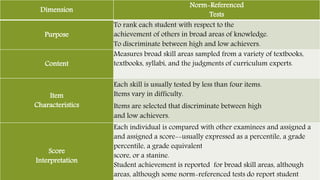
Dimension
Norm-Referenced
Tests
Purpose
To rank each student with respect to the
achievement of others in broad areas of knowledge.
To discriminate between high and low achievers.
Content
Measures broad skill areas sampled from a variety of textbooks,
textbooks, syllabi, and the judgments of curriculum experts.
Item
Characteristics
Each skill is usually tested by less than four items.
Items vary in difficulty.
Items are selected that discriminate between high
and low achievers.
Score
Interpretation
Each individual is compared with other examinees and assigned a
and assigned a score--usually expressed as a percentile, a grade
percentile, a grade equivalent
score, or a stanine.
Student achievement is reported for broad skill areas, although
areas, although some norm-referenced tests do report student
References:
• http://www.edpsycinteractive.org/topics/measeval/crnmref.html
• http://edglossary.org/norm-referenced-test/
• http://www.learnnc.org/reference/norm-referenced+assessment

Norm referenced assessment

  • 1.
  • 2.
    • An assessmentdesigned to measure and compare individual students’ performances or test results to those of an appropriate peer group (that is, norm group) at the classroom, local, or national level. • Normally has a base line set by students that is thought to be the average achievement
  • 3.
    Terms: • Norming process -Calculatingnorm-referenced scores • Norming group -the comparison group -typically comprise only a small subset of previous test takers, not all or even most previous test takers. Test developers use a variety of statistical methods to select norming groups, interpret raw scores, and determine performance levels.
  • 4.
    • Norm-referenced tests -often use a multiple-choice format, though some include open-ended, short-answer questions. They are usually based on some form of national standards, not locally determined standards or curricula
  • 5.
    Why use norm-referenced assessment? •To determine a young child’s readiness for preschool or kindergarten. These tests may be designed to measure oral-language ability, visual-motor skills, and cognitive and social development. • To evaluate basic reading, writing, and math skills. Test results may be used for a wide variety of purposes, such as measuring academic progress, making course assignments, determining readiness for grade promotion, or identifying the need for additional academic support.
  • 6.
    • to identifyspecific learning disabilities, such as autism, dyslexia, or nonverbal learning disability, or to determine eligibility for special-education services. • To make program-eligibility or college-admissions decisions (in these cases, norm-referenced scores are generally evaluated alongside other information about a student).
  • 7.
    Dimension Norm-Referenced Tests Purpose To rank eachstudent with respect to the achievement of others in broad areas of knowledge. To discriminate between high and low achievers. Content Measures broad skill areas sampled from a variety of textbooks, textbooks, syllabi, and the judgments of curriculum experts. Item Characteristics Each skill is usually tested by less than four items. Items vary in difficulty. Items are selected that discriminate between high and low achievers. Score Interpretation Each individual is compared with other examinees and assigned a and assigned a score--usually expressed as a percentile, a grade percentile, a grade equivalent score, or a stanine. Student achievement is reported for broad skill areas, although areas, although some norm-referenced tests do report student
  • 8.