TOOLS AND TECHNIQUES FOR
CLASSROOM ASSESSMENT
M.Vijayalakshmi
Assistant Professor
Assessment for Learning
Unit – III
TOOLS AND TECHNIQUES FOR
CLASSROOM ASSESSMENT
Unit – III
TOOLS AND TECHNIQUES FOR CLASSROOM ASSESSMENT
Introduction – Observation – Self-Reporting –
Anecdotal Records – Check List – Rating Scale
– Types of Tests –Assessment Tools for
Affective Domain – Attitude Scale –
Motivation Scale – Interest Scale – Types of
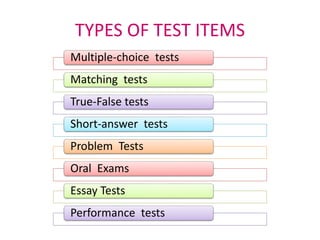
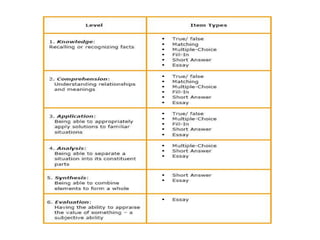
Test Items – Essay Type Questions – Short
Answer Question – Objective Type Questions
– Principles for Constructing Test Items
Introduction
• Concepts test
• Minute Tests
• Graphic organizers
• Review and reflection tools
• Feedback tools
• Rubrics
Assessment techniques
• Its purpose is to improve the quality of
student learning
• It provides faculty with feedback about their
effectiveness as teachers
• It gives students a measure of their progress
as learners
• To provide faculty with information on what,
how much and how well students are
learning
Observation / Extro spection /
Uncontrolled / Naturalistic / objective
Observation Method
• Latin word
• Observare – to keep open
• Measurement without using any instrument
or device
• Understanding the environment by sense
organs
Observation
• External behaviour of persons in appropriate
situations
• Controlled or uncontrolled
• Expert, purposive, systematic, carefully
focused and thoroughly recorded
• Should be accurate, valid and reliable
• Tools such as check list and score-card, tape-
recorder, thermometers, audiometer, stop-
watch, binoculars etc.
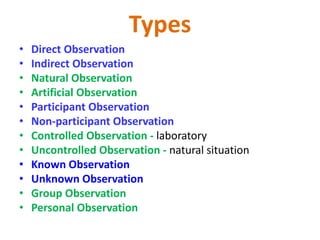
Types
• Direct Observation
• Indirect Observation
• Natural Observation
• Artificial Observation
• Participant Observation
• Non-participant Observation
• Controlled Observation - laboratory
• Uncontrolled Observation - natural situation
• Known Observation
• Unknown Observation
• Group Observation
• Personal Observation
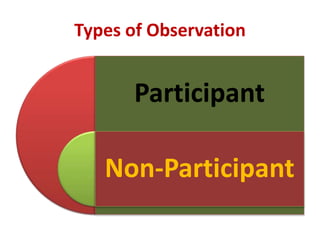
Types of Observation
Participant
Non-Participant
Uses of Observation
• In descriptive research
• Significant aspects of personality which
express themselves in behaviour
• Physical aspects of school buildings or
students and teachers – through physical
examination, measurement, assessment and
comparison with fixed standards
• In classroom – learning behaviour
• Cumulative record – anecdotal evidence –
research studies
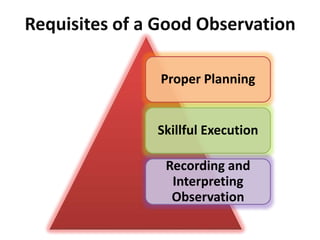
Requisites of a Good Observation
Proper Planning
Skillful Execution
Recording and
Interpreting
Observation
Self reporting
• Type of survey, questionnaire, or poll
• Respondents read the question and select a
response by themselves without researcher
interference
• Any method which involves asking a
participant about their feelings, attitudes,
and beliefs and so on
• Examples - Questionnaires and interviews
• Used in observational studies and
experiments
Questionnaires
• Consists of a set of questions usually in a
highly structured written form
• Open questions and closed questions
Interviews
• Spoken questionnaire where the interviewer
records the responses
• Structured - predetermined set of questions
• Unstructured - no questions are decided in
advance
• Questionnaires and interviews - to study
large samples of people fairly easy and
quickly.
• Ask people to reveal behaviour and feelings
which have been experienced in real
situations.
• Participants may not respond truthfully
• Social desirability bias can be a big problem
• If questionnaires are sent out, say via email
or through tutor groups, response rate can
be very low
• Unstructured interviews can be very time
consuming and difficult to carry out
• Structured interviews can restrict the
respondents' replies
• Psychologists often carry out semi-structured
interviews which consist of some pre-
determined questions and followed up with
further questions which allow the respondent
to develop their answers
Anecdotal Record
• Anecdote – short account of some happening
• Anecdotal records are factual descriptions of
the meaning incidents and events which the
teacher has observe in the lives of his
students
• An anecdotal record is a report of a
significant episode in the life of a student
- Raths Louis
Meaning
• An anecdotal record is a running description
of actual examples of behavior of a student is
observed by teachers and the counselor.
Definition
• "Anecdotes are descriptive accounts of
episodes or occurrences in a daily life of the
student."
- Brown and Martin
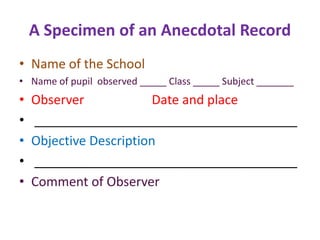
A Specimen of an Anecdotal Record
• Name of the School
• Name of pupil observed _____ Class _____ Subject _______
• Observer Date and place
• _____________________________________
• Objective Description
• _____________________________________
• Comment of Observer
Values and Uses of Anecdotal Records
• They provide specific and exact description
of personality and minimize generalizations.
• They are very helpful in understanding the
child's behavior in diverse situations.
• They provide a continuous record.
• They provide data for pupils to use in self-
appraisal
• A summary of these records is valuable for
forwarding with a pupil when he is
transferred from one school to another.
• The new members of the staff may use
these records and acquaint themselves with
the students.
Limitations
• Anecdotal record tends to be less reliable
than other tools
• They are time consuming to write
Check List
• Consisting of prepared list of items
• Used to record the presence or absence of
the item
• By checking ‘yes’ or ‘no’ or by inserting the
appropriate word or number
• Matter of fact and not judgement or opinion
• In educational studies
• Educational appraisal studies of school
buildings, text books, facilities available
• Recreation, laboratory, library etc.
Characteristics of Checklist
• Checklist is used for evaluation of self and
others.
• It is used as an instrument of observation.
• It involves questions and its answers.
• It involves signs by the respondent.
• It involves the characteristics about a
particular subject to be evaluated
Construction and Application of Checklist
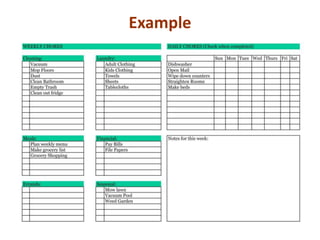
• The first horizontal line of the check list is
used to write the name or number of the
subject under observation.
• The characteristics of the subject or thing to
be evaluated are arranged in vertical column
of the evaluation sheet with the
corresponding blank options to place the tick
mark in the adjacent columns.
• Then the characteristics present in the
subjects under observation are decided and if
that characteristic is present in the subject
then the tick mark is placed in that column.
• Then after the frequency of all tick mark is
counted and marks are given to students on
the bass of predefined norms or standards.
• Then the percentage, mean, median or
correlation is used.
• A check list is simple tool of evaluation.
• lt is easy to make, easy to use, and yet can be
constructed to cover various aspects of an
individual's behaviroural adjustment.
• In preparing a checklist a teacher must keep
in mind what kinds of behaviours are
important to record and what kind of
objectives are to be evaluated
Example
Uses of Checklist
• It is useful for survey and research.
• The amount of characteristics or traits of
subjects can be known.
• It is helpful to give the appropriate guideline
to the subjects.
• To know the developmental direction of the
specific behavior pattern check list is used.
• It is useful for self-evaluation and other's
evaluation.
Limitations of Checklist
• As only sign is used in checklist therefore no
other options are found. It is subjective and
biased
• It is difficult to evaluate the personality of
student or adjustment capacity through
checklist
Rating Scale
Meaning
• A rating scale is a set of categories designed
to elicit information about a quantitative or a
qualitative attribute.
• Rating Scale is an important technique of
assessment. 'Rating' is the assessment of a
person by another person.
• Ruth Strang calls it 'directed observation'
Definition
• “Rating is a term applied to expression of
opinion or judgement regarding some
situation, object or character. Opinions are
usually expressed on a scale of values. Rating
techniques are devices by which such
judgments may be quantified"
- A.S.Barr
Rating Scale
• Personality of a individual is not assessed by
himself but by other persons who know the
individual well
• Student – teacher
• Teacher rating, personality rating, testing the
validity of many objective instruments like
paper-pencil inventories of personality &
School appraisal
• A rating scale is an improvement over check
list.
• While a checklist simply records that
something happened, a rating scale adds
another dimension: how much or how well it
happened.
• In a commonest type of rating scale, the
columns opposite the list of traits may be
captioned wither in quantitative terms such
as - always, sometimes, Never or in
qualitative terms such as Good, Average,
Poor.
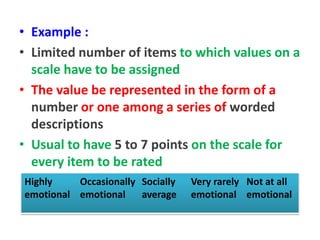
• Example :
• Limited number of items to which values on a
scale have to be assigned
• The value be represented in the form of a
number or one among a series of worded
descriptions
• Usual to have 5 to 7 points on the scale for
every item to be rated
Highly
emotional
Occasionally
emotional
Socially
average
Very rarely
emotional
Not at all
emotional
Types of Rating Scales
Numerical rating Scales:
• In this numbers are assigned to each trait.
• If is a seven-point scale, the number 7
represents the maximum amount of that trait
in the individual, and 4 represents the
average.
• The rater merely enters the appropriate
number after each name to indicate
judgement of the person
Method of Paired Comparison :
• In this the rater compares each person being
rated with respect to the trait of every other
individual, being rated in the general terms
of 'equal', 'better', or 'worse‘.
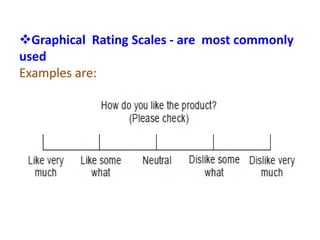
Graphical Rating Scales - are most commonly
used
Examples are:
Score cards
• It is a type of scale in which whatever is
being rated is analysed into its component
parts
• An expert assigns each part a maximum score
• The rater assigns a value to each items and
he passes judgement and these values are
totaled and a final score is pronounced
Man to Man Scale
• In this case, an individual is asked to rate
the person to be rated (the rate) by comparing
him to a person already rated and assigned a
position on the scale.
• The rate is assigned his position
Errors in rating
Generosity Error.
• This means, sometimes the rater does not
want to run down the rate, the latter being
his favourite, by giving him low ratings.
The Error of Halo Effect.
• Sometimes. the rating is done in terms of
general impressions about the rates formed
on the basis of some previous performance
The Error of Central Tendency.
• Sometimes the rater has a tendency to rate
all or many of the rates near the mid-point
on the scale
Limitations
• Hallo – Effect
• Rater frequently carry over one generalised
impression of the person from one rating to
another
• Generosity Error
• Rater develops a tendency to over estimate the
desirable qualities of the rate whom he likes
• Constant Error
• There is a tendency on the part of the rater to
see others as opposite to himself on a trait
• Average Category
• Rater have a tendency to play it safe and may
mark all items in the centre
TEST
Definition
• "A test is a systematic procedure for
observing and describing one or more
characteristics of a person with the aid of
either a numerical scale or a category system"
- L..J. Cronback
• "A test is a compact task or series of tasks
designed to ascertain the merit or quantity of
something. Educational tests constitute a
series of items for which a score is obtained.
Depending on how they are constructed, they
can serve a purpose"
- A Dictionary of Education
Purposes:
• For the grading of students,
• For individual attention required by any
student,
• For creating merit and so on.
• It tells how to shape the learning
methodologies.
• There are a number of forms of tests that can
be taken in a classroom. Give insight of each
and every student of the classroom.
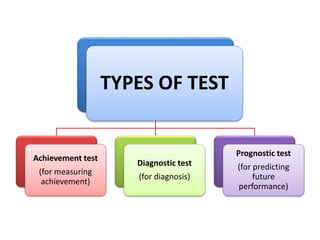
TYPES OF TEST
Achievement test
(for measuring
achievement)
Diagnostic test
(for diagnosis)
Prognostic test
(for predicting
future
performance)
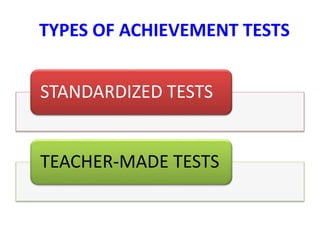
TYPES OF ACHIEVEMENT TESTS
STANDARDIZED TESTS
TEACHER-MADE TESTS
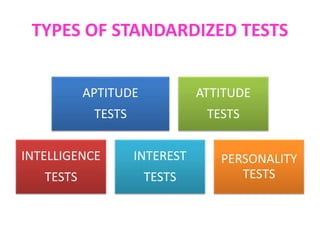
TYPES OF STANDARDIZED TESTS
APTITUDE
TESTS
ATTITUDE
TESTS
INTELLIGENCE
TESTS
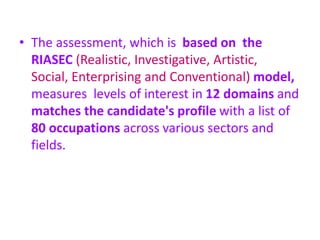
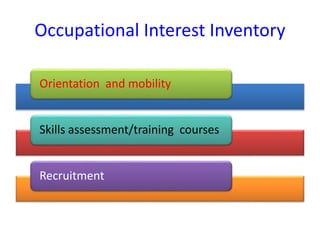
INTEREST
TESTS
PERSONALITY
TESTS
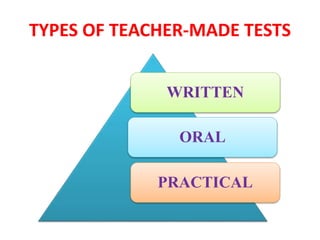
TYPES OF TEACHER-MADE TESTS
WRITTEN
ORAL
PRACTICAL
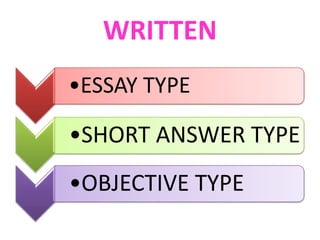
WRITTEN
•ESSAY TYPE
•SHORT ANSWER TYPE
•OBJECTIVE TYPE
Achievement test
Meaning
• An achievement test has a great significance in
all types of instructional progresses of the
individual.
• A classroom teacher depends upon the
achievements tests for measuring the progress
of his students in his are taken on their
performance in the achievement tests.
• It is, therefore, necessary that the teachers
should be well-versed with the meaning and
the characteristics of achievement tests.
Definition
• 'The type of ability tests that describe a
person has learned to do is called an
achievement test."
- Thorndike and Hagen (1969)
• A systematic procedure for determining the
amount a student has learned through
instruction."
- Gronlund (1997)
Characteristics of a good
Achievement test
• Groulund and Linn (1990) -
• A good achievement test is tried out and
selected on the basis of its difficulty level and
discriminating power
• It should have a description of measured
behavior.
• It should be divided into different
knowledge and skills according to behaviours
to be measured.
• It should contain a sufficient number of test
items for each measured behaviour
• Its instructions in regard to its administering
and scoring are so clear that they become
standardized for different users.
• It is accompanied by norm which are
developed at various levels and on various
age groups.
• It provides equivalent and comparable forms
of the test.
• It carries with it a test manual for its
administering and scoring
CHARACTERISTICS OF
ACHIEVEMENT TESTS
RELIABILITY
• The degree of accuracy with which an exam ,
test measures, what it seeks to measure a
given variable.
• A good test reliability means that the test
taker will obtain the same test score over
repeated testing as long as no other
extraneous factors have affected the score.
• A good instrument will produce consistent
scores. An instrument’s reliability is estimated
using a correlation coefficient of one type (or)
another.
VALIDITY
• Validity is the quality of a test which measures
what measures what it is supposed to
measure.
• It is the degree to which evidence, common
sense,(or) theory supports any interpretations
(or) conclusions about a student based on
his/her test performance.
A TEST IS VALID WHEN IT -
• Produce consistent scores over time.
• Measures what it intends to measures.
• Can be objectively scored
• Has representative norms
EASE IN ADMINISTRATIVE
• A test is good only when the conditions of
answering are simple (scientific & logical ). Its
instrument should be simple and clear.
COST
• A good test should be in expensive, not only
from the view point of money but also from
the view point of time & effort taken in the
construction of a test. Fortunately there is no
direct relationship between cost & quality.
TIME
• Generally the time given to students is always
in short supply however the students too do
not accept very long tests. Therefore a test
should neither be very long nor very short.
ACCEPTABILITY
• A good test should be acceptable to student
to whom its being given without regard to any
specific situation that is the question given in
the test should be neither very difficult nor
very easy.
OBJECTIVITY
• A test is objective when the scorer’s personal
judgment doesn’t affect the scoring
EQUILIBRIUM
• Achievement of the correct proportion among
questions alloted to each of the objectives
and teaching content.
SPECIFICITY
• The items in a test should be specificity to the
objectives.
• PRECISE & CLEAR
• Item should be precise, clear so that the
students can answer well and score marks
Practical uses of achievement tests
• Tests help to evaluate the extent to which the
objectives of education are being achieved
• Tests help to classify school objectives
• Tests discover the type of learning
experiences that will achieve these objectives
with the best possible results
• To evaluate, revise and improve the
curriculum in the light of these results.
• To discover backward children who need
help and to plan for remedial instruction for
such students.
• To select talented pupils for special classes
and courses.
• To decide proper classification of students.
• To get a better understanding of the needs
and abilities of pupils.
• To select students for the award of special
merits or scholarships
• To group pupils in a class so that students are
put in such a way that individual difference
are as slight as possible
FUNCTIONS OF
ACHIEVEMENT TESTS
• Provides basics for promotion to next grade.
• Find out where each student stands in various
academic areas.
• Motivate the students before a new
assignments has taken up.
• Expose pupils difficulties which the teacher
can help them to solve
STANDARDIZED TESTS
• Standardization means uniformity of
procedure in scoring, administering &
interpreting the results.
• Standardization test is one in which the
procedure, apparatus, & scoring have been
fixed so that precisely the same test can be
given at different times & places
- (LEE J CRONBACH).
• Standardization tool is one for which norms
have been established.
• A standardization test is prepared after
several trials of a test to a large number of
students.
CHARACTERISTICS OF STANDARDIZED TESTS
CONTENT IS STANDARDIZED:
• Item – selection done by component judges.
ADMINISTRATION IS STANDARDIZED:
• direction , time limits
SCORING HAS BEEN STANDARDIZED:
• rules of rules, scoring key are prepared.
INTERPRETATION HAS BEEN STANDARDIZED:
• Norms are provided.
TEACHER – MADE TESTS
• Teacher made tests are classroom tests and
are developed by the teachers.
• These tests assess students learning every
period of time or after a particular unit of
study.
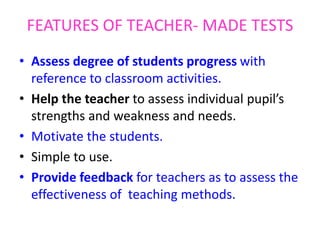
FEATURES OF TEACHER- MADE TESTS
• Assess degree of students progress with
reference to classroom activities.
• Help the teacher to assess individual pupil’s
strengths and weakness and needs.
• Motivate the students.
• Simple to use.
• Provide feedback for teachers as to assess the
effectiveness of teaching methods.
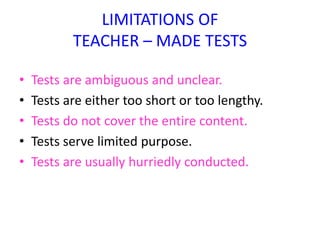
LIMITATIONS OF
TEACHER – MADE TESTS
• Tests are ambiguous and unclear.
• Tests are either too short or too lengthy.
• Tests do not cover the entire content.
• Tests serve limited purpose.
• Tests are usually hurriedly conducted.
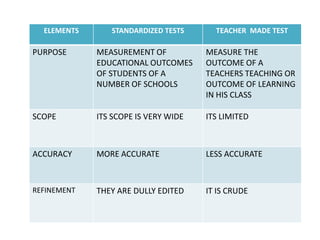
ELEMENTS STANDARDIZED TESTS TEACHER MADE TEST
PURPOSE MEASUREMENT OF
EDUCATIONAL OUTCOMES
OF STUDENTS OF A
NUMBER OF SCHOOLS
MEASURE THE
OUTCOME OF A
TEACHERS TEACHING OR
OUTCOME OF LEARNING
IN HIS CLASS
SCOPE ITS SCOPE IS VERY WIDE ITS LIMITED
ACCURACY MORE ACCURATE LESS ACCURATE
REFINEMENT THEY ARE DULLY EDITED IT IS CRUDE
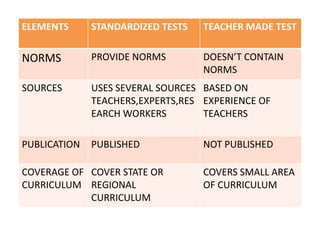
ELEMENTS STANDARDIZED TESTS TEACHER MADE TEST
NORMS PROVIDE NORMS DOESN’T CONTAIN
NORMS
SOURCES USES SEVERAL SOURCES
TEACHERS,EXPERTS,RES
EARCH WORKERS
BASED ON
EXPERIENCE OF
TEACHERS
PUBLICATION PUBLISHED NOT PUBLISHED
COVERAGE OF
CURRICULUM
COVER STATE OR
REGIONAL
CURRICULUM
COVERS SMALL AREA
OF CURRICULUM
Diagnostic tests
Meaning
• There are tests which have been devised to
provide information about the specific nature
of pupil's difficulties in given subject areas.
These tests are called diagnostic tests.
• The word diagnosis is used more or less in
the same sense in education.
• In educational diagnosis, it is the failure of
the process of education or learning that is
located and attended to be remedied.
• Educational diagnosis is "the determination
of the nature of learning difficulties and
deficiencies".
The corrective diagnosis can be done at the
following levels.
• Classification
• Finding the nature of difficulties
• Finding the causes of difficulties
• Providing remedial measures
• Preventing the difficulties from occurring
Uses of Diagnostic tests
• Point out inadequacies in specific skills
• Locate areas in which individual instruction is
required
• Furnish continuous information in order that
learning activities may be most productive of
desirable outcomes.
• Serve as a basis for improving instructional
method, instructional materials and learning
procedures
Prognostic tests
• One of the important uses of tests is to
predict how individuals behave in certain
situations.
• Prognostic tests are intended for uses in
prognosis or prediction of future success in
specific subjects of the school curriculum.
• They also frequently test some of the
aptitude factors that are not directly
dependent upon previous training of a specific
topic.
Meaning
• An aptitude is the ability to learn or to
develop proficiency in an area
• Examples are various types of reasoning,
artistic ability, motor co-ordination, musical
talent.
Aptitude tests
Aptitude Tests
• Science, literature as the latent potentialities
or skills
• Converted into special skills
• Potentiality of clerical
• Trained further to write exams in IAS and IPS
cadres
• Group I or II services
Purpose of Aptitude test
• Human efficiency is not as easily defined as
that of a machine and it is not easily
measured.
• The working efficiency of an individual varies
with a number of factors, the most important
of which are
i. His aptitude for the task involved
ii. Adequacy of his training for the job and
iii. His mindset and conditions of work.
• Aptitude is measured in terms of individual
differences.
• In a given type of work, there are those who
learn rapidly and achieve a high level of
skill and those who are slow to learn and
whose achievement is low.
• The former are said to have good aptitude
for the work in question.
• Aptitude test batteries like General Aptitude
Test Battery (GATB) and Differential Aptitude
Test (DAT) are used to measure the aptitude
of individuals in general reasoning ability,
verbal aptitude, numerical aptitude, spatial
aptitude, clerical perception, motor co-
ordination, finger dexterity, manual dexterity,
language usage etc. thus, these tests are
widely used to test the aptitude of the
students.
Measurement of Aptitude
• Differential Aptitude Tests
1. Verbal reasoning
2. Numerical ability
3. Abstract reasoning
4. Spatial relations
5. Mechanical Reasoning
6. Clerical speed and accuracy
7. Language usage – Spelling and Grammar
First three (1, 2, 3) – measure the functions
related to general intelligence
4, 5, 6 & 7 measure specific aptitudes
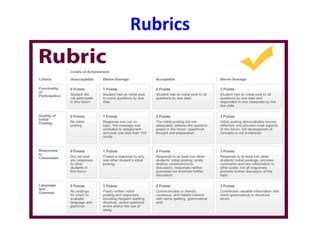
Rubrics
Meaning
• A rubric is typically an evaluation tool or
set of guidelines used to promote the
consistent application of learning
expectations, learning objectives, or
learning standards in the classroom, or
to measure their attainment against a
consistent set of criteria.
• The word rubric comes from the Latin word
for red.
• The online Merriam-Webster dictionary lists
the first meaning of rubric as "an
authoritative rule" and the fourth meaning
as "a guide listing specific criteria for
grading or scoring academic papers, projects,
or tests"
• A rubric is a coherent set of criteria for
students‘ work that includes descriptions of
levels of performance quality on the criteria.
• It should be clear from the definition that
rubrics have two major aspects: coherent sets
of criteria and descriptions of levels of
performance for these criteria.
Steps to Create a Scoring Rubrics
• Example
• Explaining the scoring rubrics by taking the
scoring of writing skill of student
• Step· 1
• Teacher uses the assignment of students for
scoring for assessing the writing skill, and he
gives a clear guideline for writing the
assignment.
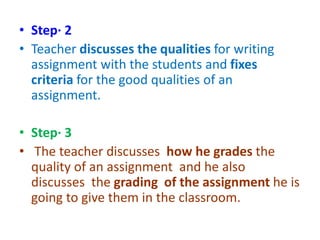
• Step· 2
• Teacher discusses the qualities for writing
assignment with the students and fixes
criteria for the good qualities of an
assignment.
• Step· 3
• The teacher discusses how he grades the
quality of an assignment and he also
discusses the grading of the assignment he is
going to give them in the classroom.
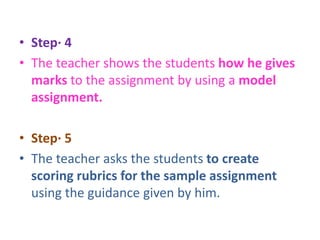
• Step· 4
• The teacher shows the students how he gives
marks to the assignment by using a model
assignment.
• Step· 5
• The teacher asks the students to create
scoring rubrics for the sample assignment
using the guidance given by him.
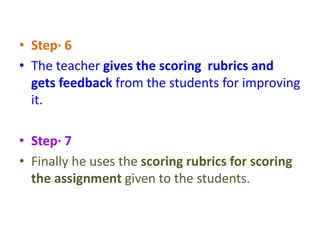
• Step· 6
• The teacher gives the scoring rubrics and
gets feedback from the students for improving
it.
• Step· 7
• Finally he uses the scoring rubrics for scoring
the assignment given to the students.
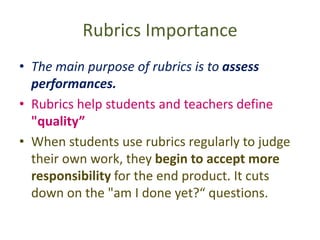
Rubrics Importance
• The main purpose of rubrics is to assess
performances.
• Rubrics help students and teachers define
"quality”
• When students use rubrics regularly to judge
their own work, they begin to accept more
responsibility for the end product. It cuts
down on the "am I done yet?“ questions.
• Rubrics reduce the time teachers spend
grading student work and make it easier for
teachers to explain to students why they got
the grade they did and what they can do to
improve.
• Parents usually like the rubrics concept once
they understand it, and they find rubrics
useful when helping with homework. As one
teacher says: "They know exactly what their
child needs to do to be successful"
ASSESSMENT TOOL FOR AFFECTIVE DOMAIN
• Affective Domain
• Prepared in 1964 by Dr.Bloom, Kruthwohl and
Masin.
• Emphasizes the development of the heart.
• It deals with values, attitudes, interest, and
appreciation, social and emotional adjustment.
• If the objectives of the affective domain are
attended to and achieved, the evaluator will be in
a position to predict the behavior of an
individual.
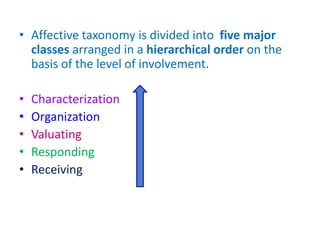
• Affective taxonomy is divided into five major
classes arranged in a hierarchical order on the
basis of the level of involvement.
• Characterization
• Organization
• Valuating
• Responding
• Receiving
• Receiving
• Learner should be sensitized to the
existence of certain phenomenon and stimuli
in his environment. This includes
awareness, willingness to receive and give
controlled or selected attention. (Ability to
discriminate the stimuli)
• Responding (Interest objective)
• This is with response that goes beyond
merely attending to phenomena. A person is
actively involved in attending to them.
• This involves responding, willingness to
respond and satisfaction in response. The
person attaches emotional significance to the
stimuli