




ASSESSMENT FOR LEARNING
TOOLS AND
TECHNIQUES FOR
CLASSROOM
ASSESSMENT
INTRODUCTION
Classroom Assessment is a systematic approach
to formative evaluation, used by instructors to
determine how much and how well students are
learning.
Classroom assessment tools and techniques and
other informal assessment tools provide key
information during the semester regarding
teaching and learning so that changes can be
made as necessary.
The central purpose of Classroom Assessment
is to empower both teachers and their
students to improve the quality of learning in
the classroom through an approach that is
learner-centered, teacher-directed, mutually
beneficial, formative, context-specific, and
firmly rooted in good practice.
Continue…
It helps for assessing course-related
knowledge and skills, learner attitudes,
values and self-awareness and for assessing
learner reactions to instruction.
Teachers also assist students in developing
self-monitoring and self-assessment skills
and strategies.
Continue…
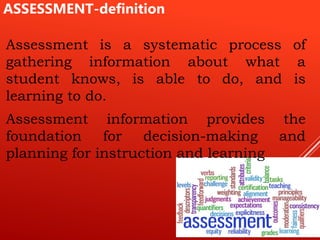
Assessment is a systematic process of
gathering information about what a
student knows, is able to do, and is
learning to do.
Assessment information provides the
foundation for decision-making and
planning for instruction and learning
ASSESSMENT-definition
TECHNIQUES AND TOOLS OF
Techniques of assessment
Methods of organizing the various
activities that find place in an
assessment process are called
“ASSESSMENT TECHNIQUES”
Tools for assessment
The devices and the materials employed in the assessment
techniques are known as “TOOLS OF ASSESSMENT”
EXAMPLE: ”Observation “is used in the collection of assessment
information, the observational activity is the “Technique“ and the
devices used in it like “checklist “,”rating scale” etc., are the tools
for assessment
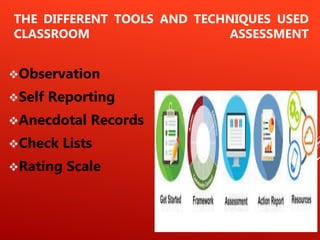
THE DIFFERENT TOOLS AND TECHNIQUES USED
CLASSROOM ASSESSMENT
Observation
Self Reporting
Anecdotal Records
Check Lists
Rating Scale
OBSERVATION-DEFINITION
Gardner (1975)-observation is the selection, provocation,
recording and encoding of that set of behaviours and settings
concerning organism “in situ’ which are consistent with
empirical aims.”
young - observation is careful and systematic viewing of a
selected situation and recording then and there ,what is
perceived .
Example :A teacher can easily guess that a student is highly
anxious and excited ,by observing external symptoms like
trembling of the hands, incoherent speech ,biting ,nails,
restlessness and similar such behaviours .
 A physical as well as mental activity.
 Selective and purposeful.
 Systematic
 Specific
 Record of immediately.
 Verifiable
 Behavior in natural surroundings
 Understanding significant events
affecting social
 Reality from the perspective of
observed person
CHARACTERISTICS OF OBSERVATION
TYPES OF OBSERVATION
 Casual & Scientific observation
 Simple and systematic observation
 Subjective and Objective
Observation
 Intra – subjective and inter
subjective observation
 Direct and indirect observation
 Structured and Unstructured
observation
 Natural and Artificial Observation
 Participant and Non-participant
observation
Casual & Scientific observation
An observation may be either casual or scientific.
Casual observation occurs without any previous
preparations.
Scientific observation is carried out with the help of tools of
measurement.
Simple observation
Observation is found in almost all research studies, at least in
the exploratory stage.
Such data collection is often called simple observation.
Its practice is not very standardized.
Systematic observation
It employs standardized procedures, training of observers,
schedules for recording is called Systematic observation
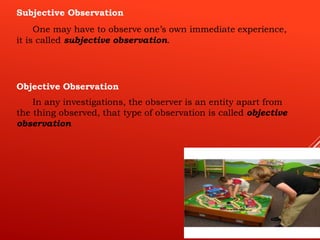
Subjective Observation
One may have to observe one’s own immediate experience,
it is called subjective observation.
Objective Observation
In any investigations, the observer is an entity apart from
the thing observed, that type of observation is called objective
observation
Intra – subjective observation
If repeated observation of a constant phenomenon by the same
observer yield constant data the observation is said to be intra
subjective.
Inter subjective observation
If repeated observations of a constant phenomenon by different
observers yield constant data the observation is said to be inter
subjective
Direct observation
The direct observation describes the situation in which the observer
is physically present and personally monitors what take place.
Indirect observation
Indirect observation is used to describe studies in which the
recording is done by mechanical, photographic or electronic means.
Structured observation
Structured observation is organised and planned which employs
formal procedures, has a set of well -defined observation categories,
and is subjected to high levels of control and differentiation.
Unstructured observation
Unstructured observations is loosely organized and the process is
largely left to the observer to define.
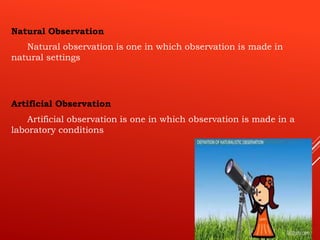
Natural Observation
Natural observation is one in which observation is made in
natural settings
Artificial Observation
Artificial observation is one in which observation is made in a
laboratory conditions
Participant observation
When the observer participates with the activities of these under
study is called participant observation
Non-participant observation
When the observer does not actually participate in the activities
of the group to be studied but simply present in the group it is
common as non-participant observation.
LIMITATIONS OF OBSERVATION
 Establishing the validity difficult
 problem of subjectivity
 Possibility of distortion.
 slow and laborious process
 Events may not be easily classifiable
 The data may be unmanageable
 It is going to be a costly affair
 It cannot offer quantitative generations.
 larger time required
Greater resources required
Lack of objectivity.
Acquiring information with
influence and wide information,
Easy in exchange of clear
observation of neutral and real
behavior
Maintaining impartial status
Maintaining objectivity
Scientific outlet.
MERITS
SELF-REPORTING-DEFINITION
 A self-report is a type of survey, questionnaire, or poll in
which respondents read the question and select a
response by themselves without researcher interference.
 A self-report is any method which involves asking a
participant about their feelings, attitudes, beliefs and so
on.
 The main strength of self-report methods are that they
are allowing participants to describe their own
experiences rather than inferring this from observing
participants.
ADVANTAGES OF SELF-REPORTING
 Obtained directly
 Information are highly valid
 Huge amount of data obtained very
quickly
 Data are highly reliable
 Easily tabulated and analysed
 Left out data are easily obtained
 Device are not complete honestly
 Necessary to check
 Improper questioning and answering to it
 Influenced by the emotions
 Low response rate
 Fixed choice question
 Lack of flexibility
 No explanatory information
 DISADVANTAGES OF SELF-REPORTING
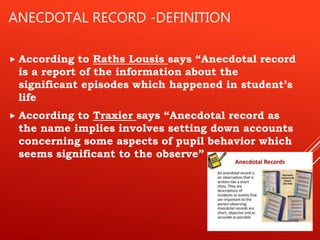
ANECDOTAL RECORD -DEFINITION
 According to Raths Lousis says “Anecdotal record
is a report of the information about the
significant episodes which happened in student’s
life
 According to Traxier says “Anecdotal record as
the name implies involves setting down accounts
concerning some aspects of pupil behavior which
seems significant to the observe”
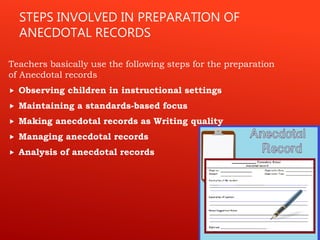
STEPS INVOLVED IN PREPARATION OF
ANECDOTAL RECORDS
Teachers basically use the following steps for the preparation
of Anecdotal records
 Observing children in instructional settings
 Maintaining a standards-based focus
 Making anecdotal records as Writing quality
 Managing anecdotal records
 Analysis of anecdotal records
MERITS
Observation of varies situation
Reliable information
Useful for cross checking
Helps in studying the behavior of children
Gives productive ideas and
recommendations
Long duration
Sometimes develops wrong notion
Misunderstand the concept
Useful only if there is accurate and
comprehensive
Not clear
Very much limited data
LIMITATIONS
CHECK LIST-DEFINITION
 Checklists are assessment
tools that set out specific criteria, which educators and
students may use to gauge skill development or progress.
 Checklists set out skills,
attitudes, strategies, and behaviours of evaluation and offer
ways to systematically organize information about a student
or group of students.
CHARACTERISTICS OF CHECKLIST
 Evaluation of self and others
 Involves in question and answer
 Instrument of observation
 Signs by the respondent
 Observe and record students
behavioral traits
 Helps in finding the students
learning efficiency
MERITS
 Easy usage
 It can fill in short duration
 Trusted information
 Easily to compute
LIMITATIONS
 Not helpful
 Gather complex
information
 Objectives can not be
stated
 Not an certainty
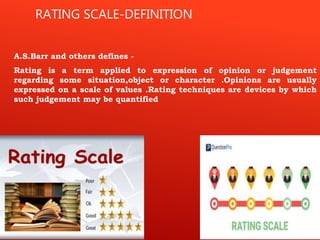
RATING SCALE-DEFINITION
A.S.Barr and others defines -
Rating is a term applied to expression of opinion or judgement
regarding some situation,object or character .Opinions are usually
expressed on a scale of values .Rating techniques are devices by which
such judgement may be quantified
TYPES OF RATING SCALE
 Graphic rating Scale
The rated value is indicated as a
dot in graduated line
 Numerical rating scale
A sequence of defined numbers is applied
to the rater or the observer, The rater
assigns an appropriate number in line to
each stimulus.
Exa:1-poor;2-good;3-excellent
 Descriptive rating scale
To mark the rated value observers will
asked to indicate anyone of the observers
will be asked to indicate anyone of the
descriptions .Exa:
High Average low
MERITS
 Easy to evaluate
 Less time consumption
 Not much training is
needed
 Various factors like
personality, teaching,
evaluating ,etc., are get
develop
LIMITATIONS
 Difficult to understand
 Generosity error
 Constant severity error
 Average error
 Halo effect
 Logical error
TEST-DEFINITION
 Brown (2004:3) stated that a test is a method of measuring a
person’s ability knowledge, or performance in a given domain.
 Anthony J Nitko (1983:6) defined test is systematic procedure
for observing and describing one or more characteristics of
person with the aid of either a numerical of category system.
CATEGORIZATION OF TESTS
 ACHIEVEMENT TEST
Dowine defines-Any test that measure
the attainments of an individual after a
period of training or learning is called an
achievement test
 DIAGNOSTIC TEST-
A test that helps the teacher to identify the
concepts in the content area taught which
student struggle to learn and the nature of
the difficulties experienced by them is called
as diagnostic test
 PROGNOSTIC TEST
Hull defines-Aptitude test is one that
measures the inborn capacity to learn a
specific vocation or skill”
TYPES OF TEST
 OBJECTIVE TYPE
W. Wiersma and S.G. Jurs
(1990) states, “objective
items are items can be
objectively scored, items
on which persons select a
response from a list of
opinions
SHORT-ANSWER
Short-answer questions are open-ended questions that require
students to create an answer. They are commonly used in
examinations to assess the basic knowledge and understanding
ESSAY TYPE
William weirsama - “Essay test is a test that requires the student to
structure a rather long written response up to several paragraphs.”
The word essay has been derived from a French word ‘essayer’ which
means ‘to try’ or ‘to attempt’
MERITS
 It has a positive
impact on student
achievement.
 It is a reliable and
objective
measurement of
achievement.
 Tests allow for equal
and equivalent
content for all
students.
 Test teaches students
prioritization.
 It allows school
districts to discover
their good teachers.
 It creates Stress and
anxiety
 Not a fair way of
testing someone’s
knowledge
 Comparison among
students
 Questions are general
and ridiculuos in
nature.
 It creates a narrower
curriculum that may
limit student learning.
 DE-MERITS
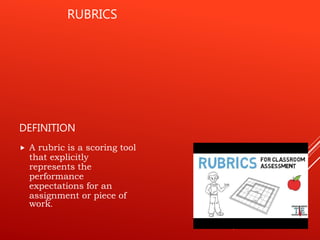
RUBRICS
 A rubric is a scoring tool
that explicitly
represents the
performance
expectations for an
assignment or piece of
work.
DEFINITION
 The traditional meanings
of the word rubric from
Latin, rubrica, red ochre,
red ink
 In education
terminology, rubric means
"a scoring guide used to
evaluate the quality of
students' constructed.
 It is a set of criteria for
grading assignments.
 It usually contain an
evaluative criteria, quality
definitions for those
criteria at particular levels
of achievement, and a
scoring strategy
 MEANING
PURPOSES OF RUBRICS
 tools for systematic recording of observations
 tools for self assessment
 samples of criteria for students prior to collecting and
evaluating data on their work
 record the development of specific skills, strategies,
attitudes and behaviours necessary for
 demonstrating learning
 clarify students' instructional needs by presenting a
record of current accomplishments.
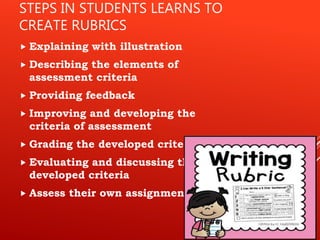
STEPS IN STUDENTS LEARNS TO
CREATE RUBRICS
 Explaining with illustration
 Describing the elements of
assessment criteria
 Providing feedback
 Improving and developing the
criteria of assessment
 Grading the developed criteria
 Evaluating and discussing the
developed criteria
 Assess their own assignments
IMPORTANCE OF RUBRICS
STUDENTS
 Helps to understand the
concept
 Helps to improve their
concentration and effort
 Helps to assess with
explicit and fairly in all
fields
 Helps to increase the
transparency and
objectivity in assessment
 Helps to improve their
performance level
 Helps to assess on their
own learning process
 To assess student
performance
transparently and
consistently
 It helps to focus on the
learning content as well
as the learning outcome
 It helps to increase
objectivity in
assessment
 TEACHERS
CONCLUSION
 To do this effectively and successful assessment , teachers must
ensure that students are involved in setting learning goals,
developing action plans, and using assessment processes to monitor
their achievement of goals.
Tools and Techniques for assessment for learning

Tools and Techniques for assessment for learning

  • 2.
  • 3.
  • 4.
    INTRODUCTION Classroom Assessment isa systematic approach to formative evaluation, used by instructors to determine how much and how well students are learning. Classroom assessment tools and techniques and other informal assessment tools provide key information during the semester regarding teaching and learning so that changes can be made as necessary.
  • 5.
    The central purposeof Classroom Assessment is to empower both teachers and their students to improve the quality of learning in the classroom through an approach that is learner-centered, teacher-directed, mutually beneficial, formative, context-specific, and firmly rooted in good practice. Continue…
  • 6.
    It helps forassessing course-related knowledge and skills, learner attitudes, values and self-awareness and for assessing learner reactions to instruction. Teachers also assist students in developing self-monitoring and self-assessment skills and strategies. Continue…
  • 7.
    Assessment is asystematic process of gathering information about what a student knows, is able to do, and is learning to do. Assessment information provides the foundation for decision-making and planning for instruction and learning ASSESSMENT-definition
  • 8.
    TECHNIQUES AND TOOLSOF Techniques of assessment Methods of organizing the various activities that find place in an assessment process are called “ASSESSMENT TECHNIQUES”
  • 9.
    Tools for assessment Thedevices and the materials employed in the assessment techniques are known as “TOOLS OF ASSESSMENT” EXAMPLE: ”Observation “is used in the collection of assessment information, the observational activity is the “Technique“ and the devices used in it like “checklist “,”rating scale” etc., are the tools for assessment
  • 10.
    THE DIFFERENT TOOLSAND TECHNIQUES USED CLASSROOM ASSESSMENT Observation Self Reporting Anecdotal Records Check Lists Rating Scale
  • 11.
    OBSERVATION-DEFINITION Gardner (1975)-observation isthe selection, provocation, recording and encoding of that set of behaviours and settings concerning organism “in situ’ which are consistent with empirical aims.”
  • 12.
    young - observationis careful and systematic viewing of a selected situation and recording then and there ,what is perceived . Example :A teacher can easily guess that a student is highly anxious and excited ,by observing external symptoms like trembling of the hands, incoherent speech ,biting ,nails, restlessness and similar such behaviours .
  • 13.
     A physicalas well as mental activity.  Selective and purposeful.  Systematic  Specific  Record of immediately.  Verifiable  Behavior in natural surroundings  Understanding significant events affecting social  Reality from the perspective of observed person CHARACTERISTICS OF OBSERVATION
  • 14.
    TYPES OF OBSERVATION Casual & Scientific observation  Simple and systematic observation  Subjective and Objective Observation  Intra – subjective and inter subjective observation  Direct and indirect observation  Structured and Unstructured observation  Natural and Artificial Observation  Participant and Non-participant observation
  • 15.
    Casual & Scientificobservation An observation may be either casual or scientific. Casual observation occurs without any previous preparations. Scientific observation is carried out with the help of tools of measurement.
  • 16.
    Simple observation Observation isfound in almost all research studies, at least in the exploratory stage. Such data collection is often called simple observation. Its practice is not very standardized. Systematic observation It employs standardized procedures, training of observers, schedules for recording is called Systematic observation
  • 17.
    Subjective Observation One mayhave to observe one’s own immediate experience, it is called subjective observation. Objective Observation In any investigations, the observer is an entity apart from the thing observed, that type of observation is called objective observation
  • 18.
    Intra – subjectiveobservation If repeated observation of a constant phenomenon by the same observer yield constant data the observation is said to be intra subjective. Inter subjective observation If repeated observations of a constant phenomenon by different observers yield constant data the observation is said to be inter subjective
  • 19.
    Direct observation The directobservation describes the situation in which the observer is physically present and personally monitors what take place. Indirect observation Indirect observation is used to describe studies in which the recording is done by mechanical, photographic or electronic means.
  • 20.
    Structured observation Structured observationis organised and planned which employs formal procedures, has a set of well -defined observation categories, and is subjected to high levels of control and differentiation. Unstructured observation Unstructured observations is loosely organized and the process is largely left to the observer to define.
  • 21.
    Natural Observation Natural observationis one in which observation is made in natural settings Artificial Observation Artificial observation is one in which observation is made in a laboratory conditions
  • 22.
    Participant observation When theobserver participates with the activities of these under study is called participant observation Non-participant observation When the observer does not actually participate in the activities of the group to be studied but simply present in the group it is common as non-participant observation.
  • 23.
    LIMITATIONS OF OBSERVATION Establishing the validity difficult  problem of subjectivity  Possibility of distortion.  slow and laborious process  Events may not be easily classifiable  The data may be unmanageable  It is going to be a costly affair  It cannot offer quantitative generations.  larger time required Greater resources required Lack of objectivity.
  • 24.
    Acquiring information with influenceand wide information, Easy in exchange of clear observation of neutral and real behavior Maintaining impartial status Maintaining objectivity Scientific outlet. MERITS
  • 25.
    SELF-REPORTING-DEFINITION  A self-reportis a type of survey, questionnaire, or poll in which respondents read the question and select a response by themselves without researcher interference.  A self-report is any method which involves asking a participant about their feelings, attitudes, beliefs and so on.  The main strength of self-report methods are that they are allowing participants to describe their own experiences rather than inferring this from observing participants.
  • 26.
    ADVANTAGES OF SELF-REPORTING Obtained directly  Information are highly valid  Huge amount of data obtained very quickly  Data are highly reliable  Easily tabulated and analysed  Left out data are easily obtained
  • 27.
     Device arenot complete honestly  Necessary to check  Improper questioning and answering to it  Influenced by the emotions  Low response rate  Fixed choice question  Lack of flexibility  No explanatory information  DISADVANTAGES OF SELF-REPORTING
  • 28.
    ANECDOTAL RECORD -DEFINITION According to Raths Lousis says “Anecdotal record is a report of the information about the significant episodes which happened in student’s life  According to Traxier says “Anecdotal record as the name implies involves setting down accounts concerning some aspects of pupil behavior which seems significant to the observe”
  • 29.
    STEPS INVOLVED INPREPARATION OF ANECDOTAL RECORDS Teachers basically use the following steps for the preparation of Anecdotal records  Observing children in instructional settings  Maintaining a standards-based focus  Making anecdotal records as Writing quality  Managing anecdotal records  Analysis of anecdotal records
  • 30.
    MERITS Observation of variessituation Reliable information Useful for cross checking Helps in studying the behavior of children Gives productive ideas and recommendations
  • 31.
    Long duration Sometimes developswrong notion Misunderstand the concept Useful only if there is accurate and comprehensive Not clear Very much limited data LIMITATIONS
  • 32.
    CHECK LIST-DEFINITION  Checklistsare assessment tools that set out specific criteria, which educators and students may use to gauge skill development or progress.  Checklists set out skills, attitudes, strategies, and behaviours of evaluation and offer ways to systematically organize information about a student or group of students.
  • 33.
    CHARACTERISTICS OF CHECKLIST Evaluation of self and others  Involves in question and answer  Instrument of observation  Signs by the respondent  Observe and record students behavioral traits  Helps in finding the students learning efficiency
  • 34.
    MERITS  Easy usage It can fill in short duration  Trusted information  Easily to compute LIMITATIONS  Not helpful  Gather complex information  Objectives can not be stated  Not an certainty
  • 35.
    RATING SCALE-DEFINITION A.S.Barr andothers defines - Rating is a term applied to expression of opinion or judgement regarding some situation,object or character .Opinions are usually expressed on a scale of values .Rating techniques are devices by which such judgement may be quantified
  • 36.
    TYPES OF RATINGSCALE  Graphic rating Scale The rated value is indicated as a dot in graduated line  Numerical rating scale A sequence of defined numbers is applied to the rater or the observer, The rater assigns an appropriate number in line to each stimulus. Exa:1-poor;2-good;3-excellent  Descriptive rating scale To mark the rated value observers will asked to indicate anyone of the observers will be asked to indicate anyone of the descriptions .Exa: High Average low
  • 38.
    MERITS  Easy toevaluate  Less time consumption  Not much training is needed  Various factors like personality, teaching, evaluating ,etc., are get develop LIMITATIONS  Difficult to understand  Generosity error  Constant severity error  Average error  Halo effect  Logical error
  • 39.
    TEST-DEFINITION  Brown (2004:3)stated that a test is a method of measuring a person’s ability knowledge, or performance in a given domain.  Anthony J Nitko (1983:6) defined test is systematic procedure for observing and describing one or more characteristics of person with the aid of either a numerical of category system.
  • 40.
    CATEGORIZATION OF TESTS ACHIEVEMENT TEST Dowine defines-Any test that measure the attainments of an individual after a period of training or learning is called an achievement test  DIAGNOSTIC TEST- A test that helps the teacher to identify the concepts in the content area taught which student struggle to learn and the nature of the difficulties experienced by them is called as diagnostic test  PROGNOSTIC TEST Hull defines-Aptitude test is one that measures the inborn capacity to learn a specific vocation or skill”
  • 41.
    TYPES OF TEST OBJECTIVE TYPE W. Wiersma and S.G. Jurs (1990) states, “objective items are items can be objectively scored, items on which persons select a response from a list of opinions
  • 42.
    SHORT-ANSWER Short-answer questions areopen-ended questions that require students to create an answer. They are commonly used in examinations to assess the basic knowledge and understanding ESSAY TYPE William weirsama - “Essay test is a test that requires the student to structure a rather long written response up to several paragraphs.” The word essay has been derived from a French word ‘essayer’ which means ‘to try’ or ‘to attempt’
  • 43.
    MERITS  It hasa positive impact on student achievement.  It is a reliable and objective measurement of achievement.  Tests allow for equal and equivalent content for all students.  Test teaches students prioritization.  It allows school districts to discover their good teachers.
  • 44.
     It createsStress and anxiety  Not a fair way of testing someone’s knowledge  Comparison among students  Questions are general and ridiculuos in nature.  It creates a narrower curriculum that may limit student learning.  DE-MERITS
  • 45.
    RUBRICS  A rubricis a scoring tool that explicitly represents the performance expectations for an assignment or piece of work. DEFINITION
  • 46.
     The traditionalmeanings of the word rubric from Latin, rubrica, red ochre, red ink  In education terminology, rubric means "a scoring guide used to evaluate the quality of students' constructed.  It is a set of criteria for grading assignments.  It usually contain an evaluative criteria, quality definitions for those criteria at particular levels of achievement, and a scoring strategy  MEANING
  • 47.
    PURPOSES OF RUBRICS tools for systematic recording of observations  tools for self assessment  samples of criteria for students prior to collecting and evaluating data on their work  record the development of specific skills, strategies, attitudes and behaviours necessary for  demonstrating learning  clarify students' instructional needs by presenting a record of current accomplishments.
  • 48.
    STEPS IN STUDENTSLEARNS TO CREATE RUBRICS  Explaining with illustration  Describing the elements of assessment criteria  Providing feedback  Improving and developing the criteria of assessment  Grading the developed criteria  Evaluating and discussing the developed criteria  Assess their own assignments
  • 49.
    IMPORTANCE OF RUBRICS STUDENTS Helps to understand the concept  Helps to improve their concentration and effort  Helps to assess with explicit and fairly in all fields  Helps to increase the transparency and objectivity in assessment  Helps to improve their performance level  Helps to assess on their own learning process
  • 50.
     To assessstudent performance transparently and consistently  It helps to focus on the learning content as well as the learning outcome  It helps to increase objectivity in assessment  TEACHERS
  • 51.
    CONCLUSION  To dothis effectively and successful assessment , teachers must ensure that students are involved in setting learning goals, developing action plans, and using assessment processes to monitor their achievement of goals.