SUBMITTED TO :- SUBMITTED BY:-
Dr. Sanjay Tignath sir Mayank Mahawar
M.Sc. 1ST SEM
ROLL NO:-12
 An unconformity is a depositional contact
between two rocks of measurably ages.
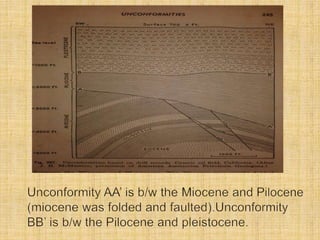
 An unconformity is a surface of erosion that
separates the younger strata from older rocks.
 It is one of the most common geological feature
found in rocks or in succession.
 Unconformities represent gaps in
the geologic record; periods of time that are not
represented by any rocks.
 Unconformities are resulted due to tectonic
activity in form of uplift or subsidence of land.
Angular unconformity
 Non conformity
Disconformity
Local unconformity
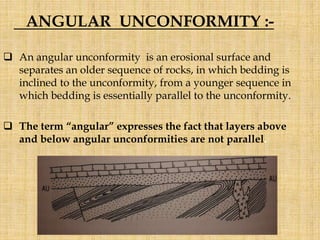
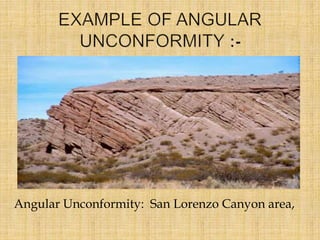
 An angular unconformity is an erosional surface and
separates an older sequence of rocks, in which bedding is
inclined to the unconformity, from a younger sequence in
which bedding is essentially parallel to the unconformity.
 The term “angular” expresses the fact that layers above
and below angular unconformities are not parallel.
ANGULAR UNCONFORMITY :-
Angular Unconformity: San Lorenzo Canyon area,
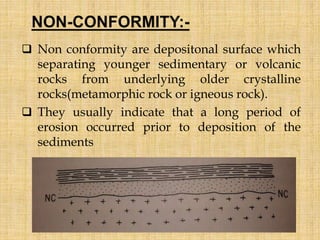
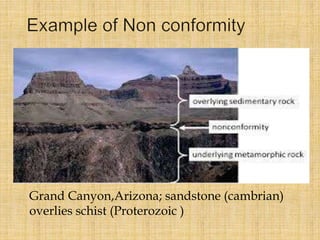
 Non conformity are depositonal surface which
separating younger sedimentary or volcanic
rocks from underlying older crystalline
rocks(metamorphic rock or igneous rock).
 They usually indicate that a long period of
erosion occurred prior to deposition of the
sediments
Grand Canyon,Arizona; sandstone (cambrian)
overlies schist (Proterozoic )
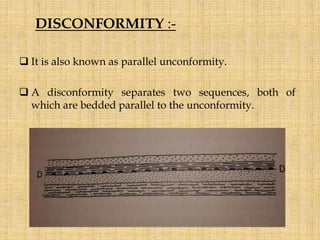
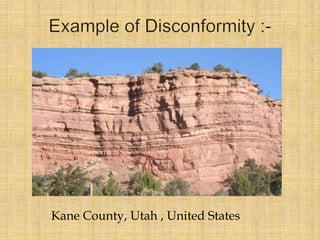
DISCONFORMITY :-
 It is also known as parallel unconformity.
 A disconformity separates two sequences, both of
which are bedded parallel to the unconformity.
Kane County, Utah , United States
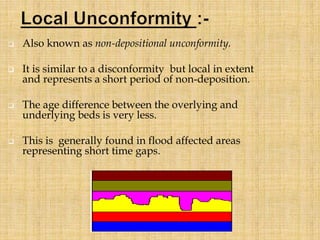
 Also known as non-depositional unconformity.
 It is similar to a disconformity but local in extent
and represents a short period of non-deposition.
 The age difference between the overlying and
underlying beds is very less.
 This is generally found in flood affected areas
representing short time gaps.
 Difference in structure
 Difference observation
 Difference in fossil record
 Presence of conglomarate
 Difference in environmental of deposition
 An outline of structural geology –PAUL F.
WILLIAMS
 Structural Geology – M.P. BILLINGS
 Structural Geology of rocks and regions –
GEORGE H. DAVIS

Unconformity

  • 1.
    SUBMITTED TO :-SUBMITTED BY:- Dr. Sanjay Tignath sir Mayank Mahawar M.Sc. 1ST SEM ROLL NO:-12
  • 2.
     An unconformityis a depositional contact between two rocks of measurably ages.  An unconformity is a surface of erosion that separates the younger strata from older rocks.  It is one of the most common geological feature found in rocks or in succession.  Unconformities represent gaps in the geologic record; periods of time that are not represented by any rocks.  Unconformities are resulted due to tectonic activity in form of uplift or subsidence of land.
  • 4.
    Angular unconformity  Nonconformity Disconformity Local unconformity
  • 5.
     An angularunconformity is an erosional surface and separates an older sequence of rocks, in which bedding is inclined to the unconformity, from a younger sequence in which bedding is essentially parallel to the unconformity.  The term “angular” expresses the fact that layers above and below angular unconformities are not parallel. ANGULAR UNCONFORMITY :-
  • 6.
    Angular Unconformity: SanLorenzo Canyon area,
  • 7.
     Non conformityare depositonal surface which separating younger sedimentary or volcanic rocks from underlying older crystalline rocks(metamorphic rock or igneous rock).  They usually indicate that a long period of erosion occurred prior to deposition of the sediments
  • 8.
    Grand Canyon,Arizona; sandstone(cambrian) overlies schist (Proterozoic )
  • 9.
    DISCONFORMITY :-  Itis also known as parallel unconformity.  A disconformity separates two sequences, both of which are bedded parallel to the unconformity.
  • 10.
    Kane County, Utah, United States
  • 11.
     Also knownas non-depositional unconformity.  It is similar to a disconformity but local in extent and represents a short period of non-deposition.  The age difference between the overlying and underlying beds is very less.  This is generally found in flood affected areas representing short time gaps.
  • 12.
     Difference instructure  Difference observation  Difference in fossil record  Presence of conglomarate  Difference in environmental of deposition
  • 13.
     An outlineof structural geology –PAUL F. WILLIAMS  Structural Geology – M.P. BILLINGS  Structural Geology of rocks and regions – GEORGE H. DAVIS