Mr. Abhay Rajpoot
RATING SCALES
 A rating scale is a method that requires the rater to
assign a value, sometimes numeric, to the rated
object, as a measure of some rated attribute.
 Rating scales - Direct observation assessment of a
person by another person.
TYPES OF RATING SCALE
 Descriptive rating scale
 Numerical rating scale
 Graphic rating scale
 Comparative rating scale
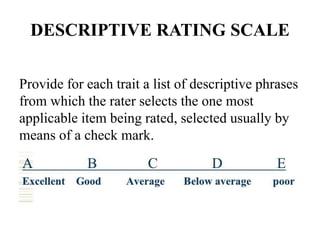
DESCRIPTIVE RATING SCALE
Provide for each trait a list of descriptive phrases
from which the rater selects the one most
applicable item being rated, selected usually by
means of a check mark.
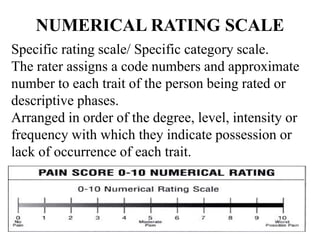
NUMERICAL RATING SCALE
Specific rating scale/ Specific category scale.
The rater assigns a code numbers and approximate
number to each trait of the person being rated or
descriptive phases.
Arranged in order of the degree, level, intensity or
frequency with which they indicate possession or
lack of occurrence of each trait.
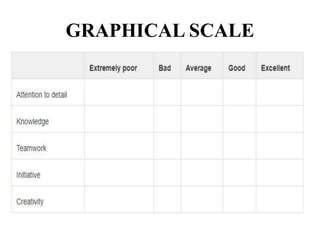
GRAPHIC RATING SCALE
The rater indicate the performer’s standing in respect to
each trait by placing a check mark at an appropriate point
along the line. Here, the degree of each characteristics is
arranged so that the rater can make as fine distinctions as
he wishes to make. This will help the rater to indicate his
own preference.
GRAPHICAL SCALE
COMPARATIVE RATING SCALE:
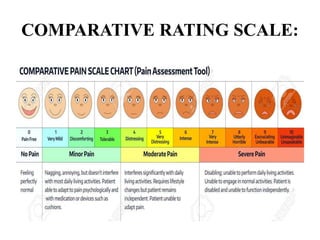
The rater has clear knowledge of the activities of
the given groups or individuals.
The positions on the rating scale are explicitly
defined it terms of a given population.
COMPARATIVE RATING SCALE:
USES OF RATING SCALE
To evaluate skills, product outcome, activities,
interest attitude and personnel characteristics.
PRINCIPLES FOR PREPARING RATING
SCALES
 It directly relates to learning objectives
 Needs to be confined to perform can be observed.
 Clearly define the specific trait or mode of behavior
 Allow some space in the rating scale card for the rater
to give supplementary remark
 3 to 7 rating positions may need to be provided.
 There should be provision to omit items, the teacher
feels unqualified to judge.
ADVANTAGES
Easy to administer and to score
Can be used for a large group of students
Clarity of feedback to students.
DISADVANTAGES
Misuse can result in consequent decrease in
objectivity
It is difficult fix up rating
It is unscientific or unreliable.
Rating Scale

Rating Scale

  • 1.
  • 2.
    RATING SCALES  Arating scale is a method that requires the rater to assign a value, sometimes numeric, to the rated object, as a measure of some rated attribute.  Rating scales - Direct observation assessment of a person by another person.
  • 3.
    TYPES OF RATINGSCALE  Descriptive rating scale  Numerical rating scale  Graphic rating scale  Comparative rating scale
  • 4.
    DESCRIPTIVE RATING SCALE Providefor each trait a list of descriptive phrases from which the rater selects the one most applicable item being rated, selected usually by means of a check mark.
  • 5.
    NUMERICAL RATING SCALE Specificrating scale/ Specific category scale. The rater assigns a code numbers and approximate number to each trait of the person being rated or descriptive phases. Arranged in order of the degree, level, intensity or frequency with which they indicate possession or lack of occurrence of each trait.
  • 6.
    GRAPHIC RATING SCALE Therater indicate the performer’s standing in respect to each trait by placing a check mark at an appropriate point along the line. Here, the degree of each characteristics is arranged so that the rater can make as fine distinctions as he wishes to make. This will help the rater to indicate his own preference.
  • 7.
  • 8.
    COMPARATIVE RATING SCALE: Therater has clear knowledge of the activities of the given groups or individuals. The positions on the rating scale are explicitly defined it terms of a given population.
  • 9.
  • 10.
    USES OF RATINGSCALE To evaluate skills, product outcome, activities, interest attitude and personnel characteristics.
  • 11.
    PRINCIPLES FOR PREPARINGRATING SCALES  It directly relates to learning objectives  Needs to be confined to perform can be observed.  Clearly define the specific trait or mode of behavior  Allow some space in the rating scale card for the rater to give supplementary remark  3 to 7 rating positions may need to be provided.  There should be provision to omit items, the teacher feels unqualified to judge.
  • 12.
    ADVANTAGES Easy to administerand to score Can be used for a large group of students Clarity of feedback to students.
  • 13.
    DISADVANTAGES Misuse can resultin consequent decrease in objectivity It is difficult fix up rating It is unscientific or unreliable.