
Dr. Roma Smart Joseph
Lucknow, India
INTRODUCTION
Rating scales allow teachers to
indicate the degree or frequency of the
behaviors, skills and strategies
displayed by the learner.
Teachers can use rating scales to
record observations.
Students can use rating scales as a self
assessment tools.
DEFINITION-
1) A Rating scale is a set of categories
designed to elicit information about a
quantitative attribute.
2) According to Barr,et.al- “Rating is a
term applied to expression or
judgment regarding some situation,
object or character. Rating techniques
are devices by which such judgments
may be quantified.”
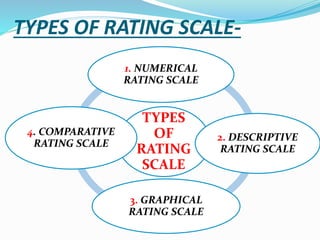
TYPES OF RATING SCALE-
TYPES
OF
RATING
SCALE
1. NUMERICAL
RATING SCALE
2. DESCRIPTIVE
RATING SCALE
3. GRAPHICAL
RATING SCALE
4. COMPARATIVE
RATING SCALE
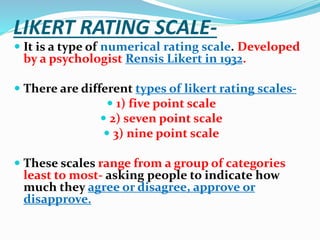
LIKERT RATING SCALE-
 It is a type of numerical rating scale. Developed
by a psychologist Rensis Likert in 1932.
 There are different types of likert rating scales-
 1) five point scale
 2) seven point scale
 3) nine point scale
 These scales range from a group of categories
least to most- asking people to indicate how
much they agree or disagree, approve or
disapprove.
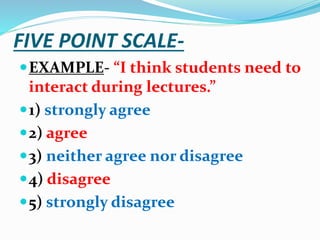
FIVE POINT SCALE-
EXAMPLE- “I think students need to
interact during lectures.”
1) strongly agree
2) agree
3) neither agree nor disagree
4) disagree
5) strongly disagree
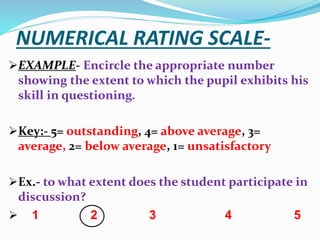
NUMERICAL RATING SCALE-
EXAMPLE- Encircle the appropriate number
showing the extent to which the pupil exhibits his
skill in questioning.
Key:- 5= outstanding, 4= above average, 3=
average, 2= below average, 1= unsatisfactory
Ex.- to what extent does the student participate in
discussion?
 1 2 3 4 5
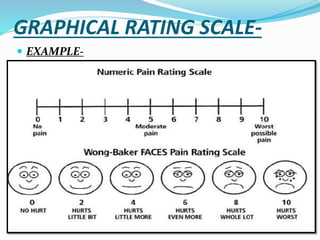
GRAPHICAL RATING SCALE-
 EXAMPLE-
DESCRIPTIVE RATING SCALE-
Provide for each trait a list of descriptive phrases from
which the rater selects the one most applicable item
being rated.
The descriptions are brief details that convey in
behavioral terms how pupil behave at different steps.
EXAMPLE- To what extent does the student participate
in discussion?
1) never participates
2) participate more than others
3) participate as much as others
ADVANTAGES OF RATING SCALE-
1) It is a standard device for recording
qualitative and quantitative judgments
about observed performance.
2) It help teachers to rate their students
periodically on various characteristics such
as punctuality, honesty, cheerfulness.
3) It can be efficient and economical in the use
of a teacher’s time.
4) It evaluate personal social development.
DISADVANTAGES-
 They examine only specific behavior/traits and may
overlook other important behaviors.
 Ratings are subjective and raters may give biased
responses.
 There are several common errors in rating scale-
 1) Ambiguity
 2) Attitude of the rater
 3) Personality of the rater, personal bias
 Misuse can result in a consequent decrease in objectivity.
Bibliography
 Tripathi Anuradha, Kumar Ramesh, Measurement and
Evaluation in Education, lucknow, Thakur Publications
pvt.ltd, 2019
 Asthana Bipin, Measurement, Evaluation and Assessment
in Education, Delhi, Bookmandelhi.com, 2018.
 URL- https://en.m.wikipedia.org
 www.slideshare.net
THANK YOU

Rating scale : A Tool of Evaluation

  • 1.
    Dr. Roma SmartJoseph Lucknow, India
  • 2.
    INTRODUCTION Rating scales allowteachers to indicate the degree or frequency of the behaviors, skills and strategies displayed by the learner. Teachers can use rating scales to record observations. Students can use rating scales as a self assessment tools.
  • 3.
    DEFINITION- 1) A Ratingscale is a set of categories designed to elicit information about a quantitative attribute. 2) According to Barr,et.al- “Rating is a term applied to expression or judgment regarding some situation, object or character. Rating techniques are devices by which such judgments may be quantified.”
  • 4.
    TYPES OF RATINGSCALE- TYPES OF RATING SCALE 1. NUMERICAL RATING SCALE 2. DESCRIPTIVE RATING SCALE 3. GRAPHICAL RATING SCALE 4. COMPARATIVE RATING SCALE
  • 5.
    LIKERT RATING SCALE- It is a type of numerical rating scale. Developed by a psychologist Rensis Likert in 1932.  There are different types of likert rating scales-  1) five point scale  2) seven point scale  3) nine point scale  These scales range from a group of categories least to most- asking people to indicate how much they agree or disagree, approve or disapprove.
  • 6.
    FIVE POINT SCALE- EXAMPLE-“I think students need to interact during lectures.” 1) strongly agree 2) agree 3) neither agree nor disagree 4) disagree 5) strongly disagree
  • 7.
    NUMERICAL RATING SCALE- EXAMPLE-Encircle the appropriate number showing the extent to which the pupil exhibits his skill in questioning. Key:- 5= outstanding, 4= above average, 3= average, 2= below average, 1= unsatisfactory Ex.- to what extent does the student participate in discussion?  1 2 3 4 5
  • 8.
  • 9.
    DESCRIPTIVE RATING SCALE- Providefor each trait a list of descriptive phrases from which the rater selects the one most applicable item being rated. The descriptions are brief details that convey in behavioral terms how pupil behave at different steps. EXAMPLE- To what extent does the student participate in discussion? 1) never participates 2) participate more than others 3) participate as much as others
  • 10.
    ADVANTAGES OF RATINGSCALE- 1) It is a standard device for recording qualitative and quantitative judgments about observed performance. 2) It help teachers to rate their students periodically on various characteristics such as punctuality, honesty, cheerfulness. 3) It can be efficient and economical in the use of a teacher’s time. 4) It evaluate personal social development.
  • 11.
    DISADVANTAGES-  They examineonly specific behavior/traits and may overlook other important behaviors.  Ratings are subjective and raters may give biased responses.  There are several common errors in rating scale-  1) Ambiguity  2) Attitude of the rater  3) Personality of the rater, personal bias  Misuse can result in a consequent decrease in objectivity.
  • 12.
    Bibliography  Tripathi Anuradha,Kumar Ramesh, Measurement and Evaluation in Education, lucknow, Thakur Publications pvt.ltd, 2019  Asthana Bipin, Measurement, Evaluation and Assessment in Education, Delhi, Bookmandelhi.com, 2018.  URL- https://en.m.wikipedia.org  www.slideshare.net
  • 13.