ESP and
READING
By: Shanen Allison Braga
Glicel Felicia
Anajean Jandayan
Alan Hirvela
Reading occupies
what might be
called a curious
place in English
for Specific
Purposes (ESP)
“In any self-assessment
or questionnaire-based
survey, students
almost always cite
reading as the skill
causing them the least
difficulty.”
- Jordan (1997)
“It will come as no surprise to
most people to discover that in
ESP terms, by far the most
significant skill is that of
reading.”
–McDonough (1984)
Lesson Overview
• Foundations Of Reading In
ESP
• Emerging Pedagogical
Perspectives In Reading
• Researches On Reading
• Business English
Foundation
of Reading
in ESP
F O U N DA T I O N S O F R E A D I N G I N E S P
“The pendulum may have
swung too far in the
direction of speech, and
many teachers are now
seeking to increase the effort
applied to learning and
teaching a command of the
written language and
especially to the learning and
teaching of reading.”
-Peter Stevens, 1997
English is the
language of
textbooks and
journals.
-McDonough (1984)
 Initial Stage
“the analysis had been of the surface forms
of language”---
 Register analysis- study at the sentence
level of the use of language in different
communicative settings.
FROM REGISTER ANALYSIS
TO DISCOURSE ANALYSIS
F O U N DAT I O N S O F R E A D I N G I N E S P
REGISTER ANALYSIS.
ESP focused on language at the sentence level
 Second Phase
“attention is shifted to the level above the
sentence, as ESP became closely involved
with the emerging field of discourse or ”---
FROM REGISTER ANALYSIS
TO DISCOURSE ANALYSIS
F O U N DAT I O N S O F R E A D I N G I N E S P
DISCOURSE OR RHETORICAL ANALYSIS
FROM REGISTER ANALYSIS
TO DISCOURSE ANALYSIS
F O U N DAT I O N S O F R E A D I N G I N E S P
“They (readers) were interested in how discoursal
elements in the text “primed” the reading and
understanding of them.” –Widdowson (1979)
English in
Focus
-Allen and Widdowson
(1974)
Began to look
at longer
stretches of
texts
FROM REGISTER ANALYSIS
TO DISCOURSE ANALYSIS
F O U N DAT I O N S O F R E A D I N G I N E S P
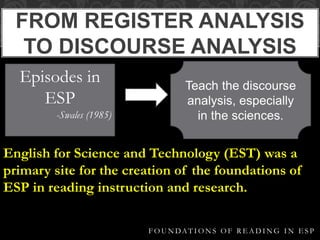
English for Science and Technology (EST) was a
primary site for the creation of the foundations of
ESP in reading instruction and research.
Episodes in
ESP
-Swales (1985)
Teach the discourse
analysis, especially
in the sciences.
FROM REGISTER ANALYSIS
TO DISCOURSE ANALYSIS
F O U N DAT I O N S O F R E A D I N G I N E S P
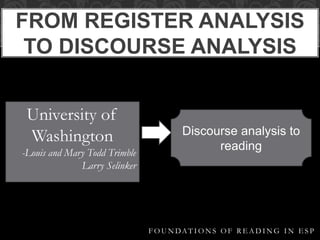
University of
Washington
-Louis and Mary Todd Trimble
Larry Selinker
Discourse analysis to
reading
FROM REGISTER ANALYSIS
TO DISCOURSE ANALYSIS
F O U N DAT I O N S O F R E A D I N G I N E S P
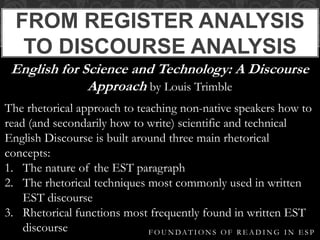
English for Science and Technology: A Discourse
Approach by Louis Trimble
The rhetorical approach to teaching non-native speakers how to
read (and secondarily how to write) scientific and technical
English Discourse is built around three main rhetorical
concepts:
1. The nature of the EST paragraph
2. The rhetorical techniques most commonly used in written
EST discourse
3. Rhetorical functions most frequently found in written EST
discourse
FROM REGISTER ANALYSIS
TO DISCOURSE ANALYSIS
F O U N D A T I O N S O F R E A D I N G I N E S P
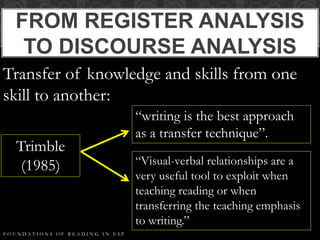
Transfer of knowledge and skills from one
skill to another:
Trimble
(1985)
“writing is the best approach
as a transfer technique”.
“Visual-verbal relationships are a
very useful tool to exploit when
teaching reading or when
transferring the teaching emphasis
to writing.”
FROM REGISTER ANALYSIS
TO DISCOURSE ANALYSIS
F O U N D A T I O N S O F R E A D I N G I N E S P
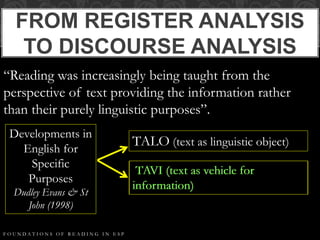
“Reading was increasingly being taught from the
perspective of text providing the information rather
than their purely linguistic purposes”.
Developments in
English for
Specific
Purposes
Dudley Evans & St
John (1998)
TALO (text as linguistic object)
TAVI (text as vehicle for
information)
TAVI (text as vehicle for
information)
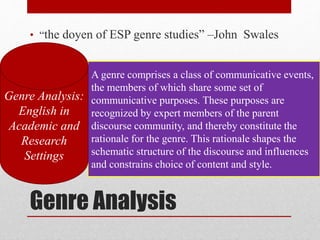
A genre comprises a class of communicative events,
the members of which share some set of
communicative purposes. These purposes are
recognized by expert members of the parent
discourse community, and thereby constitute the
rationale for the genre. This rationale shapes the
schematic structure of the discourse and influences
and constrains choice of content and style.
Genre Analysis
• “the doyen of ESP genre studies” –John Swales
Genre Analysis:
English in
Academic and
Research
Settings
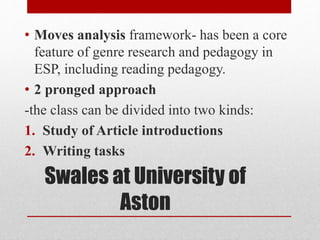
Swales at University of
Aston
• Moves analysis framework- has been a core
feature of genre research and pedagogy in
ESP, including reading pedagogy.
• 2 pronged approach
-the class can be divided into two kinds:
1. Study of Article introductions
2. Writing tasks
Emerging
Perspectives and
Research on
Reading
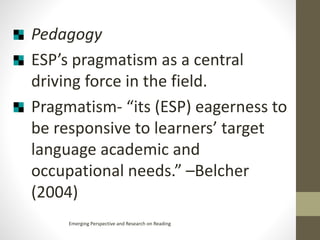
Pedagogy
ESP’s pragmatism as a central
driving force in the field.
Pragmatism- “its (ESP) eagerness to
be responsive to learners’ target
language academic and
occupational needs.” –Belcher
(2004)
Emerging Perspective and Research on Reading
“ Reading is sometimes taught on its own as a
separate skill, sometimes in conjunction with
writing, and sometimes as a component of a
study skills programme. Whether a single skill or
an integrated approach is taken, the main focus of
reading instruction often tends to be the
development of sub-skills related to extracting
different types of information from texts, such as
skimming for gist and scanning for specific
details.” –Bruce (2011)
“When students read, it is for a
purpose.” -Jordan (1997)
•Two primary frameworks (Bruce,
2011)
1. Reading as a stand-alone skill
2. Reading in an Integrated skills
framework
Emerging Perspective and Research on Reading
TEACHING READING SKILLS
TEXTBOOKS
VOCABULARY
READING AS A STAND-
ALONE SKILL
READING AS A STAND-ALONE SKILL
1. Teaching reading skills
• Use of carefully selected pre-reading materials
-Huang, Cheng, and Chern (2006)
• Pedagogy is oriented toward a
“location” mode
“The student rarely
comes ‘blind’ to the
business of reading.”
“the most necessary
skill is that of locating
the relevant or
desired information
in the text”
• Explicit teaching of metadiscourse features
• The effects of instruction on students’
reading comprehension.
• Conclusion: “Metadiscourse can have
positive influence on comprehension”
CRAWFORD CAMICIOTTOLI (2003)
LINN AND MUNBY (1996)
• Qualitative study of the metacognitive reading
strategy use
• Conclusion: “Some of the comprehension
strategies taught in general purpose English
courses may not be useful in specialized English
reading .”
• Students need to vary their strategies as the
reading requires”
DHIEB-HENIA (2003)
• Effects Metacognitive strategy among
university students studying Biology
• Conclusion: Metacognitive reading
strategy enhanced their comprehension of
research articles in that discipline.
MARTINEZ (2002)
• Exposing undergraduate EST students to
five versions of an authentic text
• Conclusion: The more the students
recognized and understood the rhetorical
features guiding organization of the text,
the more effectively they read.
PRITCHARD AND NASR (2004)
• Engineering students in Egypt
• Positive values accruing from training
students in using textual and contextual
clues and exposing them to authentic texts
in their discipline.
HALL ET AL (1986)
• Problems encountered by EST students at a
university in Thailand
• Course approach based on “information
structuring” of the ways in which ideas were
organized.
• Emphasis on “macro-cohesion” (links between
content ranging across the texts and outside the
text) and on “micro-cohesion” (discourse
connections between sentences)
BLANTON (1984)
• Propose a “hierarchical model” of
reading instruction in which students
work through a carefully sequenced set
of reading tasks
• The “hierarchical nature of academic
discourse”
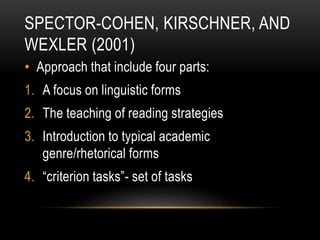
SPECTOR-COHEN, KIRSCHNER, AND
WEXLER (2001)
• Approach that include four parts:
1. A focus on linguistic forms
2. The teaching of reading strategies
3. Introduction to typical academic
genre/rhetorical forms
4. “criterion tasks”- set of tasks
TEACHING READING SKILLS
TEXTBOOKS
VOCABULARY
READING AS A STAND-
ALONE SKILL
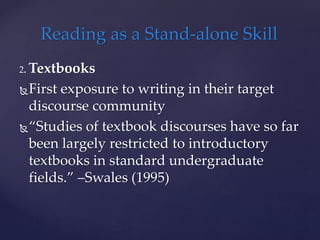
2. Textbooks
First exposure to writing in their target
discourse community
“Studies of textbook discourses have so far
been largely restricted to introductory
textbooks in standard undergraduate
fields.” –Swales (1995)
Reading as a Stand-alone Skill
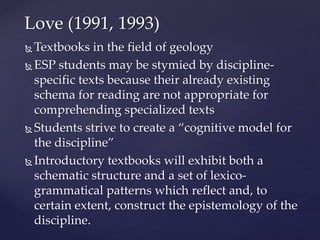
 Textbooks in the field of geology
 ESP students may be stymied by discipline-
specific texts because their already existing
schema for reading are not appropriate for
comprehending specialized texts
 Students strive to create a “cognitive model for
the discipline”
 Introductory textbooks will exhibit both a
schematic structure and a set of lexico-
grammatical patterns which reflect and, to
certain extent, construct the epistemology of the
discipline.
Love (1991, 1993)
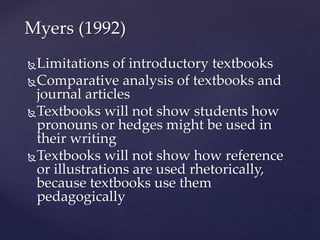
Limitations of introductory textbooks
Comparative analysis of textbooks and
journal articles
Textbooks will not show students how
pronouns or hedges might be used in
their writing
Textbooks will not show how reference
or illustrations are used rhetorically,
because textbooks use them
pedagogically
Myers (1992)
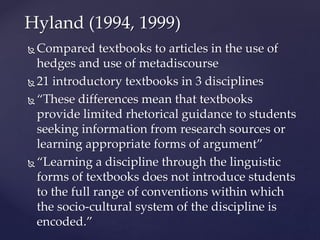
 Compared textbooks to articles in the use of
hedges and use of metadiscourse
 21 introductory textbooks in 3 disciplines
 “These differences mean that textbooks
provide limited rhetorical guidance to students
seeking information from research sources or
learning appropriate forms of argument”
 “Learning a discipline through the linguistic
forms of textbooks does not introduce students
to the full range of conventions within which
the socio-cultural system of the discipline is
encoded.”
Hyland (1994, 1999)
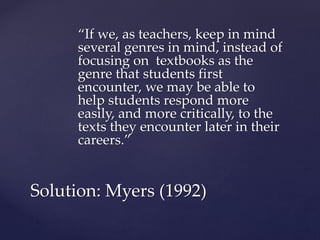
“If we, as teachers, keep in mind
several genres in mind, instead of
focusing on textbooks as the
genre that students first
encounter, we may be able to
help students respond more
easily, and more critically, to the
texts they encounter later in their
careers.”
Solution: Myers (1992)
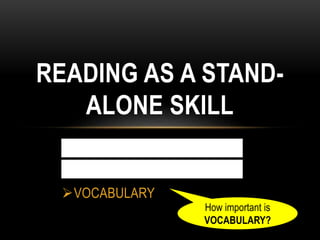
TEACHING READING SKILLS
TEXTBOOKS
VOCABULARY
READING AS A STAND-
ALONE SKILL
How important is
VOCABULARY?
Reading as a Stand-alone Skill
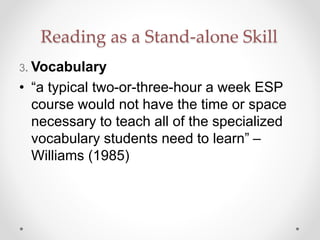
3. Vocabulary
• “a typical two-or-three-hour a week ESP
course would not have the time or space
necessary to teach all of the specialized
vocabulary students need to learn” –
Williams (1985)
Five Vocabulary Learning
strategies for ESP
1. Inferring from context
2. Identifying lexical familiarization
3. Unchaining nominal compounds
4. Synonym search
5. Word analysis
• Pre-corpus approach- traditional
approach to literature on reading.
• Salager (1983)- constructed a corpus of
vocabulary used in medical English texts
• Moss (1992)- studied the importance of
cognate recognition
“a strategy of structured and graded practice
in cognate recognition”
Ward (1999)
• Study: Experiences in reading of undergraduate
engineering students in Thailand in reading
English language textbooks in their chosen
disciplines
• How large a vocabulary do EAP engineering
students need?
• Conclusion: Engineering students would benefit
more from early exposure to an engineering
English corpus and, in combination with that
corpus, would need a general vocabulary of only
2,000 word families.
Ward (2001)
• “textbook reading: Students avoided the
vocabulary by concentrating their attention on
the applications, and especially the examples
given in those textbooks”
Ward (2009)
• Translated textbooks: significant vocabulary-
related problems among undergraduate
engineering students that made reading of
textbooks written in English difficult
• “Subtechnical vocabulary”
-items which are neither highly
technical nor obviously general.
-Examples cited by Baker
“others have said…”
“one explanation is…”
“it has been pointed out by…”
• Marshall and Gilmour (1993)
-Subtechnical vocabulary- “the words which
express the relations which exist between
the key scientific concepts”
-Study: Reading ability of over 2,000 EST
students
-Recommendations: ESP teachers should
not simply teach “lists of scientific and
technical words” but instead should also
“teach the contexts and structural relations
within which the words have meaning.”
Genre-based approaches
Portfolios
READING IN
INTEGRATED SKILLS
CONTEXT
JORDAN (1997)
“Reading as a skill has been linked with writing. This is
a fundamental characteristic of the target academic
situation in which students are typically reading books and
journals, noting, summarizing, paraphrasing, and then
writing essays, etc. In practice material for reading, the
link with writing is normally included. Although the focus
may be on various reading strategies and comprehension
practice, the resultant exercise usually involve writing
(apart from multiple-choice questions and yes/no,
true/fallsel formats).
“Today, genre is one of the most
important and most influential concepts
in language education.” –Hyland (2004)
framework where “students are constantly
involved in research into texts, roles, and
contexts and into the strategies they employ in
completing literary tasks within specific
situations”. –Johns (1997)
Socioliterate Competence
Frames- awareness of
certain core genre features
which allows students to
put texts they encounter
into the appropriate frames
and then process and
understand them based on
the textual properties of
those frames
-Paltridge, 1985
Tardy
(2006)
“At a range of educational levels, at
least some learners appear to be
motivated by genre-based
instruction and can develop
metalanguage for talking about
texts through such instruction.
Similarly, the rhetorical
consciousness-raising of genre-
based reading instruction may
increase students’ ability to locate
information in texts and develop a
better understanding of text’s
rhetorical elements.
 EAP/ESP course is linked
to:
content course + ESP teacher
 “discourse community
dilemma”-Johns (1988)
Joint cooperation of the teacher
and the disciplinary expert
addresses such a dilemma.
Studies regarding effects of genre-
based instruction
Henry and Roseberry (1998)
Compared 2 groups of undergraduate
students at a university
Findings: the group which received genre-
based reading and writing outperformed
the non-genre group.
Hyon (2001, 2002)
Findings:
Modest long term
effects for the
course, with some
students retaining
and using more of
the genre-based
reading input than
others.
Long term effect
of a genre-
based course
8 students (5
graduates, 2
undergrad, 1
employee)
Swales and Lindermann (2002)
 Effects of a graduate level EAP course
on the literature review writing of
graduate students.
 They developed a genre-based
pedagogy which facilitated the
connection between reading and writing
 Findings: Reported overall positive
effects

Parkinson (2007)
Findings: Both
reading
comprehension
and writing
expression
“improved
significantly.”
Approach emphasizes pre-
reading activities, discussion,
an vocabulary and
comprehension exercises.
genre-based
reading-writing
course for
students at a
university in
South Africa.
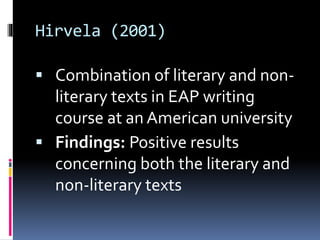
Hirvela (2001)
 Combination of literary and non-
literary texts in EAP writing
course at an American university
 Findings: Positive results
concerning both the literary and
non-literary texts
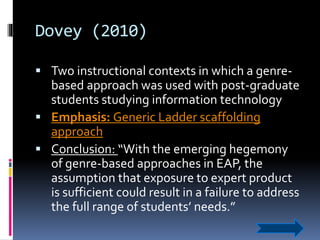
Dovey (2010)
 Two instructional contexts in which a genre-
based approach was used with post-graduate
students studying information technology
 Emphasis: Generic Ladder scaffolding
approach
 Conclusion: “With the emerging hegemony
of genre-based approaches in EAP, the
assumption that exposure to expert product
is sufficient could result in a failure to address
the full range of students’ needs.”
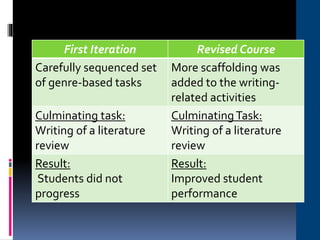
First Iteration Revised Course
Carefully sequenced set
of genre-based tasks
More scaffolding was
added to the writing-
related activities
Culminating task:
Writing of a literature
review
CulminatingTask:
Writing of a literature
review
Result:
Students did not
progress
Result:
Improved student
performance
Genre-based approaches
Portfolios
READING IN
INTEGRATED SKILLS
CONTEXT
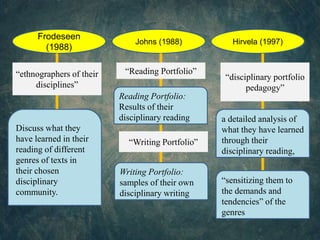
Frodeseen
(1988)
Johns (1988) Hirvela (1997)
Discuss what they
have learned in their
reading of different
genres of texts in
their chosen
disciplinary
community.
“ethnographers of their
disciplines”
Reading Portfolio:
Results of their
disciplinary reading
“Reading Portfolio”
a detailed analysis of
what they have learned
through their
disciplinary reading,
“disciplinary portfolio
pedagogy”
“Writing Portfolio”
Writing Portfolio:
samples of their own
disciplinary writing
“sensitizing them to
the demands and
tendencies” of the
genres
English for Specific Purposes and Reading

English for Specific Purposes and Reading

  • 1.
    ESP and READING By: ShanenAllison Braga Glicel Felicia Anajean Jandayan Alan Hirvela
  • 2.
    Reading occupies what mightbe called a curious place in English for Specific Purposes (ESP) “In any self-assessment or questionnaire-based survey, students almost always cite reading as the skill causing them the least difficulty.” - Jordan (1997)
  • 3.
    “It will comeas no surprise to most people to discover that in ESP terms, by far the most significant skill is that of reading.” –McDonough (1984)
  • 4.
    Lesson Overview • FoundationsOf Reading In ESP • Emerging Pedagogical Perspectives In Reading • Researches On Reading • Business English
  • 5.
  • 6.
    F O UN DA T I O N S O F R E A D I N G I N E S P “The pendulum may have swung too far in the direction of speech, and many teachers are now seeking to increase the effort applied to learning and teaching a command of the written language and especially to the learning and teaching of reading.” -Peter Stevens, 1997 English is the language of textbooks and journals. -McDonough (1984)
  • 7.
     Initial Stage “theanalysis had been of the surface forms of language”---  Register analysis- study at the sentence level of the use of language in different communicative settings. FROM REGISTER ANALYSIS TO DISCOURSE ANALYSIS F O U N DAT I O N S O F R E A D I N G I N E S P REGISTER ANALYSIS. ESP focused on language at the sentence level
  • 8.
     Second Phase “attentionis shifted to the level above the sentence, as ESP became closely involved with the emerging field of discourse or ”--- FROM REGISTER ANALYSIS TO DISCOURSE ANALYSIS F O U N DAT I O N S O F R E A D I N G I N E S P DISCOURSE OR RHETORICAL ANALYSIS
  • 9.
    FROM REGISTER ANALYSIS TODISCOURSE ANALYSIS F O U N DAT I O N S O F R E A D I N G I N E S P “They (readers) were interested in how discoursal elements in the text “primed” the reading and understanding of them.” –Widdowson (1979) English in Focus -Allen and Widdowson (1974) Began to look at longer stretches of texts
  • 10.
    FROM REGISTER ANALYSIS TODISCOURSE ANALYSIS F O U N DAT I O N S O F R E A D I N G I N E S P English for Science and Technology (EST) was a primary site for the creation of the foundations of ESP in reading instruction and research. Episodes in ESP -Swales (1985) Teach the discourse analysis, especially in the sciences.
  • 11.
    FROM REGISTER ANALYSIS TODISCOURSE ANALYSIS F O U N DAT I O N S O F R E A D I N G I N E S P University of Washington -Louis and Mary Todd Trimble Larry Selinker Discourse analysis to reading
  • 12.
    FROM REGISTER ANALYSIS TODISCOURSE ANALYSIS F O U N DAT I O N S O F R E A D I N G I N E S P English for Science and Technology: A Discourse Approach by Louis Trimble The rhetorical approach to teaching non-native speakers how to read (and secondarily how to write) scientific and technical English Discourse is built around three main rhetorical concepts: 1. The nature of the EST paragraph 2. The rhetorical techniques most commonly used in written EST discourse 3. Rhetorical functions most frequently found in written EST discourse
  • 13.
    FROM REGISTER ANALYSIS TODISCOURSE ANALYSIS F O U N D A T I O N S O F R E A D I N G I N E S P Transfer of knowledge and skills from one skill to another: Trimble (1985) “writing is the best approach as a transfer technique”. “Visual-verbal relationships are a very useful tool to exploit when teaching reading or when transferring the teaching emphasis to writing.”
  • 14.
    FROM REGISTER ANALYSIS TODISCOURSE ANALYSIS F O U N D A T I O N S O F R E A D I N G I N E S P “Reading was increasingly being taught from the perspective of text providing the information rather than their purely linguistic purposes”. Developments in English for Specific Purposes Dudley Evans & St John (1998) TALO (text as linguistic object) TAVI (text as vehicle for information) TAVI (text as vehicle for information)
  • 15.
    A genre comprisesa class of communicative events, the members of which share some set of communicative purposes. These purposes are recognized by expert members of the parent discourse community, and thereby constitute the rationale for the genre. This rationale shapes the schematic structure of the discourse and influences and constrains choice of content and style. Genre Analysis • “the doyen of ESP genre studies” –John Swales Genre Analysis: English in Academic and Research Settings
  • 16.
    Swales at Universityof Aston • Moves analysis framework- has been a core feature of genre research and pedagogy in ESP, including reading pedagogy. • 2 pronged approach -the class can be divided into two kinds: 1. Study of Article introductions 2. Writing tasks
  • 17.
  • 18.
    Pedagogy ESP’s pragmatism asa central driving force in the field. Pragmatism- “its (ESP) eagerness to be responsive to learners’ target language academic and occupational needs.” –Belcher (2004) Emerging Perspective and Research on Reading
  • 19.
    “ Reading issometimes taught on its own as a separate skill, sometimes in conjunction with writing, and sometimes as a component of a study skills programme. Whether a single skill or an integrated approach is taken, the main focus of reading instruction often tends to be the development of sub-skills related to extracting different types of information from texts, such as skimming for gist and scanning for specific details.” –Bruce (2011)
  • 20.
    “When students read,it is for a purpose.” -Jordan (1997) •Two primary frameworks (Bruce, 2011) 1. Reading as a stand-alone skill 2. Reading in an Integrated skills framework Emerging Perspective and Research on Reading
  • 21.
  • 22.
    READING AS ASTAND-ALONE SKILL 1. Teaching reading skills • Use of carefully selected pre-reading materials -Huang, Cheng, and Chern (2006)
  • 23.
    • Pedagogy isoriented toward a “location” mode “The student rarely comes ‘blind’ to the business of reading.” “the most necessary skill is that of locating the relevant or desired information in the text”
  • 24.
    • Explicit teachingof metadiscourse features • The effects of instruction on students’ reading comprehension. • Conclusion: “Metadiscourse can have positive influence on comprehension” CRAWFORD CAMICIOTTOLI (2003)
  • 25.
    LINN AND MUNBY(1996) • Qualitative study of the metacognitive reading strategy use • Conclusion: “Some of the comprehension strategies taught in general purpose English courses may not be useful in specialized English reading .” • Students need to vary their strategies as the reading requires”
  • 26.
    DHIEB-HENIA (2003) • EffectsMetacognitive strategy among university students studying Biology • Conclusion: Metacognitive reading strategy enhanced their comprehension of research articles in that discipline.
  • 27.
    MARTINEZ (2002) • Exposingundergraduate EST students to five versions of an authentic text • Conclusion: The more the students recognized and understood the rhetorical features guiding organization of the text, the more effectively they read.
  • 28.
    PRITCHARD AND NASR(2004) • Engineering students in Egypt • Positive values accruing from training students in using textual and contextual clues and exposing them to authentic texts in their discipline.
  • 29.
    HALL ET AL(1986) • Problems encountered by EST students at a university in Thailand • Course approach based on “information structuring” of the ways in which ideas were organized. • Emphasis on “macro-cohesion” (links between content ranging across the texts and outside the text) and on “micro-cohesion” (discourse connections between sentences)
  • 30.
    BLANTON (1984) • Proposea “hierarchical model” of reading instruction in which students work through a carefully sequenced set of reading tasks • The “hierarchical nature of academic discourse”
  • 31.
    SPECTOR-COHEN, KIRSCHNER, AND WEXLER(2001) • Approach that include four parts: 1. A focus on linguistic forms 2. The teaching of reading strategies 3. Introduction to typical academic genre/rhetorical forms 4. “criterion tasks”- set of tasks
  • 32.
  • 33.
    2. Textbooks First exposureto writing in their target discourse community “Studies of textbook discourses have so far been largely restricted to introductory textbooks in standard undergraduate fields.” –Swales (1995) Reading as a Stand-alone Skill
  • 34.
     Textbooks inthe field of geology  ESP students may be stymied by discipline- specific texts because their already existing schema for reading are not appropriate for comprehending specialized texts  Students strive to create a “cognitive model for the discipline”  Introductory textbooks will exhibit both a schematic structure and a set of lexico- grammatical patterns which reflect and, to certain extent, construct the epistemology of the discipline. Love (1991, 1993)
  • 35.
    Limitations of introductorytextbooks Comparative analysis of textbooks and journal articles Textbooks will not show students how pronouns or hedges might be used in their writing Textbooks will not show how reference or illustrations are used rhetorically, because textbooks use them pedagogically Myers (1992)
  • 36.
     Compared textbooksto articles in the use of hedges and use of metadiscourse  21 introductory textbooks in 3 disciplines  “These differences mean that textbooks provide limited rhetorical guidance to students seeking information from research sources or learning appropriate forms of argument”  “Learning a discipline through the linguistic forms of textbooks does not introduce students to the full range of conventions within which the socio-cultural system of the discipline is encoded.” Hyland (1994, 1999)
  • 37.
    “If we, asteachers, keep in mind several genres in mind, instead of focusing on textbooks as the genre that students first encounter, we may be able to help students respond more easily, and more critically, to the texts they encounter later in their careers.” Solution: Myers (1992)
  • 38.
    TEACHING READING SKILLS TEXTBOOKS VOCABULARY READINGAS A STAND- ALONE SKILL How important is VOCABULARY?
  • 39.
    Reading as aStand-alone Skill 3. Vocabulary • “a typical two-or-three-hour a week ESP course would not have the time or space necessary to teach all of the specialized vocabulary students need to learn” – Williams (1985)
  • 40.
    Five Vocabulary Learning strategiesfor ESP 1. Inferring from context 2. Identifying lexical familiarization 3. Unchaining nominal compounds 4. Synonym search 5. Word analysis
  • 41.
    • Pre-corpus approach-traditional approach to literature on reading. • Salager (1983)- constructed a corpus of vocabulary used in medical English texts • Moss (1992)- studied the importance of cognate recognition “a strategy of structured and graded practice in cognate recognition”
  • 42.
    Ward (1999) • Study:Experiences in reading of undergraduate engineering students in Thailand in reading English language textbooks in their chosen disciplines • How large a vocabulary do EAP engineering students need? • Conclusion: Engineering students would benefit more from early exposure to an engineering English corpus and, in combination with that corpus, would need a general vocabulary of only 2,000 word families.
  • 43.
    Ward (2001) • “textbookreading: Students avoided the vocabulary by concentrating their attention on the applications, and especially the examples given in those textbooks” Ward (2009) • Translated textbooks: significant vocabulary- related problems among undergraduate engineering students that made reading of textbooks written in English difficult
  • 44.
    • “Subtechnical vocabulary” -itemswhich are neither highly technical nor obviously general. -Examples cited by Baker “others have said…” “one explanation is…” “it has been pointed out by…”
  • 45.
    • Marshall andGilmour (1993) -Subtechnical vocabulary- “the words which express the relations which exist between the key scientific concepts” -Study: Reading ability of over 2,000 EST students -Recommendations: ESP teachers should not simply teach “lists of scientific and technical words” but instead should also “teach the contexts and structural relations within which the words have meaning.”
  • 46.
  • 47.
    JORDAN (1997) “Reading asa skill has been linked with writing. This is a fundamental characteristic of the target academic situation in which students are typically reading books and journals, noting, summarizing, paraphrasing, and then writing essays, etc. In practice material for reading, the link with writing is normally included. Although the focus may be on various reading strategies and comprehension practice, the resultant exercise usually involve writing (apart from multiple-choice questions and yes/no, true/fallsel formats).
  • 48.
    “Today, genre isone of the most important and most influential concepts in language education.” –Hyland (2004) framework where “students are constantly involved in research into texts, roles, and contexts and into the strategies they employ in completing literary tasks within specific situations”. –Johns (1997) Socioliterate Competence
  • 49.
    Frames- awareness of certaincore genre features which allows students to put texts they encounter into the appropriate frames and then process and understand them based on the textual properties of those frames -Paltridge, 1985
  • 50.
    Tardy (2006) “At a rangeof educational levels, at least some learners appear to be motivated by genre-based instruction and can develop metalanguage for talking about texts through such instruction. Similarly, the rhetorical consciousness-raising of genre- based reading instruction may increase students’ ability to locate information in texts and develop a better understanding of text’s rhetorical elements.
  • 51.
     EAP/ESP courseis linked to: content course + ESP teacher  “discourse community dilemma”-Johns (1988) Joint cooperation of the teacher and the disciplinary expert addresses such a dilemma.
  • 52.
    Studies regarding effectsof genre- based instruction Henry and Roseberry (1998) Compared 2 groups of undergraduate students at a university Findings: the group which received genre- based reading and writing outperformed the non-genre group.
  • 53.
    Hyon (2001, 2002) Findings: Modestlong term effects for the course, with some students retaining and using more of the genre-based reading input than others. Long term effect of a genre- based course 8 students (5 graduates, 2 undergrad, 1 employee)
  • 54.
    Swales and Lindermann(2002)  Effects of a graduate level EAP course on the literature review writing of graduate students.  They developed a genre-based pedagogy which facilitated the connection between reading and writing  Findings: Reported overall positive effects
  • 55.
     Parkinson (2007) Findings: Both reading comprehension andwriting expression “improved significantly.” Approach emphasizes pre- reading activities, discussion, an vocabulary and comprehension exercises. genre-based reading-writing course for students at a university in South Africa.
  • 56.
    Hirvela (2001)  Combinationof literary and non- literary texts in EAP writing course at an American university  Findings: Positive results concerning both the literary and non-literary texts
  • 57.
    Dovey (2010)  Twoinstructional contexts in which a genre- based approach was used with post-graduate students studying information technology  Emphasis: Generic Ladder scaffolding approach  Conclusion: “With the emerging hegemony of genre-based approaches in EAP, the assumption that exposure to expert product is sufficient could result in a failure to address the full range of students’ needs.”
  • 58.
    First Iteration RevisedCourse Carefully sequenced set of genre-based tasks More scaffolding was added to the writing- related activities Culminating task: Writing of a literature review CulminatingTask: Writing of a literature review Result: Students did not progress Result: Improved student performance
  • 59.
  • 60.
    Frodeseen (1988) Johns (1988) Hirvela(1997) Discuss what they have learned in their reading of different genres of texts in their chosen disciplinary community. “ethnographers of their disciplines” Reading Portfolio: Results of their disciplinary reading “Reading Portfolio” a detailed analysis of what they have learned through their disciplinary reading, “disciplinary portfolio pedagogy” “Writing Portfolio” Writing Portfolio: samples of their own disciplinary writing “sensitizing them to the demands and tendencies” of the genres

Editor's Notes

  • #2 Reading occupies what might be called a curious place in English for Specific Purposes (ESP)