Rating Scales
DefinitionRating scales can help to evaluate the quality of the behavior of one student or many students.It also measure the degree to which a student exhibits a specified behavior.
DescriptorsDescriptors – provide detailed information regarding each of the levels of the rating scale.These scales are useful when they are combined with other types of assessment, such as with data obtained from:Interval Recording
Event Recording;
and the results of other assessment approaches.An Example of Descriptors in a Rating Scale
Elliot, Busse, and Greshman (1993) suggested that the following issues be considered when using rating scales:Ratings are summaries of observations of the relative frequency of specific behaviors.Ratings of social behavior are judgments affected by one’s environment and rater’s standards for behavior.The social validity of the behaviors one asses and eventually treats should be understood.Multiple assessors of the same child’s behavior may agree only moderately.Many characteristics of a student may influence social behavior; however the student’s sex is a particularly salient variable.
Rating ScalesSeveral rating forms are commonly used in the assessment of behavior problems.Many of these include forms for teachers and parents.While rating scales can be useful, they have been criticized as being impressionistic,lacking interrater reliability, and being affected by the subjectivity of the observer(Sattler, 2001).
Examples Teacher Report Form (Achenbach, 1991b) Child Behavior Checklist (Achenbach, 1991a)Behavior Rating Profile -2 (Brown & Hammerhill, 1990)Conners Teacher Rating Scales and Conners Parent Rating Scales (1997)
Teacher Report Form (Achenbach, 1991b) The Teacher's Report Form (TRF) obtains teacher's reports of children's academic performance, adaptive functioning, and behavioral/emotional problems.Teachers rate the children's academic performance in each subject on a five-point scale ranging from 1 (far below grade level) to 5 (far above grade level). Cognitive and achievement test scores for the child, if available, can also be provided on the form.
Teacher Report Form (Achenbach, 1991b) For adaptive functioning, teachers use a seven-point scale to compare the child to typical pupils for how hard he/she is working, how appropriately he/she is behaving, how much he/she is learning, and how happy he/she is.The Teacher Report Form is for students aged 5-18. Items on these instruments are closely related so that both parents and teachers are rating the student on similar dimensions
Child Behavior Checklist (Achenbach, 1991a)The Achenbach system allows for the student to be rated on both positive, or adaptive, behaviors and behavioral syndromes. A device by which parents or other individuals who know the child well rate a child's problem behaviors and competencies. This instrument can either be self-administered or administered through an interview.
Child Behavior Checklist (Achenbach, 1991a)The CBCL can also be used to measure a child's change in behavior over time or following a treatment. The first section of this questionnaire consists of 20 competence items and the second section consists of 120 items on behavior or emotional problems during the past 6 months. Two CBCL forms are available for parents: one for children aged 2-3 years and another for students aged 4-18 years. The Parent Form includes, in addition to the rating scales, some open – minded questions such as “What concerns you most about your child?”
Youth Self-Report (Achenbach, 1991c)The Youth Self Report (YSR) provides self-ratings for 20 competence and problem items paralleling those of the Child Behavior Checklist (CBCL)/Ages 6-18. The YSR also includes open-ended responses to items covering physical problems, concerns, and strengths. Youths rate themselves for how true each item is now or was within the past six months, using the same three-point response scale as the CBCL/6-18 and Teacher Report Form.
Behavior Rating Profile -2 (Brown & Hammerhill, 1990)A unique battery of six norm-referenced instruments that provides different evaluations of a student's behavior at home, at school, and in interpersonal relationships from the varied perspectives of parents, teachers, peers, and the target students themselves. The diverse responses that are collected for the BRP-2 allow examiners to test several different diagnostic hypotheses when they are confronted with reports of problem behavior.
Behavior Rating Profile -2 (Brown & Hammerhill, 1990)The BRP-2 can identify students whose behavior is perceived to be deviant; it can identify the specific settings in which behavior problems are particularly prominent; and it can identify persons whose perceptions of a student's behavior are different from those of other respondents.The BRP-2 is appropriate for students who range in age from 6-6 years through 18-6 years or who are enrolled in Grades 1 through 12. The BRP-2 components were all normed individually on large, representative populations. 
Conners Teacher Rating Scales and Conners Parent Rating Scales (1997)Description of Test 	This test is a paper-and-pencil or computer –administered instrument used to evaluate problem behaviors of children as reported by the child’s teacher, parents or alternate caregiver.Administration Time: UntimedPublisher: Multi-Health Systems Inc.Author: C. Keith Conners (1997)
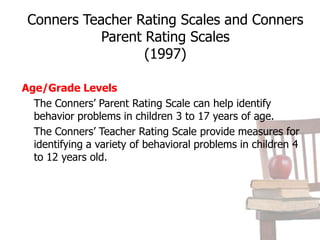
Conners Teacher Rating Scales and Conners Parent Rating Scales (1997)Age/Grade Levels	The Conners’ Parent Rating Scale can help identify behavior problems in children 3 to 17 years of age. 	The Conners’ Teacher Rating Scale provide measures for identifying a variety of behavioral problems in children 4 to 12 years old.
Conners Teacher Rating Scales and Conners Parent Rating Scales (1997)Conners Teacher Rating ScaleConners Teacher Rating Scale - 39The person providing the information about the child is the teacher. This scale is utilized for children 3 to 17 years old.The person providing the information about the child is the teacher.This scale is utilized for children 4 to 12 years old.
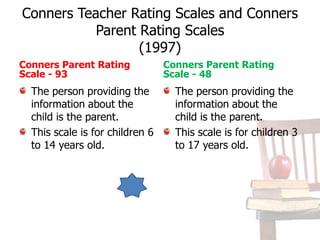
Conners Teacher Rating Scales and Conners Parent Rating Scales (1997)Conners Parent Rating Scale - 93Conners Parent Rating Scale - 48The person providing the information about the child is the parent. This scale is for children 6 to 14 years old.The person providing the information about the child is the parent.This scale is for children 3 to 17 years old.
These forms measure a variety of behavioral characteristics group into several scalesConduct ProblemsConduct DisorderHyperactivityInattentive-passiveAnxious-passiveAsocialDaydream attention problemsEmotional overindulgentAnxious-shyHyperactive-immatureLearning ProblemsObsessive CompulsivePsychosomaticRestless-disorganizedAnxietyImpulsive-hyperactive
Strengths of the Conners Parent Rating Scale and Conners Teacher Rating ScalesThe instrument has been used by professional for over 20 years.This test is a thorough measure of a student’s behavioral characteristics because of the number of questions raised.Materials presented on ADHD are in accordance with diagnostic criteria of the DSM-N
Weaknesses of the Conners Parent Rating Scale and Conners Teacher Rating ScalesThe test standardization sample is not well described, which may be problematic for generalizability.The test has not been updated to measure more current definitions of ADD and ADHD.
Sourceshttp://www.aseba.org/forms/schoolagecbcl.pdfhttp://www.aseba.org/forms/trf.pdfhttp://www.aseba.org/forms/ysr.pdfhttp://cornerstonepeds.net/images/website231/conners_rating_2__parent_eval.pdfhttp://www.pediatricpartnersmd.com/documents/ADD-HOMEEVALUATION.pdfhttp://www.cerealcitypeds.com/upload/add-adhd-dr-dolbee-parent-and-teacher-forms.pdfhttp://www.proedaust.com.au/psyc/details.cfm?number=33http://vinst.umdnj.edu/VAID/TestReport.asp?Code=BRP2Phttp://vinst.umdnj.edu/VAID/TestReport.asp?Code=CBCAhttp://vinst.umdnj.edu/VAID/TestReport.asp?Code=YSRhttp://vinst.umdnj.edu/VAID/TestReport.asp?Code=TRF

Rating scales

  • 1.
  • 2.
    DefinitionRating scales canhelp to evaluate the quality of the behavior of one student or many students.It also measure the degree to which a student exhibits a specified behavior.
  • 3.
    DescriptorsDescriptors – providedetailed information regarding each of the levels of the rating scale.These scales are useful when they are combined with other types of assessment, such as with data obtained from:Interval Recording
  • 4.
  • 5.
    and the resultsof other assessment approaches.An Example of Descriptors in a Rating Scale
  • 6.
    Elliot, Busse, andGreshman (1993) suggested that the following issues be considered when using rating scales:Ratings are summaries of observations of the relative frequency of specific behaviors.Ratings of social behavior are judgments affected by one’s environment and rater’s standards for behavior.The social validity of the behaviors one asses and eventually treats should be understood.Multiple assessors of the same child’s behavior may agree only moderately.Many characteristics of a student may influence social behavior; however the student’s sex is a particularly salient variable.
  • 7.
    Rating ScalesSeveral ratingforms are commonly used in the assessment of behavior problems.Many of these include forms for teachers and parents.While rating scales can be useful, they have been criticized as being impressionistic,lacking interrater reliability, and being affected by the subjectivity of the observer(Sattler, 2001).
  • 8.
    Examples Teacher ReportForm (Achenbach, 1991b) Child Behavior Checklist (Achenbach, 1991a)Behavior Rating Profile -2 (Brown & Hammerhill, 1990)Conners Teacher Rating Scales and Conners Parent Rating Scales (1997)
  • 9.
    Teacher Report Form(Achenbach, 1991b) The Teacher's Report Form (TRF) obtains teacher's reports of children's academic performance, adaptive functioning, and behavioral/emotional problems.Teachers rate the children's academic performance in each subject on a five-point scale ranging from 1 (far below grade level) to 5 (far above grade level). Cognitive and achievement test scores for the child, if available, can also be provided on the form.
  • 10.
    Teacher Report Form(Achenbach, 1991b) For adaptive functioning, teachers use a seven-point scale to compare the child to typical pupils for how hard he/she is working, how appropriately he/she is behaving, how much he/she is learning, and how happy he/she is.The Teacher Report Form is for students aged 5-18. Items on these instruments are closely related so that both parents and teachers are rating the student on similar dimensions
  • 11.
    Child Behavior Checklist(Achenbach, 1991a)The Achenbach system allows for the student to be rated on both positive, or adaptive, behaviors and behavioral syndromes. A device by which parents or other individuals who know the child well rate a child's problem behaviors and competencies. This instrument can either be self-administered or administered through an interview.
  • 12.
    Child Behavior Checklist(Achenbach, 1991a)The CBCL can also be used to measure a child's change in behavior over time or following a treatment. The first section of this questionnaire consists of 20 competence items and the second section consists of 120 items on behavior or emotional problems during the past 6 months. Two CBCL forms are available for parents: one for children aged 2-3 years and another for students aged 4-18 years. The Parent Form includes, in addition to the rating scales, some open – minded questions such as “What concerns you most about your child?”
  • 13.
    Youth Self-Report (Achenbach,1991c)The Youth Self Report (YSR) provides self-ratings for 20 competence and problem items paralleling those of the Child Behavior Checklist (CBCL)/Ages 6-18. The YSR also includes open-ended responses to items covering physical problems, concerns, and strengths. Youths rate themselves for how true each item is now or was within the past six months, using the same three-point response scale as the CBCL/6-18 and Teacher Report Form.
  • 14.
    Behavior Rating Profile-2 (Brown & Hammerhill, 1990)A unique battery of six norm-referenced instruments that provides different evaluations of a student's behavior at home, at school, and in interpersonal relationships from the varied perspectives of parents, teachers, peers, and the target students themselves. The diverse responses that are collected for the BRP-2 allow examiners to test several different diagnostic hypotheses when they are confronted with reports of problem behavior.
  • 15.
    Behavior Rating Profile-2 (Brown & Hammerhill, 1990)The BRP-2 can identify students whose behavior is perceived to be deviant; it can identify the specific settings in which behavior problems are particularly prominent; and it can identify persons whose perceptions of a student's behavior are different from those of other respondents.The BRP-2 is appropriate for students who range in age from 6-6 years through 18-6 years or who are enrolled in Grades 1 through 12. The BRP-2 components were all normed individually on large, representative populations. 
  • 16.
    Conners Teacher RatingScales and Conners Parent Rating Scales (1997)Description of Test This test is a paper-and-pencil or computer –administered instrument used to evaluate problem behaviors of children as reported by the child’s teacher, parents or alternate caregiver.Administration Time: UntimedPublisher: Multi-Health Systems Inc.Author: C. Keith Conners (1997)
  • 17.
    Conners Teacher RatingScales and Conners Parent Rating Scales (1997)Age/Grade Levels The Conners’ Parent Rating Scale can help identify behavior problems in children 3 to 17 years of age. The Conners’ Teacher Rating Scale provide measures for identifying a variety of behavioral problems in children 4 to 12 years old.
  • 18.
    Conners Teacher RatingScales and Conners Parent Rating Scales (1997)Conners Teacher Rating ScaleConners Teacher Rating Scale - 39The person providing the information about the child is the teacher. This scale is utilized for children 3 to 17 years old.The person providing the information about the child is the teacher.This scale is utilized for children 4 to 12 years old.
  • 19.
    Conners Teacher RatingScales and Conners Parent Rating Scales (1997)Conners Parent Rating Scale - 93Conners Parent Rating Scale - 48The person providing the information about the child is the parent. This scale is for children 6 to 14 years old.The person providing the information about the child is the parent.This scale is for children 3 to 17 years old.
  • 20.
    These forms measurea variety of behavioral characteristics group into several scalesConduct ProblemsConduct DisorderHyperactivityInattentive-passiveAnxious-passiveAsocialDaydream attention problemsEmotional overindulgentAnxious-shyHyperactive-immatureLearning ProblemsObsessive CompulsivePsychosomaticRestless-disorganizedAnxietyImpulsive-hyperactive
  • 21.
    Strengths of theConners Parent Rating Scale and Conners Teacher Rating ScalesThe instrument has been used by professional for over 20 years.This test is a thorough measure of a student’s behavioral characteristics because of the number of questions raised.Materials presented on ADHD are in accordance with diagnostic criteria of the DSM-N
  • 22.
    Weaknesses of theConners Parent Rating Scale and Conners Teacher Rating ScalesThe test standardization sample is not well described, which may be problematic for generalizability.The test has not been updated to measure more current definitions of ADD and ADHD.
  • 23.