Validity and Reliability
Good Assessments 
 Regardless of its other characteristics, 
the most important characteristics in 
determining the usefulness of 
assessment information are its validity 
and reliability.
Validity 
Validity has been defined as referring to 
the appropriateness, correctness, 
meaningfulness, and usefulness of the 
specific inferences researchers make 
based on the data they collect.
Validity 
 Validity is an evaluation of the 
adequacy and appropriateness of the 
interpretations and uses of assessment 
results. 
 Validity is always determined by a 
judgment made by the test user.
Nature of Validity 
 Appropriateness of the interpretation and use made 
of the results of an assessment procedure for a 
given group of individuals 
 A matter of degree 
 Specific to some particular use or interpretation 
 A unitary concept 
 Overall evaluate judgment
Sources of Validity 
 Test content 
 Response process 
 Internal structure
Evidence of Validity 
There are 3 types of evidence a researcher might 
collect: 
Content-related evidence of validity 
Content and format of the instrument 
Criterion-related evidence of validity 
Relationship between scores obtained using the instrument and 
scores obtained 
Construct-related evidence of validity 
Psychological construct being measured by the instrument
Content Validity 
 Compare the assessment tasks to the 
specifications describing the task domain under 
consideration 
 The extent to which an assessment procedure 
adequately represents the content of the 
assessment domain being sampled
Content Validity 
Example: 
The content validity of the instrument has been 
validated by four HR managers to identify the 
relevancy of the human resource management 
practices in automobile industry. 
Their CV were attached together in Appendices 2 for 
reference.
Example 
After the pilot studies, the PES instrument was subjected to 
content validation by a panel of senior teachers and 
educationists (Credentials enclosed in Appendix G). 
All members of the panel worked independently. Each was 
presented with a set of the instrument and informed of the 
purpose of the instrument. 
They were then requested to study the items and decide on the 
suitability of the items. They were also asked if any other items 
should be included to fulfil the purpose of the instrument, and 
to comment on any part of the scale's items that they felt needed 
amending or clarification.
Example 
Appendix G: Credentials of Panel for Instrument Validation 
Name, Qualification and Experience 
1. DR. FOO SAY FOOI 
He is a lecturer in Educational Administration, Faculty of Educational Studies, 
Universiti Putra Malaysia. 
2. ASSOC. PROF. DR. TURIMAN SUANDI 
A lecturer in the Faculty of Educational Studies, Universiti Putra Malaysia. Among 
others, he lectures on Research Design. Presently Deputy Dean for Development 
and Students. 
3. ASSOC. PROF. DR. ZAIDATOL AKMALIAH L. PIHIE 
A lecturer in the field of Educational Administration at the Faculty of Educational 
Studies, Universiti Putra Malaysia. She had written articles and books related to 
educational management and administration. She is the Deputy Dean in the 
FPPUPM.
Construct Validity 
 Establish the meaning of assessment results by controlling 
the development of the assessment, evaluate the cognitive 
procession used by students to perform tasks, evaluate the 
relationships of the scores with other relevant measures, 
and experimentally determine what factors influence 
performance. 
 The extent to which empirical evidence confirms that an 
inferred construct exists and that a given assessment 
procedure is measuring the inferred construct accurately
Criterion Validity 
 Compare assessment results with another 
performance obtained at a later date or with 
another measure of performance obtained 
concurrently (for estimating present status). 
 The degree to which performance on an 
assessment procedure accurately predicts a 
student’s performance on an external criterion
Factors Influence Validity 
 Unclear directions 
 Reading vocabulary and sentence structure 
too difficult 
 Ambiguity 
 Inadequate time limits 
 Overemphasis of easy-to-assess aspects of 
domain at the expense of important but 
difficult-to-assess aspects
Factors Influence Validity 
 Test items inappropriate for the outcomes 

being measured 
 Poorly constructed test items 
 Test too short 
 Improper arrangement of items 
 Identifiable pattern of answers 
 First impression 
 Personal theories
Reliability 
 Refers to the consistency of measurement, 
that is, how consistent test scores or other 
assessment results are from one 
measurement to another.
Nature of Reliability 
 Refers to the results obtained with an instrument 
and not to the instrument itself 
 An estimate of reliability always refers to a 
particular type of consistency (time, task, students, 
rater) 
 Reliability is a necessary but not sufficient 
condition for validity 
 Reliability is assessed primarily with statistical 
indices
Terminology 
 Correlation Coefficient: a statistic that indicates 
the degree of relationship between any two sets of 
scores obtained from the same group of individuals
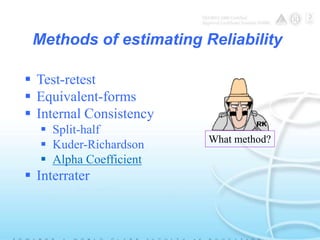
Methods of estimating Reliability 
 Test-retest 
 Equivalent-forms 
 Internal Consistency 
 Split-half 
 Kuder-Richardson 
 Alpha Coefficient 
 Interrater 
What method?
Test-Retest 
 Give the same test twice to the same group 
with some time interval between tests, from 
several minutes to several days
Equivalent Forms 
 Give two forms of the test to the same group 
in close succession
Test-Retest with equivalent forms 
 Give two forms of the test to the same group 
with an increased time interval between 
forms
Internal-Consistency Methods 
There are several internal-consistency methods that require 
only one administration of an instrument. 
Split-half Procedure: involves scoring two halves of a test 
separately for each subject and calculating the correlation 
coefficient between the two scores. 
Kuder-Richardson Approaches: (KR20 and KR21) requires 3 
pieces of information: 
Number of items on the test 
The mean 
The standard deviation 
Considered the most frequent method for determining internal 
consistency 
Alpha Coefficient: a general form of the KR20 used to 
calculate the reliability of items that are not scored right vs. 
wrong.
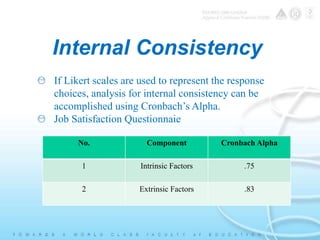
Internal Consistency 
If Likert scales are used to represent the response 
choices, analysis for internal consistency can be 
accomplished using Cronbach’s Alpha. 
Job Satisfaction Questionnaie 
No. Component Cronbach Alpha 
1 Intrinsic Factors .75 
2 Extrinsic Factors .83
Interrater 
 Give a set of student responses requiring 
judgmental scoring to two or more raters 
and have them independently score the 
responses
Factors Influencing 
Reliability Measures 
 Number of assessment tasks 
 Spread of scores 
 Objectivity
Validity-Reliability 
 Reliability is a necessary but 
insufficient condition for validity. 
 Reliability (consistency) of 
measurement is needed to obtain valid 
results, but we can have reliability 
without validity.
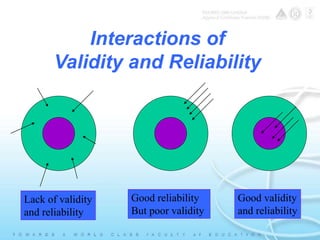
Interactions of 
Validity and Reliability 
Lack of validity 
and reliability 
Good reliability 
But poor validity 
Good validity 
and reliability
Other Factors Influencing 
Validity and Reliability
Objectivity 
 Refers to the degree to which equally 
competent scorers obtain the same 
results. 
 The test items (objective type) 
 The results (not influenced by scorer’s 
judgment or opinion)
Practicality 
 Economical from the viewpoint of both 
time and money. 
 Easily administered and scored. 
 Produce results that can be accurately 
interpreted and applied by available 
school personnel
Usability 
 Ease of administration 
 Time required for administration 
 Ease of interpretation and application 
 Availability of equivalent or 
comparable forms 
 Cost of testing
The Standard Error of 
Measurement 
 The index used in educational assessment to 
describe the consistency of a particular 
person’s performance(s) 
 Reflection of the consistency of an 
individual’s scores 
 The higher the reliability of a test, the 
smaller the SE of measurable will be
Teachers’ Ethical Responsibilities 
Regarding Assessment 
 Make fair and impartial decisions 
 Construct and administer fair and clear 
assessments 
 Motivate pupils to do their best 
 Teach pupils the varied types of assessments 
 Provide opportunities for pupils to practice 
test approaches 
 Make reasonable accommodations for 
students with disabilities
Summary 
 Concept of Validity 
 Factors influencing validity 
 Concept of Reliability 
 Factors influencing reliability
Questions 
How important is the concept of ‘validity’ in 
classroom assessment? 
To what extent do reliability concerns affect 
the construction of a good test?
References 
 Linn, R. L., & Miller, M. D. (2005). 
Measurement and assessment in testing. 
International Edition. 9th Ed. New Jersey: 
Pearson Merrill Prentice Hall 
 Airasian, P.W. (2005). Classroom 
assessment: Concepts and applications. 5th 
Ed. Boston: McGrawHill.

Week 8 & 9 - Validity and Reliability

  • 1.
  • 2.
    Good Assessments Regardless of its other characteristics, the most important characteristics in determining the usefulness of assessment information are its validity and reliability.
  • 3.
    Validity Validity hasbeen defined as referring to the appropriateness, correctness, meaningfulness, and usefulness of the specific inferences researchers make based on the data they collect.
  • 4.
    Validity  Validityis an evaluation of the adequacy and appropriateness of the interpretations and uses of assessment results.  Validity is always determined by a judgment made by the test user.
  • 5.
    Nature of Validity  Appropriateness of the interpretation and use made of the results of an assessment procedure for a given group of individuals  A matter of degree  Specific to some particular use or interpretation  A unitary concept  Overall evaluate judgment
  • 6.
    Sources of Validity  Test content  Response process  Internal structure
  • 7.
    Evidence of Validity There are 3 types of evidence a researcher might collect: Content-related evidence of validity Content and format of the instrument Criterion-related evidence of validity Relationship between scores obtained using the instrument and scores obtained Construct-related evidence of validity Psychological construct being measured by the instrument
  • 8.
    Content Validity Compare the assessment tasks to the specifications describing the task domain under consideration  The extent to which an assessment procedure adequately represents the content of the assessment domain being sampled
  • 9.
    Content Validity Example: The content validity of the instrument has been validated by four HR managers to identify the relevancy of the human resource management practices in automobile industry. Their CV were attached together in Appendices 2 for reference.
  • 10.
    Example After thepilot studies, the PES instrument was subjected to content validation by a panel of senior teachers and educationists (Credentials enclosed in Appendix G). All members of the panel worked independently. Each was presented with a set of the instrument and informed of the purpose of the instrument. They were then requested to study the items and decide on the suitability of the items. They were also asked if any other items should be included to fulfil the purpose of the instrument, and to comment on any part of the scale's items that they felt needed amending or clarification.
  • 11.
    Example Appendix G:Credentials of Panel for Instrument Validation Name, Qualification and Experience 1. DR. FOO SAY FOOI He is a lecturer in Educational Administration, Faculty of Educational Studies, Universiti Putra Malaysia. 2. ASSOC. PROF. DR. TURIMAN SUANDI A lecturer in the Faculty of Educational Studies, Universiti Putra Malaysia. Among others, he lectures on Research Design. Presently Deputy Dean for Development and Students. 3. ASSOC. PROF. DR. ZAIDATOL AKMALIAH L. PIHIE A lecturer in the field of Educational Administration at the Faculty of Educational Studies, Universiti Putra Malaysia. She had written articles and books related to educational management and administration. She is the Deputy Dean in the FPPUPM.
  • 12.
    Construct Validity Establish the meaning of assessment results by controlling the development of the assessment, evaluate the cognitive procession used by students to perform tasks, evaluate the relationships of the scores with other relevant measures, and experimentally determine what factors influence performance.  The extent to which empirical evidence confirms that an inferred construct exists and that a given assessment procedure is measuring the inferred construct accurately
  • 13.
    Criterion Validity Compare assessment results with another performance obtained at a later date or with another measure of performance obtained concurrently (for estimating present status).  The degree to which performance on an assessment procedure accurately predicts a student’s performance on an external criterion
  • 14.
    Factors Influence Validity  Unclear directions  Reading vocabulary and sentence structure too difficult  Ambiguity  Inadequate time limits  Overemphasis of easy-to-assess aspects of domain at the expense of important but difficult-to-assess aspects
  • 15.
    Factors Influence Validity  Test items inappropriate for the outcomes being measured  Poorly constructed test items  Test too short  Improper arrangement of items  Identifiable pattern of answers  First impression  Personal theories
  • 16.
    Reliability  Refersto the consistency of measurement, that is, how consistent test scores or other assessment results are from one measurement to another.
  • 17.
    Nature of Reliability  Refers to the results obtained with an instrument and not to the instrument itself  An estimate of reliability always refers to a particular type of consistency (time, task, students, rater)  Reliability is a necessary but not sufficient condition for validity  Reliability is assessed primarily with statistical indices
  • 18.
    Terminology  CorrelationCoefficient: a statistic that indicates the degree of relationship between any two sets of scores obtained from the same group of individuals
  • 19.
    Methods of estimatingReliability  Test-retest  Equivalent-forms  Internal Consistency  Split-half  Kuder-Richardson  Alpha Coefficient  Interrater What method?
  • 20.
    Test-Retest  Givethe same test twice to the same group with some time interval between tests, from several minutes to several days
  • 21.
    Equivalent Forms Give two forms of the test to the same group in close succession
  • 22.
    Test-Retest with equivalentforms  Give two forms of the test to the same group with an increased time interval between forms
  • 23.
    Internal-Consistency Methods Thereare several internal-consistency methods that require only one administration of an instrument. Split-half Procedure: involves scoring two halves of a test separately for each subject and calculating the correlation coefficient between the two scores. Kuder-Richardson Approaches: (KR20 and KR21) requires 3 pieces of information: Number of items on the test The mean The standard deviation Considered the most frequent method for determining internal consistency Alpha Coefficient: a general form of the KR20 used to calculate the reliability of items that are not scored right vs. wrong.
  • 24.
    Internal Consistency IfLikert scales are used to represent the response choices, analysis for internal consistency can be accomplished using Cronbach’s Alpha. Job Satisfaction Questionnaie No. Component Cronbach Alpha 1 Intrinsic Factors .75 2 Extrinsic Factors .83
  • 25.
    Interrater  Givea set of student responses requiring judgmental scoring to two or more raters and have them independently score the responses
  • 26.
    Factors Influencing ReliabilityMeasures  Number of assessment tasks  Spread of scores  Objectivity
  • 27.
    Validity-Reliability  Reliabilityis a necessary but insufficient condition for validity.  Reliability (consistency) of measurement is needed to obtain valid results, but we can have reliability without validity.
  • 28.
    Interactions of Validityand Reliability Lack of validity and reliability Good reliability But poor validity Good validity and reliability
  • 29.
    Other Factors Influencing Validity and Reliability
  • 30.
    Objectivity  Refersto the degree to which equally competent scorers obtain the same results.  The test items (objective type)  The results (not influenced by scorer’s judgment or opinion)
  • 31.
    Practicality  Economicalfrom the viewpoint of both time and money.  Easily administered and scored.  Produce results that can be accurately interpreted and applied by available school personnel
  • 32.
    Usability  Easeof administration  Time required for administration  Ease of interpretation and application  Availability of equivalent or comparable forms  Cost of testing
  • 33.
    The Standard Errorof Measurement  The index used in educational assessment to describe the consistency of a particular person’s performance(s)  Reflection of the consistency of an individual’s scores  The higher the reliability of a test, the smaller the SE of measurable will be
  • 34.
    Teachers’ Ethical Responsibilities Regarding Assessment  Make fair and impartial decisions  Construct and administer fair and clear assessments  Motivate pupils to do their best  Teach pupils the varied types of assessments  Provide opportunities for pupils to practice test approaches  Make reasonable accommodations for students with disabilities
  • 35.
    Summary  Conceptof Validity  Factors influencing validity  Concept of Reliability  Factors influencing reliability
  • 36.
    Questions How importantis the concept of ‘validity’ in classroom assessment? To what extent do reliability concerns affect the construction of a good test?
  • 37.
    References  Linn,R. L., & Miller, M. D. (2005). Measurement and assessment in testing. International Edition. 9th Ed. New Jersey: Pearson Merrill Prentice Hall  Airasian, P.W. (2005). Classroom assessment: Concepts and applications. 5th Ed. Boston: McGrawHill.