
RATING SCALE
Presented By-
Pratyusha Ranjan Sahoo
PhD Research Scholar
Regional Institute of Education (NCERT), Bhubaneswar1
Contents
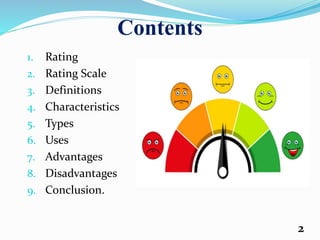
1. Rating
2. Rating Scale
3. Definitions
4. Characteristics
5. Types
6. Uses
7. Advantages
8. Disadvantages
9. Conclusion.
2
Rating
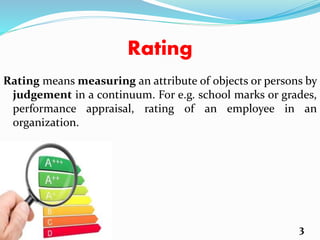
Rating means measuring an attribute of objects or persons by
judgement in a continuum. For e.g. school marks or grades,
performance appraisal, rating of an employee in an
organization.
3
Rating scale
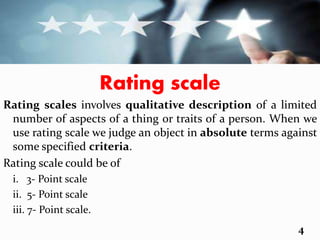
Rating scales involves qualitative description of a limited
number of aspects of a thing or traits of a person. When we
use rating scale we judge an object in absolute terms against
some specified criteria.
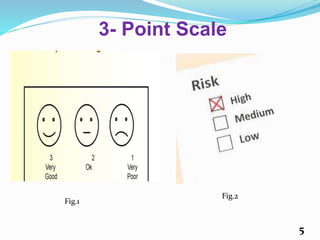
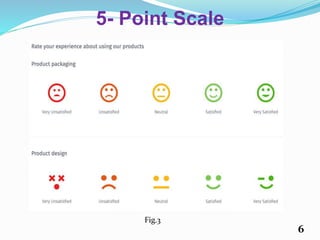
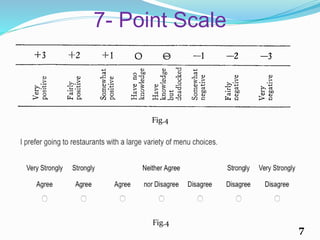
Rating scale could be of
i. 3- Point scale
ii. 5- Point scale
iii. 7- Point scale.
4
3- Point Scale
Fig.1
5
Fig.2
5- Point Scale
6
Fig.3
7- Point Scale
7
Fig.4
Fig.4
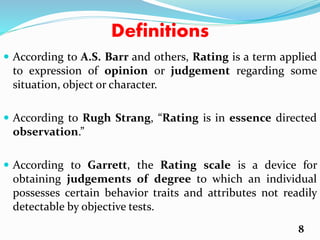
Definitions
 According to A.S. Barr and others, Rating is a term applied
to expression of opinion or judgement regarding some
situation, object or character.
 According to Rugh Strang, “Rating is in essence directed
observation.”
 According to Garrett, the Rating scale is a device for
obtaining judgements of degree to which an individual
possesses certain behavior traits and attributes not readily
detectable by objective tests.
8
Characteristics
 Rating scales are value judgements about attributes of one
person by another person.
 These scales are most commonly used tools to carry out
structural observation.
 Rating scales are generally developed to make quantitative
judgements about qualitative attributes.
 Rating scale provide more flexibility to judge the level of
performance or presence of attribute among subjects.
9
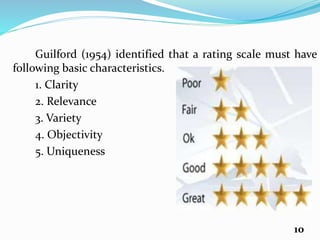
Guilford (1954) identified that a rating scale must have
following basic characteristics.
1. Clarity
2. Relevance
3. Variety
4. Objectivity
5. Uniqueness
10
Types
Rating scales are also of various types. Some of their main types
are as follows.
1. Numerical Scale
2. Descriptive Scale
3. Rank order scale
4. Graphic Scale
5. Percentage of Group Scale
6. Paired Comparison scales
7. Forced Choice Scales
8. Rating by cumulative points.
11
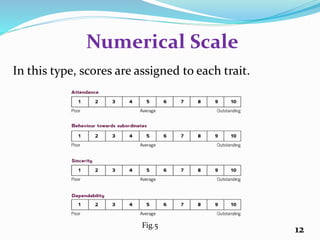
Numerical Scale
In this type, scores are assigned to each trait.
12
Fig.5
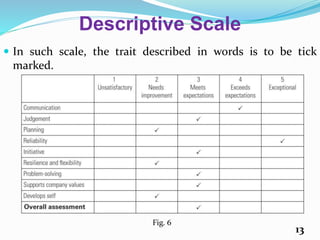
Descriptive Scale
 In such scale, the trait described in words is to be tick
marked.
13
Fig. 6
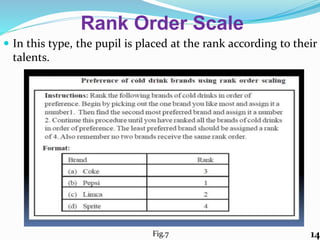
Rank Order Scale
 In this type, the pupil is placed at the rank according to their
talents.
14
Fig.7
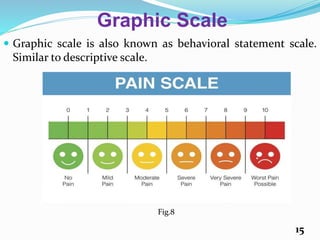
Graphic Scale
 Graphic scale is also known as behavioral statement scale.
Similar to descriptive scale.
15
Fig.8
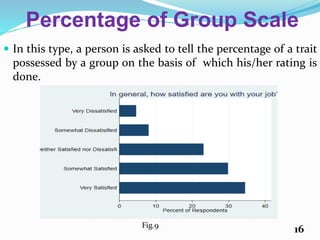
Percentage of Group Scale
 In this type, a person is asked to tell the percentage of a trait
possessed by a group on the basis of which his/her rating is
done.
16
Fig.9
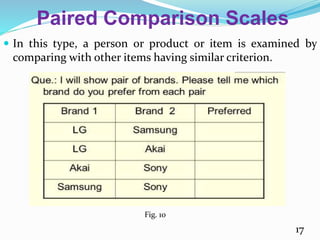
Paired Comparison Scales
 In this type, a person or product or item is examined by
comparing with other items having similar criterion.
17
Fig. 10
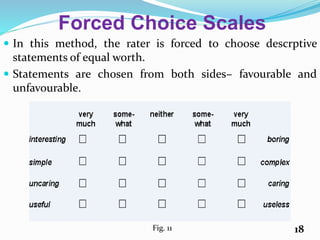
Forced Choice Scales
 In this method, the rater is forced to choose descrptive
statements of equal worth.
 Statements are chosen from both sides– favourable and
unfavourable.
18
Fig. 11
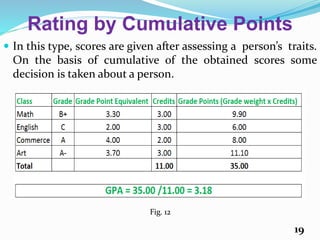
Rating by Cumulative Points
 In this type, scores are given after assessing a person’s traits.
On the basis of cumulative of the obtained scores some
decision is taken about a person.
19
Fig. 12
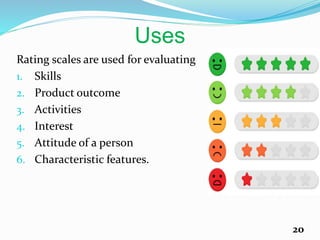
Uses
Rating scales are used for evaluating
1. Skills
2. Product outcome
3. Activities
4. Interest
5. Attitude of a person
6. Characteristic features.
20
Advantages
 Records qualitative and quantitative judgments about
observed performance.
 Evaluate products such as typed letter, responses of
demonstration, sample of diagram, charts etc.
 Help teachers to rate students periodically on various
characteristics such as punctuality, honesty, cheerfulness and
other personal traits.
 Adaptable and flexible.
 Used within a large number of students.
 Helps in promoting and appointing the persons.
 Helps the students at the time of admission.
 Motivates the students or pupils to know their shortcomings.
21
Disadvantages
 It is difficult to fix up rating about many aspects of an
individual or item or organization.
 Lack of uniformity with which terms are interpreted by the
evaluator.
 Common sources of errors in rating scales, that affect the
validity of a rater, they are :
1. Ambiguity.
2. Attitude of the rater
3. Personality of the rater; Halo effect; personal bias; logical
errors
4.Opportunity for adequate observation.
22
Conclusion
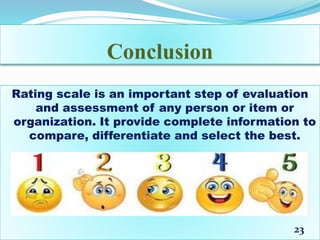
Rating scale is an important step of evaluation
and assessment of any person or item or
organization. It provide complete information to
compare, differentiate and select the best.
23
24

RATING SCALE- Pratyusha Ranjan Sahoo.pptx

  • 1.
    RATING SCALE Presented By- PratyushaRanjan Sahoo PhD Research Scholar Regional Institute of Education (NCERT), Bhubaneswar1
  • 2.
    Contents 1. Rating 2. RatingScale 3. Definitions 4. Characteristics 5. Types 6. Uses 7. Advantages 8. Disadvantages 9. Conclusion. 2
  • 3.
    Rating Rating means measuringan attribute of objects or persons by judgement in a continuum. For e.g. school marks or grades, performance appraisal, rating of an employee in an organization. 3
  • 4.
    Rating scale Rating scalesinvolves qualitative description of a limited number of aspects of a thing or traits of a person. When we use rating scale we judge an object in absolute terms against some specified criteria. Rating scale could be of i. 3- Point scale ii. 5- Point scale iii. 7- Point scale. 4
  • 5.
  • 6.
  • 7.
  • 8.
    Definitions  According toA.S. Barr and others, Rating is a term applied to expression of opinion or judgement regarding some situation, object or character.  According to Rugh Strang, “Rating is in essence directed observation.”  According to Garrett, the Rating scale is a device for obtaining judgements of degree to which an individual possesses certain behavior traits and attributes not readily detectable by objective tests. 8
  • 9.
    Characteristics  Rating scalesare value judgements about attributes of one person by another person.  These scales are most commonly used tools to carry out structural observation.  Rating scales are generally developed to make quantitative judgements about qualitative attributes.  Rating scale provide more flexibility to judge the level of performance or presence of attribute among subjects. 9
  • 10.
    Guilford (1954) identifiedthat a rating scale must have following basic characteristics. 1. Clarity 2. Relevance 3. Variety 4. Objectivity 5. Uniqueness 10
  • 11.
    Types Rating scales arealso of various types. Some of their main types are as follows. 1. Numerical Scale 2. Descriptive Scale 3. Rank order scale 4. Graphic Scale 5. Percentage of Group Scale 6. Paired Comparison scales 7. Forced Choice Scales 8. Rating by cumulative points. 11
  • 12.
    Numerical Scale In thistype, scores are assigned to each trait. 12 Fig.5
  • 13.
    Descriptive Scale  Insuch scale, the trait described in words is to be tick marked. 13 Fig. 6
  • 14.
    Rank Order Scale In this type, the pupil is placed at the rank according to their talents. 14 Fig.7
  • 15.
    Graphic Scale  Graphicscale is also known as behavioral statement scale. Similar to descriptive scale. 15 Fig.8
  • 16.
    Percentage of GroupScale  In this type, a person is asked to tell the percentage of a trait possessed by a group on the basis of which his/her rating is done. 16 Fig.9
  • 17.
    Paired Comparison Scales In this type, a person or product or item is examined by comparing with other items having similar criterion. 17 Fig. 10
  • 18.
    Forced Choice Scales In this method, the rater is forced to choose descrptive statements of equal worth.  Statements are chosen from both sides– favourable and unfavourable. 18 Fig. 11
  • 19.
    Rating by CumulativePoints  In this type, scores are given after assessing a person’s traits. On the basis of cumulative of the obtained scores some decision is taken about a person. 19 Fig. 12
  • 20.
    Uses Rating scales areused for evaluating 1. Skills 2. Product outcome 3. Activities 4. Interest 5. Attitude of a person 6. Characteristic features. 20
  • 21.
    Advantages  Records qualitativeand quantitative judgments about observed performance.  Evaluate products such as typed letter, responses of demonstration, sample of diagram, charts etc.  Help teachers to rate students periodically on various characteristics such as punctuality, honesty, cheerfulness and other personal traits.  Adaptable and flexible.  Used within a large number of students.  Helps in promoting and appointing the persons.  Helps the students at the time of admission.  Motivates the students or pupils to know their shortcomings. 21
  • 22.
    Disadvantages  It isdifficult to fix up rating about many aspects of an individual or item or organization.  Lack of uniformity with which terms are interpreted by the evaluator.  Common sources of errors in rating scales, that affect the validity of a rater, they are : 1. Ambiguity. 2. Attitude of the rater 3. Personality of the rater; Halo effect; personal bias; logical errors 4.Opportunity for adequate observation. 22
  • 23.
    Conclusion Rating scale isan important step of evaluation and assessment of any person or item or organization. It provide complete information to compare, differentiate and select the best. 23
  • 24.