Topic: Learning to Observe?
Name: Sana Mushtaq (2021_113)
Subject: Technical Writing and Presentation Skills
Submitted to: Dr. Bazgha Moin Qazi
BS Elementary Education
6th Morning
University Of The Punjab
What is observational learning?
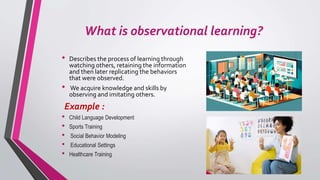
• Describes the process of learning through
watching others, retaining the information
and then later replicating the behaviors
that were observed.
• We acquire knowledge and skills by
observing and imitating others.
Example :
• Child Language Development
• Sports Training
• Social Behavior Modeling
• Educational Settings
• Healthcare Training
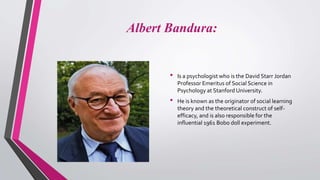
Albert Bandura:
• Is a psychologist who is the David Starr Jordan
Professor Emeritus of Social Science in
Psychology at Stanford University.
• He is known as the originator of social learning
theory and the theoretical construct of self-
efficacy, and is also responsible for the
influential 1961 Bobo doll experiment.
Observational Learning
Albert Bandura:
• The replication of other's behavior through observation
and imitation. (Also called "modeling" and "social
learning")
• Albert Bandura believed that direct reinforcement and
punishment could not account for all learning that
occurs.What about when children copy the behavior of
their parents when no reinforcement is given ?
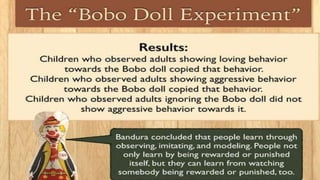
The "Bobo Doll Experiment"
The "Bobo Doll Experiment“
Result:
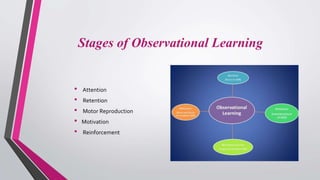
Stages of Observational Learning
• Attention
• Retention
• Motor Reproduction
• Motivation
• Reinforcement
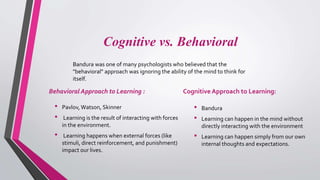
Cognitive vs. Behavioral
Behavioral Approach to Learning :
• Pavlov, Watson, Skinner
• Learning is the result of interacting with forces
in the environment.
• Learning happens when external forces (like
stimuli, direct reinforcement, and punishment)
impact our lives.
Cognitive Approach to Learning:
Bandura was one of many psychologists who believed that the
"behavioral" approach was ignoring the ability of the mind to think for
itself.
• Bandura
• Learning can happen in the mind without
directly interacting with the environment
• Learning can happen simply from our own
internal thoughts and expectations.
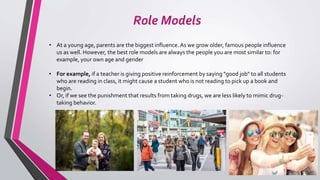
Role Models
• At a young age, parents are the biggest influence.As we grow older, famous people influence
us as well. However, the best role models are always the people you are most similar to: for
example, your own age and gender
• For example, if a teacher is giving positive reinforcement by saying "good job" to all students
who are reading in class, it might cause a student who is not reading to pick up a book and
begin.
• Or, if we see the punishment that results from taking drugs, we are less likely to mimic drug-
taking behavior.
Conclusion:
• The future of observational learning, especially
with the advent of digital technology, is poised
to further revolutionize how we acquire
knowledge and skills. It challenges traditional
learning paradigms, advocating for more
engagement and interaction in learning
environments.
• This exploration not only deepens our
appreciation of observational learning but also
invites us to integrate its principles more fully
into our daily lives and learning strategies.
Observational Learning

Observational Learning

  • 1.
    Topic: Learning toObserve? Name: Sana Mushtaq (2021_113) Subject: Technical Writing and Presentation Skills Submitted to: Dr. Bazgha Moin Qazi BS Elementary Education 6th Morning University Of The Punjab
  • 2.
    What is observationallearning? • Describes the process of learning through watching others, retaining the information and then later replicating the behaviors that were observed. • We acquire knowledge and skills by observing and imitating others. Example : • Child Language Development • Sports Training • Social Behavior Modeling • Educational Settings • Healthcare Training
  • 3.
    Albert Bandura: • Isa psychologist who is the David Starr Jordan Professor Emeritus of Social Science in Psychology at Stanford University. • He is known as the originator of social learning theory and the theoretical construct of self- efficacy, and is also responsible for the influential 1961 Bobo doll experiment.
  • 4.
    Observational Learning Albert Bandura: •The replication of other's behavior through observation and imitation. (Also called "modeling" and "social learning") • Albert Bandura believed that direct reinforcement and punishment could not account for all learning that occurs.What about when children copy the behavior of their parents when no reinforcement is given ?
  • 5.
    The "Bobo DollExperiment"
  • 6.
    The "Bobo DollExperiment“ Result:
  • 7.
    Stages of ObservationalLearning • Attention • Retention • Motor Reproduction • Motivation • Reinforcement
  • 8.
    Cognitive vs. Behavioral BehavioralApproach to Learning : • Pavlov, Watson, Skinner • Learning is the result of interacting with forces in the environment. • Learning happens when external forces (like stimuli, direct reinforcement, and punishment) impact our lives. Cognitive Approach to Learning: Bandura was one of many psychologists who believed that the "behavioral" approach was ignoring the ability of the mind to think for itself. • Bandura • Learning can happen in the mind without directly interacting with the environment • Learning can happen simply from our own internal thoughts and expectations.
  • 10.
    Role Models • Ata young age, parents are the biggest influence.As we grow older, famous people influence us as well. However, the best role models are always the people you are most similar to: for example, your own age and gender • For example, if a teacher is giving positive reinforcement by saying "good job" to all students who are reading in class, it might cause a student who is not reading to pick up a book and begin. • Or, if we see the punishment that results from taking drugs, we are less likely to mimic drug- taking behavior.
  • 11.
    Conclusion: • The futureof observational learning, especially with the advent of digital technology, is poised to further revolutionize how we acquire knowledge and skills. It challenges traditional learning paradigms, advocating for more engagement and interaction in learning environments. • This exploration not only deepens our appreciation of observational learning but also invites us to integrate its principles more fully into our daily lives and learning strategies.