Anagrams
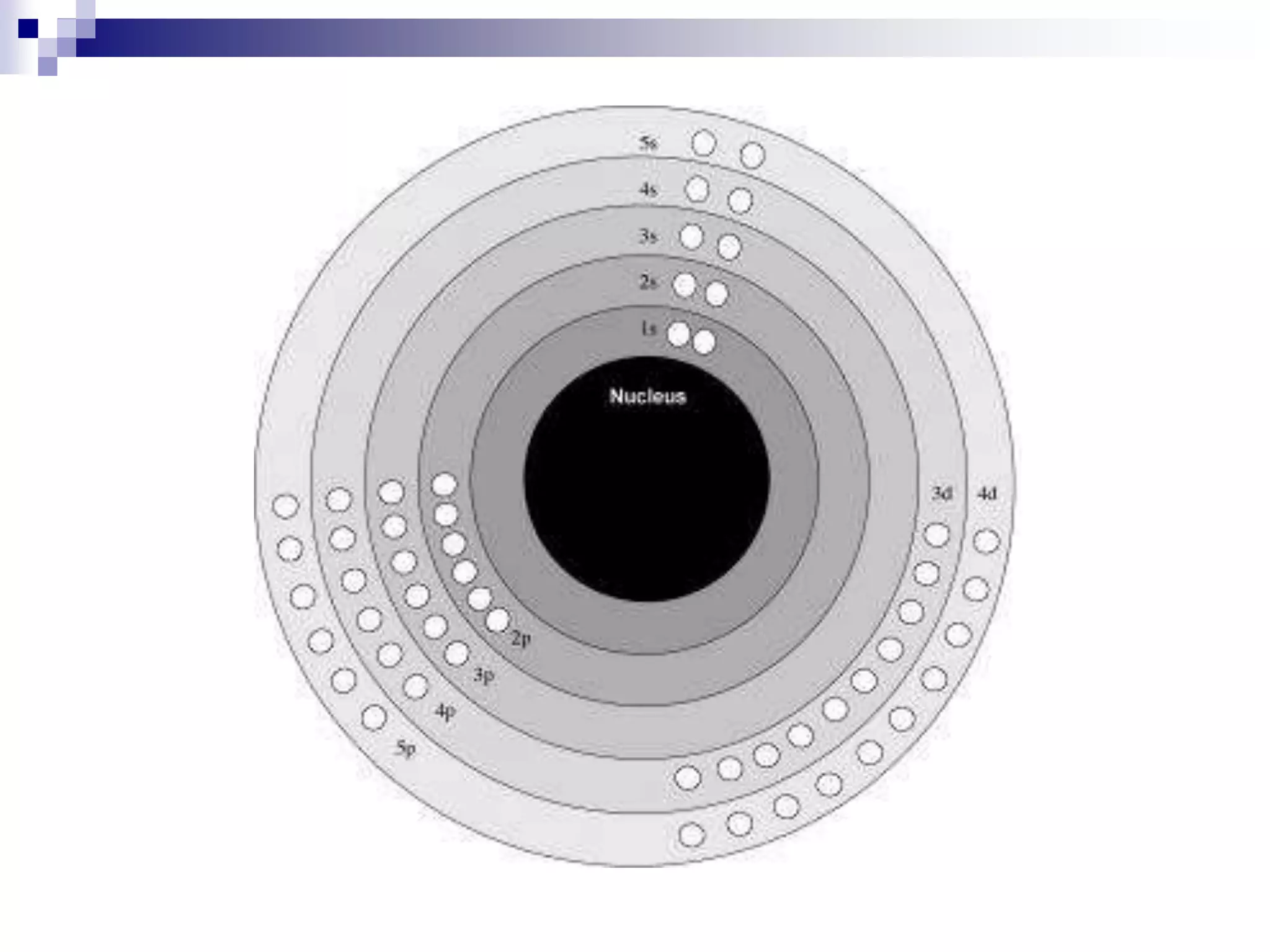
Electron Location
Electron Configuration
 It is the assignment of all of the electrons
in an atom into specific shells and
subshells
 Uses symbols of the orbitals and the
number of electrons (written of
superscripts) that occupy each orbital.
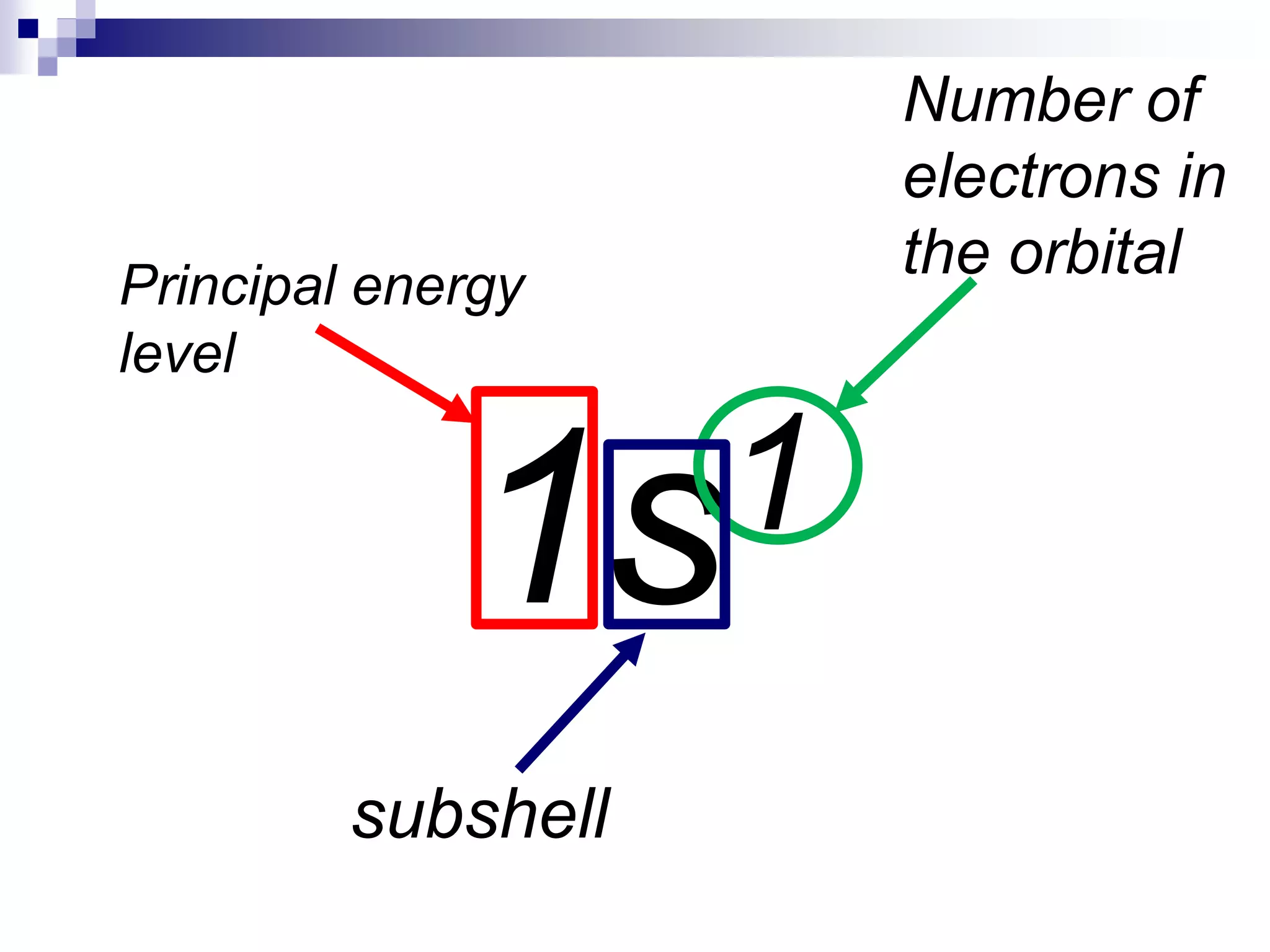
1s1
subshell
Number of
electrons in
the orbital
Principal energy
level
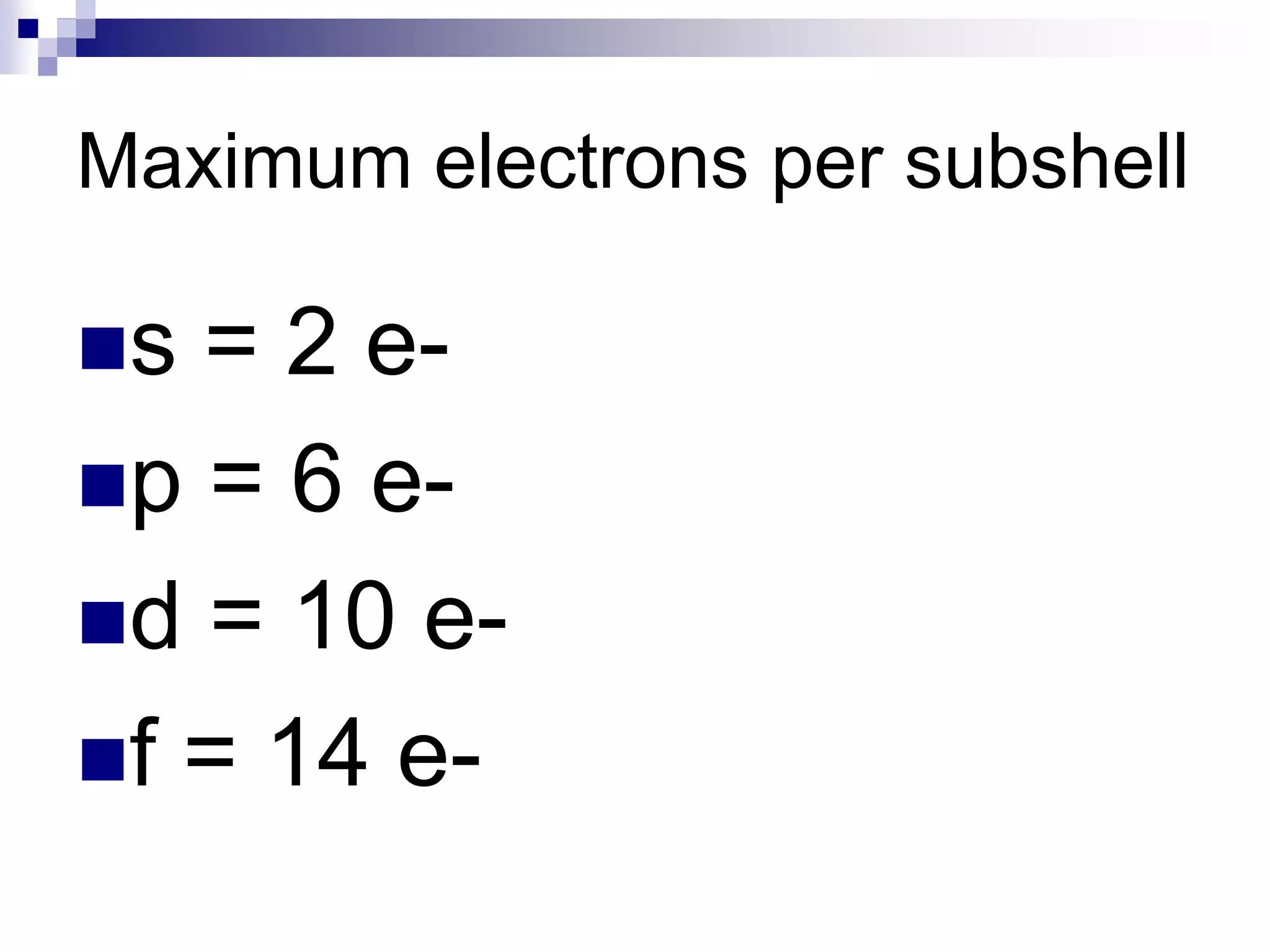
Maximum electrons per subshell
s = 2 e-
p = 6 e-
d = 10 e-
f = 14 e-
Exercise
First 10!!
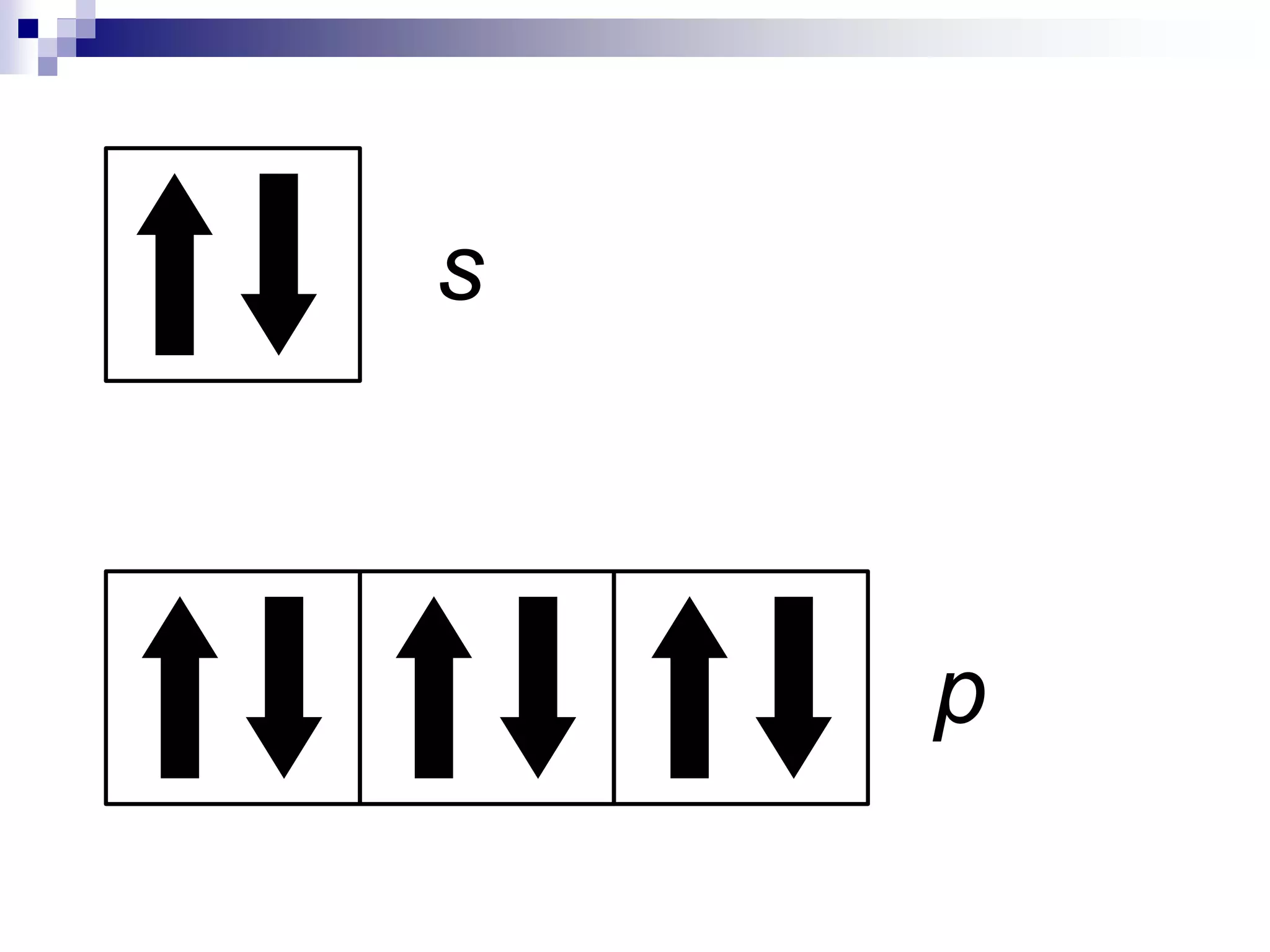
Orbital Diagram/ Orbital
Notation
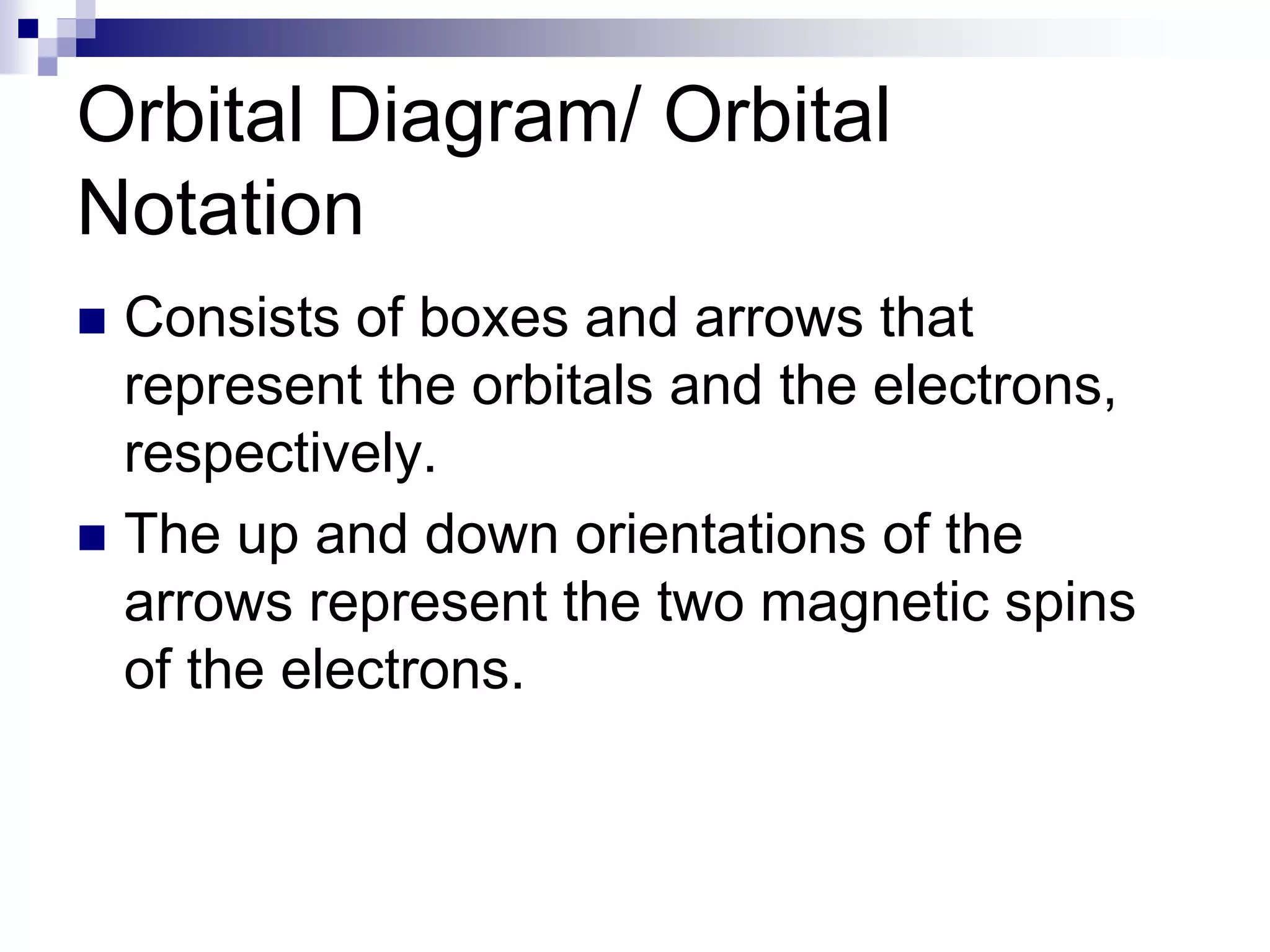
 Consists of boxes and arrows that
represent the orbitals and the electrons,
respectively.
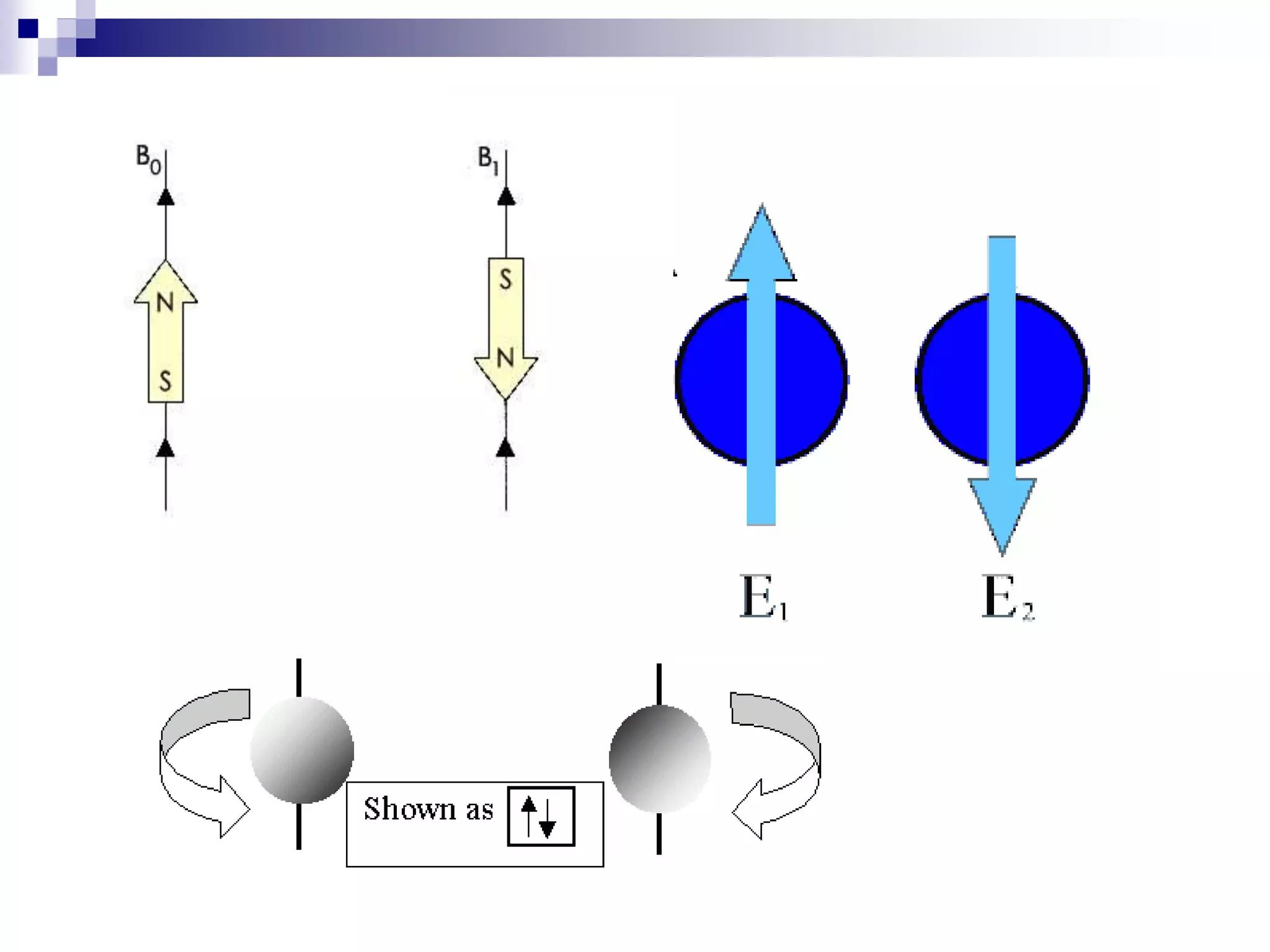
 The up and down orientations of the
arrows represent the two magnetic spins
of the electrons.
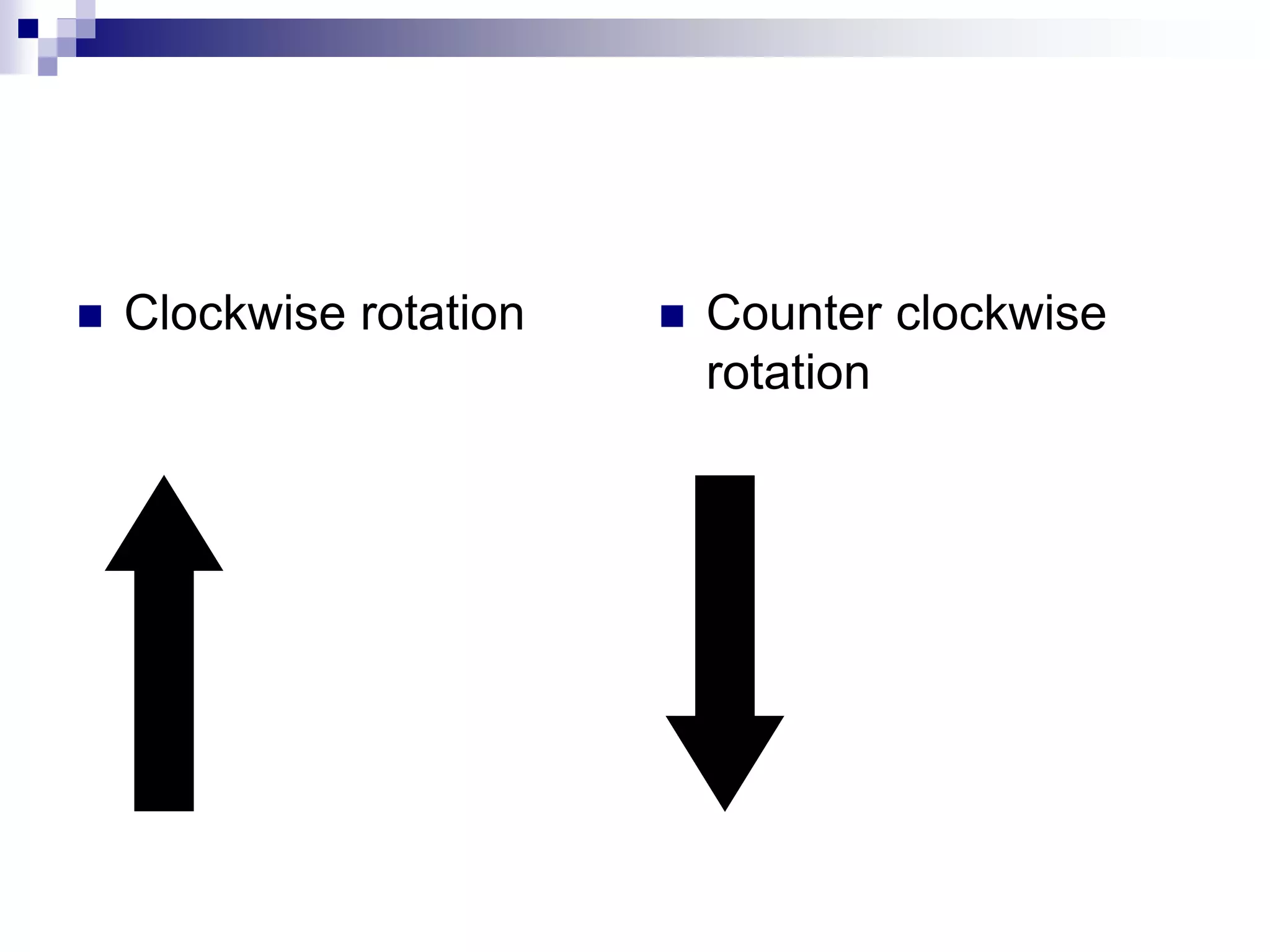
 Clockwise rotation  Counter clockwise
rotation
s
p
Aufbau Principle
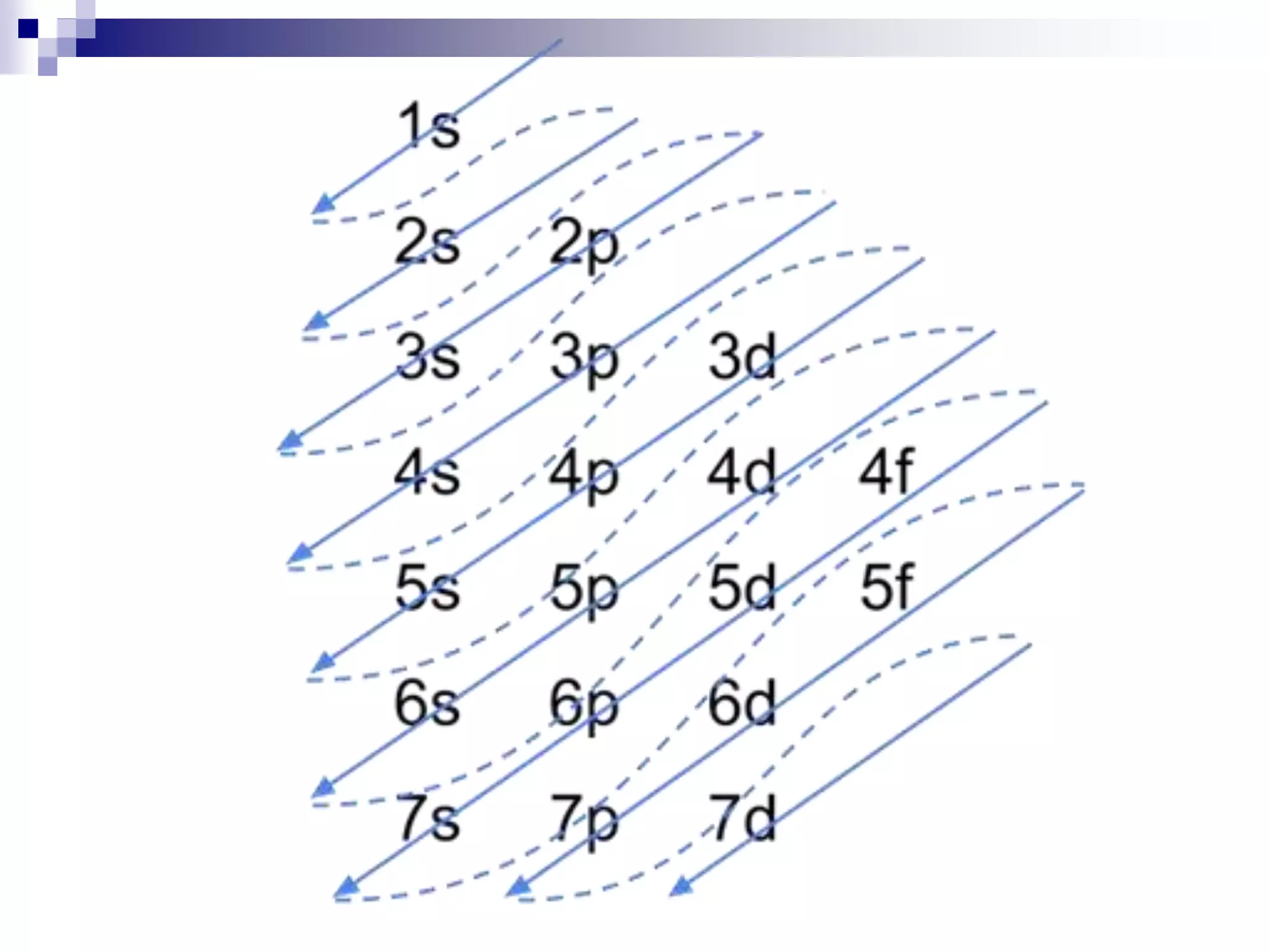
 States that electrons should occupy first
the orbitals with lower energy before those
with higher energy.
 Example, 1s orbital should be filled first
before the 2s orbital.
 4s orbital has lower energy than the 3d
orbital.
Pauli exclusion principle
 States that no two electrons in an atom can
possess the same set of quantum numbers.
 This principle emphasizes the significance of the
spin quantum numbers.
 If two electrons in an atom have the same n, l,
and ml, they should still have different ms.
 One electron must have ms= -1/2 and the other
should be ms= +1/2
Hund’s rule of maximum
multiplicity
 Suggests that the most stable
arrangement of electrons in subshells is
the one with the greatest number of
parallel spins.
 This means that each orbital in a subshell
is singly occupied before pairing of
electrons occurs.
Exercise
First 10!!
Quiz!!
Quiz # 6 (1/2 crosswise)
Write the electron
configuration and draw the
orbital diagram of the elements
with atomic number 21 to 25.
Louis de Broglie
 Initially thought that electrons behave both
like a wave and a particle.
 However, he later emphasized that
electrons behave more like a wave.
 Proposed that electrons be considered as
a wave confined in the space surrounding
an atomic nucleus.
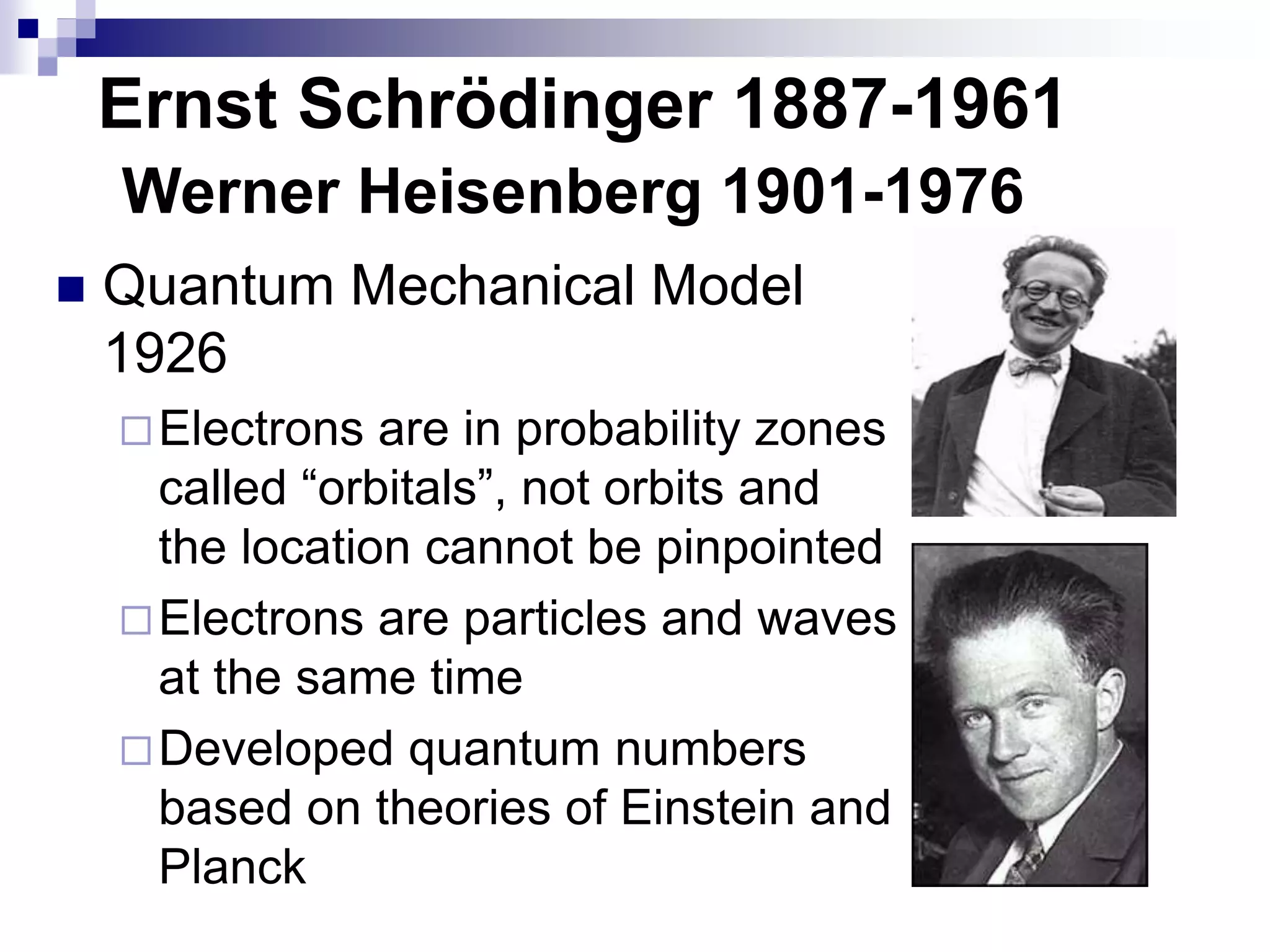
Ernst Schrödinger 1887-1961
 Quantum Mechanical Model
1926
Electrons are in probability zones
called “orbitals”, not orbits and
the location cannot be pinpointed
Electrons are particles and waves
at the same time
Developed quantum numbers
based on theories of Einstein and
Planck
Werner Heisenberg 1901-1976
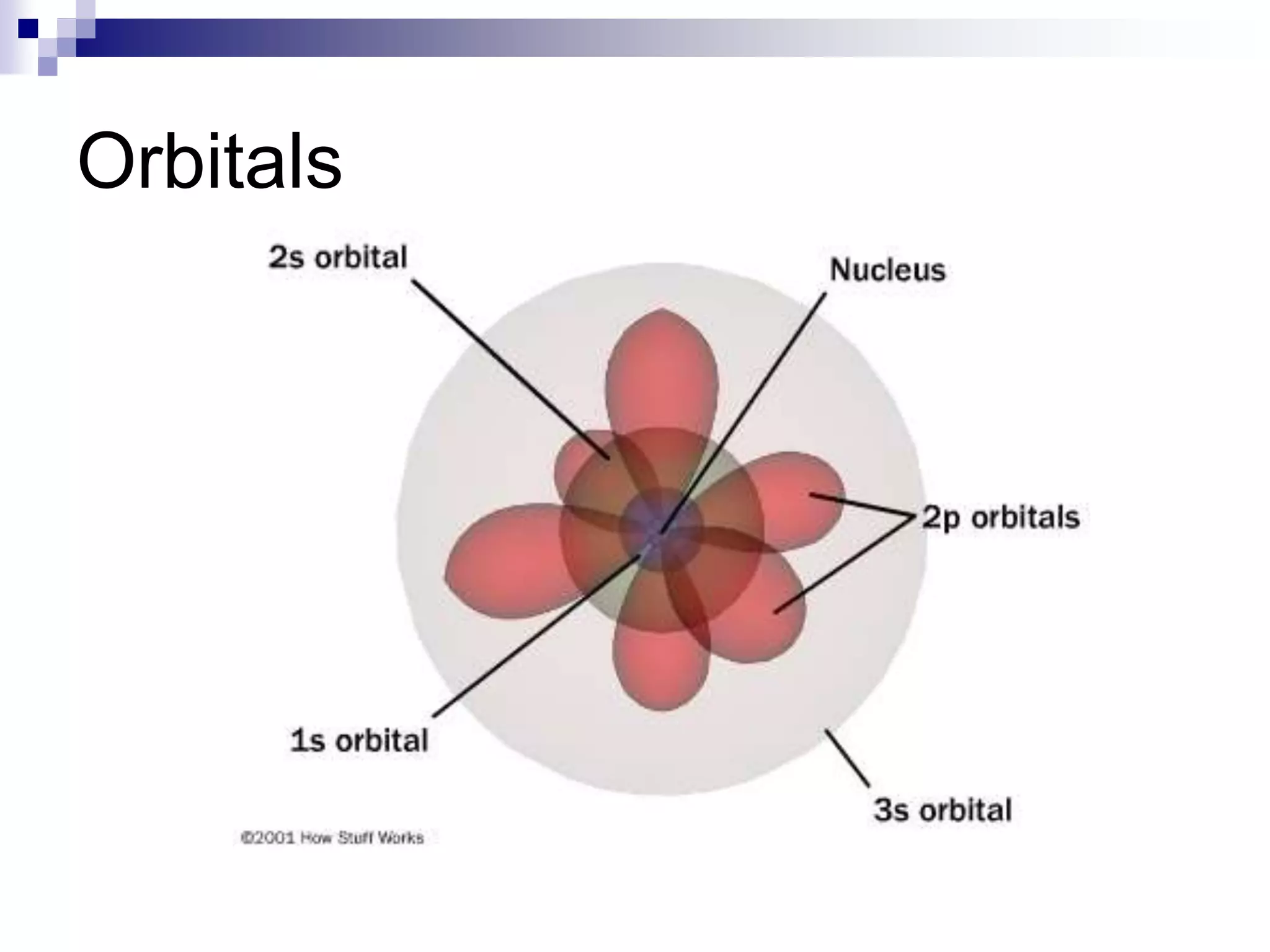
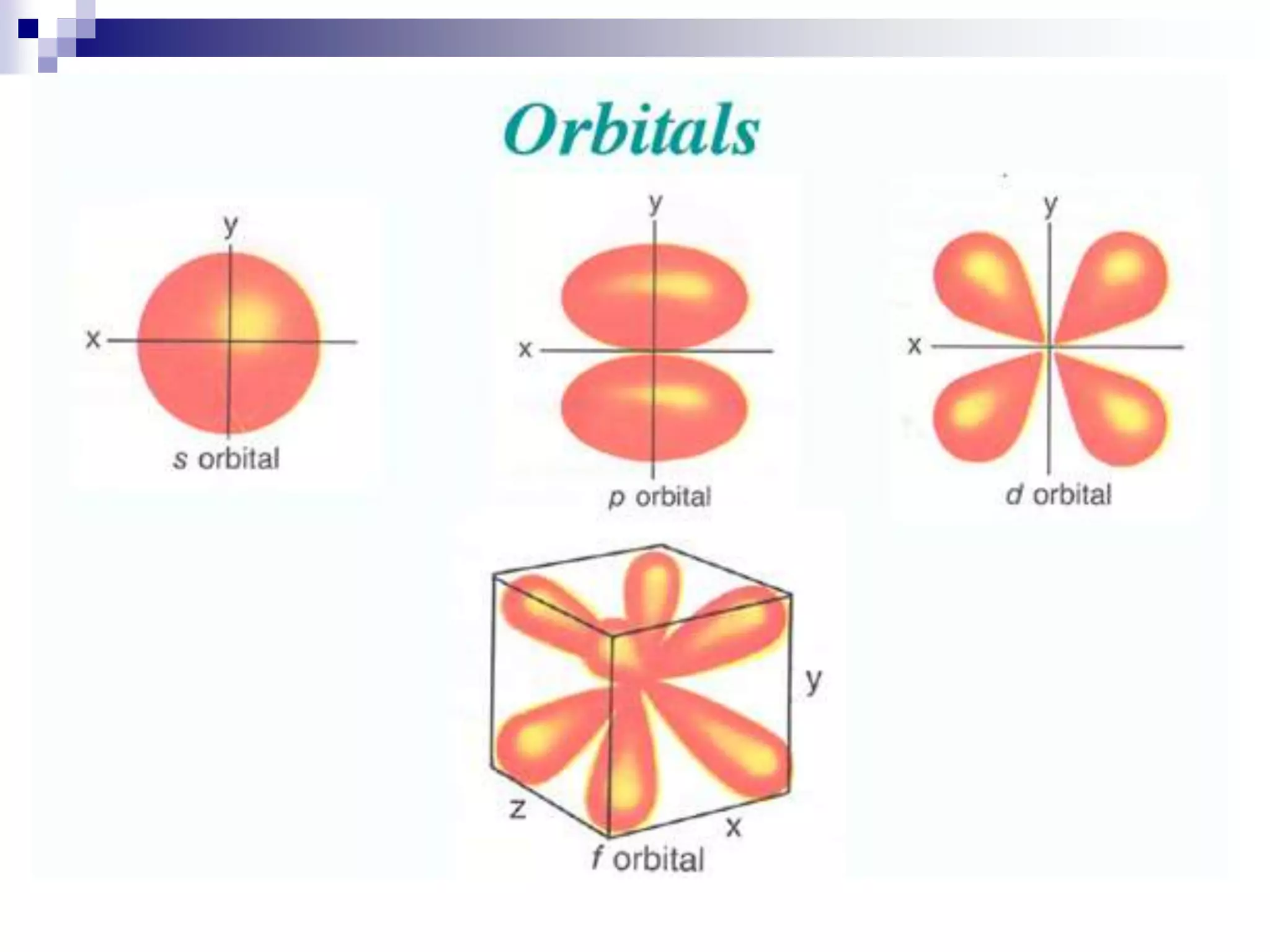
Orbitals
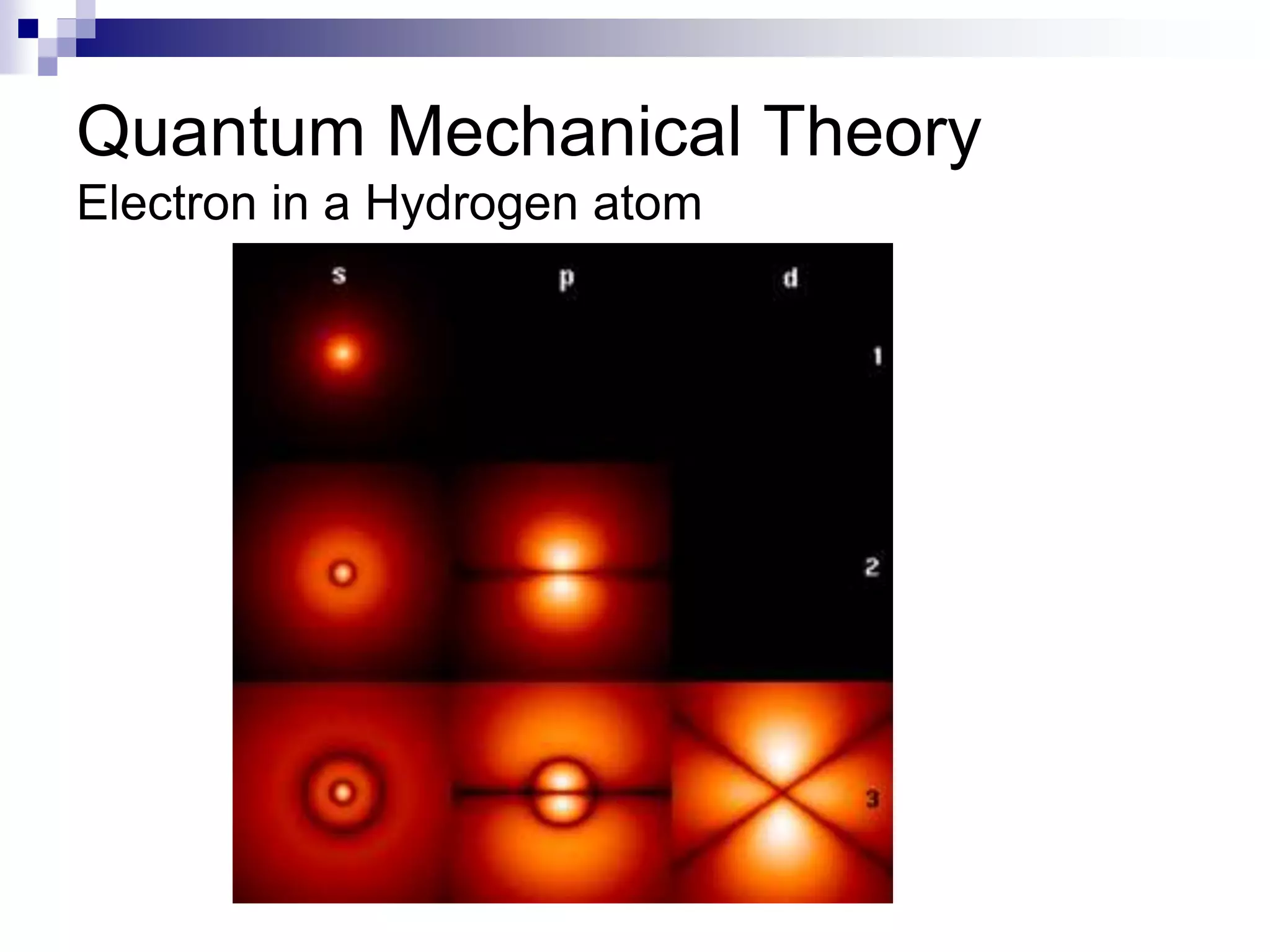
Quantum Mechanical Theory
Electron in a Hydrogen atom
 Quantum number describe the atomic
orbitals as well as the properties of the
electrons in those orbitals.
Quantum Numbers
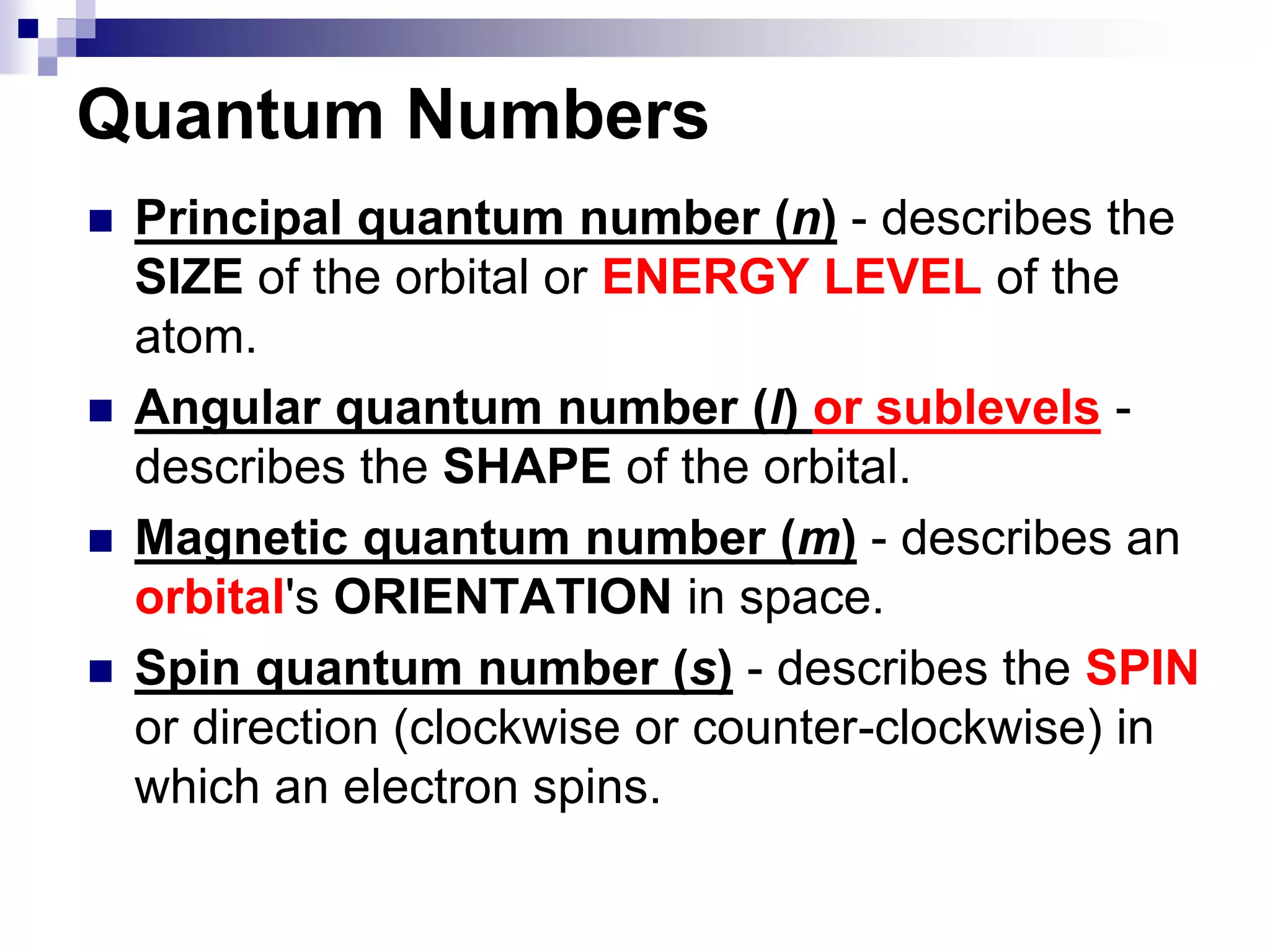
 Principal quantum number (n) - describes the
SIZE of the orbital or ENERGY LEVEL of the
atom.
 Angular quantum number (l) or sublevels -
describes the SHAPE of the orbital.
 Magnetic quantum number (m) - describes an
orbital's ORIENTATION in space.
 Spin quantum number (s) - describes the SPIN
or direction (clockwise or counter-clockwise) in
which an electron spins.
Quantum Numbers
Principle Quantum Number (n) or
Energy Level
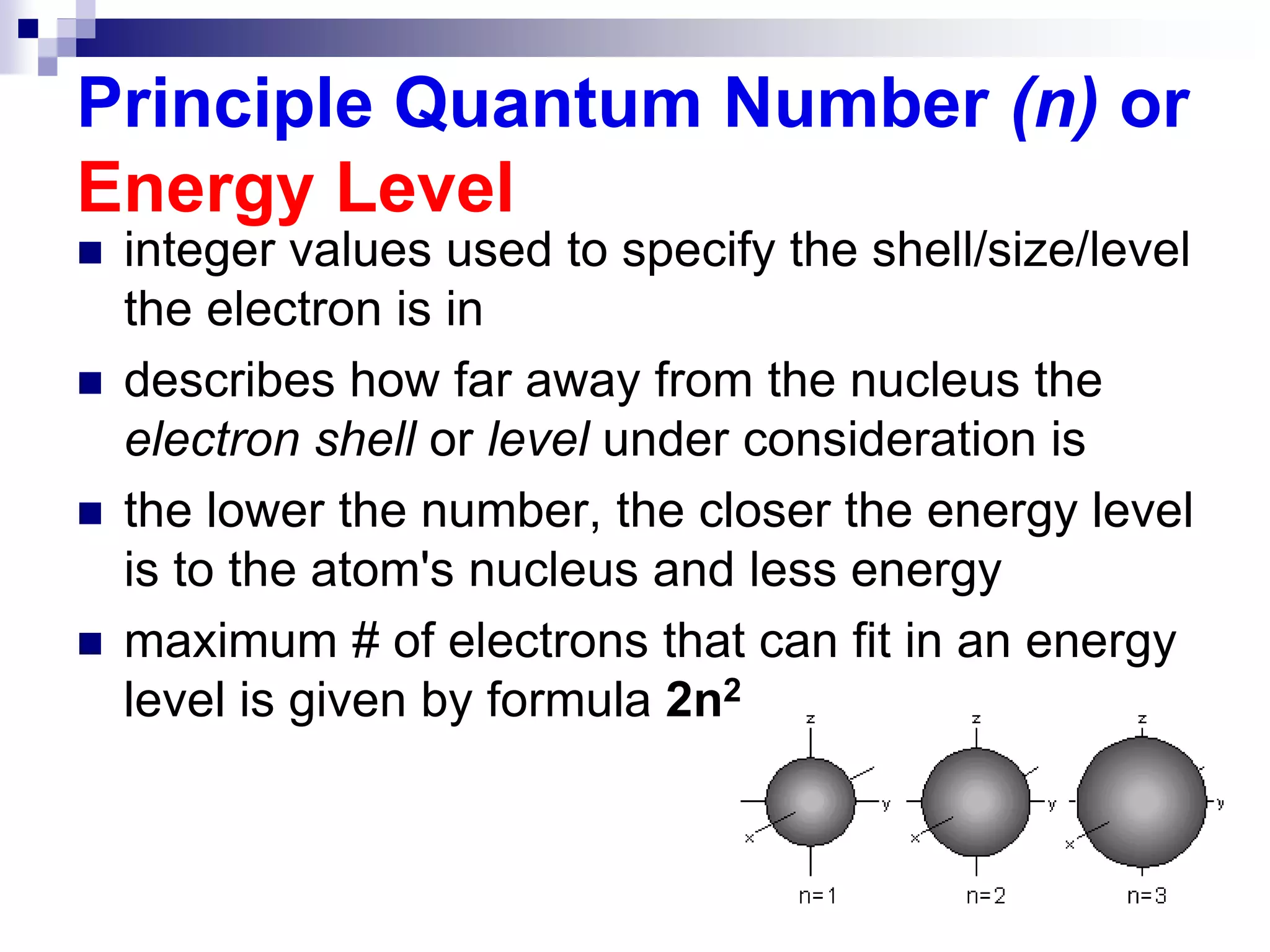
 integer values used to specify the shell/size/level
the electron is in
 describes how far away from the nucleus the
electron shell or level under consideration is
 the lower the number, the closer the energy level
is to the atom's nucleus and less energy
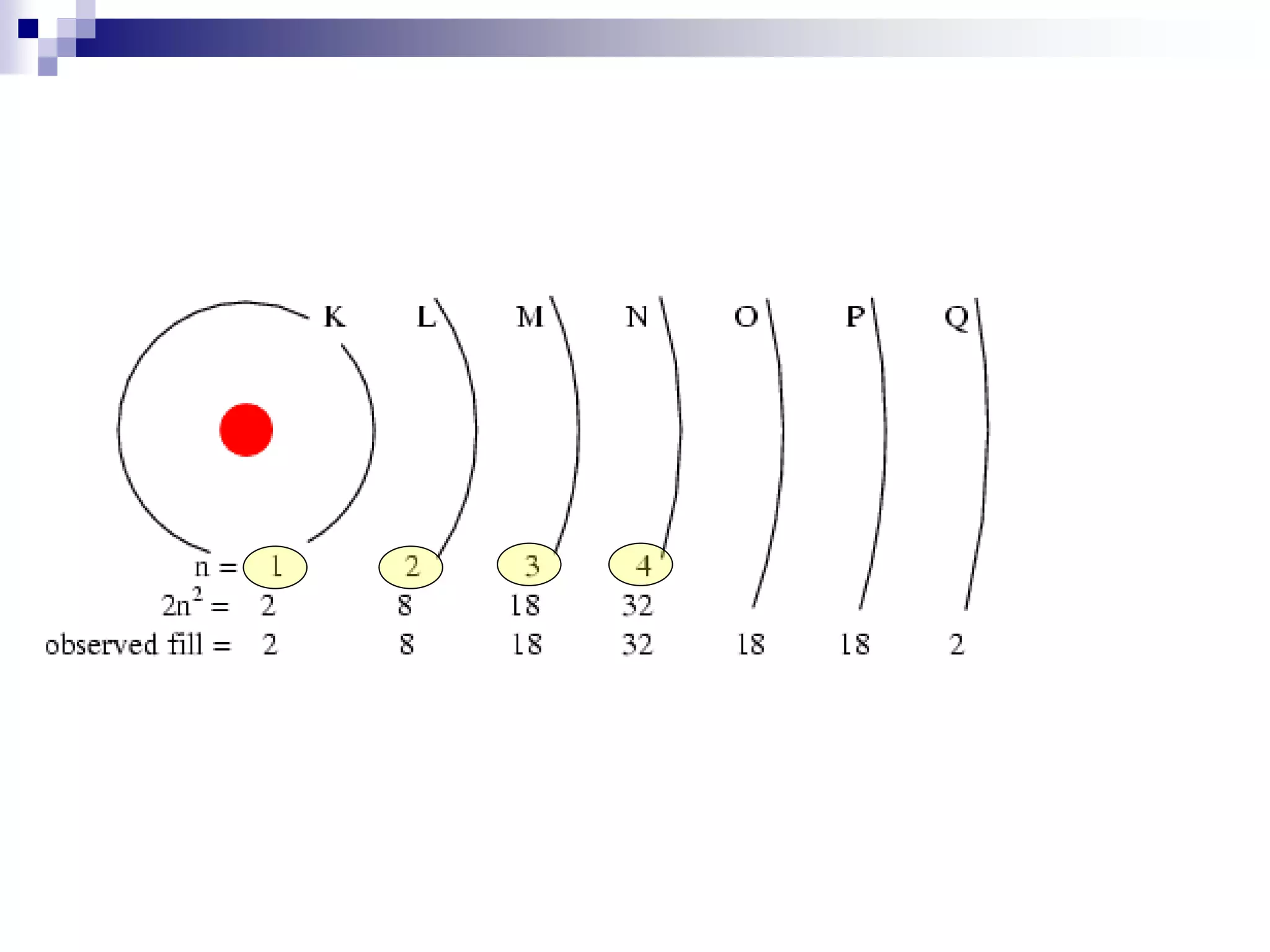
 maximum # of electrons that can fit in an energy
level is given by formula 2n2
Angular/Azimuthal Quantum
Number (l) or Sub-level
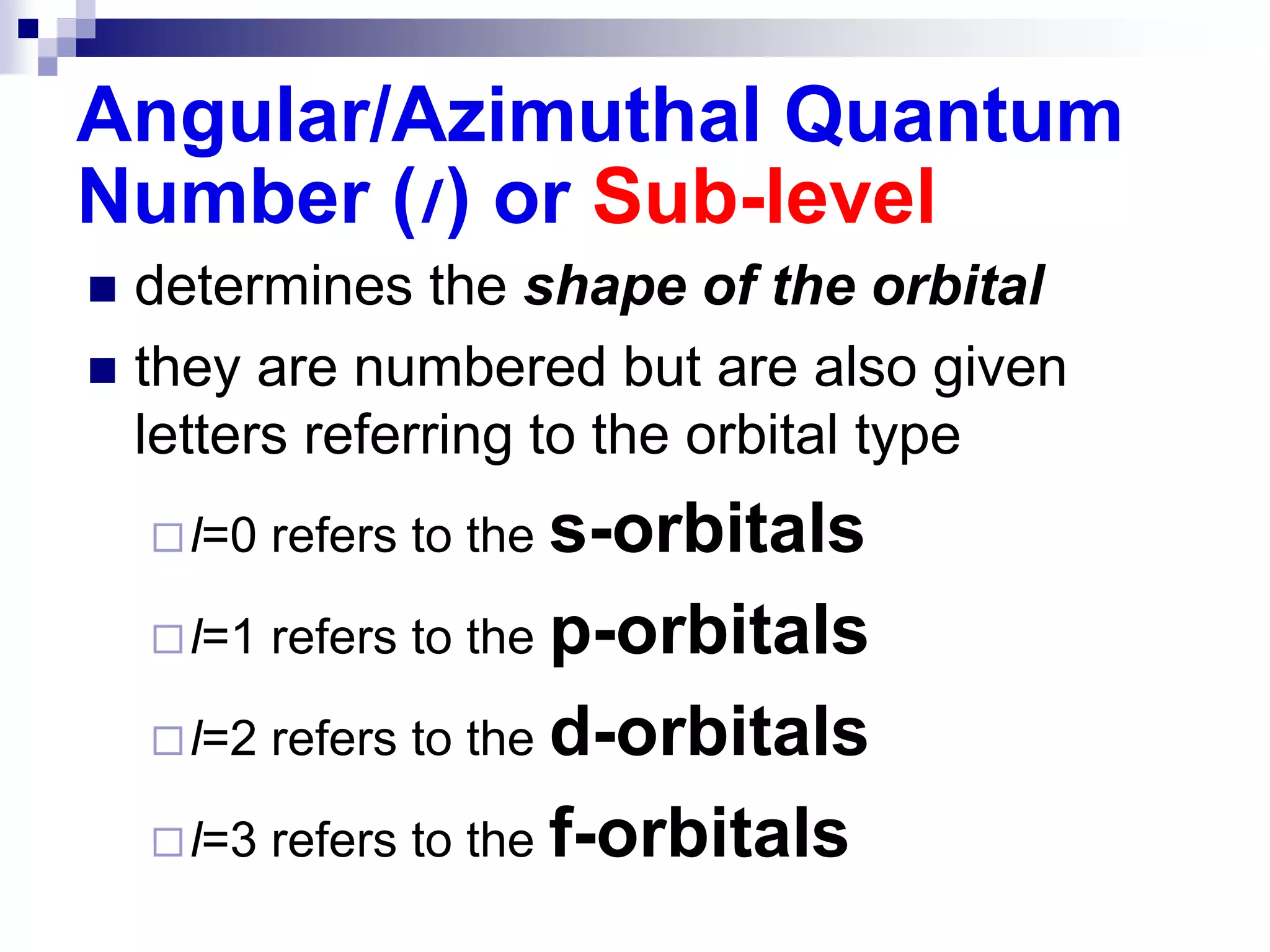
 determines the shape of the orbital
 they are numbered but are also given
letters referring to the orbital type
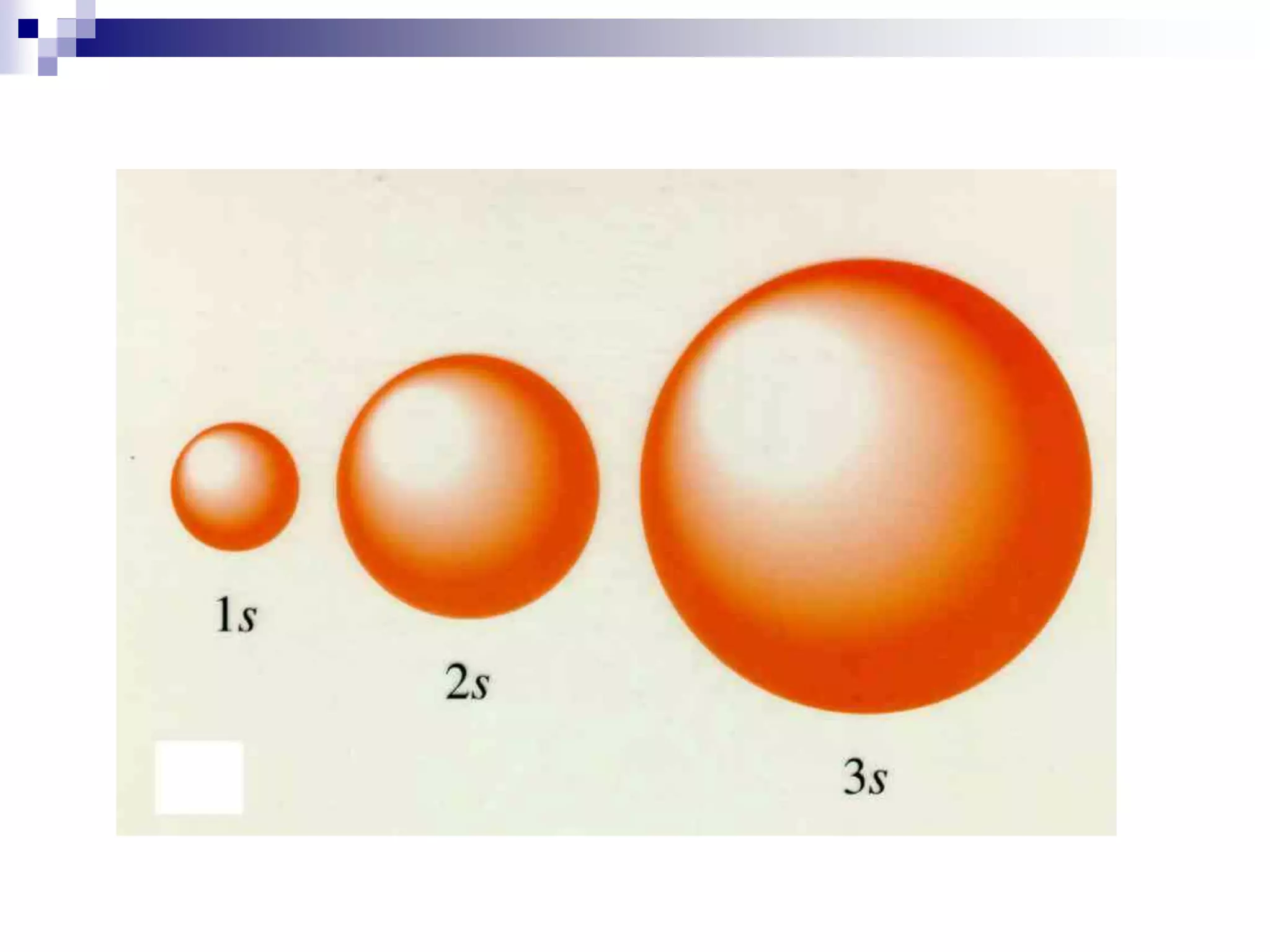
l=0 refers to the s-orbitals
l=1 refers to the p-orbitals
l=2 refers to the d-orbitals
l=3 refers to the f-orbitals
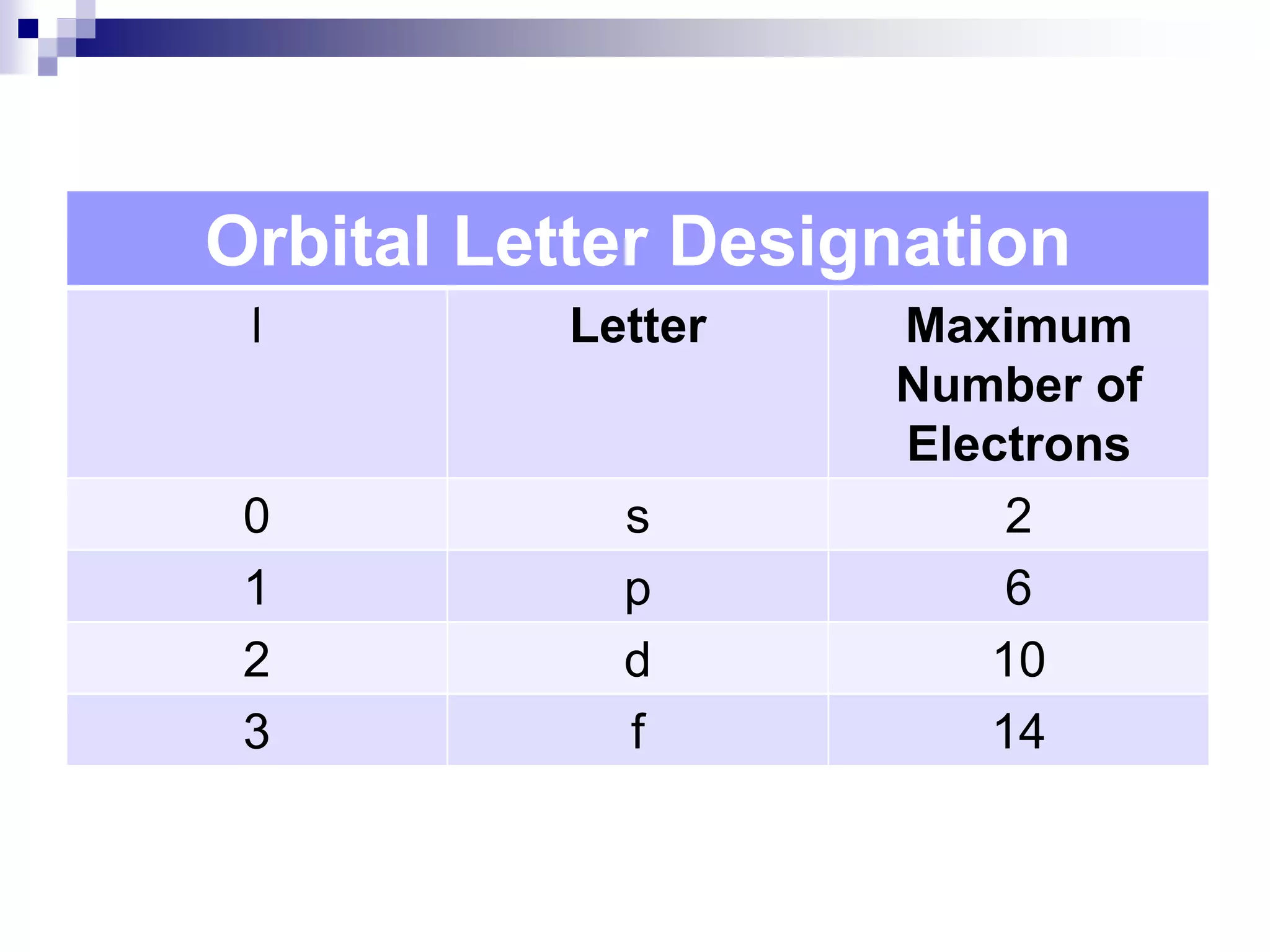
Orbital Letter Designation
l Letter Maximum
Number of
Electrons
0 s 2
1 p 6
2 d 10
3 f 14
Magnetic quantum number (ml)
or Orbitals
 the third of a set of quantum numbers
 tells us how many orbitals there are of a
particular type and their orientation in
space of a particular orbital
 only two electrons can fit in an orbital
 = electron
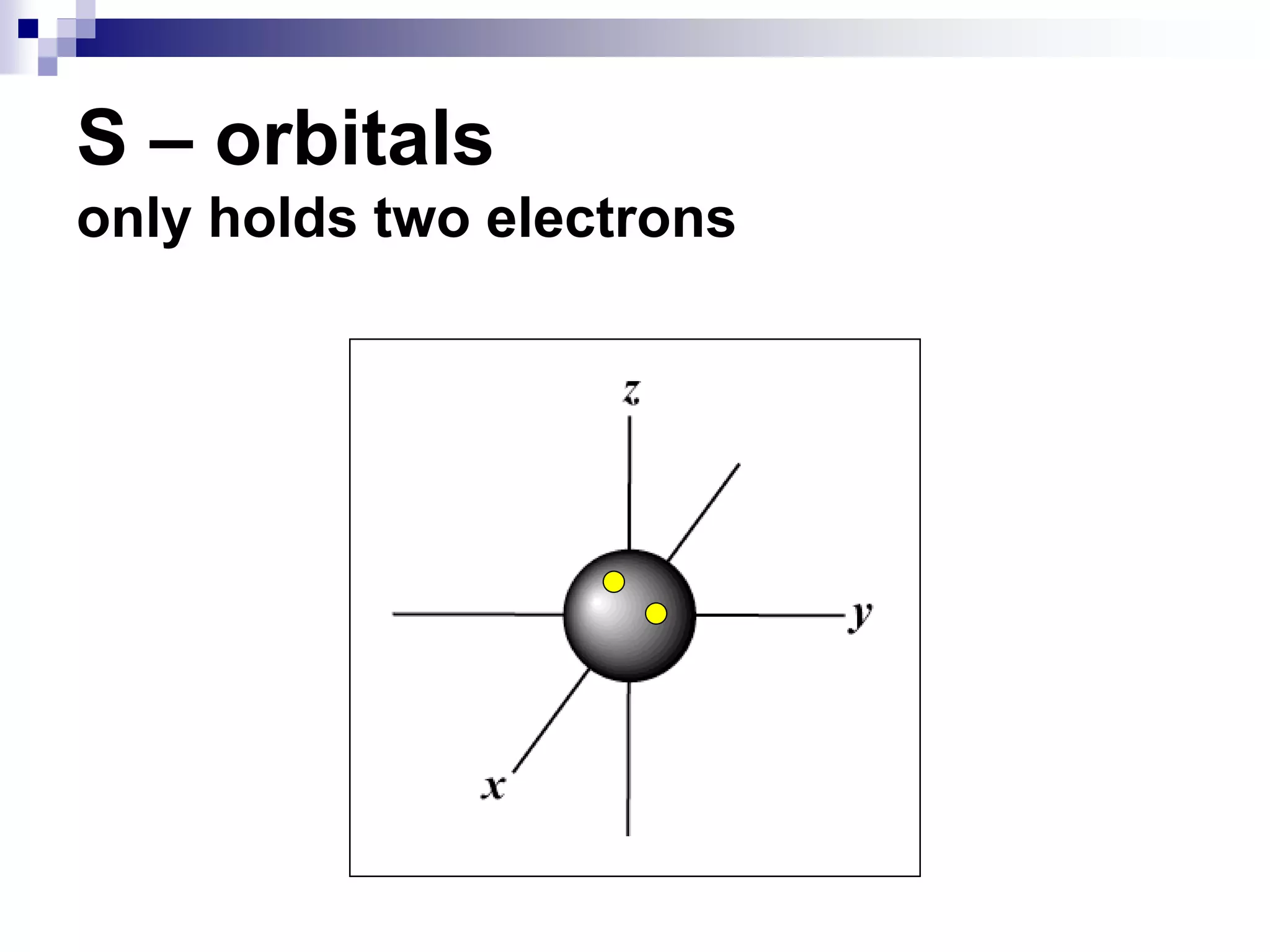
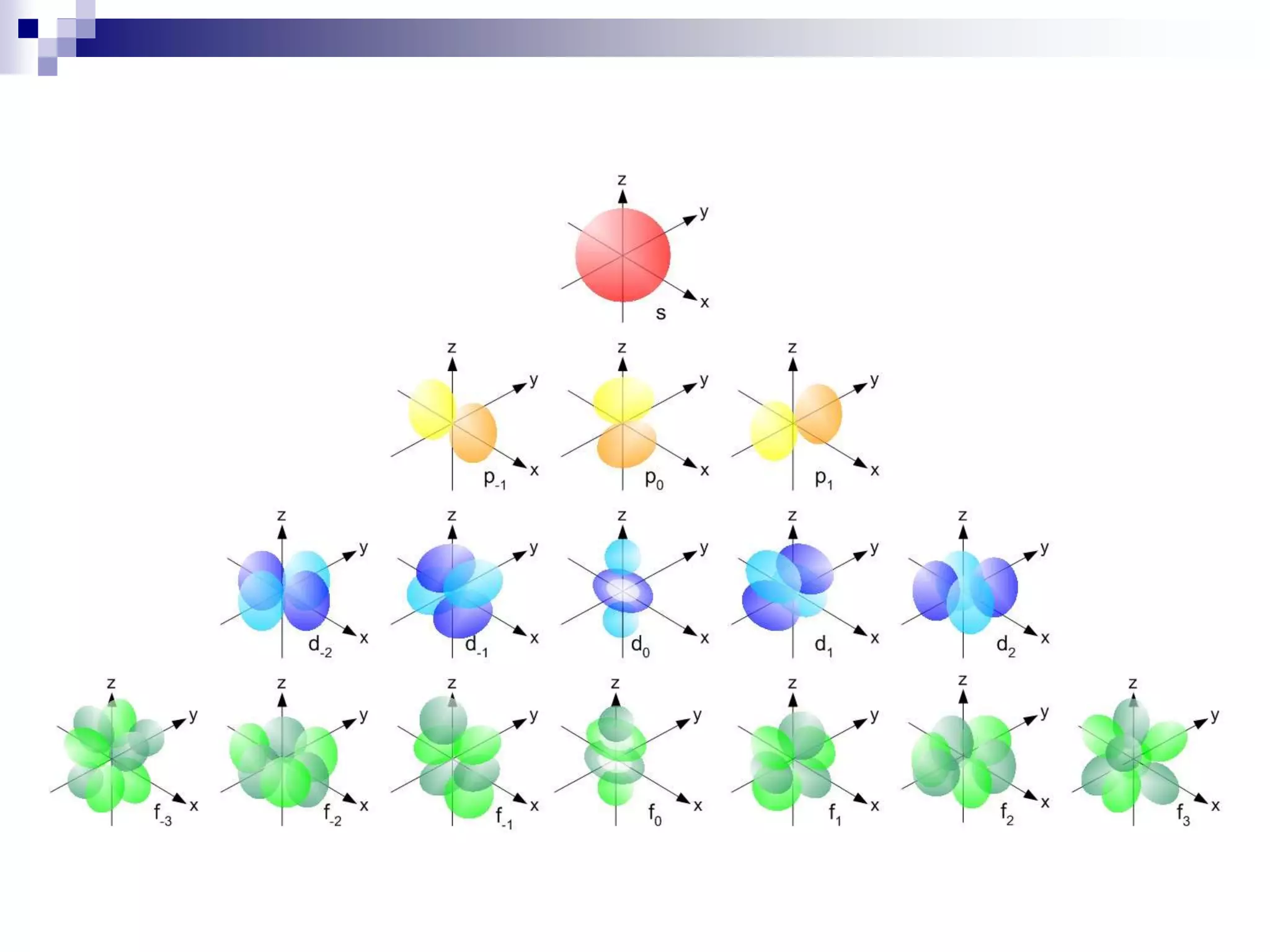
S – orbitals
only holds two electrons
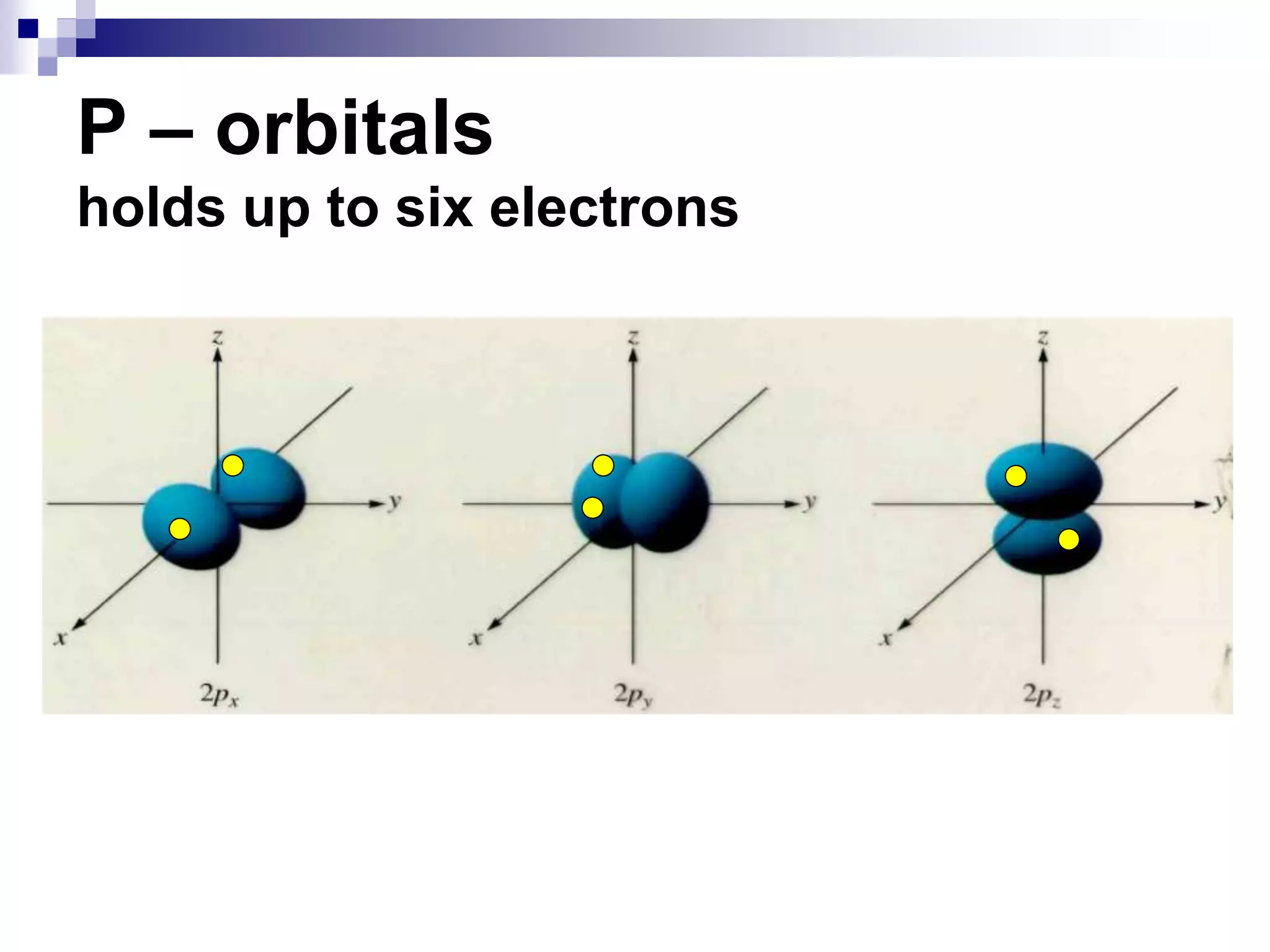
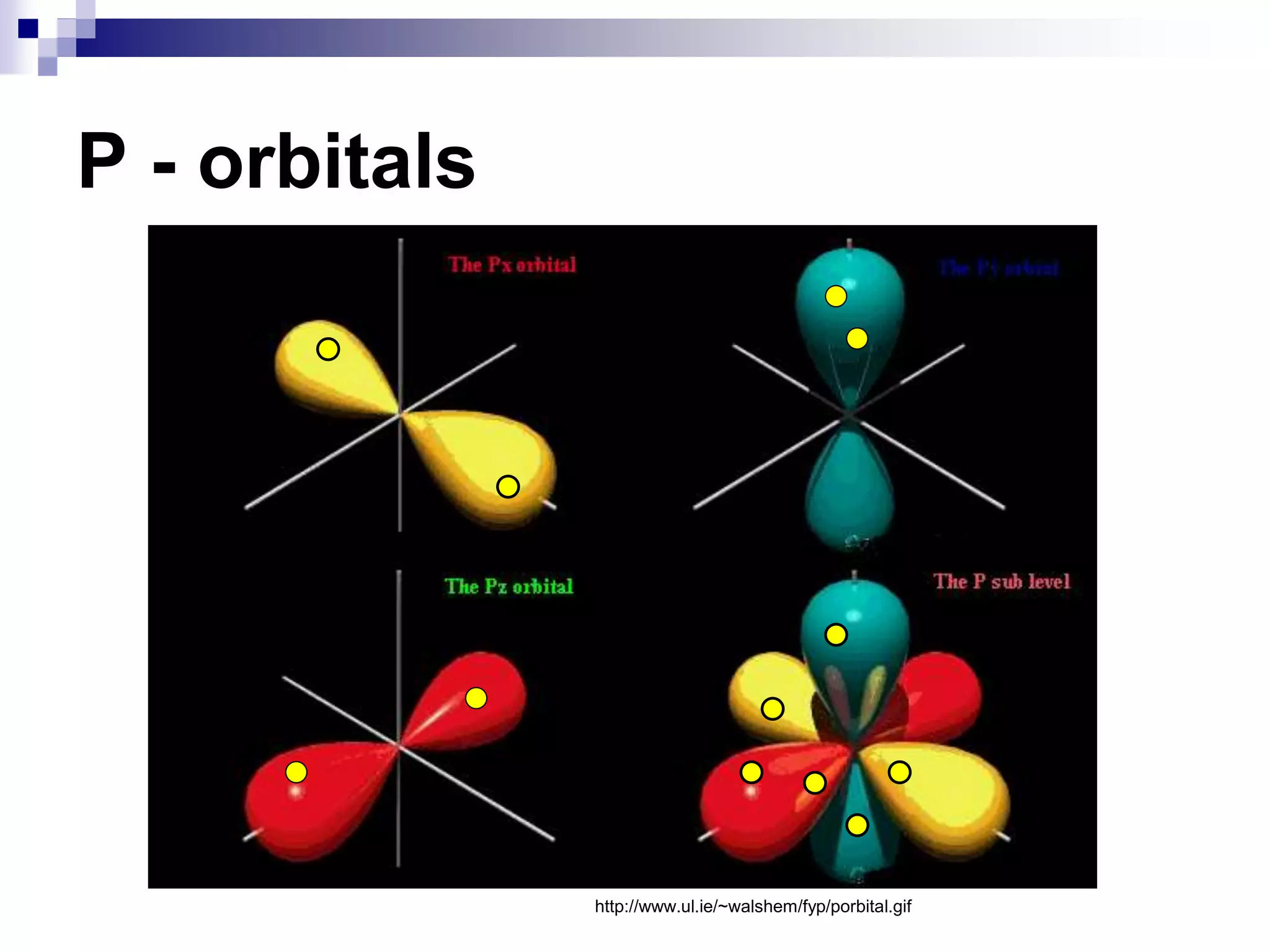
P – orbitals
holds up to six electrons
http://www.ul.ie/~walshem/fyp/porbital.gif
P - orbitals
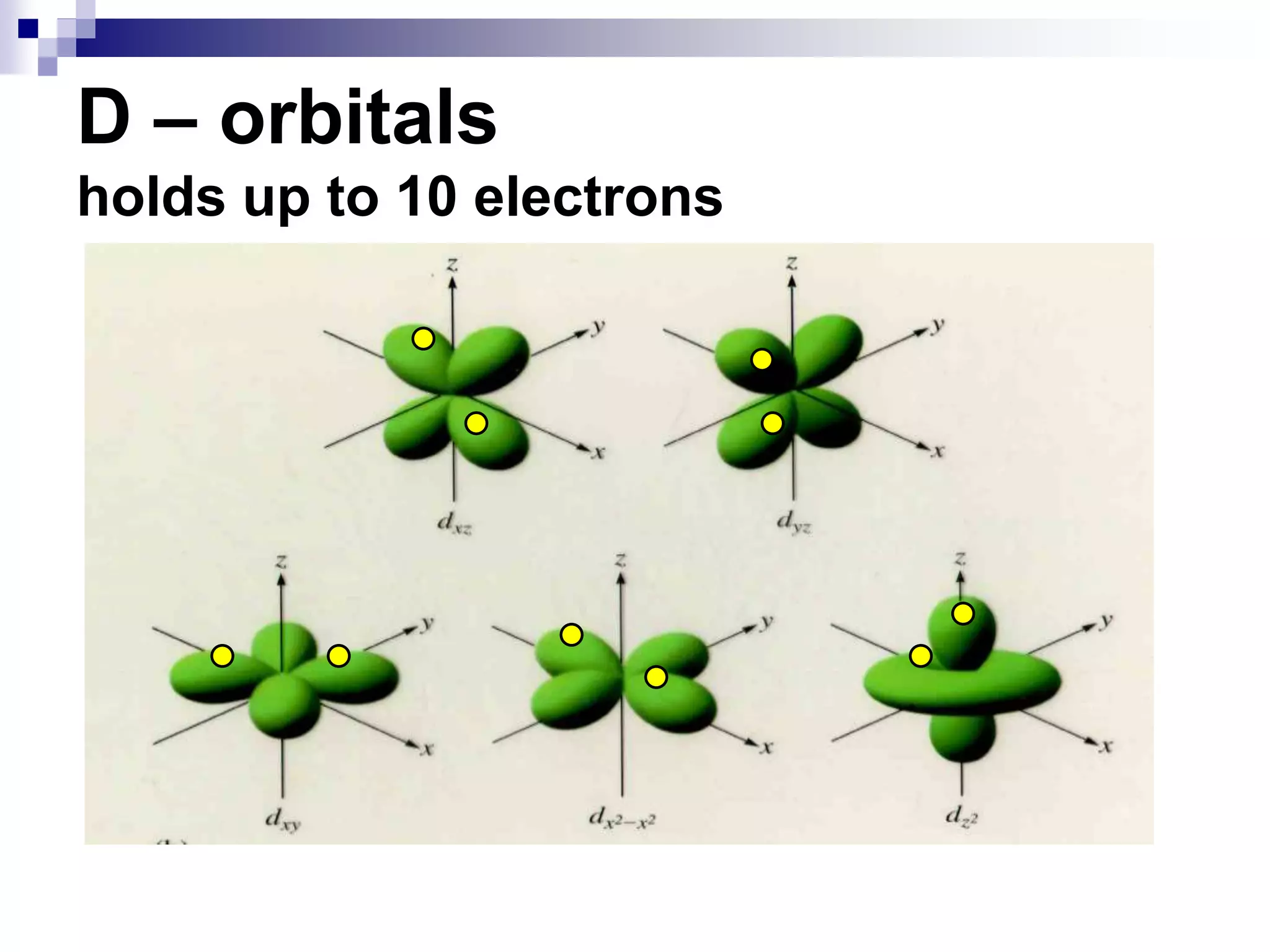
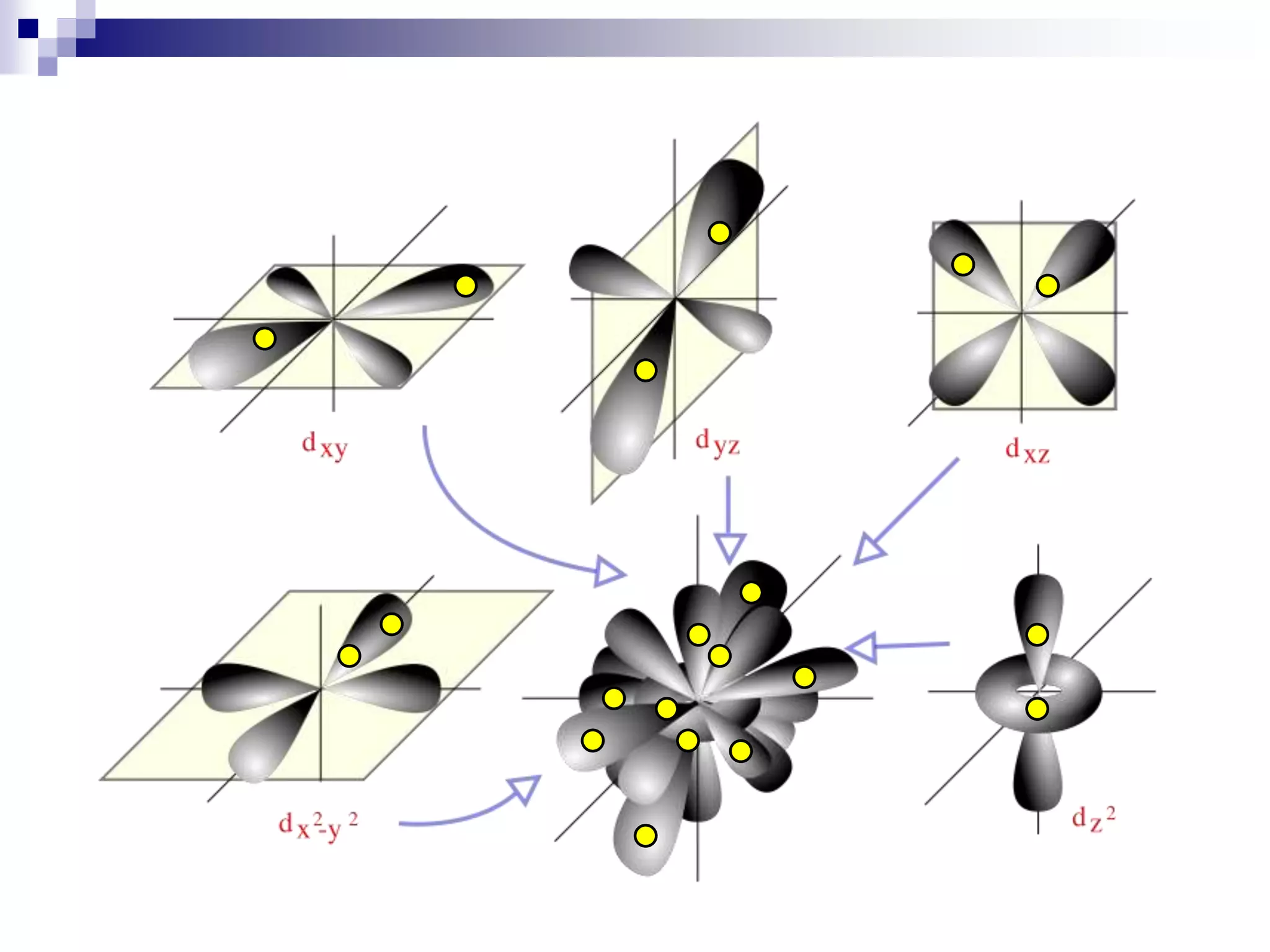
D – orbitals
holds up to 10 electrons
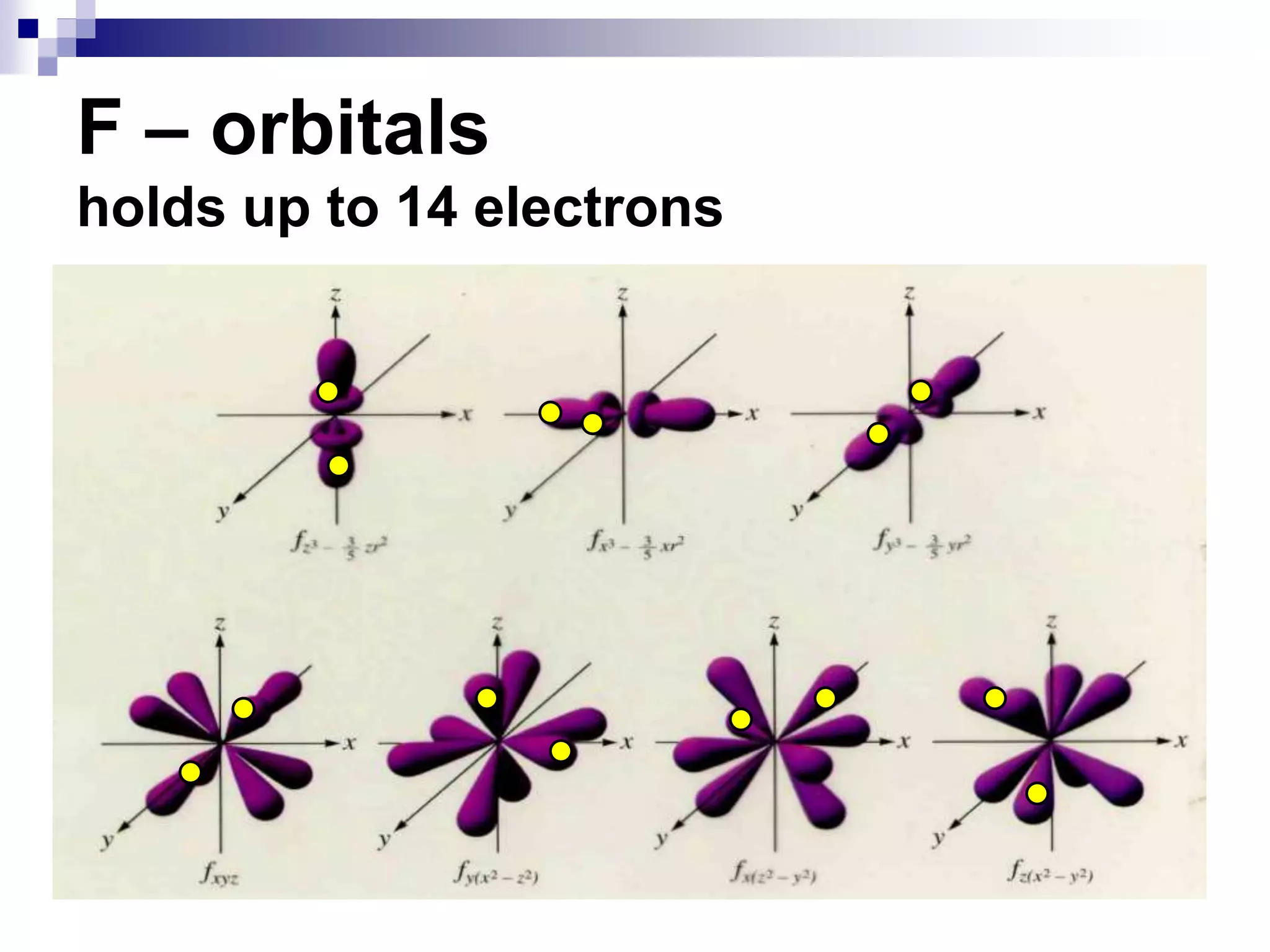
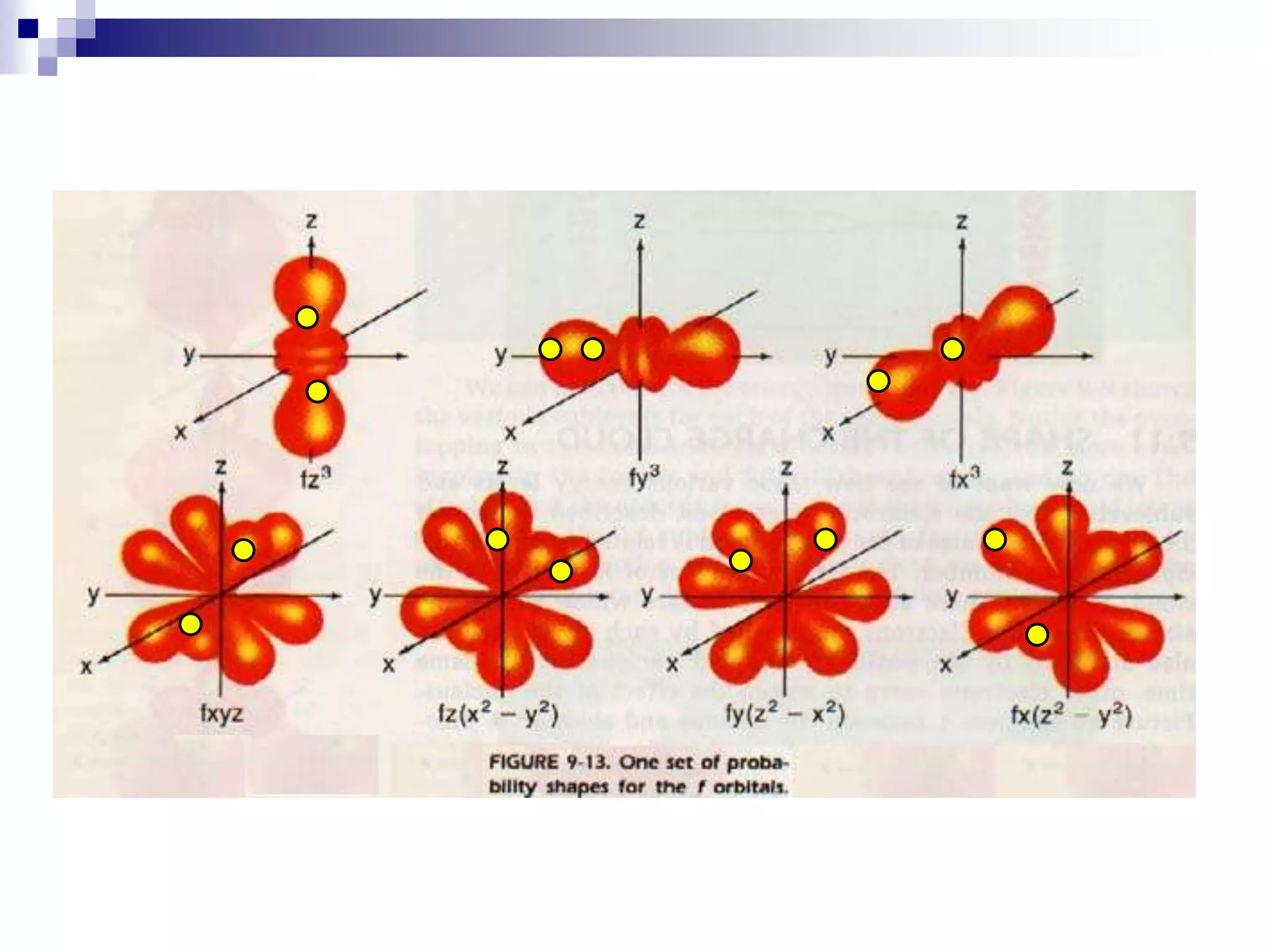
F – orbitals
holds up to 14 electrons
http://www.shsu.edu/~chm_tgc/BbAIF/PDB
s/applet/PDBorbitals.html
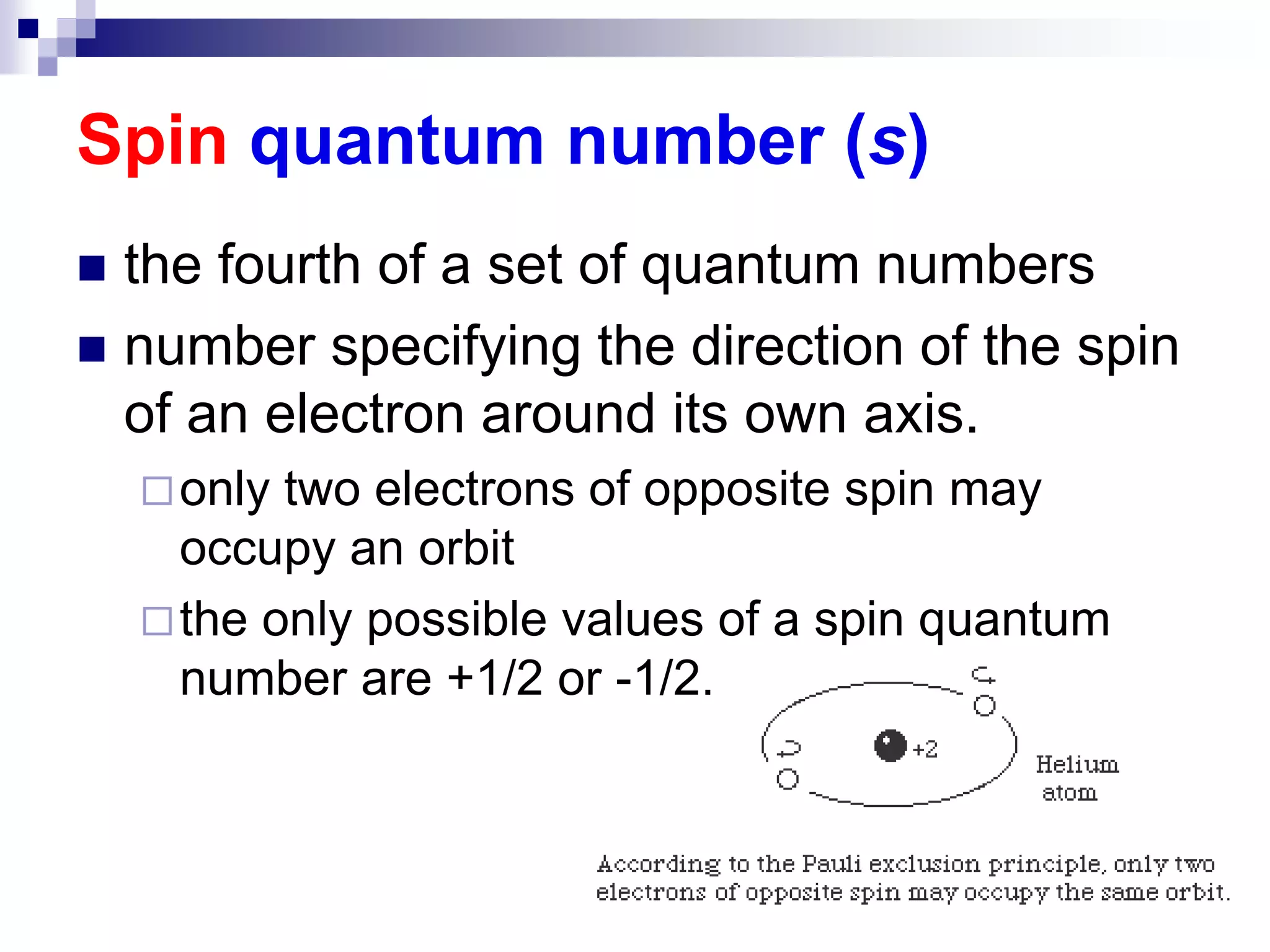
Spin quantum number (s)
 the fourth of a set of quantum numbers
 number specifying the direction of the spin
of an electron around its own axis.
only two electrons of opposite spin may
occupy an orbit
the only possible values of a spin quantum
number are +1/2 or -1/2.
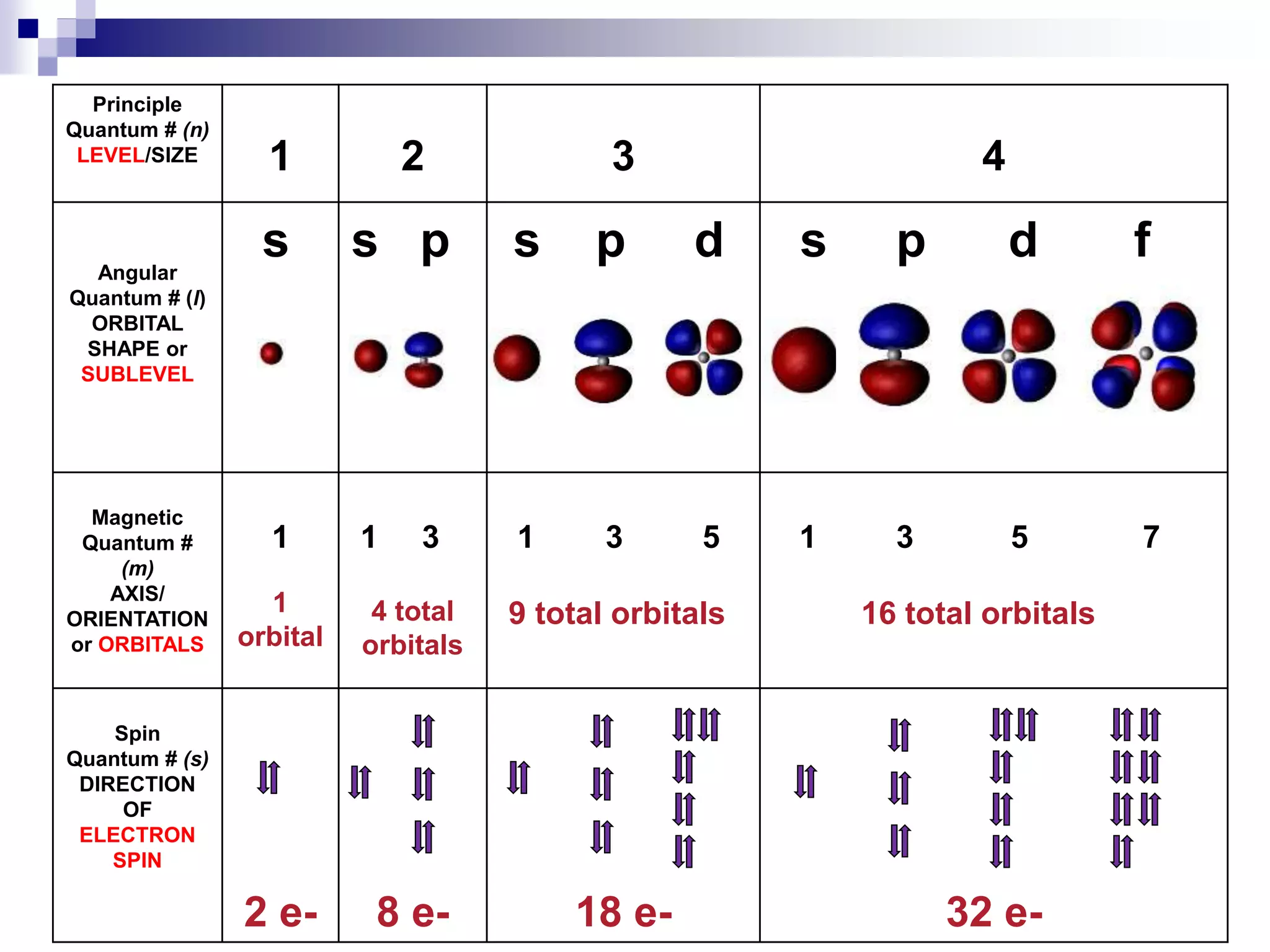
Principle
Quantum # (n)
LEVEL/SIZE 1 2 3 4
Angular
Quantum # (l)
ORBITAL
SHAPE or
SUBLEVEL
s s p s p d s p d f
Magnetic
Quantum #
(m)
AXIS/
ORIENTATION
or ORBITALS
1
1
orbital
1 3
4 total
orbitals
1 3 5
9 total orbitals
1 3 5 7
16 total orbitals
Spin
Quantum # (s)
DIRECTION
OF
ELECTRON
SPIN
2 e- 8 e- 18 e- 32 e-
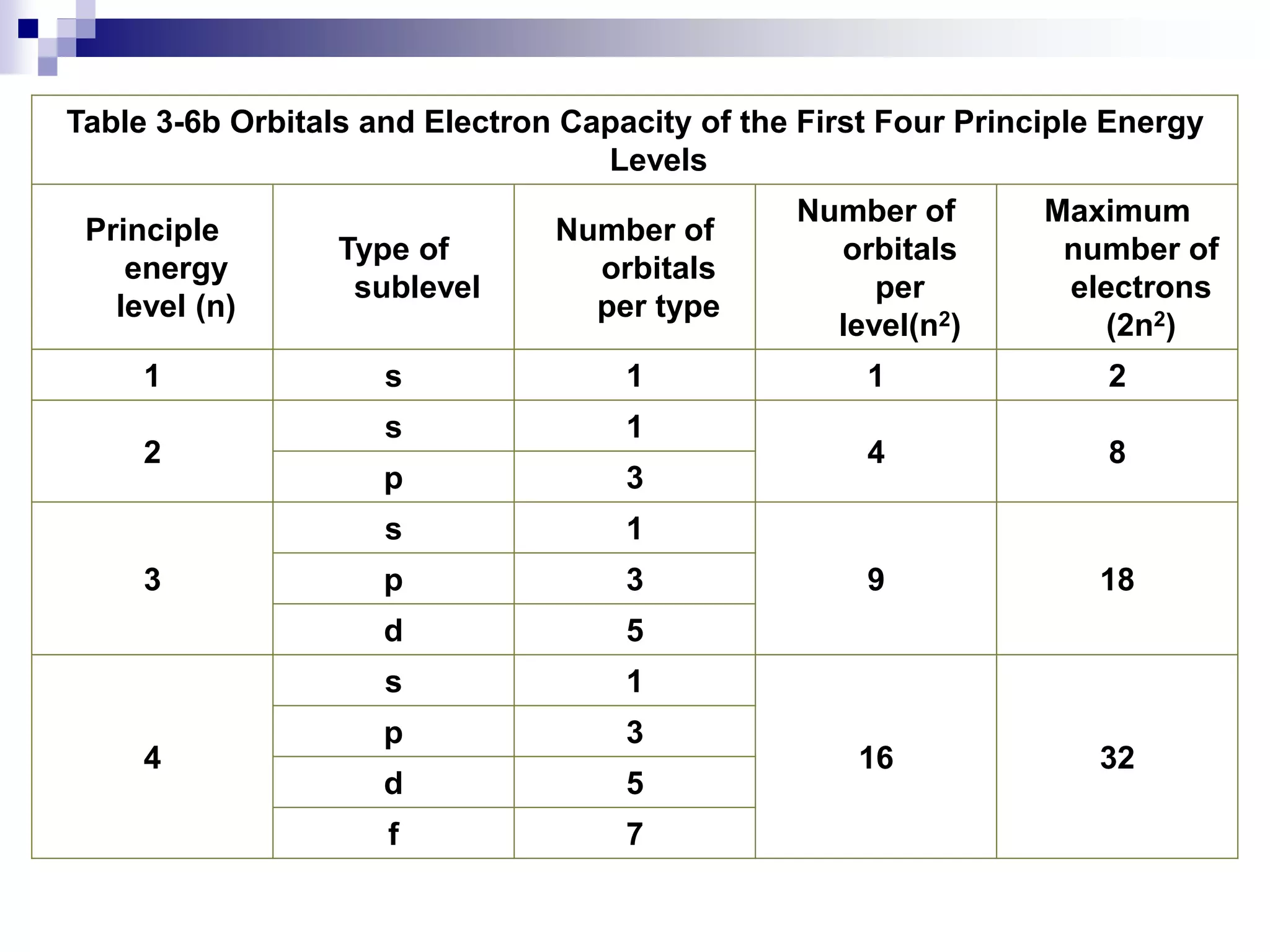
Table 3-6b Orbitals and Electron Capacity of the First Four Principle Energy
Levels
Principle
energy
level (n)
Type of
sublevel
Number of
orbitals
per type
Number of
orbitals
per
level(n2)
Maximum
number of
electrons
(2n2)
1 s 1 1 2
2
s 1
4 8
p 3
3
s 1
9 18
p 3
d 5
4
s 1
16 32
p 3
d 5
f 7
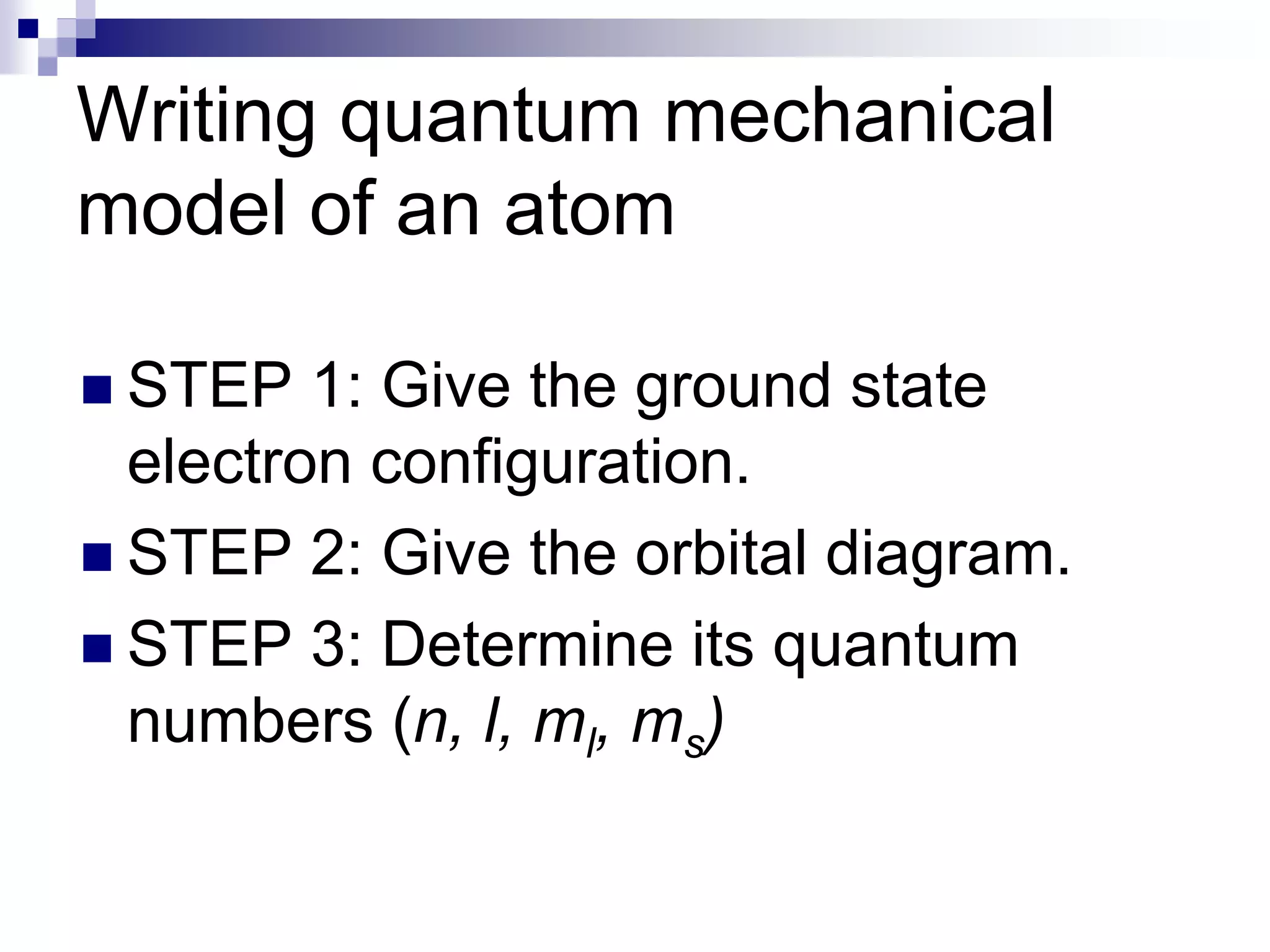
Writing quantum mechanical
model of an atom
 STEP 1: Give the ground state
electron configuration.
 STEP 2: Give the orbital diagram.
 STEP 3: Determine its quantum
numbers (n, l, ml, ms)
Quiz!!

Electron configuration and quantum numbers

  • 2.
  • 3.
  • 4.
    Electron Configuration  Itis the assignment of all of the electrons in an atom into specific shells and subshells  Uses symbols of the orbitals and the number of electrons (written of superscripts) that occupy each orbital.
  • 5.
    1s1 subshell Number of electrons in theorbital Principal energy level
  • 6.
    Maximum electrons persubshell s = 2 e- p = 6 e- d = 10 e- f = 14 e-
  • 8.
  • 9.
    Orbital Diagram/ Orbital Notation Consists of boxes and arrows that represent the orbitals and the electrons, respectively.  The up and down orientations of the arrows represent the two magnetic spins of the electrons.
  • 10.
     Clockwise rotation Counter clockwise rotation
  • 11.
  • 12.
    Aufbau Principle  Statesthat electrons should occupy first the orbitals with lower energy before those with higher energy.  Example, 1s orbital should be filled first before the 2s orbital.  4s orbital has lower energy than the 3d orbital.
  • 13.
    Pauli exclusion principle States that no two electrons in an atom can possess the same set of quantum numbers.  This principle emphasizes the significance of the spin quantum numbers.  If two electrons in an atom have the same n, l, and ml, they should still have different ms.  One electron must have ms= -1/2 and the other should be ms= +1/2
  • 14.
    Hund’s rule ofmaximum multiplicity  Suggests that the most stable arrangement of electrons in subshells is the one with the greatest number of parallel spins.  This means that each orbital in a subshell is singly occupied before pairing of electrons occurs.
  • 15.
  • 16.
  • 17.
    Quiz # 6(1/2 crosswise) Write the electron configuration and draw the orbital diagram of the elements with atomic number 21 to 25.
  • 18.
    Louis de Broglie Initially thought that electrons behave both like a wave and a particle.  However, he later emphasized that electrons behave more like a wave.  Proposed that electrons be considered as a wave confined in the space surrounding an atomic nucleus.
  • 19.
    Ernst Schrödinger 1887-1961 Quantum Mechanical Model 1926 Electrons are in probability zones called “orbitals”, not orbits and the location cannot be pinpointed Electrons are particles and waves at the same time Developed quantum numbers based on theories of Einstein and Planck Werner Heisenberg 1901-1976
  • 20.
  • 21.
  • 22.
     Quantum numberdescribe the atomic orbitals as well as the properties of the electrons in those orbitals. Quantum Numbers
  • 23.
     Principal quantumnumber (n) - describes the SIZE of the orbital or ENERGY LEVEL of the atom.  Angular quantum number (l) or sublevels - describes the SHAPE of the orbital.  Magnetic quantum number (m) - describes an orbital's ORIENTATION in space.  Spin quantum number (s) - describes the SPIN or direction (clockwise or counter-clockwise) in which an electron spins. Quantum Numbers
  • 24.
    Principle Quantum Number(n) or Energy Level  integer values used to specify the shell/size/level the electron is in  describes how far away from the nucleus the electron shell or level under consideration is  the lower the number, the closer the energy level is to the atom's nucleus and less energy  maximum # of electrons that can fit in an energy level is given by formula 2n2
  • 27.
    Angular/Azimuthal Quantum Number (l)or Sub-level  determines the shape of the orbital  they are numbered but are also given letters referring to the orbital type l=0 refers to the s-orbitals l=1 refers to the p-orbitals l=2 refers to the d-orbitals l=3 refers to the f-orbitals
  • 29.
    Orbital Letter Designation lLetter Maximum Number of Electrons 0 s 2 1 p 6 2 d 10 3 f 14
  • 30.
    Magnetic quantum number(ml) or Orbitals  the third of a set of quantum numbers  tells us how many orbitals there are of a particular type and their orientation in space of a particular orbital  only two electrons can fit in an orbital  = electron
  • 31.
    S – orbitals onlyholds two electrons
  • 32.
    P – orbitals holdsup to six electrons
  • 33.
  • 34.
    D – orbitals holdsup to 10 electrons
  • 36.
    F – orbitals holdsup to 14 electrons
  • 38.
  • 40.
    Spin quantum number(s)  the fourth of a set of quantum numbers  number specifying the direction of the spin of an electron around its own axis. only two electrons of opposite spin may occupy an orbit the only possible values of a spin quantum number are +1/2 or -1/2.
  • 42.
    Principle Quantum # (n) LEVEL/SIZE1 2 3 4 Angular Quantum # (l) ORBITAL SHAPE or SUBLEVEL s s p s p d s p d f Magnetic Quantum # (m) AXIS/ ORIENTATION or ORBITALS 1 1 orbital 1 3 4 total orbitals 1 3 5 9 total orbitals 1 3 5 7 16 total orbitals Spin Quantum # (s) DIRECTION OF ELECTRON SPIN 2 e- 8 e- 18 e- 32 e-
  • 43.
    Table 3-6b Orbitalsand Electron Capacity of the First Four Principle Energy Levels Principle energy level (n) Type of sublevel Number of orbitals per type Number of orbitals per level(n2) Maximum number of electrons (2n2) 1 s 1 1 2 2 s 1 4 8 p 3 3 s 1 9 18 p 3 d 5 4 s 1 16 32 p 3 d 5 f 7
  • 45.
    Writing quantum mechanical modelof an atom  STEP 1: Give the ground state electron configuration.  STEP 2: Give the orbital diagram.  STEP 3: Determine its quantum numbers (n, l, ml, ms)
  • 46.

Editor's Notes

  • #3 Boardworks GCSE Additional Science: Chemistry Patterns in the Periodic Table