
Objectives
Describe the types of relationships
indicated by a balanced chemical
equation.
State the mole ratios from a balanced
chemical equation
Rally coach:
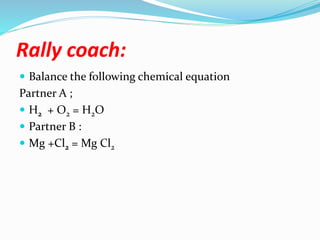
 Balance the following chemical equation
Partner A ;
 H2 + O2 = H2O
 Partner B :
 Mg +Cl2 = Mg Cl2
Stoichiometry
 Stoichiometry: The study of quantitative
relationships between the amounts of reactants used
and amounts of products formed by a chemical
reaction
 Stoichiometry is based on the law of conservation of
mass. Which states that states that matter is neither
created nor destroyed in a chemical reaction
 In any chemical reaction, the amount of matter
present at the end of the reaction is the same as the
amount of matter present at the beginning. Therefore,
the mass of the reactants equals the mass of the
products.
 Amounts of reactants = Amounts of products
Relationships Derived From A
Balanced Chemical Equation
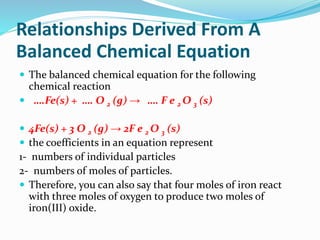
 The balanced chemical equation for the following
chemical reaction
 ….Fe(s) + …. O 2 (g) → …. F e 2 O 3 (s)
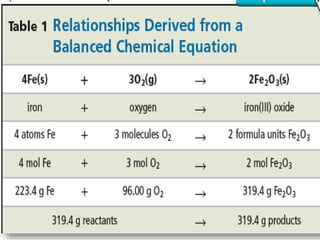
 4Fe(s) + 3 O 2 (g) → 2F e 2 O 3 (s)
 the coefficients in an equation represent
1- numbers of individual particles
2- numbers of moles of particles.
 Therefore, you can also say that four moles of iron react
with three moles of oxygen to produce two moles of
iron(III) oxide.
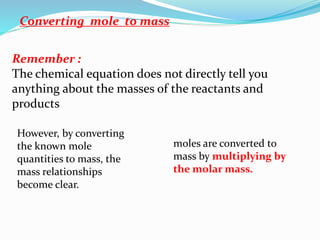
Converting mole to mass
However, by converting
the known mole
quantities to mass, the
mass relationships
become clear.
Remember :
The chemical equation does not directly tell you
anything about the masses of the reactants and
products
moles are converted to
mass by multiplying by
the molar mass.
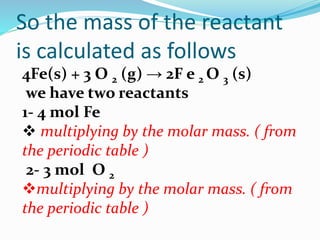
So the mass of the reactant
is calculated as follows
4Fe(s) + 3 O 2 (g) → 2F e 2 O 3 (s)
we have two reactants
1- 4 mol Fe
 multiplying by the molar mass. ( from
the periodic table )
2- 3 mol O 2
multiplying by the molar mass. ( from
the periodic table )
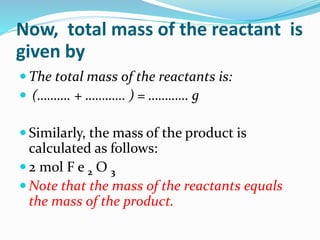
Now, total mass of the reactant is
given by
 The total mass of the reactants is:
 (………. + ………… ) = ………… g
 Similarly, the mass of the product is
calculated as follows:
 2 mol F e 2 O 3
 Note that the mass of the reactants equals
the mass of the product.
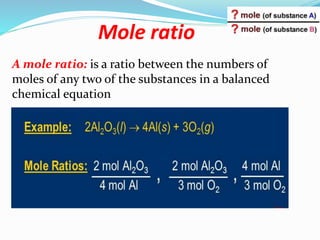
Mole ratio
A mole ratio: is a ratio between the numbers of
moles of any two of the substances in a balanced
chemical equation
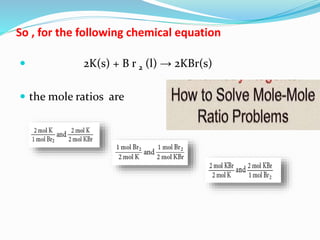
So , for the following chemical equation
 2K(s) + B r 2 (l) → 2KBr(s)
 the mole ratios are
Ch 11 sec 1. Stoichiometry

Ch 11 sec 1. Stoichiometry

  • 2.
    Objectives Describe the typesof relationships indicated by a balanced chemical equation. State the mole ratios from a balanced chemical equation
  • 3.
    Rally coach:  Balancethe following chemical equation Partner A ;  H2 + O2 = H2O  Partner B :  Mg +Cl2 = Mg Cl2
  • 4.
    Stoichiometry  Stoichiometry: Thestudy of quantitative relationships between the amounts of reactants used and amounts of products formed by a chemical reaction  Stoichiometry is based on the law of conservation of mass. Which states that states that matter is neither created nor destroyed in a chemical reaction
  • 5.
     In anychemical reaction, the amount of matter present at the end of the reaction is the same as the amount of matter present at the beginning. Therefore, the mass of the reactants equals the mass of the products.  Amounts of reactants = Amounts of products
  • 6.
    Relationships Derived FromA Balanced Chemical Equation  The balanced chemical equation for the following chemical reaction  ….Fe(s) + …. O 2 (g) → …. F e 2 O 3 (s)  4Fe(s) + 3 O 2 (g) → 2F e 2 O 3 (s)  the coefficients in an equation represent 1- numbers of individual particles 2- numbers of moles of particles.  Therefore, you can also say that four moles of iron react with three moles of oxygen to produce two moles of iron(III) oxide.
  • 8.
    Converting mole tomass However, by converting the known mole quantities to mass, the mass relationships become clear. Remember : The chemical equation does not directly tell you anything about the masses of the reactants and products moles are converted to mass by multiplying by the molar mass.
  • 9.
    So the massof the reactant is calculated as follows 4Fe(s) + 3 O 2 (g) → 2F e 2 O 3 (s) we have two reactants 1- 4 mol Fe  multiplying by the molar mass. ( from the periodic table ) 2- 3 mol O 2 multiplying by the molar mass. ( from the periodic table )
  • 10.
    Now, total massof the reactant is given by  The total mass of the reactants is:  (………. + ………… ) = ………… g  Similarly, the mass of the product is calculated as follows:  2 mol F e 2 O 3  Note that the mass of the reactants equals the mass of the product.
  • 12.
    Mole ratio A moleratio: is a ratio between the numbers of moles of any two of the substances in a balanced chemical equation
  • 13.
    So , forthe following chemical equation  2K(s) + B r 2 (l) → 2KBr(s)  the mole ratios are