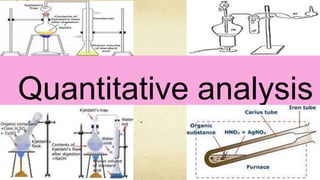
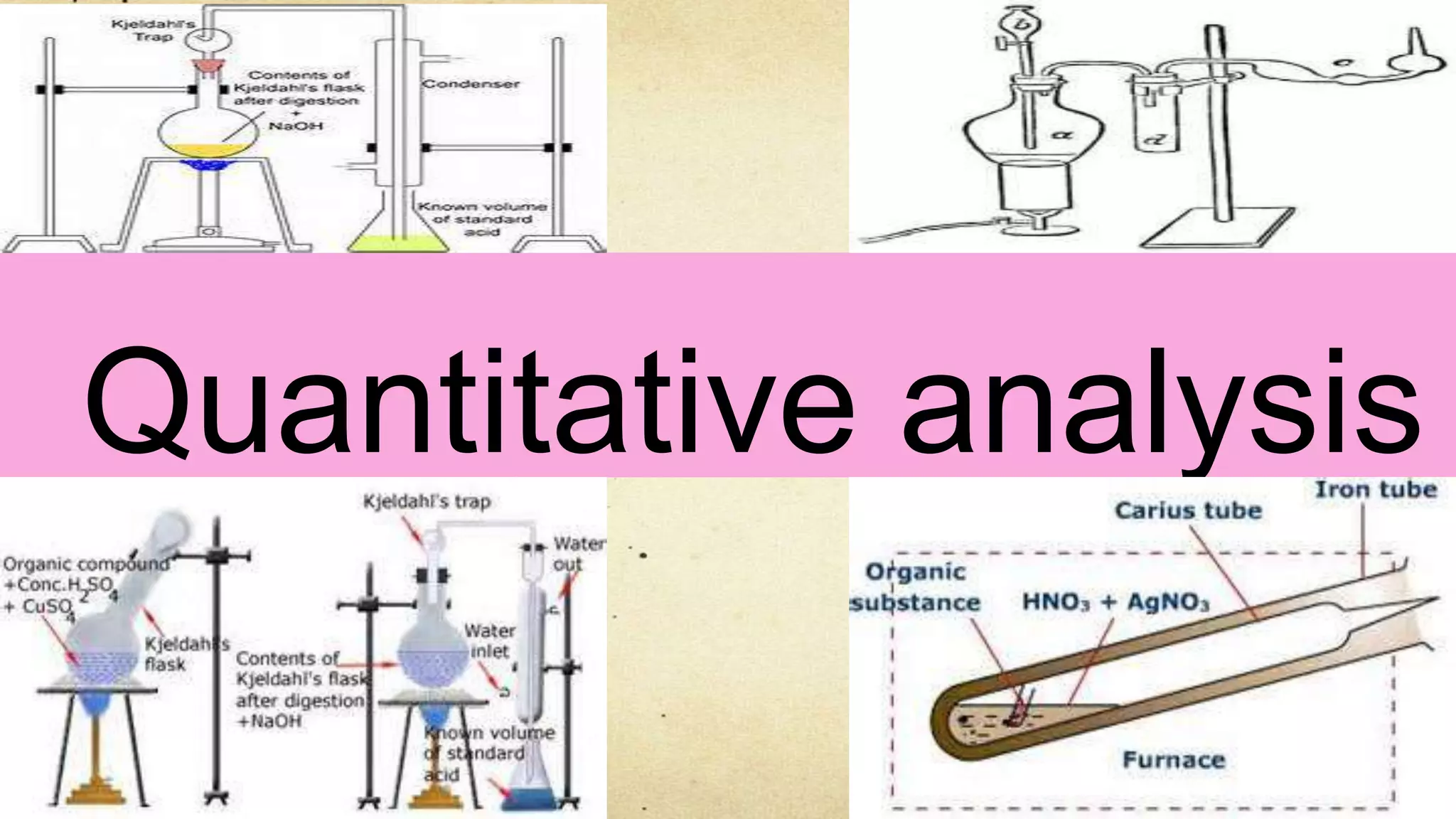
Quantitative analysis
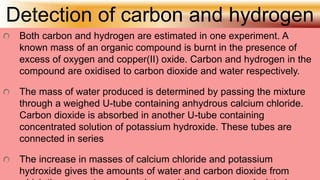
Detection of carbon and hydrogen
Both carbon and hydrogen are estimated in one experiment. A
known mass of an organic compound is burnt in the presence of
excess of oxygen and copper(II) oxide. Carbon and hydrogen in the
compound are oxidised to carbon dioxide and water respectively.
The mass of water produced is determined by passing the mixture
through a weighed U-tube containing anhydrous calcium chloride.
Carbon dioxide is absorbed in another U-tube containing
concentrated solution of potassium hydroxide. These tubes are
connected in series
The increase in masses of calcium chloride and potassium
hydroxide gives the amounts of water and carbon dioxide from
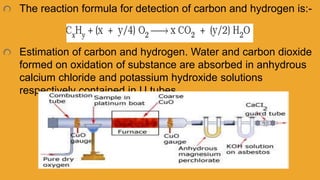
The reaction formula for detection of carbon and hydrogen is:-
Estimation of carbon and hydrogen. Water and carbon dioxide
formed on oxidation of substance are absorbed in anhydrous
calcium chloride and potassium hydroxide solutions
respectively contained in U tubes.
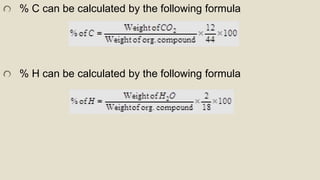
% C can be calculated by the following formula
% H can be calculated by the following formula
Estimation of nitrogen
Nitrogen is estimated by 2 methods :-
1) DUMAS METHOD:-
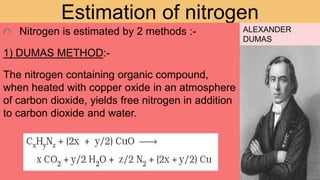
The nitrogen containing organic compound,
when heated with copper oxide in an atmosphere
of carbon dioxide, yields free nitrogen in addition
to carbon dioxide and water.
ALEXANDER
DUMAS
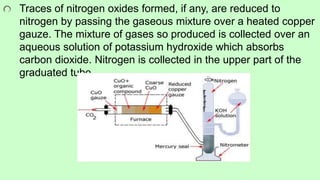
Traces of nitrogen oxides formed, if any, are reduced to
nitrogen by passing the gaseous mixture over a heated copper
gauze. The mixture of gases so produced is collected over an
aqueous solution of potassium hydroxide which absorbs
carbon dioxide. Nitrogen is collected in the upper part of the
graduated tube .
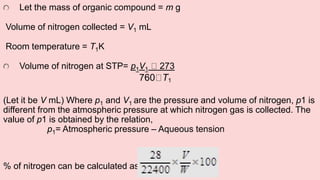
Let the mass of organic compound = m g
Volume of nitrogen collected = V1 mL
Room temperature = T1K
Volume of nitrogen at STP= p1V1 273
760 T1
(Let it be V mL) Where p1 and V1 are the pressure and volume of nitrogen, p1 is
different from the atmospheric pressure at which nitrogen gas is collected. The
value of p1 is obtained by the relation,
p1= Atmospheric pressure – Aqueous tension
% of nitrogen can be calculated as :-
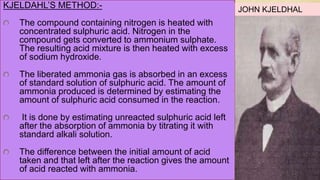
KJELDAHL’S METHOD:-
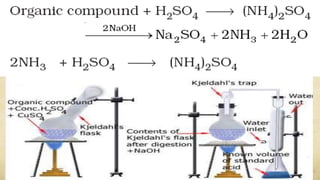
The compound containing nitrogen is heated with
concentrated sulphuric acid. Nitrogen in the
compound gets converted to ammonium sulphate.
The resulting acid mixture is then heated with excess
of sodium hydroxide.
The liberated ammonia gas is absorbed in an excess
of standard solution of sulphuric acid. The amount of
ammonia produced is determined by estimating the
amount of sulphuric acid consumed in the reaction.
It is done by estimating unreacted sulphuric acid left
after the absorption of ammonia by titrating it with
standard alkali solution.
The difference between the initial amount of acid
taken and that left after the reaction gives the amount
of acid reacted with ammonia.
JOHN KJELDHAL
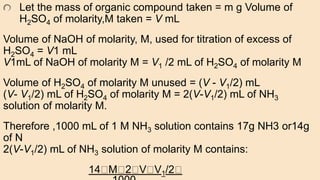
Let the mass of organic compound taken = m g Volume of
H2SO4 of molarity,M taken = V mL
Volume of NaOH of molarity, M, used for titration of excess of
H2SO4 = V1 mL
V1mL of NaOH of molarity M = V1 /2 mL of H2SO4 of molarity M
Volume of H2SO4 of molarity M unused = (V - V1/2) mL
(V- V1/2) mL of H2SO4 of molarity M = 2(V-V1/2) mL of NH3
solution of molarity M.
Therefore ,1000 mL of 1 M NH3 solution contains 17g NH3 or14g
of N
2(V-V1/2) mL of NH3 solution of molarity M contains:
14 M 2 V V1/2
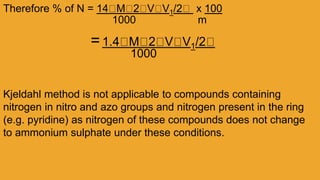
Therefore % of N = 14 M 2 V V1/2 x 100
1000 m
=1.4 M 2 V V1/2
1000
Kjeldahl method is not applicable to compounds containing
nitrogen in nitro and azo groups and nitrogen present in the ring
(e.g. pyridine) as nitrogen of these compounds does not change
to ammonium sulphate under these conditions.
Carius method
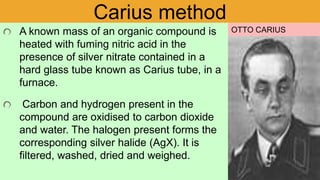
A known mass of an organic compound is
heated with fuming nitric acid in the
presence of silver nitrate contained in a
hard glass tube known as Carius tube, in a
furnace.
Carbon and hydrogen present in the
compound are oxidised to carbon dioxide
and water. The halogen present forms the
corresponding silver halide (AgX). It is
filtered, washed, dried and weighed.
OTTO CARIUS
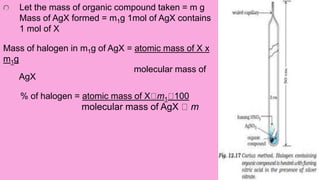
Let the mass of organic compound taken = m g
Mass of AgX formed = m1g 1mol of AgX contains
1 mol of X
Mass of halogen in m1g of AgX = atomic mass of X x
m1g
molecular mass of
AgX
% of halogen = atomic mass of X m1 100
molecular mass of AgX m
Estimation of sulphur
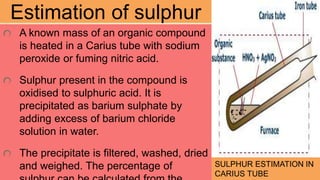
A known mass of an organic compound
is heated in a Carius tube with sodium
peroxide or fuming nitric acid.
Sulphur present in the compound is
oxidised to sulphuric acid. It is
precipitated as barium sulphate by
adding excess of barium chloride
solution in water.
The precipitate is filtered, washed, dried
and weighed. The percentage of SULPHUR ESTIMATION IN
CARIUS TUBE
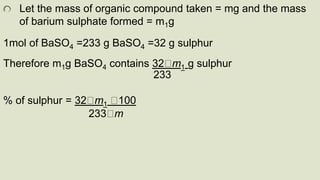
Let the mass of organic compound taken = mg and the mass
of barium sulphate formed = m1g
1mol of BaSO4 =233 g BaSO4 =32 g sulphur
Therefore m1g BaSO4 contains 32 m1 g sulphur
233
% of sulphur = 32 m1 100
233 m
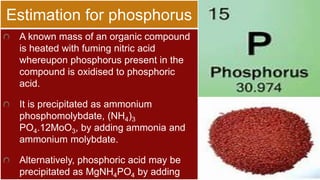
Estimation for phosphorus
A known mass of an organic compound
is heated with fuming nitric acid
whereupon phosphorus present in the
compound is oxidised to phosphoric
acid.
It is precipitated as ammonium
phosphomolybdate, (NH4)3
PO4.12MoO3, by adding ammonia and
ammonium molybdate.
Alternatively, phosphoric acid may be
precipitated as MgNH4PO4 by adding
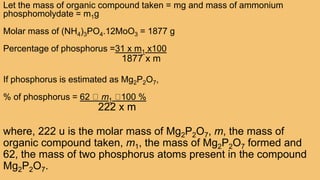
Let the mass of organic compound taken = mg and mass of ammonium
phosphomolydate = m1g
Molar mass of (NH4)3PO4.12MoO3 = 1877 g
Percentage of phosphorus =31 x m1 x100
1877 x m
If phosphorus is estimated as Mg2P2O7,
% of phosphorus = 62 m1 100 %
222 x m
where, 222 u is the molar mass of Mg2P2O7, m, the mass of
organic compound taken, m1, the mass of Mg2P2O7 formed and
62, the mass of two phosphorus atoms present in the compound
Mg2P2O7.
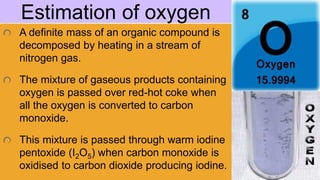
Estimation of oxygen
A definite mass of an organic compound is
decomposed by heating in a stream of
nitrogen gas.
The mixture of gaseous products containing
oxygen is passed over red-hot coke when
all the oxygen is converted to carbon
monoxide.
This mixture is passed through warm iodine
pentoxide (I2O5) when carbon monoxide is
oxidised to carbon dioxide producing iodine.
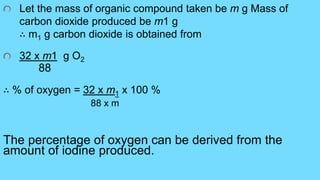
Let the mass of organic compound taken be m g Mass of
carbon dioxide produced be m1 g
∴ m1 g carbon dioxide is obtained from
32 x m1 g O2
88
∴ % of oxygen = 32 x m1 x 100 %
88 x m
The percentage of oxygen can be derived from the
amount of iodine produced.

Quantitative analysis 11

  • 1.
  • 2.
    Detection of carbonand hydrogen Both carbon and hydrogen are estimated in one experiment. A known mass of an organic compound is burnt in the presence of excess of oxygen and copper(II) oxide. Carbon and hydrogen in the compound are oxidised to carbon dioxide and water respectively. The mass of water produced is determined by passing the mixture through a weighed U-tube containing anhydrous calcium chloride. Carbon dioxide is absorbed in another U-tube containing concentrated solution of potassium hydroxide. These tubes are connected in series The increase in masses of calcium chloride and potassium hydroxide gives the amounts of water and carbon dioxide from
  • 3.
    The reaction formulafor detection of carbon and hydrogen is:- Estimation of carbon and hydrogen. Water and carbon dioxide formed on oxidation of substance are absorbed in anhydrous calcium chloride and potassium hydroxide solutions respectively contained in U tubes.
  • 4.
    % C canbe calculated by the following formula % H can be calculated by the following formula
  • 5.
    Estimation of nitrogen Nitrogenis estimated by 2 methods :- 1) DUMAS METHOD:- The nitrogen containing organic compound, when heated with copper oxide in an atmosphere of carbon dioxide, yields free nitrogen in addition to carbon dioxide and water. ALEXANDER DUMAS
  • 6.
    Traces of nitrogenoxides formed, if any, are reduced to nitrogen by passing the gaseous mixture over a heated copper gauze. The mixture of gases so produced is collected over an aqueous solution of potassium hydroxide which absorbs carbon dioxide. Nitrogen is collected in the upper part of the graduated tube .
  • 7.
    Let the massof organic compound = m g Volume of nitrogen collected = V1 mL Room temperature = T1K Volume of nitrogen at STP= p1V1 273 760 T1 (Let it be V mL) Where p1 and V1 are the pressure and volume of nitrogen, p1 is different from the atmospheric pressure at which nitrogen gas is collected. The value of p1 is obtained by the relation, p1= Atmospheric pressure – Aqueous tension % of nitrogen can be calculated as :-
  • 8.
    KJELDAHL’S METHOD:- The compoundcontaining nitrogen is heated with concentrated sulphuric acid. Nitrogen in the compound gets converted to ammonium sulphate. The resulting acid mixture is then heated with excess of sodium hydroxide. The liberated ammonia gas is absorbed in an excess of standard solution of sulphuric acid. The amount of ammonia produced is determined by estimating the amount of sulphuric acid consumed in the reaction. It is done by estimating unreacted sulphuric acid left after the absorption of ammonia by titrating it with standard alkali solution. The difference between the initial amount of acid taken and that left after the reaction gives the amount of acid reacted with ammonia. JOHN KJELDHAL
  • 10.
    Let the massof organic compound taken = m g Volume of H2SO4 of molarity,M taken = V mL Volume of NaOH of molarity, M, used for titration of excess of H2SO4 = V1 mL V1mL of NaOH of molarity M = V1 /2 mL of H2SO4 of molarity M Volume of H2SO4 of molarity M unused = (V - V1/2) mL (V- V1/2) mL of H2SO4 of molarity M = 2(V-V1/2) mL of NH3 solution of molarity M. Therefore ,1000 mL of 1 M NH3 solution contains 17g NH3 or14g of N 2(V-V1/2) mL of NH3 solution of molarity M contains: 14 M 2 V V1/2
  • 11.
    Therefore % ofN = 14 M 2 V V1/2 x 100 1000 m =1.4 M 2 V V1/2 1000 Kjeldahl method is not applicable to compounds containing nitrogen in nitro and azo groups and nitrogen present in the ring (e.g. pyridine) as nitrogen of these compounds does not change to ammonium sulphate under these conditions.
  • 12.
    Carius method A knownmass of an organic compound is heated with fuming nitric acid in the presence of silver nitrate contained in a hard glass tube known as Carius tube, in a furnace. Carbon and hydrogen present in the compound are oxidised to carbon dioxide and water. The halogen present forms the corresponding silver halide (AgX). It is filtered, washed, dried and weighed. OTTO CARIUS
  • 13.
    Let the massof organic compound taken = m g Mass of AgX formed = m1g 1mol of AgX contains 1 mol of X Mass of halogen in m1g of AgX = atomic mass of X x m1g molecular mass of AgX % of halogen = atomic mass of X m1 100 molecular mass of AgX m
  • 14.
    Estimation of sulphur Aknown mass of an organic compound is heated in a Carius tube with sodium peroxide or fuming nitric acid. Sulphur present in the compound is oxidised to sulphuric acid. It is precipitated as barium sulphate by adding excess of barium chloride solution in water. The precipitate is filtered, washed, dried and weighed. The percentage of SULPHUR ESTIMATION IN CARIUS TUBE
  • 15.
    Let the massof organic compound taken = mg and the mass of barium sulphate formed = m1g 1mol of BaSO4 =233 g BaSO4 =32 g sulphur Therefore m1g BaSO4 contains 32 m1 g sulphur 233 % of sulphur = 32 m1 100 233 m
  • 16.
    Estimation for phosphorus Aknown mass of an organic compound is heated with fuming nitric acid whereupon phosphorus present in the compound is oxidised to phosphoric acid. It is precipitated as ammonium phosphomolybdate, (NH4)3 PO4.12MoO3, by adding ammonia and ammonium molybdate. Alternatively, phosphoric acid may be precipitated as MgNH4PO4 by adding
  • 17.
    Let the massof organic compound taken = mg and mass of ammonium phosphomolydate = m1g Molar mass of (NH4)3PO4.12MoO3 = 1877 g Percentage of phosphorus =31 x m1 x100 1877 x m If phosphorus is estimated as Mg2P2O7, % of phosphorus = 62 m1 100 % 222 x m where, 222 u is the molar mass of Mg2P2O7, m, the mass of organic compound taken, m1, the mass of Mg2P2O7 formed and 62, the mass of two phosphorus atoms present in the compound Mg2P2O7.
  • 18.
    Estimation of oxygen Adefinite mass of an organic compound is decomposed by heating in a stream of nitrogen gas. The mixture of gaseous products containing oxygen is passed over red-hot coke when all the oxygen is converted to carbon monoxide. This mixture is passed through warm iodine pentoxide (I2O5) when carbon monoxide is oxidised to carbon dioxide producing iodine.
  • 19.
    Let the massof organic compound taken be m g Mass of carbon dioxide produced be m1 g ∴ m1 g carbon dioxide is obtained from 32 x m1 g O2 88 ∴ % of oxygen = 32 x m1 x 100 % 88 x m The percentage of oxygen can be derived from the amount of iodine produced.