LANTHANIDE CONTRACTION
AND SEPARATION OF
LANTHANIDES
BY
K.N.S.SWAMI., M.Sc., SET.
GUEST FACULTY IN CHEMISTY
DEPARTMENT OF CHEMISTRY &
PHARMACEUTICAL CHEMISTRY
P.R.GOVERNMENT COLLEGE(AUTONOMUS),KAKINADA
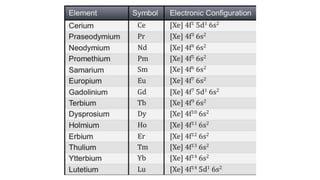
Introduction:
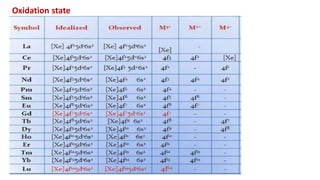
Oxidation state
LANTHANIDE CONTRACTION:
As the atomic number increases each succeeding element ,
contains one more electron in the 4f orbital and one proton in the
nucleus. The 4f electrons are ineffective in screening the outer
electrons from the nucleus causing imperfect shielding . As a result
there is a gradual increase in the nucleus attraction for the outer
electrons consequently gradual decrease in size occur. This is called
Lanthanide contraction.
Consequences
SEPARATION OF LANTHANIDES:
Except promethium, they occur together in earth’s crust in various forms and very
difficult to separate from each other because all the lanthanides have the same size
and charge (of +3 unit). The chemical properties of these elements which depend on
the size and charge are, therefore, almost identical. Hence, their isolation from one
another is quite difficult. However, the following methods have been used to
separate them from one another.
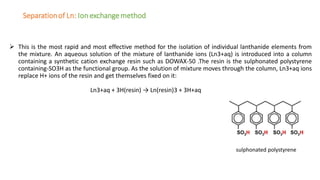
 This is the most rapid and most effective method for the isolation of individual lanthanide elements from
the mixture. An aqueous solution of the mixture of lanthanide ions (Ln3+aq) is introduced into a column
containing a synthetic cation exchange resin such as DOWAX-50 .The resin is the sulphonated polystyrene
containing-SO3H as the functional group. As the solution of mixture moves through the column, Ln3+aq ions
replace H+ ions of the resin and get themselves fixed on it:
Ln3+aq + 3H(resin) → Ln(resin)3 + 3H+aq
Separationof Ln: Ionexchangemethod
sulphonated polystyrene
 The bonding of the lanthanide ion to the resin depends on its size, i. e, the smaller the size of the
lanthanide ion, the more firmly it is bound to the resin and vice versa. Since lanthanide ions are
hydrated, therefore size of the hydrated ions should be considered for binding purpose. Hydration of the
ions depends upon size i. e, smaller the size of the ion greater will be the hydration. Therefore in case of
lanthanide ions, the smallest lanthanide ion, namely will be the most heavily hydrated. Thus it will have
the maximum size and therefore the least firmly bound to the resin while reverse will be the case with
La+3 which will be the most firmly bound to the resin
 A solution containing several lanthanide ions is dropped slowly down a column of synthetic ion
exchange resin so that the lanthanide ions are bound less firmly to the resin in the order La+3 to Lu+3.
They are then eluted from the column by using a solution containing citric acid and ammonium citrate.
For the ammonium ions elute the metal ions from the resin as:
3NH4
+ +Ln (resin) → 3NH4 resin + Ln+3
The metal ions then form a complex with the citrate ions.
Ln+3 + citrate ions → Ln citrate complex
Since Lu+3 is the least firmly bound to resin therefore on elution,
Lu citrate complex is obtained first from the bottom of the column
while La citrate complex emerges last of all from the bottom of
the column. Complexing agents such as EDTA, amino carboxylic
acids and hydroxy carboxylic acids have also been found to be
convenient elutants.
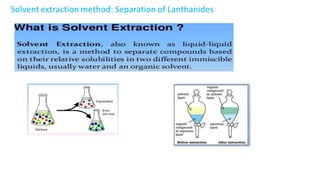
Solvent extraction method: Separation of Lanthanides
Decreases in ionic
radius willincreases
complexation.
Lanthanide contraction

Lanthanide contraction

  • 1.
    LANTHANIDE CONTRACTION AND SEPARATIONOF LANTHANIDES BY K.N.S.SWAMI., M.Sc., SET. GUEST FACULTY IN CHEMISTY DEPARTMENT OF CHEMISTRY & PHARMACEUTICAL CHEMISTRY P.R.GOVERNMENT COLLEGE(AUTONOMUS),KAKINADA
  • 2.
  • 4.
  • 5.
    LANTHANIDE CONTRACTION: As theatomic number increases each succeeding element , contains one more electron in the 4f orbital and one proton in the nucleus. The 4f electrons are ineffective in screening the outer electrons from the nucleus causing imperfect shielding . As a result there is a gradual increase in the nucleus attraction for the outer electrons consequently gradual decrease in size occur. This is called Lanthanide contraction.
  • 7.
  • 10.
    SEPARATION OF LANTHANIDES: Exceptpromethium, they occur together in earth’s crust in various forms and very difficult to separate from each other because all the lanthanides have the same size and charge (of +3 unit). The chemical properties of these elements which depend on the size and charge are, therefore, almost identical. Hence, their isolation from one another is quite difficult. However, the following methods have been used to separate them from one another.
  • 11.
     This isthe most rapid and most effective method for the isolation of individual lanthanide elements from the mixture. An aqueous solution of the mixture of lanthanide ions (Ln3+aq) is introduced into a column containing a synthetic cation exchange resin such as DOWAX-50 .The resin is the sulphonated polystyrene containing-SO3H as the functional group. As the solution of mixture moves through the column, Ln3+aq ions replace H+ ions of the resin and get themselves fixed on it: Ln3+aq + 3H(resin) → Ln(resin)3 + 3H+aq Separationof Ln: Ionexchangemethod sulphonated polystyrene
  • 12.
     The bondingof the lanthanide ion to the resin depends on its size, i. e, the smaller the size of the lanthanide ion, the more firmly it is bound to the resin and vice versa. Since lanthanide ions are hydrated, therefore size of the hydrated ions should be considered for binding purpose. Hydration of the ions depends upon size i. e, smaller the size of the ion greater will be the hydration. Therefore in case of lanthanide ions, the smallest lanthanide ion, namely will be the most heavily hydrated. Thus it will have the maximum size and therefore the least firmly bound to the resin while reverse will be the case with La+3 which will be the most firmly bound to the resin  A solution containing several lanthanide ions is dropped slowly down a column of synthetic ion exchange resin so that the lanthanide ions are bound less firmly to the resin in the order La+3 to Lu+3. They are then eluted from the column by using a solution containing citric acid and ammonium citrate. For the ammonium ions elute the metal ions from the resin as: 3NH4 + +Ln (resin) → 3NH4 resin + Ln+3
  • 13.
    The metal ionsthen form a complex with the citrate ions. Ln+3 + citrate ions → Ln citrate complex Since Lu+3 is the least firmly bound to resin therefore on elution, Lu citrate complex is obtained first from the bottom of the column while La citrate complex emerges last of all from the bottom of the column. Complexing agents such as EDTA, amino carboxylic acids and hydroxy carboxylic acids have also been found to be convenient elutants.
  • 14.
    Solvent extraction method:Separation of Lanthanides
  • 15.
    Decreases in ionic radiuswillincreases complexation.