UNIT –V
INNER TRANSITION ELEMENTS
(Rare earths)
INNER TRANSITION ELEMENTS
(Rare earths)
• The elements which have partly tilled (n-2) f-
orbitals are df-block elements.
• Since their inner subshells (4f and 5f) are
successively filled with electrons, these electrons
are called transition elements. These are two
series of inner transition elements.
They are
• Lanthanide series (4f-block elements)
• Actinide series (5f-block elements)
LATHANIDES
• A group of 14 elements after lantanum (Z=58)
consititutes anthanide series.
Characteristic properties of lanthanides
• Electronic configuration:
Lanthanides have 4f2-14 5d0-1 6s2 ionic
configuration.
• Oxidation states: The principal oxidation state
of lanthanides is +3. In the case of La, Gd and
Lu, removal of three electrons yield stable 4f0,
4f7 and 4f14 configuration.
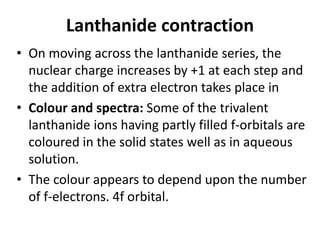
Lanthanide contraction
• On moving across the lanthanide series, the
nuclear charge increases by +1 at each step and
the addition of extra electron takes place in
• Colour and spectra: Some of the trivalent
lanthanide ions having partly filled f-orbitals are
coloured in the solid states well as in aqueous
solution.
• The colour appears to depend upon the number
of f-electrons. 4f orbital.
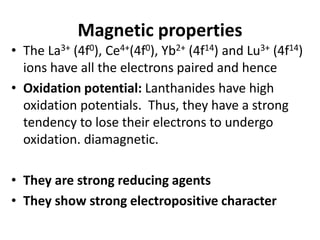
Magnetic properties
• The La3+ (4f0), Ce4+(4f0), Yb2+ (4f14) and Lu3+ (4f14)
ions have all the electrons paired and hence
• Oxidation potential: Lanthanides have high
oxidation potentials. Thus, they have a strong
tendency to lose their electrons to undergo
oxidation. diamagnetic.
• They are strong reducing agents
• They show strong electropositive character
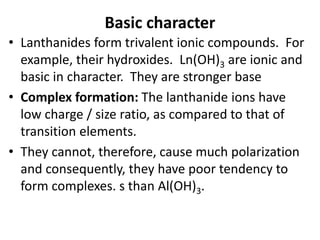
Basic character
• Lanthanides form trivalent ionic compounds. For
example, their hydroxides. Ln(OH)3 are ionic and
basic in character. They are stronger base
• Complex formation: The lanthanide ions have
low charge / size ratio, as compared to that of
transition elements.
• They cannot, therefore, cause much polarization
and consequently, they have poor tendency to
form complexes. s than Al(OH)3.
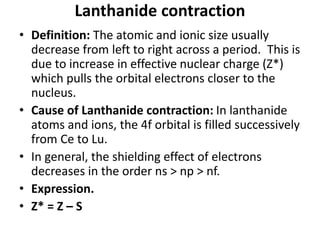
Lanthanide contraction
• Definition: The atomic and ionic size usually
decrease from left to right across a period. This is
due to increase in effective nuclear charge (Z*)
which pulls the orbital electrons closer to the
nucleus.
• Cause of Lanthanide contraction: In lanthanide
atoms and ions, the 4f orbital is filled successively
from Ce to Lu.
• In general, the shielding effect of electrons
decreases in the order ns > np > nf.
• Expression.
• Z* = Z – S
Consequence of lanthanide contraction
• Due to the close similarity in electronic configuration
the lanthanides have identical chemical properties.
• The lanthanide contraction also explains the
decreasing basicity of the lanthanides.
• Certain pairs of elements such as Zr/Hf, Nb/Ta and
Mo/W have almost idential size against the expected
size increase due to increased atomic numbers.
• This is a direct consequence of the lanthanide
contraction.
Extraction of Lanthanides from Monazite sand
• Extraction of Lanthanide mixture
• Monazite ore is finely powdered and digested with hot
conc.H2SO4 in cast iron pans when thorium and
lanthanides go into solution as their sulphate.
• The pasty mass of the sulphates is agitated with water and
then filtered to remove silica.
• The formation of H3PO4 makes the solution acidic. When
it is neutralised with ammonia or magnesia mixture,
thorium phosphate is precipitated and removed.
• The solution containing the sulphates of lanthanides is
treated with Na2SO4 when light lanthanides (La to Sm) are
precipitated as double sulphates while the heavier
lanthanides (Gd to Lu) remain in solution as simple
sulphates.
• The precipitated double sulphates ae treated
with hot NaOH when hydroxides of light
lanthanides are formed.
• The hydroxides ae washed and dried in air at
1000C to get oxides of light lanthanides.
• The oxides are treated with dil. HNO3 when
cerium is precipitated as CeO2.
• The solution contains nitrated of La, Pr, Nd and
Sm. From this, the individual lanthanides are
separated by a suitable method
Separation of Lanthanides
• Fractional crystallisation method
The separation of lanthanide ions by this method is based
on the slight differences in solubility.
• Fractional precipitation method
The differences in stability of lanthanide complexes is the
basic principle of this method
• Solvent extraction method
This method works on the slight difference in the partition
coefficients of the salts of lanthanides between water and
an organic solvent.
• Ion exchange method
This is the most elegant for lanthanide separation. It is
based on the principle of selective exchange of lanthanide
ions with the H+ ion of a cation exchange resin.
Actinides
• The 14 elements from Th (Al.No.90) to Lw
(At.No.103) are characterised by the
progressive filling up of the 5f-orbitals. They
constitute the actinide series.
• Characteristic Properties of Actinides
• Electronic configuration: The 5f block
elements (actinides) have (n-2)f1-14 (n-1) d1 ns2
configuration analogous to lanthanides.
• Metallic nature:Like the lanthanides, actinides
are all metals.
• Oxidation states: Unlike lanthanides, the
actinides have no character oxidation state.
• Colour: Actinides cations having unpaired 5f
electrons are coloured in the solid as well as in
aqueous solution.
• Actinide contraction: Like the lanthanides,
actinides show the phenomenon of actinide
contraction.
• Magnetic properties: Like the lanthanides,
actinides are strongly paramagnetic.
Transuranic elements
• Elements lying beyond uranium i.e. beyond atomic
number 92 are called transuranic elements (Z = 93-
103). These are radioactive elements produced
through nuclear reactions.
• Neptunium: It was prepared by Wahi and Seaborg in
1942 by the action of high speed neutrons on U – 238.
• Plutonium: Plutonium – 239 is a very important
isotope in nuclear chemistry. It is produced on a large
scale (from natural uranium) by the action of slow
neutrons on U – 238.
• Americium: It is prepared by bombarding Pu – 239
with alpha particles.
Comparison of Lanthanides and Actinides
Points of Similarity
• Both show +3 oxidation state
• In both the cases, f-orbitals of (n-2) shell are progressively
filled up
• A contraction in atomic and ionic size is observed in both
the cases (lanthanide and actinide contractions)
• Both lanthanides and actinides show sharp line-like
absorption spectra due to f-f transition
• They have low electronegativity values
• These elements are quite reactive
• These elements form coloured ions
• Their nitrates, perchlorates and sulphates in the +3 state are
soluble in water.
• Their hydroxides and carbonates in +3 state are insoluble in
water.
• Members of both the series show ion exchange behaviour
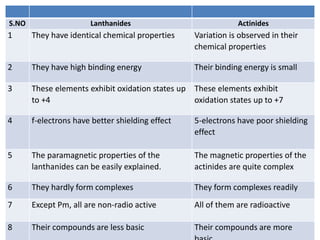
S.NO Lanthanides Actinides
1 They have identical chemical properties Variation is observed in their
chemical properties
2 They have high binding energy Their binding energy is small
3 These elements exhibit oxidation states up
to +4
These elements exhibit
oxidation states up to +7
4 f-electrons have better shielding effect 5-electrons have poor shielding
effect
5 The paramagnetic properties of the
lanthanides can be easily explained.
The magnetic properties of the
actinides are quite complex
6 They hardly form complexes They form complexes readily
7 Except Pm, all are non-radio active All of them are radioactive
8 Their compounds are less basic Their compounds are more

Inner transition elements

  • 1.
    UNIT –V INNER TRANSITIONELEMENTS (Rare earths)
  • 2.
    INNER TRANSITION ELEMENTS (Rareearths) • The elements which have partly tilled (n-2) f- orbitals are df-block elements. • Since their inner subshells (4f and 5f) are successively filled with electrons, these electrons are called transition elements. These are two series of inner transition elements. They are • Lanthanide series (4f-block elements) • Actinide series (5f-block elements)
  • 3.
    LATHANIDES • A groupof 14 elements after lantanum (Z=58) consititutes anthanide series. Characteristic properties of lanthanides • Electronic configuration: Lanthanides have 4f2-14 5d0-1 6s2 ionic configuration. • Oxidation states: The principal oxidation state of lanthanides is +3. In the case of La, Gd and Lu, removal of three electrons yield stable 4f0, 4f7 and 4f14 configuration.
  • 4.
    Lanthanide contraction • Onmoving across the lanthanide series, the nuclear charge increases by +1 at each step and the addition of extra electron takes place in • Colour and spectra: Some of the trivalent lanthanide ions having partly filled f-orbitals are coloured in the solid states well as in aqueous solution. • The colour appears to depend upon the number of f-electrons. 4f orbital.
  • 5.
    Magnetic properties • TheLa3+ (4f0), Ce4+(4f0), Yb2+ (4f14) and Lu3+ (4f14) ions have all the electrons paired and hence • Oxidation potential: Lanthanides have high oxidation potentials. Thus, they have a strong tendency to lose their electrons to undergo oxidation. diamagnetic. • They are strong reducing agents • They show strong electropositive character
  • 6.
    Basic character • Lanthanidesform trivalent ionic compounds. For example, their hydroxides. Ln(OH)3 are ionic and basic in character. They are stronger base • Complex formation: The lanthanide ions have low charge / size ratio, as compared to that of transition elements. • They cannot, therefore, cause much polarization and consequently, they have poor tendency to form complexes. s than Al(OH)3.
  • 7.
    Lanthanide contraction • Definition:The atomic and ionic size usually decrease from left to right across a period. This is due to increase in effective nuclear charge (Z*) which pulls the orbital electrons closer to the nucleus. • Cause of Lanthanide contraction: In lanthanide atoms and ions, the 4f orbital is filled successively from Ce to Lu. • In general, the shielding effect of electrons decreases in the order ns > np > nf. • Expression. • Z* = Z – S
  • 8.
    Consequence of lanthanidecontraction • Due to the close similarity in electronic configuration the lanthanides have identical chemical properties. • The lanthanide contraction also explains the decreasing basicity of the lanthanides. • Certain pairs of elements such as Zr/Hf, Nb/Ta and Mo/W have almost idential size against the expected size increase due to increased atomic numbers. • This is a direct consequence of the lanthanide contraction.
  • 9.
    Extraction of Lanthanidesfrom Monazite sand • Extraction of Lanthanide mixture • Monazite ore is finely powdered and digested with hot conc.H2SO4 in cast iron pans when thorium and lanthanides go into solution as their sulphate. • The pasty mass of the sulphates is agitated with water and then filtered to remove silica. • The formation of H3PO4 makes the solution acidic. When it is neutralised with ammonia or magnesia mixture, thorium phosphate is precipitated and removed. • The solution containing the sulphates of lanthanides is treated with Na2SO4 when light lanthanides (La to Sm) are precipitated as double sulphates while the heavier lanthanides (Gd to Lu) remain in solution as simple sulphates.
  • 10.
    • The precipitateddouble sulphates ae treated with hot NaOH when hydroxides of light lanthanides are formed. • The hydroxides ae washed and dried in air at 1000C to get oxides of light lanthanides. • The oxides are treated with dil. HNO3 when cerium is precipitated as CeO2. • The solution contains nitrated of La, Pr, Nd and Sm. From this, the individual lanthanides are separated by a suitable method
  • 11.
    Separation of Lanthanides •Fractional crystallisation method The separation of lanthanide ions by this method is based on the slight differences in solubility. • Fractional precipitation method The differences in stability of lanthanide complexes is the basic principle of this method • Solvent extraction method This method works on the slight difference in the partition coefficients of the salts of lanthanides between water and an organic solvent. • Ion exchange method This is the most elegant for lanthanide separation. It is based on the principle of selective exchange of lanthanide ions with the H+ ion of a cation exchange resin.
  • 12.
    Actinides • The 14elements from Th (Al.No.90) to Lw (At.No.103) are characterised by the progressive filling up of the 5f-orbitals. They constitute the actinide series. • Characteristic Properties of Actinides • Electronic configuration: The 5f block elements (actinides) have (n-2)f1-14 (n-1) d1 ns2 configuration analogous to lanthanides.
  • 13.
    • Metallic nature:Likethe lanthanides, actinides are all metals. • Oxidation states: Unlike lanthanides, the actinides have no character oxidation state. • Colour: Actinides cations having unpaired 5f electrons are coloured in the solid as well as in aqueous solution. • Actinide contraction: Like the lanthanides, actinides show the phenomenon of actinide contraction. • Magnetic properties: Like the lanthanides, actinides are strongly paramagnetic.
  • 14.
    Transuranic elements • Elementslying beyond uranium i.e. beyond atomic number 92 are called transuranic elements (Z = 93- 103). These are radioactive elements produced through nuclear reactions. • Neptunium: It was prepared by Wahi and Seaborg in 1942 by the action of high speed neutrons on U – 238. • Plutonium: Plutonium – 239 is a very important isotope in nuclear chemistry. It is produced on a large scale (from natural uranium) by the action of slow neutrons on U – 238. • Americium: It is prepared by bombarding Pu – 239 with alpha particles.
  • 15.
    Comparison of Lanthanidesand Actinides Points of Similarity • Both show +3 oxidation state • In both the cases, f-orbitals of (n-2) shell are progressively filled up • A contraction in atomic and ionic size is observed in both the cases (lanthanide and actinide contractions) • Both lanthanides and actinides show sharp line-like absorption spectra due to f-f transition • They have low electronegativity values • These elements are quite reactive • These elements form coloured ions • Their nitrates, perchlorates and sulphates in the +3 state are soluble in water. • Their hydroxides and carbonates in +3 state are insoluble in water. • Members of both the series show ion exchange behaviour
  • 16.
    S.NO Lanthanides Actinides 1They have identical chemical properties Variation is observed in their chemical properties 2 They have high binding energy Their binding energy is small 3 These elements exhibit oxidation states up to +4 These elements exhibit oxidation states up to +7 4 f-electrons have better shielding effect 5-electrons have poor shielding effect 5 The paramagnetic properties of the lanthanides can be easily explained. The magnetic properties of the actinides are quite complex 6 They hardly form complexes They form complexes readily 7 Except Pm, all are non-radio active All of them are radioactive 8 Their compounds are less basic Their compounds are more