
Sequential Extraction of
Phosphorus from Soil: A
Geoarcheology Application
Ariel Atkinson, A.R. Smith Department of Chemistry, Appalachian
State University, Boone, NC 28607, Senior Research Final
Presentation under the supervision of Carol M. Babyak
Why?
-50 soil samples from Fayetteville, NC
-New I-95 loop will be built
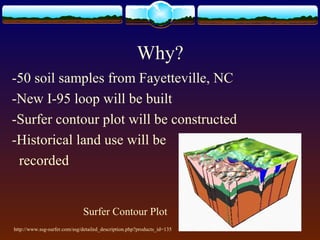
-Surfer contour plot will be constructed
-Historical land use will be
recorded
http://www.ssg-surfer.com/ssg/detailed_description.php?products_id=135
Surfer Contour Plot
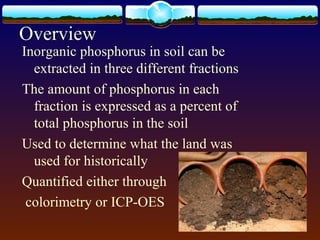
Inorganic phosphorus in soil can be
extracted in three different fractions
The amount of phosphorus in each
fraction is expressed as a percent of
total phosphorus in the soil
Used to determine what the land was
used for historically
Quantified either through
colorimetry or ICP-OES
Overview
Phosphorus
Abundant in the environment
Comes from a variety of human activities:
-farming -cleaning -food preparation
-medical care -waste
Stable in soil  can reveal the historical land use
patterns.
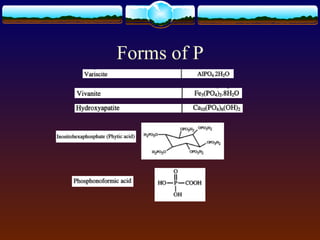
Forms of P
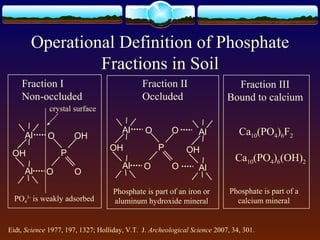
Operational Definition of Phosphate
Fractions in Soil
Fraction I
Non-occluded
Fraction II
Occluded
Fraction III
Bound to calcium
Al
Al
OH
crystal surface
O
O
P
O
OH
Eidt, Science 1977, 197, 1327; Holliday, V.T. J. Archeological Science 2007, 34, 301.
Ca10(PO4)6F2
Ca10(PO4)6(OH)2
Al
Al
OH
O
O
P
O
O Al
Al
OH
Phosphate is part of an iron or
aluminum hydroxide mineral
Phosphate is part of a
calcium mineralPO4
3-
is weakly adsorbed
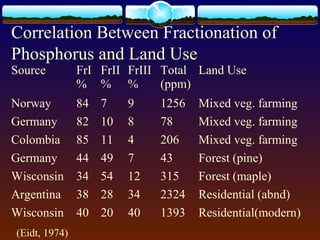
Correlation Between Fractionation of
Phosphorus and Land Use
Source FrI
%
FrII
%
FrIII
%
Total
(ppm)
Land Use
Norway 84 7 9 1256 Mixed veg. farming
Germany 82 10 8 78 Mixed veg. farming
Colombia 85 11 4 206 Mixed veg. farming
Germany 44 49 7 43 Forest (pine)
Wisconsin 34 54 12 315 Forest (maple)
Argentina 38 28 34 2324 Residential (abnd)
Wisconsin 40 20 40 1393 Residential(modern)
(Eidt, 1974)
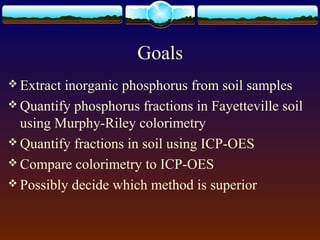
Goals
 Extract inorganic phosphorus from soil samples
 Quantify phosphorus fractions in Fayetteville soil
using Murphy-Riley colorimetry
 Quantify fractions in soil using ICP-OES
 Compare colorimetry to ICP-OES
 Possibly decide which method is superior
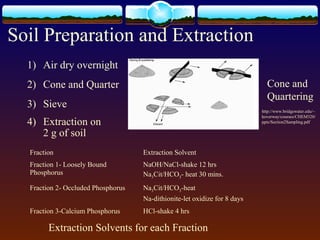
Soil Preparation and Extraction
Fraction Extraction Solvent
Fraction 1- Loosely Bound
Phosphorus
NaOH/NaCl-shake 12 hrs
Na3Cit/HCO3- heat 30 mins.
Fraction 2- Occluded Phosphorus Na3Cit/HCO3-heat
Na-dithionite-let oxidize for 8 days
Fraction 3-Calcium Phosphorus HCl-shake 4 hrs
1) Air dry overnight
2) Cone and Quarter
3) Sieve
4) Extraction on
2 g of soil
http://www.bridgewater.edu/~
koverway/courses/CHEM320/
ppts/Section2Sampling.pdf
Cone and
Quartering
Extraction Solvents for each Fraction
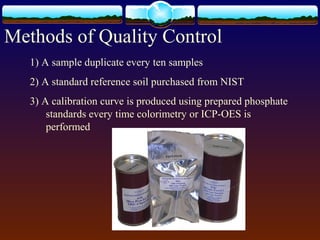
Methods of Quality Control
1) A sample duplicate every ten samples
2) A standard reference soil purchased from NIST
3) A calibration curve is produced using prepared phosphate
standards every time colorimetry or ICP-OES is
performed
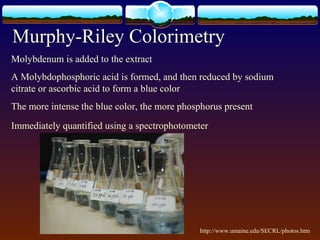
Murphy-Riley Colorimetry
Molybdenum is added to the extract
A Molybdophosphoric acid is formed, and then reduced by sodium
citrate or ascorbic acid to form a blue color
The more intense the blue color, the more phosphorus present
Immediately quantified using a spectrophotometer
http://www.umaine.edu/SECRL/photos.htm
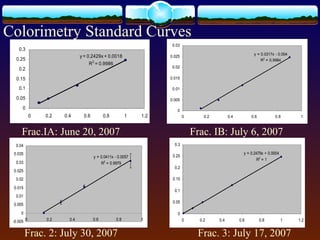
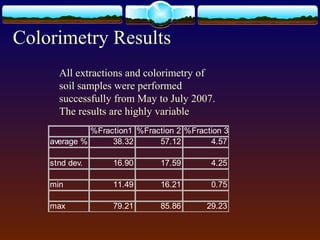
y = 0.2479x + 0.0004
R2
= 1
0
0.05
0.1
0.15
0.2
0.25
0.3
0 0.2 0.4 0.6 0.8 1 1.2
y = 0.0411x - 0.0057
R2
= 0.9979
-0.005
0
0.005
0.01
0.015
0.02
0.025
0.03
0.035
0.04
0 0.2 0.4 0.6 0.8 1
y = 0.2429x + 0.0018
R2
= 0.9986
0
0.05
0.1
0.15
0.2
0.25
0.3
0 0.2 0.4 0.6 0.8 1 1.2
Frac.IA: June 20, 2007 Frac. IB: July 6, 2007
Frac. 2: July 30, 2007 Frac. 3: July 17, 2007
y = 0.0317x - 0.004
R2
= 0.9984
0
0.005
0.01
0.015
0.02
0.025
0.03
0 0.2 0.4 0.6 0.8 1
Colorimetry Standard Curves
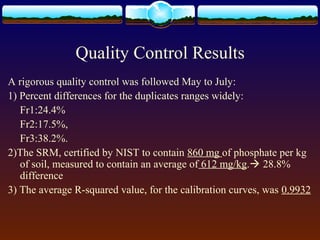
Colorimetry Results
%Fraction1 %Fraction 2 %Fraction 3
average % 38.32 57.12 4.57
stnd dev. 16.90 17.59 4.25
min 11.49 16.21 0.75
max 79.21 85.86 29.23
All extractions and colorimetry of
soil samples were performed
successfully from May to July 2007.
The results are highly variable
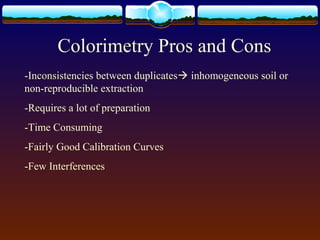
Quality Control Results
A rigorous quality control was followed May to July:
1) Percent differences for the duplicates ranges widely:
Fr1:24.4%
Fr2:17.5%,
Fr3:38.2%.
2)The SRM, certified by NIST to contain 860 mg of phosphate per kg
of soil, measured to contain an average of 612 mg/kg. 28.8%
difference
3) The average R-squared value, for the calibration curves, was 0.9932
Colorimetry Pros and Cons
-Inconsistencies between duplicates inhomogeneous soil or
non-reproducible extraction
-Requires a lot of preparation
-Time Consuming
-Fairly Good Calibration Curves
-Few Interferences
ICP-OES
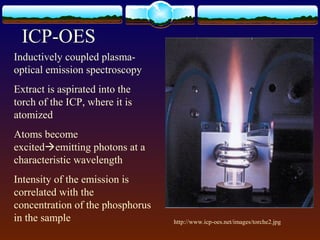
Inductively coupled plasma-
optical emission spectroscopy
Extract is aspirated into the
torch of the ICP, where it is
atomized
Atoms become
excitedemitting photons at a
characteristic wavelength
Intensity of the emission is
correlated with the
concentration of the phosphorus
in the sample http://www.icp-oes.net/images/torche2.jpg
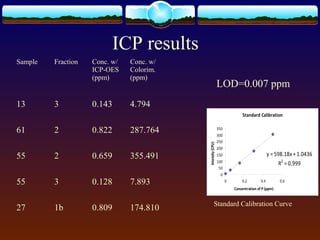
ICP results
Standard Calibration
y = 598.18x +1.0436
R2
= 0.999
0
50
100
150
200
250
300
350
0 0.2 0.4 0.6
Concentration of P (ppm)
Intensity(CPU)
LOD=0.007 ppm
Sample Fraction Conc. w/
ICP-OES
(ppm)
Conc. w/
Colorim.
(ppm)
13 3 0.143 4.794
61 2 0.822 287.764
55 2 0.659 355.491
55 3 0.128 7.893
27 1b 0.809 174.810 Standard Calibration Curve
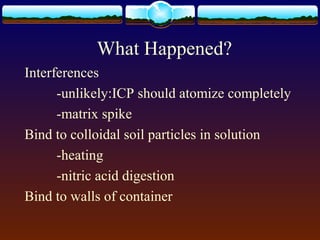
What Happened?
Interferences
-unlikely:ICP should atomize completely
-matrix spike
Bind to colloidal soil particles in solution
-heating
-nitric acid digestion
Bind to walls of container
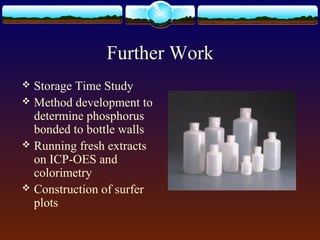
Further Work
 Storage Time Study
 Method development to
determine phosphorus
bonded to bottle walls
 Running fresh extracts
on ICP-OES and
colorimetry
 Construction of surfer
plots
Summary
- > 50 samples from Fayetteville were sequentially
extracted.
- > 200 extracts were analyzed using M-R colorimetry.
-Colorimetry data will be used to construct Surfer
plots.
-Due to sample storage, it is impossible to say whether
ICP-OES or colorimetry is the best method.
Acknowledgements
I would like to acknowledge the following people for
their help:
-Dr. Carol M Babyak
-Dr. Keith Seramur
-Dr. Shea Tuberty
-Dr. Lynn Siefferman
-The A.R. Smith Department of Chemistry
References
 Eidt, Robert C. 1977.Detection and Examination of
Anthrosols by Phosphate Analysis. Science. 197. 4311: p.
30-34
 Eidt, Robert. Woods. 1974. Theoretical and Practical
Considerations in the Analysis of Anthrosols. Abandoned
Settlement Analysis. 1st
ed, p.155-189.
 Murphy, J. Riley,J.P.1962. A MODIFIED SINGLE
SOLUTION METHOD FOR THE DETERMINATION OF
PHOSPHATE IN NATURAL WATERS.
Anal.Chim.Acta, 27: 31-36.
 Sobeck, Ebeling.2007. “Mass Spectrometric Analysis for
Phosphate in Soil Extracts.”Analytical Sciences
Digital Library E-UGR.
<http://www.asdlib.org/articles.php?type=eUGH>
 Standard Methods for the Examination of Water and
Wastewater. 1999. p.4-139 – 4-147.

Sequential extraction of phosphorous from soil

  • 1.
    Sequential Extraction of Phosphorusfrom Soil: A Geoarcheology Application Ariel Atkinson, A.R. Smith Department of Chemistry, Appalachian State University, Boone, NC 28607, Senior Research Final Presentation under the supervision of Carol M. Babyak
  • 2.
    Why? -50 soil samplesfrom Fayetteville, NC -New I-95 loop will be built -Surfer contour plot will be constructed -Historical land use will be recorded http://www.ssg-surfer.com/ssg/detailed_description.php?products_id=135 Surfer Contour Plot
  • 3.
    Inorganic phosphorus insoil can be extracted in three different fractions The amount of phosphorus in each fraction is expressed as a percent of total phosphorus in the soil Used to determine what the land was used for historically Quantified either through colorimetry or ICP-OES Overview
  • 4.
    Phosphorus Abundant in theenvironment Comes from a variety of human activities: -farming -cleaning -food preparation -medical care -waste Stable in soil  can reveal the historical land use patterns.
  • 5.
  • 6.
    Operational Definition ofPhosphate Fractions in Soil Fraction I Non-occluded Fraction II Occluded Fraction III Bound to calcium Al Al OH crystal surface O O P O OH Eidt, Science 1977, 197, 1327; Holliday, V.T. J. Archeological Science 2007, 34, 301. Ca10(PO4)6F2 Ca10(PO4)6(OH)2 Al Al OH O O P O O Al Al OH Phosphate is part of an iron or aluminum hydroxide mineral Phosphate is part of a calcium mineralPO4 3- is weakly adsorbed
  • 7.
    Correlation Between Fractionationof Phosphorus and Land Use Source FrI % FrII % FrIII % Total (ppm) Land Use Norway 84 7 9 1256 Mixed veg. farming Germany 82 10 8 78 Mixed veg. farming Colombia 85 11 4 206 Mixed veg. farming Germany 44 49 7 43 Forest (pine) Wisconsin 34 54 12 315 Forest (maple) Argentina 38 28 34 2324 Residential (abnd) Wisconsin 40 20 40 1393 Residential(modern) (Eidt, 1974)
  • 8.
    Goals  Extract inorganicphosphorus from soil samples  Quantify phosphorus fractions in Fayetteville soil using Murphy-Riley colorimetry  Quantify fractions in soil using ICP-OES  Compare colorimetry to ICP-OES  Possibly decide which method is superior
  • 9.
    Soil Preparation andExtraction Fraction Extraction Solvent Fraction 1- Loosely Bound Phosphorus NaOH/NaCl-shake 12 hrs Na3Cit/HCO3- heat 30 mins. Fraction 2- Occluded Phosphorus Na3Cit/HCO3-heat Na-dithionite-let oxidize for 8 days Fraction 3-Calcium Phosphorus HCl-shake 4 hrs 1) Air dry overnight 2) Cone and Quarter 3) Sieve 4) Extraction on 2 g of soil http://www.bridgewater.edu/~ koverway/courses/CHEM320/ ppts/Section2Sampling.pdf Cone and Quartering Extraction Solvents for each Fraction
  • 10.
    Methods of QualityControl 1) A sample duplicate every ten samples 2) A standard reference soil purchased from NIST 3) A calibration curve is produced using prepared phosphate standards every time colorimetry or ICP-OES is performed
  • 11.
    Murphy-Riley Colorimetry Molybdenum isadded to the extract A Molybdophosphoric acid is formed, and then reduced by sodium citrate or ascorbic acid to form a blue color The more intense the blue color, the more phosphorus present Immediately quantified using a spectrophotometer http://www.umaine.edu/SECRL/photos.htm
  • 12.
    y = 0.2479x+ 0.0004 R2 = 1 0 0.05 0.1 0.15 0.2 0.25 0.3 0 0.2 0.4 0.6 0.8 1 1.2 y = 0.0411x - 0.0057 R2 = 0.9979 -0.005 0 0.005 0.01 0.015 0.02 0.025 0.03 0.035 0.04 0 0.2 0.4 0.6 0.8 1 y = 0.2429x + 0.0018 R2 = 0.9986 0 0.05 0.1 0.15 0.2 0.25 0.3 0 0.2 0.4 0.6 0.8 1 1.2 Frac.IA: June 20, 2007 Frac. IB: July 6, 2007 Frac. 2: July 30, 2007 Frac. 3: July 17, 2007 y = 0.0317x - 0.004 R2 = 0.9984 0 0.005 0.01 0.015 0.02 0.025 0.03 0 0.2 0.4 0.6 0.8 1 Colorimetry Standard Curves
  • 13.
    Colorimetry Results %Fraction1 %Fraction2 %Fraction 3 average % 38.32 57.12 4.57 stnd dev. 16.90 17.59 4.25 min 11.49 16.21 0.75 max 79.21 85.86 29.23 All extractions and colorimetry of soil samples were performed successfully from May to July 2007. The results are highly variable
  • 14.
    Quality Control Results Arigorous quality control was followed May to July: 1) Percent differences for the duplicates ranges widely: Fr1:24.4% Fr2:17.5%, Fr3:38.2%. 2)The SRM, certified by NIST to contain 860 mg of phosphate per kg of soil, measured to contain an average of 612 mg/kg. 28.8% difference 3) The average R-squared value, for the calibration curves, was 0.9932
  • 15.
    Colorimetry Pros andCons -Inconsistencies between duplicates inhomogeneous soil or non-reproducible extraction -Requires a lot of preparation -Time Consuming -Fairly Good Calibration Curves -Few Interferences
  • 16.
    ICP-OES Inductively coupled plasma- opticalemission spectroscopy Extract is aspirated into the torch of the ICP, where it is atomized Atoms become excitedemitting photons at a characteristic wavelength Intensity of the emission is correlated with the concentration of the phosphorus in the sample http://www.icp-oes.net/images/torche2.jpg
  • 17.
    ICP results Standard Calibration y= 598.18x +1.0436 R2 = 0.999 0 50 100 150 200 250 300 350 0 0.2 0.4 0.6 Concentration of P (ppm) Intensity(CPU) LOD=0.007 ppm Sample Fraction Conc. w/ ICP-OES (ppm) Conc. w/ Colorim. (ppm) 13 3 0.143 4.794 61 2 0.822 287.764 55 2 0.659 355.491 55 3 0.128 7.893 27 1b 0.809 174.810 Standard Calibration Curve
  • 18.
    What Happened? Interferences -unlikely:ICP shouldatomize completely -matrix spike Bind to colloidal soil particles in solution -heating -nitric acid digestion Bind to walls of container
  • 19.
    Further Work  StorageTime Study  Method development to determine phosphorus bonded to bottle walls  Running fresh extracts on ICP-OES and colorimetry  Construction of surfer plots
  • 20.
    Summary - > 50samples from Fayetteville were sequentially extracted. - > 200 extracts were analyzed using M-R colorimetry. -Colorimetry data will be used to construct Surfer plots. -Due to sample storage, it is impossible to say whether ICP-OES or colorimetry is the best method.
  • 21.
    Acknowledgements I would liketo acknowledge the following people for their help: -Dr. Carol M Babyak -Dr. Keith Seramur -Dr. Shea Tuberty -Dr. Lynn Siefferman -The A.R. Smith Department of Chemistry
  • 22.
    References  Eidt, RobertC. 1977.Detection and Examination of Anthrosols by Phosphate Analysis. Science. 197. 4311: p. 30-34  Eidt, Robert. Woods. 1974. Theoretical and Practical Considerations in the Analysis of Anthrosols. Abandoned Settlement Analysis. 1st ed, p.155-189.  Murphy, J. Riley,J.P.1962. A MODIFIED SINGLE SOLUTION METHOD FOR THE DETERMINATION OF PHOSPHATE IN NATURAL WATERS. Anal.Chim.Acta, 27: 31-36.  Sobeck, Ebeling.2007. “Mass Spectrometric Analysis for Phosphate in Soil Extracts.”Analytical Sciences Digital Library E-UGR. <http://www.asdlib.org/articles.php?type=eUGH>  Standard Methods for the Examination of Water and Wastewater. 1999. p.4-139 – 4-147.