Forensic Science An Introduction to Scientific and Investigative Techniques Stuart H. James and Jon J. Nordby Chapter 20 CRC Press: Forensic Science, James and Nordby, 3rd Edition
Chapter 20 Forensic Tire Tread and Tire Track Evidence  Chapter Author: William J. Bodziak Presentation created by Greg Galardi,  Peru, Nebraska Edited by Stuart H. James, Fort Lauderdale, Florida and Dan Mabel, Richmond, Virginia Chapter 20 CRC Press: Forensic Science, James and Nordby, 3rd Edition
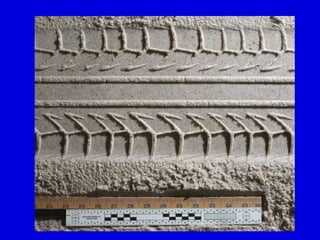
Forensic Tire Tread and Tire Track Evidence Tire impressions reflect the tread design and dimensional features of individual tires on a vehicle Tire Tracks are relational dimensions between two or more tires: tracks can be used to determine the wheelbase of the vehicle Chapter 20 CRC Press: Forensic Science, James and Nordby, 3rd Edition
 
 
Original Equipment Tires, Replacement Tires and Tire Construction Original Equipment Tires - tires sold on new equipment  Replacement tires – those used to replace worn or damaged tires Most tires today are of radial ply construction Tires are composed of liner, sidewall rubber, beads, belts and tread rubber Chapter 20 CRC Press: Forensic Science, James and Nordby, 3rd Edition
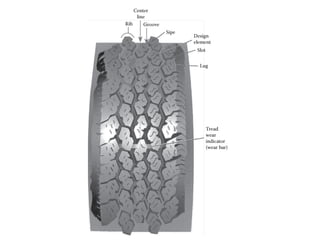
Tread Nomenclature and Sidewall Information Tire treads are composed of design elements separated by grooves Grooves which run across a tire are called slots or transverse grooves Tread wear indicators – raised areas which indicate tread wear Chapter 20 CRC Press: Forensic Science, James and Nordby, 3rd Edition
 
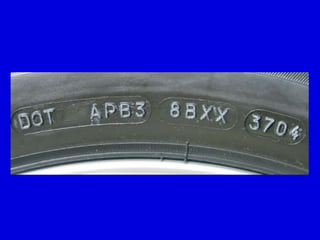
Tread Nomenclature and Sidewall Information Department of Transportation number, known as DOT number – consists of: DOT  AC  L9  ABCD  4901 DOT impression Plant code and manufacturer Date of manufacture Tires made after January 1, 2000 have four numbers in last group, while prior to that there are three numbers Chapter 20 CRC Press: Forensic Science, James and Nordby, 3rd Edition
 
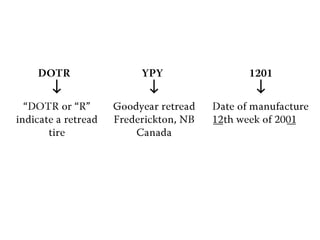
Tread Nomenclature and Sidewall Information Retread tires – have slightly different numbers DOTR  YPY  1201 DOTR – Department of Transportation retread YPY – Manufacturer retread 1201 – date and year of manufacture Chapter 20 CRC Press: Forensic Science, James and Nordby, 3rd Edition
 
Tread Nomenclature and Sidewall Information Common tire size designation includes: P   195 / 65   R   15 P – passenger tire 195 – approximate width in millimeters 65- aspect ratio R – radial tire 15 – rim diameter in inches Chapter 20 CRC Press: Forensic Science, James and Nordby, 3rd Edition
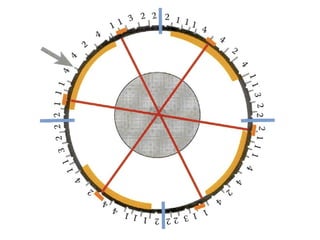
Noise Treatment Stress Cycle - Under load of a vehicle, rotating tire goes through stress  Contact Patch – portion of tire touching ground Noise treatment – tire industry created tire designs that vary the size (pitch) design elements of tire. This reduces or controls noise emitted by tire  Chapter 20 CRC Press: Forensic Science, James and Nordby, 3rd Edition
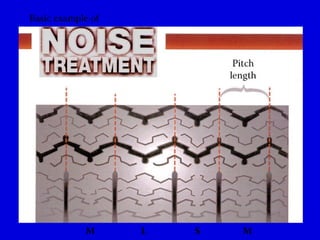
Noise Treatment Mixture of three design elements, small (S), medium (M) and large (L) allow manufacturers to change size of tires and minimize noise Noise treatment is different on opposite sides of tire Chapter 20 CRC Press: Forensic Science, James and Nordby, 3rd Edition
 
 
Tread Wear Indicators Tread Wear Indicator, or known as a wear bar, is a raised rubber bar 1/16 of an inch above base of grooves of tire DOT requires all tires contain a minimum of six tread wear indicators As tread wears down on tire, these become noticeable and indicate tire needs replacement – these indicators can be retained in 3-D impressions Chapter 20 CRC Press: Forensic Science, James and Nordby, 3rd Edition
Retread Tires Retread tires are primarily used for  commercial or fleet vehicles in United States Two types of retread processes: Mold Cured Process Pre-Cured Process Some retread tires have valuable individual characteristics which provide information to the examiner Chapter 20 CRC Press: Forensic Science, James and Nordby, 3rd Edition
Tire Track Evidence Tire track evidence consists of : Tire track width Wheelbase dimensions Turning diameter Relative positions of turning tracks Chapter 20 CRC Press: Forensic Science, James and Nordby, 3rd Edition
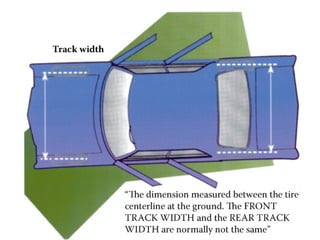
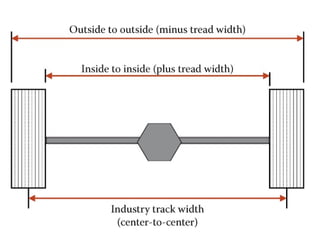
Tire Track Evidence Track Width (Stance) – measurement made from one center of one wheel to  opposite center of wheel Front wheels turning produce unreliable measurements Rear wheels accurately record turns Chapter 20 CRC Press: Forensic Science, James and Nordby, 3rd Edition
 
Tire Track Evidence Wheelbase – measurement of center of hubs of front wheels to center of hubs of rear wheel  Normally these measurements are not present at crime scenes Chapter 20 CRC Press: Forensic Science, James and Nordby, 3rd Edition
 
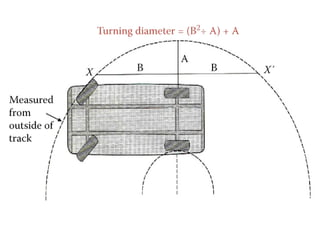
Tire Track Evidence Turning Diameter – Diameter of circle a vehicle makes when its steering wheel is fully turned – pertains to front wheels only Turning diameter is measured by (B squared/A) + A, where: B = distance between two points ( x and x’) on turn circle A = distance between outer margin and a mid point between x and x’ Chapter 20 CRC Press: Forensic Science, James and Nordby, 3rd Edition
 
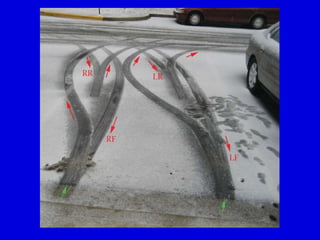
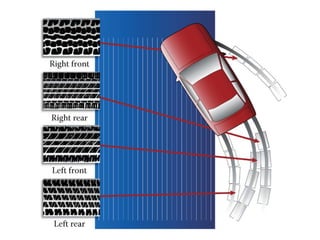
Tire Positions in a Turn When vehicle moves in straight path, only rear tire tracks are available When a vehicle turns, rear and front tires rack separately Important to understand and document at crime scenes Chapter 20 CRC Press: Forensic Science, James and Nordby, 3rd Edition
 
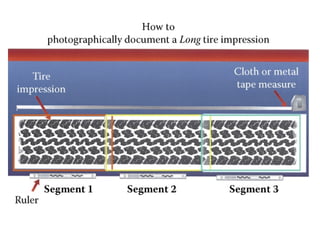
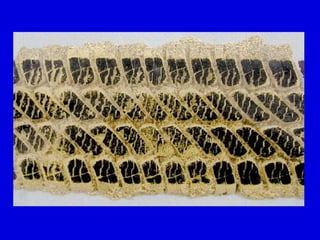
Recovery of Evidence Tire impressions must be: Photographed from all angles with and without measurement tool (ruler) Cast – a 3 foot impression requires 15-25 pounds of dental stone Measured – width, length and depth Direction of travel noted  Impressions made if possible, and Pictures of the source (tire) must be included for comparison Chapter 20 CRC Press: Forensic Science, James and Nordby, 3rd Edition
Known Tires and Exemplars Tire tread examinations compare the tire impressions recovered from scene with tires taken from a known vehicle Two categories of tires: Suspect - Vehicle of suspect Elimination - Vehicles of police, ambulance, etc All tires should be seized from suspect vehicle for comparison Chapter 20 CRC Press: Forensic Science, James and Nordby, 3rd Edition
Tire Impression, the Examination Process, and Conclusions Tire impressions are resulting transfer of tread detail of a tire against a substrate Impressions can be three or two dimensional Forensic examination begins with visual comparison and elimination of tires which do not match impression Chapter 20 CRC Press: Forensic Science, James and Nordby, 3rd Edition
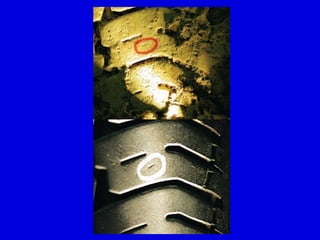
Tire Impression, the Examination Process, and Conclusions Forensic examination continues with full circumference test impressions Impressions are superimposed on  known impression over cast or original tire Other factors to be evaluated are tread design, tread dimension, noise treatment, wear features and random individual characteristics Chapter 20 CRC Press: Forensic Science, James and Nordby, 3rd Edition


20 Forensic Science Powerpoint Chapter 20 Forensic Tire Impress

  • 1.
    Forensic Science AnIntroduction to Scientific and Investigative Techniques Stuart H. James and Jon J. Nordby Chapter 20 CRC Press: Forensic Science, James and Nordby, 3rd Edition
  • 2.
    Chapter 20 ForensicTire Tread and Tire Track Evidence Chapter Author: William J. Bodziak Presentation created by Greg Galardi, Peru, Nebraska Edited by Stuart H. James, Fort Lauderdale, Florida and Dan Mabel, Richmond, Virginia Chapter 20 CRC Press: Forensic Science, James and Nordby, 3rd Edition
  • 3.
    Forensic Tire Treadand Tire Track Evidence Tire impressions reflect the tread design and dimensional features of individual tires on a vehicle Tire Tracks are relational dimensions between two or more tires: tracks can be used to determine the wheelbase of the vehicle Chapter 20 CRC Press: Forensic Science, James and Nordby, 3rd Edition
  • 4.
  • 5.
  • 6.
    Original Equipment Tires,Replacement Tires and Tire Construction Original Equipment Tires - tires sold on new equipment Replacement tires – those used to replace worn or damaged tires Most tires today are of radial ply construction Tires are composed of liner, sidewall rubber, beads, belts and tread rubber Chapter 20 CRC Press: Forensic Science, James and Nordby, 3rd Edition
  • 7.
    Tread Nomenclature andSidewall Information Tire treads are composed of design elements separated by grooves Grooves which run across a tire are called slots or transverse grooves Tread wear indicators – raised areas which indicate tread wear Chapter 20 CRC Press: Forensic Science, James and Nordby, 3rd Edition
  • 8.
  • 9.
    Tread Nomenclature andSidewall Information Department of Transportation number, known as DOT number – consists of: DOT AC L9 ABCD 4901 DOT impression Plant code and manufacturer Date of manufacture Tires made after January 1, 2000 have four numbers in last group, while prior to that there are three numbers Chapter 20 CRC Press: Forensic Science, James and Nordby, 3rd Edition
  • 10.
  • 11.
    Tread Nomenclature andSidewall Information Retread tires – have slightly different numbers DOTR YPY 1201 DOTR – Department of Transportation retread YPY – Manufacturer retread 1201 – date and year of manufacture Chapter 20 CRC Press: Forensic Science, James and Nordby, 3rd Edition
  • 12.
  • 13.
    Tread Nomenclature andSidewall Information Common tire size designation includes: P 195 / 65 R 15 P – passenger tire 195 – approximate width in millimeters 65- aspect ratio R – radial tire 15 – rim diameter in inches Chapter 20 CRC Press: Forensic Science, James and Nordby, 3rd Edition
  • 14.
    Noise Treatment StressCycle - Under load of a vehicle, rotating tire goes through stress Contact Patch – portion of tire touching ground Noise treatment – tire industry created tire designs that vary the size (pitch) design elements of tire. This reduces or controls noise emitted by tire Chapter 20 CRC Press: Forensic Science, James and Nordby, 3rd Edition
  • 15.
    Noise Treatment Mixtureof three design elements, small (S), medium (M) and large (L) allow manufacturers to change size of tires and minimize noise Noise treatment is different on opposite sides of tire Chapter 20 CRC Press: Forensic Science, James and Nordby, 3rd Edition
  • 16.
  • 17.
  • 18.
    Tread Wear IndicatorsTread Wear Indicator, or known as a wear bar, is a raised rubber bar 1/16 of an inch above base of grooves of tire DOT requires all tires contain a minimum of six tread wear indicators As tread wears down on tire, these become noticeable and indicate tire needs replacement – these indicators can be retained in 3-D impressions Chapter 20 CRC Press: Forensic Science, James and Nordby, 3rd Edition
  • 19.
    Retread Tires Retreadtires are primarily used for commercial or fleet vehicles in United States Two types of retread processes: Mold Cured Process Pre-Cured Process Some retread tires have valuable individual characteristics which provide information to the examiner Chapter 20 CRC Press: Forensic Science, James and Nordby, 3rd Edition
  • 20.
    Tire Track EvidenceTire track evidence consists of : Tire track width Wheelbase dimensions Turning diameter Relative positions of turning tracks Chapter 20 CRC Press: Forensic Science, James and Nordby, 3rd Edition
  • 21.
    Tire Track EvidenceTrack Width (Stance) – measurement made from one center of one wheel to opposite center of wheel Front wheels turning produce unreliable measurements Rear wheels accurately record turns Chapter 20 CRC Press: Forensic Science, James and Nordby, 3rd Edition
  • 22.
  • 23.
    Tire Track EvidenceWheelbase – measurement of center of hubs of front wheels to center of hubs of rear wheel Normally these measurements are not present at crime scenes Chapter 20 CRC Press: Forensic Science, James and Nordby, 3rd Edition
  • 24.
  • 25.
    Tire Track EvidenceTurning Diameter – Diameter of circle a vehicle makes when its steering wheel is fully turned – pertains to front wheels only Turning diameter is measured by (B squared/A) + A, where: B = distance between two points ( x and x’) on turn circle A = distance between outer margin and a mid point between x and x’ Chapter 20 CRC Press: Forensic Science, James and Nordby, 3rd Edition
  • 26.
  • 27.
    Tire Positions ina Turn When vehicle moves in straight path, only rear tire tracks are available When a vehicle turns, rear and front tires rack separately Important to understand and document at crime scenes Chapter 20 CRC Press: Forensic Science, James and Nordby, 3rd Edition
  • 28.
  • 29.
    Recovery of EvidenceTire impressions must be: Photographed from all angles with and without measurement tool (ruler) Cast – a 3 foot impression requires 15-25 pounds of dental stone Measured – width, length and depth Direction of travel noted Impressions made if possible, and Pictures of the source (tire) must be included for comparison Chapter 20 CRC Press: Forensic Science, James and Nordby, 3rd Edition
  • 30.
    Known Tires andExemplars Tire tread examinations compare the tire impressions recovered from scene with tires taken from a known vehicle Two categories of tires: Suspect - Vehicle of suspect Elimination - Vehicles of police, ambulance, etc All tires should be seized from suspect vehicle for comparison Chapter 20 CRC Press: Forensic Science, James and Nordby, 3rd Edition
  • 31.
    Tire Impression, theExamination Process, and Conclusions Tire impressions are resulting transfer of tread detail of a tire against a substrate Impressions can be three or two dimensional Forensic examination begins with visual comparison and elimination of tires which do not match impression Chapter 20 CRC Press: Forensic Science, James and Nordby, 3rd Edition
  • 32.
    Tire Impression, theExamination Process, and Conclusions Forensic examination continues with full circumference test impressions Impressions are superimposed on known impression over cast or original tire Other factors to be evaluated are tread design, tread dimension, noise treatment, wear features and random individual characteristics Chapter 20 CRC Press: Forensic Science, James and Nordby, 3rd Edition
  • 33.
  • 34.
  • 35.