COMBUSTION
REACTIONS
OF COAL
K.S.S.N.PRAKASH
Sapid : 500058663
COMBUSTION REACTION
 A Combustion reaction is a major class of chemical reactions,
commonly referred to as "burning".
 Combustion usually occurs when a hydrocarbon reacts with oxygen to
produce carbon dioxide and water.
hydrocarbon + oxygen → carbon dioxide + water
 Combustion is an exothermic reaction, so it releases heat, but
sometimes the reaction proceeds so slowly that a temperature change
is not noticeable.
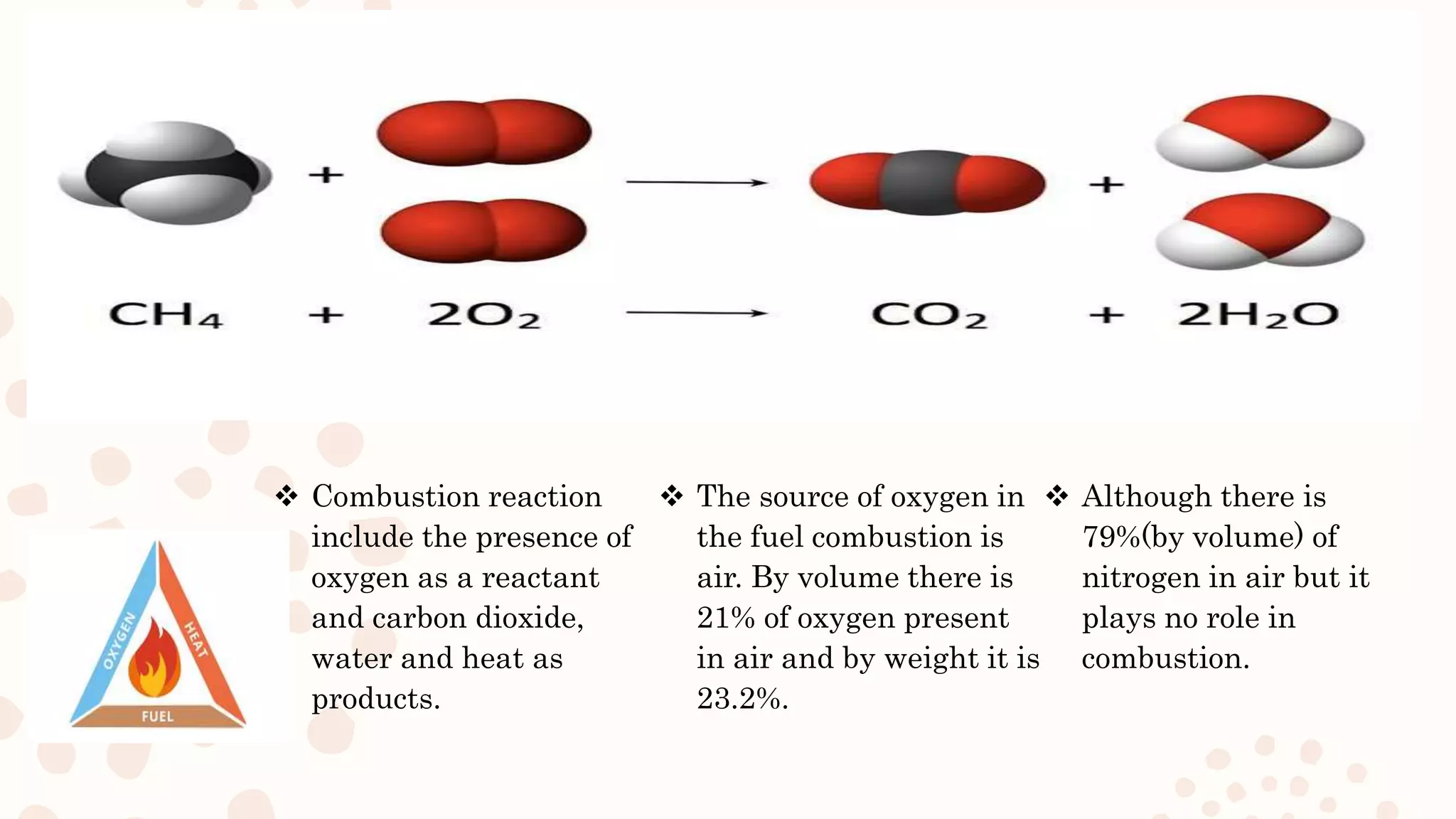
 Combustion reaction
include the presence of
oxygen as a reactant
and carbon dioxide,
water and heat as
products.
 The source of oxygen in
the fuel combustion is
air. By volume there is
21% of oxygen present
in air and by weight it is
23.2%.
 Although there is
79%(by volume) of
nitrogen in air but it
plays no role in
combustion.
CHEMISTRY OF COMBUSTION
 All fuels contain combustible elements. The main combustible elements in coal are Carbon ,
Hydrogen and small amount of Sulphur. Petroleum's , gases and the volatile portions of coal
contain hydrocarbons and some carbon monoxide.
 When these combustible elements combine chemically with oxygen present in air supplied for
combustion, energy is liberated with in the boilers, cylinder of i.c. engine and the combustion
chambers of gas turbines.
 To calculate the amount of air required for complete combustion of a fuel, its chemical analysis,
atomic and molecular weights of its constituents must be known.
CHEMICAL REACTION BETWEEN O2 AND COMBUSTIBLE ELEMENTS OF
COAL
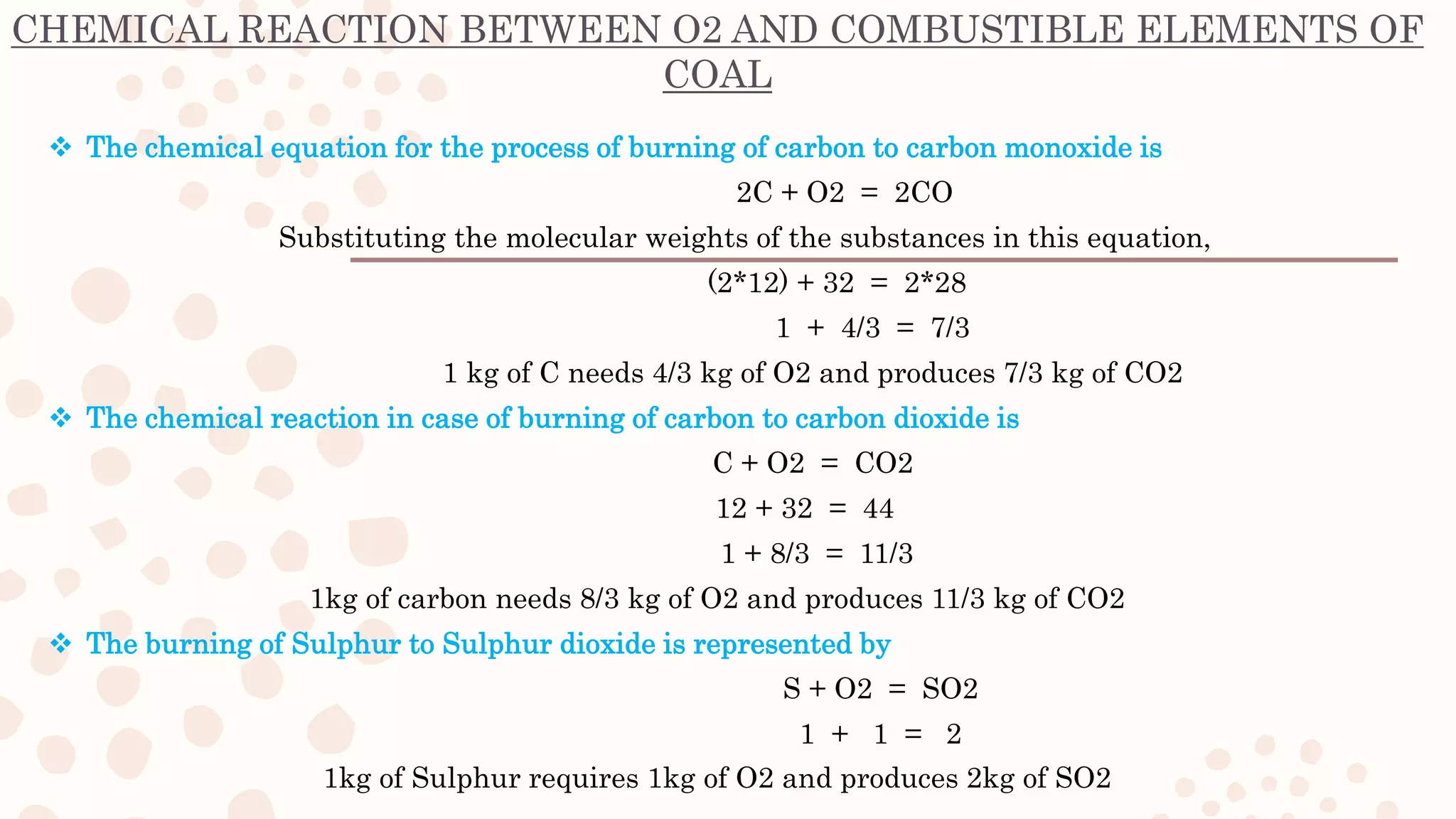
 The chemical equation for the process of burning of carbon to carbon monoxide is
2C + O2 = 2CO
Substituting the molecular weights of the substances in this equation,
(2*12) + 32 = 2*28
1 + 4/3 = 7/3
1 kg of C needs 4/3 kg of O2 and produces 7/3 kg of CO2
 The chemical reaction in case of burning of carbon to carbon dioxide is
C + O2 = CO2
12 + 32 = 44
1 + 8/3 = 11/3
1kg of carbon needs 8/3 kg of O2 and produces 11/3 kg of CO2
 The burning of Sulphur to Sulphur dioxide is represented by
S + O2 = SO2
1 + 1 = 2
1kg of Sulphur requires 1kg of O2 and produces 2kg of SO2
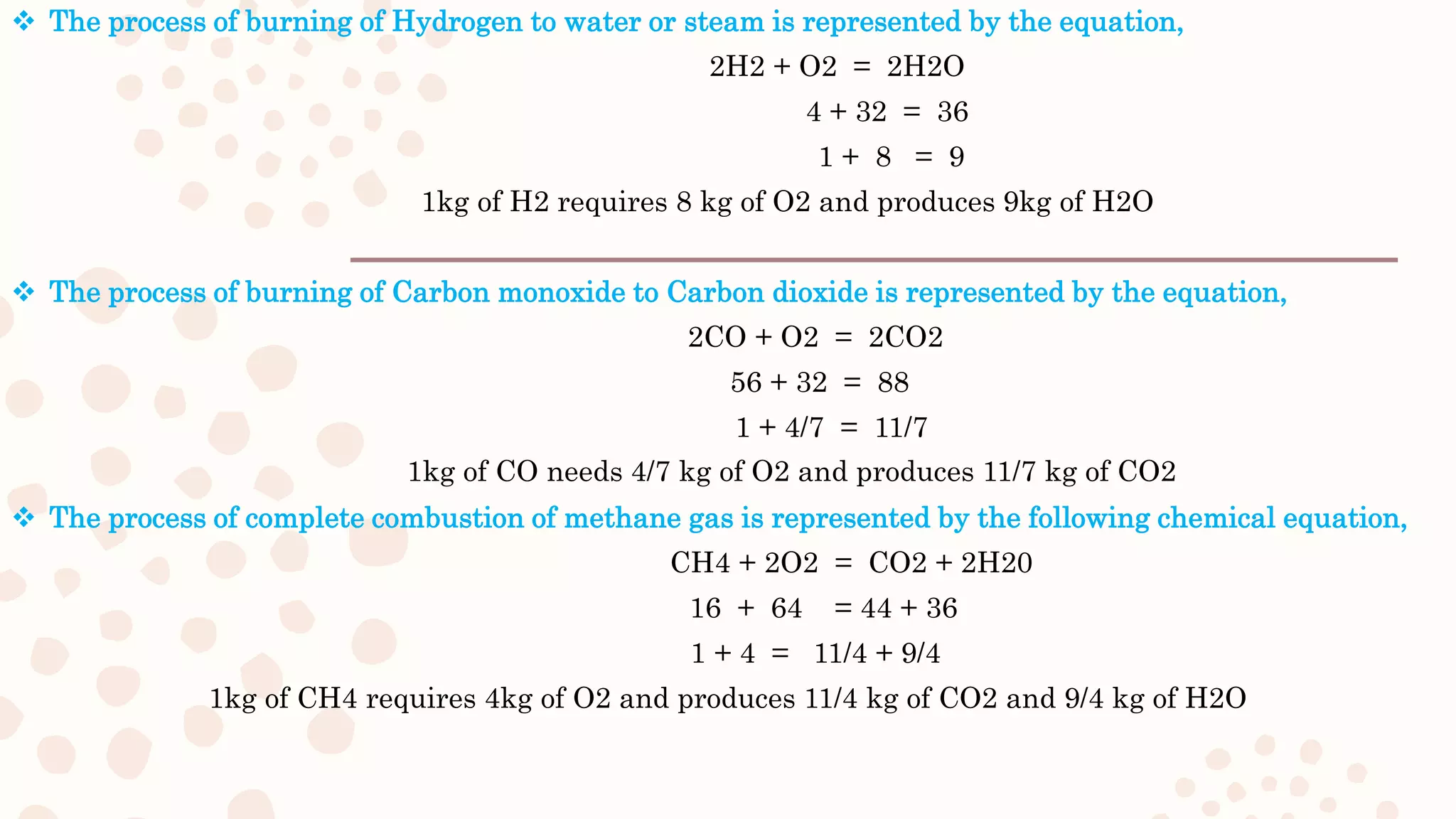
 The process of burning of Hydrogen to water or steam is represented by the equation,
2H2 + O2 = 2H2O
4 + 32 = 36
1 + 8 = 9
1kg of H2 requires 8 kg of O2 and produces 9kg of H2O
 The process of burning of Carbon monoxide to Carbon dioxide is represented by the equation,
2CO + O2 = 2CO2
56 + 32 = 88
1 + 4/7 = 11/7
1kg of CO needs 4/7 kg of O2 and produces 11/7 kg of CO2
 The process of complete combustion of methane gas is represented by the following chemical equation,
CH4 + 2O2 = CO2 + 2H20
16 + 64 = 44 + 36
1 + 4 = 11/4 + 9/4
1kg of CH4 requires 4kg of O2 and produces 11/4 kg of CO2 and 9/4 kg of H2O
References:
 Power plant engineering by Black and Veatch (G. Scott Stallard
and Todd S. Jonas)
 Power plant engineering by PC. Sharma 7th Edition
 Anne Marie Helmenstine, Ph.D. (Updated July 03, 2017)
(https://www.thoughtco.com/combustion-reactions-604030)

Combustion reactions of coal

  • 1.
  • 2.
    COMBUSTION REACTION  ACombustion reaction is a major class of chemical reactions, commonly referred to as "burning".  Combustion usually occurs when a hydrocarbon reacts with oxygen to produce carbon dioxide and water. hydrocarbon + oxygen → carbon dioxide + water  Combustion is an exothermic reaction, so it releases heat, but sometimes the reaction proceeds so slowly that a temperature change is not noticeable.
  • 3.
     Combustion reaction includethe presence of oxygen as a reactant and carbon dioxide, water and heat as products.  The source of oxygen in the fuel combustion is air. By volume there is 21% of oxygen present in air and by weight it is 23.2%.  Although there is 79%(by volume) of nitrogen in air but it plays no role in combustion.
  • 4.
    CHEMISTRY OF COMBUSTION All fuels contain combustible elements. The main combustible elements in coal are Carbon , Hydrogen and small amount of Sulphur. Petroleum's , gases and the volatile portions of coal contain hydrocarbons and some carbon monoxide.  When these combustible elements combine chemically with oxygen present in air supplied for combustion, energy is liberated with in the boilers, cylinder of i.c. engine and the combustion chambers of gas turbines.  To calculate the amount of air required for complete combustion of a fuel, its chemical analysis, atomic and molecular weights of its constituents must be known.
  • 6.
    CHEMICAL REACTION BETWEENO2 AND COMBUSTIBLE ELEMENTS OF COAL  The chemical equation for the process of burning of carbon to carbon monoxide is 2C + O2 = 2CO Substituting the molecular weights of the substances in this equation, (2*12) + 32 = 2*28 1 + 4/3 = 7/3 1 kg of C needs 4/3 kg of O2 and produces 7/3 kg of CO2  The chemical reaction in case of burning of carbon to carbon dioxide is C + O2 = CO2 12 + 32 = 44 1 + 8/3 = 11/3 1kg of carbon needs 8/3 kg of O2 and produces 11/3 kg of CO2  The burning of Sulphur to Sulphur dioxide is represented by S + O2 = SO2 1 + 1 = 2 1kg of Sulphur requires 1kg of O2 and produces 2kg of SO2
  • 7.
     The processof burning of Hydrogen to water or steam is represented by the equation, 2H2 + O2 = 2H2O 4 + 32 = 36 1 + 8 = 9 1kg of H2 requires 8 kg of O2 and produces 9kg of H2O  The process of burning of Carbon monoxide to Carbon dioxide is represented by the equation, 2CO + O2 = 2CO2 56 + 32 = 88 1 + 4/7 = 11/7 1kg of CO needs 4/7 kg of O2 and produces 11/7 kg of CO2  The process of complete combustion of methane gas is represented by the following chemical equation, CH4 + 2O2 = CO2 + 2H20 16 + 64 = 44 + 36 1 + 4 = 11/4 + 9/4 1kg of CH4 requires 4kg of O2 and produces 11/4 kg of CO2 and 9/4 kg of H2O
  • 8.
    References:  Power plantengineering by Black and Veatch (G. Scott Stallard and Todd S. Jonas)  Power plant engineering by PC. Sharma 7th Edition  Anne Marie Helmenstine, Ph.D. (Updated July 03, 2017) (https://www.thoughtco.com/combustion-reactions-604030)