F – BLOCK ELEMENT
(n-2)f
Introduction
• Penultimate (n -1)d
• prepenultimate (n -2)f
• Inner transition element- e- use is both shell.
• Intermediate behavior like d- block element.
• 2 series of f- block element-
• Lanthanide series – our main topic.
• actinide series- radioactive.
Lanthanide series
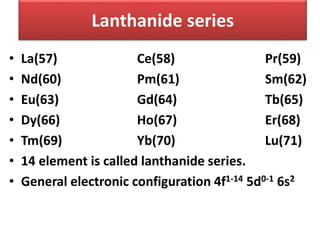
• La(57) Ce(58) Pr(59)
• Nd(60) Pm(61) Sm(62)
• Eu(63) Gd(64) Tb(65)
• Dy(66) Ho(67) Er(68)
• Tm(69) Yb(70) Lu(71)
• 14 element is called lanthanide series.
• General electronic configuration 4f1-14 5d0-1 6s2
Ln Greek hidden
Lanthanum, a
“rare earth” is
used in camera
lenses amongst
other things.
Lanthanum is
found in uranium
minerals
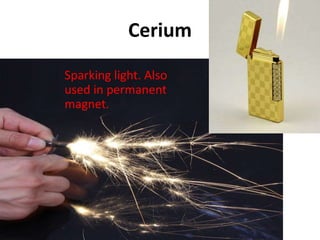
Cerium
Sparking light. Also
used in permanent
magnet.
Praseodymium
Praseodymium
Neodymium
Neodymium- strong magnet
Neodymium
Europeium
• Europium is used to
produce blue, red and
white radiances in
computer monitors
and television screens.
It is also used in
energy efficient light
bulbs.
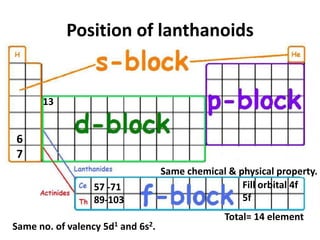
Position of lanthanoids
13
6
7
57 -71
89-103
Total= 14 element
Same no. of valency 5d1 and 6s2.
Same chemical & physical property.
Fill orbital 4f
5f
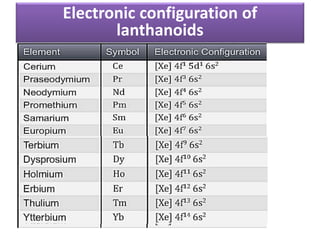
Electronic configuration of
lanthanoids
• E.C Based on aufbau principle .
La (57)
1s2 2s2 2p6 3s2 3p6 3d10 4s2 4p6 4d10 5s2 5p6 5d1 6s2
[Xe] – 54
1s2 2s2 2p6 3s2 3p6 3d10 4s2 4p6 4d10 5s2 5p6
The electronic configuration of Ln is
[Xe] 4f0 5d1 6s2 or [Xe] 4f0
Similarly Ce- 4f1, Pr- 4f2,……… Lu-4f14.(expected)
but observed E.C is not true for all element.
Electronic configuration of
lanthanoids
Oxidation state
• Common oxidation state is +3 more stable.
• Loses of two 6s electron and one 5d or 4f
electron.
• Some either show +2 or +4 Oxidation state.
• Ln [Xe] 4f0 5d1 6s2 and Ln+3 [Xe]4f0 5d0 6s0
Ln, Pm, Ho, Eb, Lu +3
Ce, Pr, Tb, Dy +3, +4
Sm, Eu, Tm, Yb +2, +3
Nd, +2, +3, +3
Chemical reactivity of Lanthanids
1. Carbides-C
2. Hydrides- H2
3. Oxides- O2
4. Reaction with nitrogen
5. Reaction with mineral acids
6. Reaction with water
7. Reaction with sulphure
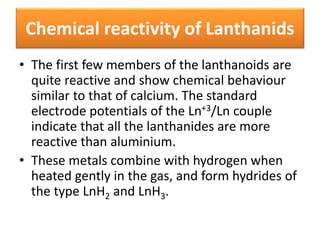
• The first few members of the lanthanoids are
quite reactive and show chemical behaviour
similar to that of calcium. The standard
electrode potentials of the Ln+3/Ln couple
indicate that all the lanthanides are more
reactive than aluminium.
• These metals combine with hydrogen when
heated gently in the gas, and form hydrides of
the type LnH2 and LnH3.
Chemical reactivity of Lanthanids
• lanthanoids (Ln)
Ln + 3H2 → 2LnH3
lanthanoid Hydrogen Lanthanoid hydride
2Ln + 3O2 → 2Ln2O3
lanthanoid Oxygen Lanthanoid Oxide
• The oxide Ln2O3 react with water to form insoluble
hydroxides.
Ln2O3 + 3H2O → 2Ln(OH)3
Ln2O3 + 3CO2 → Ln2(CO3)3
Chemical reactivity of Lanthanids
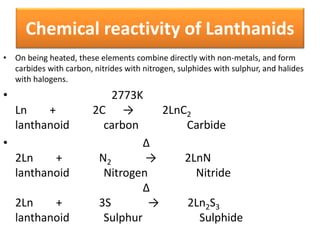
• On being heated, these elements combine directly with non-metals, and form
carbides with carbon, nitrides with nitrogen, sulphides with sulphur, and halides
with halogens.
• 2773K
Ln + 2C → 2LnC2
lanthanoid carbon Carbide
• Δ
2Ln + N2 → 2LnN
lanthanoid Nitrogen Nitride
Δ
2Ln + 3S → 2Ln2S3
lanthanoid Sulphur Sulphide
Chemical reactivity of Lanthanids
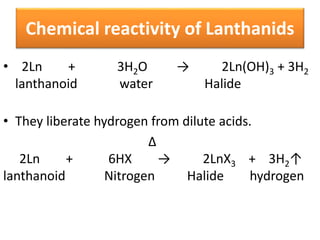
• 2Ln + 3H2O → 2Ln(OH)3 + 3H2
lanthanoid water Halide
• They liberate hydrogen from dilute acids.
Δ
2Ln + 6HX → 2LnX3 + 3H2↑
lanthanoid Nitrogen Halide hydrogen
Chemical reactivity of Lanthanids
Lanthanoid contraction and
its consequences
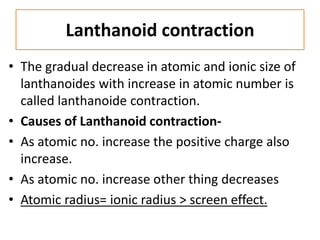
Lanthanoid contraction
• The gradual decrease in atomic and ionic size of
lanthanoides with increase in atomic number is
called lanthanoide contraction.
• Causes of Lanthanoid contraction-
• As atomic no. increase the positive charge also
increase.
• As atomic no. increase other thing decreases
• Atomic radius= ionic radius > screen effect.
Effects of Lanthanoid contraction
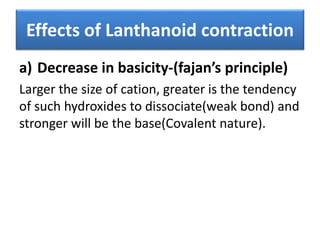
a) Decrease in basicity-(fajan’s principle)
Larger the size of cation, greater is the tendency
of such hydroxides to dissociate(weak bond) and
stronger will be the base(Covalent nature).
• b) Ionic radii of post lanthanoids
• The element which follow the lanthanoids in the
third transition series are known as post
lanthanoids.
• The ionic radii of the element which follow
lanthanium(Hf, Ta, W, etc) are similar to that of
the element of previous period.
• There is normal increase in size Sc to Y to La.
Effects of Lanthanoid contraction
Group
Series ↓
4 5 6 7
1st transition Ti(132pm) V(122pm) Cr(106pm) Mn(94pm)
2nd transition Zr(145pm) Nb(134pm) Mo(129pm) Tc(114pm)
3rd transition Hf(144pm) Ta(134pm) W(130pm) Re(114pm)
Effects of Lanthanoid contraction
This are similar no. of valency and property is
called chemical twins.
Actinoids
• 7 period and actinide series.
• Electron enter in 5f orbital.
• Many physical and chemical property are
similar to actinium(actinoids).
• Second inner transition element.
• Outermost and penultimate shell remain the
same.
• General E.C 5f1-10 6d0-1 7s2
Actinide
• Np(93)- Neptune Pu(94)
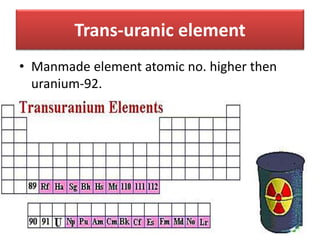
Trans-uranic element
• Manmade element atomic no. higher then
uranium-92.
Electronic configuration
• Ac (89)-
1s22s22p63s23p63d104s24p64d105s25p64f145d106s26
p66d17s2.
• [Rn]- 86
• 1s22s22p63s23p63d104s24p64d105s25p64f145d106s26
p6
• Ac electronic configuration is
• [Rn] 6d17s2 or [Rn] 5f0 6d1 7s2
• 6d and 7s electron is same only 5f electron
change by increasing order. Th(90)- [Rn] 5f1,……..
5f10.
Electronic configuration
Oxidation state of actinoids
• Common oxidation state is +3.
• Np+3, Pu+3 get oxidised Np+4,Pu+4 in aqs
soln. some become stable some unstable.
Ac Th Pa U Np Am Cm Bk Cf Es Fm Md No Lr
2 2 2
3 3 3 3 3 3 3 3 3 3 3 3 3 3
4 4 4 4 4 4 4 4
5 5 5 5 5
6 6 6 6
7 7
Comparison between lanthanoids and
actinoids

F block element

  • 1.
    F – BLOCKELEMENT (n-2)f
  • 2.
    Introduction • Penultimate (n-1)d • prepenultimate (n -2)f • Inner transition element- e- use is both shell. • Intermediate behavior like d- block element. • 2 series of f- block element- • Lanthanide series – our main topic. • actinide series- radioactive.
  • 3.
    Lanthanide series • La(57)Ce(58) Pr(59) • Nd(60) Pm(61) Sm(62) • Eu(63) Gd(64) Tb(65) • Dy(66) Ho(67) Er(68) • Tm(69) Yb(70) Lu(71) • 14 element is called lanthanide series. • General electronic configuration 4f1-14 5d0-1 6s2
  • 4.
    Ln Greek hidden Lanthanum,a “rare earth” is used in camera lenses amongst other things. Lanthanum is found in uranium minerals
  • 5.
  • 6.
  • 7.
  • 8.
  • 9.
  • 10.
  • 11.
  • 12.
    • Europium isused to produce blue, red and white radiances in computer monitors and television screens. It is also used in energy efficient light bulbs.
  • 13.
    Position of lanthanoids 13 6 7 57-71 89-103 Total= 14 element Same no. of valency 5d1 and 6s2. Same chemical & physical property. Fill orbital 4f 5f
  • 14.
    Electronic configuration of lanthanoids •E.C Based on aufbau principle . La (57) 1s2 2s2 2p6 3s2 3p6 3d10 4s2 4p6 4d10 5s2 5p6 5d1 6s2 [Xe] – 54 1s2 2s2 2p6 3s2 3p6 3d10 4s2 4p6 4d10 5s2 5p6 The electronic configuration of Ln is [Xe] 4f0 5d1 6s2 or [Xe] 4f0 Similarly Ce- 4f1, Pr- 4f2,……… Lu-4f14.(expected) but observed E.C is not true for all element.
  • 15.
  • 16.
    Oxidation state • Commonoxidation state is +3 more stable. • Loses of two 6s electron and one 5d or 4f electron. • Some either show +2 or +4 Oxidation state. • Ln [Xe] 4f0 5d1 6s2 and Ln+3 [Xe]4f0 5d0 6s0 Ln, Pm, Ho, Eb, Lu +3 Ce, Pr, Tb, Dy +3, +4 Sm, Eu, Tm, Yb +2, +3 Nd, +2, +3, +3
  • 17.
    Chemical reactivity ofLanthanids 1. Carbides-C 2. Hydrides- H2 3. Oxides- O2 4. Reaction with nitrogen 5. Reaction with mineral acids 6. Reaction with water 7. Reaction with sulphure
  • 18.
    • The firstfew members of the lanthanoids are quite reactive and show chemical behaviour similar to that of calcium. The standard electrode potentials of the Ln+3/Ln couple indicate that all the lanthanides are more reactive than aluminium. • These metals combine with hydrogen when heated gently in the gas, and form hydrides of the type LnH2 and LnH3. Chemical reactivity of Lanthanids
  • 19.
    • lanthanoids (Ln) Ln+ 3H2 → 2LnH3 lanthanoid Hydrogen Lanthanoid hydride 2Ln + 3O2 → 2Ln2O3 lanthanoid Oxygen Lanthanoid Oxide • The oxide Ln2O3 react with water to form insoluble hydroxides. Ln2O3 + 3H2O → 2Ln(OH)3 Ln2O3 + 3CO2 → Ln2(CO3)3 Chemical reactivity of Lanthanids
  • 20.
    • On beingheated, these elements combine directly with non-metals, and form carbides with carbon, nitrides with nitrogen, sulphides with sulphur, and halides with halogens. • 2773K Ln + 2C → 2LnC2 lanthanoid carbon Carbide • Δ 2Ln + N2 → 2LnN lanthanoid Nitrogen Nitride Δ 2Ln + 3S → 2Ln2S3 lanthanoid Sulphur Sulphide Chemical reactivity of Lanthanids
  • 21.
    • 2Ln +3H2O → 2Ln(OH)3 + 3H2 lanthanoid water Halide • They liberate hydrogen from dilute acids. Δ 2Ln + 6HX → 2LnX3 + 3H2↑ lanthanoid Nitrogen Halide hydrogen Chemical reactivity of Lanthanids
  • 22.
  • 23.
    Lanthanoid contraction • Thegradual decrease in atomic and ionic size of lanthanoides with increase in atomic number is called lanthanoide contraction. • Causes of Lanthanoid contraction- • As atomic no. increase the positive charge also increase. • As atomic no. increase other thing decreases • Atomic radius= ionic radius > screen effect.
  • 24.
    Effects of Lanthanoidcontraction a) Decrease in basicity-(fajan’s principle) Larger the size of cation, greater is the tendency of such hydroxides to dissociate(weak bond) and stronger will be the base(Covalent nature).
  • 25.
    • b) Ionicradii of post lanthanoids • The element which follow the lanthanoids in the third transition series are known as post lanthanoids. • The ionic radii of the element which follow lanthanium(Hf, Ta, W, etc) are similar to that of the element of previous period. • There is normal increase in size Sc to Y to La. Effects of Lanthanoid contraction
  • 26.
    Group Series ↓ 4 56 7 1st transition Ti(132pm) V(122pm) Cr(106pm) Mn(94pm) 2nd transition Zr(145pm) Nb(134pm) Mo(129pm) Tc(114pm) 3rd transition Hf(144pm) Ta(134pm) W(130pm) Re(114pm) Effects of Lanthanoid contraction This are similar no. of valency and property is called chemical twins.
  • 27.
    Actinoids • 7 periodand actinide series. • Electron enter in 5f orbital. • Many physical and chemical property are similar to actinium(actinoids). • Second inner transition element. • Outermost and penultimate shell remain the same. • General E.C 5f1-10 6d0-1 7s2
  • 28.
  • 29.
    Trans-uranic element • Manmadeelement atomic no. higher then uranium-92.
  • 30.
    Electronic configuration • Ac(89)- 1s22s22p63s23p63d104s24p64d105s25p64f145d106s26 p66d17s2. • [Rn]- 86 • 1s22s22p63s23p63d104s24p64d105s25p64f145d106s26 p6 • Ac electronic configuration is • [Rn] 6d17s2 or [Rn] 5f0 6d1 7s2 • 6d and 7s electron is same only 5f electron change by increasing order. Th(90)- [Rn] 5f1,…….. 5f10.
  • 31.
  • 32.
    Oxidation state ofactinoids • Common oxidation state is +3. • Np+3, Pu+3 get oxidised Np+4,Pu+4 in aqs soln. some become stable some unstable. Ac Th Pa U Np Am Cm Bk Cf Es Fm Md No Lr 2 2 2 3 3 3 3 3 3 3 3 3 3 3 3 3 3 4 4 4 4 4 4 4 4 5 5 5 5 5 6 6 6 6 7 7
  • 33.

Editor's Notes

  • #34 Oxocations are the polyatomic cations contain one or more oxygen atoms.Example: VO +, VO2 +, TO2 + etc Binding energy- molecuel ko combine hone me jo energy kharch hoti hair use B.E.