


PSYCHOANALYSIS
Presented by:
Mary Anne A. Portuguez
MP-IP-1
BRIEF BACKGROUND
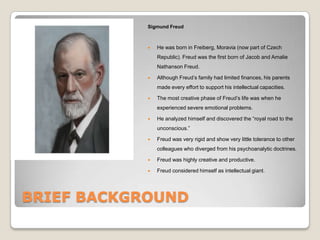
Sigmund Freud
 He was born in Freiberg, Moravia (now part of Czech
Republic). Freud was the first born of Jacob and Amalie
Nathanson Freud.
 Although Freud’s family had limited finances, his parents
made every effort to support his intellectual capacities.
 The most creative phase of Freud’s life was when he
experienced severe emotional problems.
 He analyzed himself and discovered the “royal road to the
unconscious.”
 Freud was very rigid and show very little tolerance to other
colleagues who diverged from his psychoanalytic doctrines.
 Freud was highly creative and productive.
 Freud considered himself as intellectual giant.
VIEW OF HUMAN NATURE
 Freud basically views the human nature as
deterministic. (Corey, 2009).
 Freud was mostly neutral or pessimistic about the
nature of humans. (Flanagan & Flanagan, 2004).
 According to six dimensions (Feist &
Feist, 2009), Freud’s view of human nature can be
summarized as follows:
deterministic, causal, pessimistic, unconscious, biolog
ical and both unique/similar.
THERAPEUTIC PROCESS
◦ To make the unconscious conscious or increase client
awareness.
◦ To help the client develop greater ego-control or self-control
over unhealthy or maladaptive impulses.
◦ To help the client dispose of maladaptive or unhealthy
internalized objects and replace them with more adaptive
internalized objects.
◦ To repair self-defects through mirroring, presenting a
potentially idealized object, and expressing empathy during
optimal therapeutic failures.
THERAPEUTIC TECHNIQUES
There are number of techniques that evolve over time
in order to accommodate the dynamic individual and to
help the counselor in facilitating deeper understanding by
counselees and these are the following:
 Creating trusting atmosphere, free association
 Interpretation of resistance
 Dream analysis
 Interpretation of parapraxes
 Interpretation of the transference relationship
 Creating Trusting Atmosphere
All external stimuli are minimized.
 Free Association
The basic rule in traditional psychoanalysis, “Say whatever comes to
mind.” This is designed to facilitate emergence of unconscious
impulses and conflicts.
>The patient’s internal stimuli are minimized.
>Cognitive selection or conscious planning is reduced.
 Dream Analysis
An important procedure for uncovering unconscious material and
giving the client insight into some areas of unresolved problems
(Corey, 2009).
 Interpretation of Parapraxes
Parapraxes is a general term for minor errors such as slips of the
tongue, mistakes in writing, motor movements, forgetting things,
and small accidents. Freud called such phenomena the
“Psychopathology of Everyday Life” and attributed them to the
unconscious forces (Chaplin, 1985).
 Interpretation of the Transference Relationships
Transference is a client distortion that involves re-
experiencing Oedipal issues in the therapeutic relationship.
Countertransference is the therapist’s tendency to see the
client in terms of his or her own previous relationships.
This is a negative factor in therapy. “Recognize this
counter-transference…and overcome it. No psychoanalyst
goes further than his own complexes and internal
resistances permit.”
CULTURAL ISSUES
 Freud was a member of a western society, dominated by males.
He came from the majority of European well-off males, and so his
approach of viewing things came from his membership of this
kind of class
 he was a Jew who faced an ongoing prejudice among people in
Vienna. He was struggling with conflicts between his cultural
heritages as well as his religion and the pervasive influence of
anti-Semitism during his time
 Freud’s theory grew out based on a small and unrepresentative
sample of people, restricted to him and to those who sought
psychoanalysis with him.
SOCIAL ISSUES
In relation to women, some feminists have challenged
Freud’s view of women, suggesting he looked at them as
second-class citizens who were somehow lacking as
compared to his male companions (Neukrug, 2011).
Given his upbringing during the middle of the 19th
century, parental acceptance of his domination of his
sisters, a tendency to exaggerate differences between
women and men, and his belief that women inhabited the
dark continent of humanity, it seems unlikely that Freud
possessed the essential experiences to understand women
(Feist & Feist, 2009).
SPIRITUAL ISSUES
Freud admitted that he was an atheist. Although
an Atheist, he had complex views of religion.
According to him, belief in God was partly remnants
of projections from early tribes. He believed that
early tribes needed to find an external force that
would control their primal urges. In order to do
so, they find a way to prevent in killing one another
which is to create a God to pray to and to bestow
everything to God as an agent to control their internal
drives.
KEY CONCEPTS
 UNCONSCIOUS AND CONSCIOUS
Freud’s greatest contribution is his exploration of the unconscious and his
insistence that people are motivated primarily by drives of which they have little or no
awareness (Feist & Feist, 2009).
 STRUCTURE OF PERSONALITY
The personality consists of three systems: the id, the ego, and the superego. These
are names for psychological structures and should not be thought of as manikins that
separately operate the personality; one’s personality functions as a whole rather than as
three discrete segments. The id is the biological component, the ego is the psychological
component, and the superego is the social component (Corey, 2009).
 DRIVES AND INSTINCTS
According to Freud, humans are born with coexisting instincts namely life instincts
(Eros) and death instinct (Thanatos). The life instinct functions to meet basic needs for
love and intimacy, sex, and survival of the individual and species. He believed that the aim
of life is death (Neukrug, 2011).
Instincts are raw, possesses no conscience, and are largely unconscious. Thus,
humans must find ways to restrict these especially if living in the civilized world.
KEY CONCEPTS
 ANXIETY
Anxiety is a feeling of dread that results from repressed feelings, memories, desires, and
experience that emerge to the surface of awareness. It can be considered as a state of tension
that motivates us to do something (Corey, 2009).
 EGO DEFENSE MECHANISMS
It serve a useful function by protecting the ego against this kind of conflict or pain of anxiety
(Feist & Feist, 2009). Ego defenses are normal behaviors that can have adaptive value provided
they do not become a style of life that enables the individual to avoid facing reality (Corey, 2009).
 PSYCHOSEXUAL STAGES OF DEVELOPMENT
One of Freud’s contributions is that he believed that childhood experiences strongly
influence adult personality. Personality development involves a series of conflicts between
individual, who wants to satisfy his or her instinctual impulses, and the social environment
(especially the family), which restricts this kind of desire. Through development, the individual
finds ways to get as much hedonic gratification as possible, given the constraints in society. These
adaptational strategies constitute the personality (Cloniger, 2004). These stages are known
known as Oral phase, Anal phase, Phallic phase, Latency Period, Genital Period.
Useful Resources for further
Readings
 Campbell, J.B. et. al. Theories of Personality. John Wiley & Sons, Inc.: Canada. 2004.
 Chaplin, J.P. Dictionary of Psychology. Bantam Dell: Canada. 1986.
 Cloninger, S. Theories of Personality: Understanding Persons. Pearson Education, Inc: New Jersey.
2004.
 Corey, G. Theory and Practice of Counseling and Psychotherapy. Thomson Brooks/Cole: USA.
2009.
 Feist, G. & Feist, G. Theories of Personality. McGraw-Hill Companies Inc.: USA. 2008.
 Flanagan, J. & Flanagan, R. Counseling and Psychotherapy Theories in Context and Practice. John
Wiley & Sons, Inc. : New Jersey. 2004.
 Neukrug, E. Counseling Theory and Practice. Brookes/Cole, Cengage Learning. 2010.
 Schultz, D. & Schultz, S. Theories of Personality. Wadsworth: United States of America. 2005.
 Scaturo, D. J. The evolution of psychotherapy and the concept of manualization: An integrative
perspective. Professional Psychology: Research and Practice, 32(5), 522-530. doi: 10.1037//0735-
7028.32.5.522. 2001.
 Shedler, J. The efficacy of psychodynamic psychotherapy. American Psychologist, 65(2), 98-109.
doi: 10.1037/a0018378. 2010.

Psychoanalysis ppt

  • 1.
  • 2.
    BRIEF BACKGROUND Sigmund Freud He was born in Freiberg, Moravia (now part of Czech Republic). Freud was the first born of Jacob and Amalie Nathanson Freud.  Although Freud’s family had limited finances, his parents made every effort to support his intellectual capacities.  The most creative phase of Freud’s life was when he experienced severe emotional problems.  He analyzed himself and discovered the “royal road to the unconscious.”  Freud was very rigid and show very little tolerance to other colleagues who diverged from his psychoanalytic doctrines.  Freud was highly creative and productive.  Freud considered himself as intellectual giant.
  • 3.
    VIEW OF HUMANNATURE  Freud basically views the human nature as deterministic. (Corey, 2009).  Freud was mostly neutral or pessimistic about the nature of humans. (Flanagan & Flanagan, 2004).  According to six dimensions (Feist & Feist, 2009), Freud’s view of human nature can be summarized as follows: deterministic, causal, pessimistic, unconscious, biolog ical and both unique/similar.
  • 4.
    THERAPEUTIC PROCESS ◦ Tomake the unconscious conscious or increase client awareness. ◦ To help the client develop greater ego-control or self-control over unhealthy or maladaptive impulses. ◦ To help the client dispose of maladaptive or unhealthy internalized objects and replace them with more adaptive internalized objects. ◦ To repair self-defects through mirroring, presenting a potentially idealized object, and expressing empathy during optimal therapeutic failures.
  • 5.
    THERAPEUTIC TECHNIQUES There arenumber of techniques that evolve over time in order to accommodate the dynamic individual and to help the counselor in facilitating deeper understanding by counselees and these are the following:  Creating trusting atmosphere, free association  Interpretation of resistance  Dream analysis  Interpretation of parapraxes  Interpretation of the transference relationship
  • 6.
     Creating TrustingAtmosphere All external stimuli are minimized.  Free Association The basic rule in traditional psychoanalysis, “Say whatever comes to mind.” This is designed to facilitate emergence of unconscious impulses and conflicts. >The patient’s internal stimuli are minimized. >Cognitive selection or conscious planning is reduced.
  • 7.
     Dream Analysis Animportant procedure for uncovering unconscious material and giving the client insight into some areas of unresolved problems (Corey, 2009).  Interpretation of Parapraxes Parapraxes is a general term for minor errors such as slips of the tongue, mistakes in writing, motor movements, forgetting things, and small accidents. Freud called such phenomena the “Psychopathology of Everyday Life” and attributed them to the unconscious forces (Chaplin, 1985).
  • 8.
     Interpretation ofthe Transference Relationships Transference is a client distortion that involves re- experiencing Oedipal issues in the therapeutic relationship. Countertransference is the therapist’s tendency to see the client in terms of his or her own previous relationships. This is a negative factor in therapy. “Recognize this counter-transference…and overcome it. No psychoanalyst goes further than his own complexes and internal resistances permit.”
  • 9.
    CULTURAL ISSUES  Freudwas a member of a western society, dominated by males. He came from the majority of European well-off males, and so his approach of viewing things came from his membership of this kind of class  he was a Jew who faced an ongoing prejudice among people in Vienna. He was struggling with conflicts between his cultural heritages as well as his religion and the pervasive influence of anti-Semitism during his time  Freud’s theory grew out based on a small and unrepresentative sample of people, restricted to him and to those who sought psychoanalysis with him.
  • 10.
    SOCIAL ISSUES In relationto women, some feminists have challenged Freud’s view of women, suggesting he looked at them as second-class citizens who were somehow lacking as compared to his male companions (Neukrug, 2011). Given his upbringing during the middle of the 19th century, parental acceptance of his domination of his sisters, a tendency to exaggerate differences between women and men, and his belief that women inhabited the dark continent of humanity, it seems unlikely that Freud possessed the essential experiences to understand women (Feist & Feist, 2009).
  • 11.
    SPIRITUAL ISSUES Freud admittedthat he was an atheist. Although an Atheist, he had complex views of religion. According to him, belief in God was partly remnants of projections from early tribes. He believed that early tribes needed to find an external force that would control their primal urges. In order to do so, they find a way to prevent in killing one another which is to create a God to pray to and to bestow everything to God as an agent to control their internal drives.
  • 12.
    KEY CONCEPTS  UNCONSCIOUSAND CONSCIOUS Freud’s greatest contribution is his exploration of the unconscious and his insistence that people are motivated primarily by drives of which they have little or no awareness (Feist & Feist, 2009).  STRUCTURE OF PERSONALITY The personality consists of three systems: the id, the ego, and the superego. These are names for psychological structures and should not be thought of as manikins that separately operate the personality; one’s personality functions as a whole rather than as three discrete segments. The id is the biological component, the ego is the psychological component, and the superego is the social component (Corey, 2009).  DRIVES AND INSTINCTS According to Freud, humans are born with coexisting instincts namely life instincts (Eros) and death instinct (Thanatos). The life instinct functions to meet basic needs for love and intimacy, sex, and survival of the individual and species. He believed that the aim of life is death (Neukrug, 2011). Instincts are raw, possesses no conscience, and are largely unconscious. Thus, humans must find ways to restrict these especially if living in the civilized world.
  • 13.
    KEY CONCEPTS  ANXIETY Anxietyis a feeling of dread that results from repressed feelings, memories, desires, and experience that emerge to the surface of awareness. It can be considered as a state of tension that motivates us to do something (Corey, 2009).  EGO DEFENSE MECHANISMS It serve a useful function by protecting the ego against this kind of conflict or pain of anxiety (Feist & Feist, 2009). Ego defenses are normal behaviors that can have adaptive value provided they do not become a style of life that enables the individual to avoid facing reality (Corey, 2009).  PSYCHOSEXUAL STAGES OF DEVELOPMENT One of Freud’s contributions is that he believed that childhood experiences strongly influence adult personality. Personality development involves a series of conflicts between individual, who wants to satisfy his or her instinctual impulses, and the social environment (especially the family), which restricts this kind of desire. Through development, the individual finds ways to get as much hedonic gratification as possible, given the constraints in society. These adaptational strategies constitute the personality (Cloniger, 2004). These stages are known known as Oral phase, Anal phase, Phallic phase, Latency Period, Genital Period.
  • 14.
    Useful Resources forfurther Readings  Campbell, J.B. et. al. Theories of Personality. John Wiley & Sons, Inc.: Canada. 2004.  Chaplin, J.P. Dictionary of Psychology. Bantam Dell: Canada. 1986.  Cloninger, S. Theories of Personality: Understanding Persons. Pearson Education, Inc: New Jersey. 2004.  Corey, G. Theory and Practice of Counseling and Psychotherapy. Thomson Brooks/Cole: USA. 2009.  Feist, G. & Feist, G. Theories of Personality. McGraw-Hill Companies Inc.: USA. 2008.  Flanagan, J. & Flanagan, R. Counseling and Psychotherapy Theories in Context and Practice. John Wiley & Sons, Inc. : New Jersey. 2004.  Neukrug, E. Counseling Theory and Practice. Brookes/Cole, Cengage Learning. 2010.  Schultz, D. & Schultz, S. Theories of Personality. Wadsworth: United States of America. 2005.  Scaturo, D. J. The evolution of psychotherapy and the concept of manualization: An integrative perspective. Professional Psychology: Research and Practice, 32(5), 522-530. doi: 10.1037//0735- 7028.32.5.522. 2001.  Shedler, J. The efficacy of psychodynamic psychotherapy. American Psychologist, 65(2), 98-109. doi: 10.1037/a0018378. 2010.