



GOALS & SCOPE
OF COUNSELING
GOALS
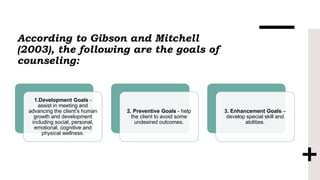
According to Gibson and Mitchell
(2003), the following are the goals of
counseling:
1.Development Goals -
assist in meeting and
advancing the client’s human
growth and development
including social, personal,
emotional, cognitive and
physical wellness.
2. Preventive Goals - help
the client to avoid some
undesired outcomes.
3. Enhancement Goals –
develop special skill and
abilities.
According to Gibson and Mitchell
(2003), the following are the goals of
counseling:
4. Remedial Goals –
assist the client to
overcome and treat an
undesirable
development.
5. Exploratory Goals –
examine the options,
test the skills and try
new and different
activities.
6. Reinforcement
Goals – help the client
in recognizing that what
they are doing, thinking,
and feeling is fine.
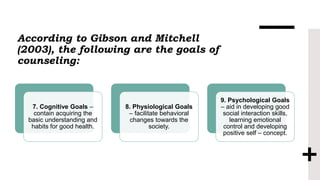
According to Gibson and Mitchell
(2003), the following are the goals of
counseling:
7. Cognitive Goals –
contain acquiring the
basic understanding and
habits for good health.
8. Physiological Goals
– facilitate behavioral
changes towards the
society.
9. Psychological Goals
– aid in developing good
social interaction skills,
learning emotional
control and developing
positive self – concept.
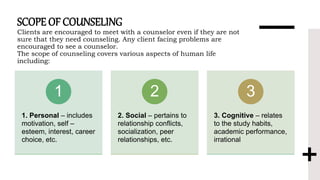
SCOPE OF COUNSELING
Clients are encouraged to meet with a counselor even if they are not
sure that they need counseling. Any client facing problems are
encouraged to see a counselor.
The scope of counseling covers various aspects of human life
including:
1. Personal – includes
motivation, self –
esteem, interest, career
choice, etc.
1
2. Social – pertains to
relationship conflicts,
socialization, peer
relationships, etc.
2
3. Cognitive – relates
to the study habits,
academic performance,
irrational
3
The scope of counseling
covers various aspects
of human life
including:
3. Cognitive – relates to
the study habits,
academic performance,
irrational thoughts, etc.
4. Behavioral – contains
absenteeism, bullying,
restlessness,
misbehavior, etc.
5. Psychological –
comprises of personality
development, stress, etc.
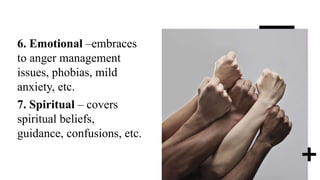
6. Emotional –embraces
to anger management
issues, phobias, mild
anxiety, etc.
7. Spiritual – covers
spiritual beliefs,
guidance, confusions, etc.
8. HEALTH - -
INCLUDES
WELLNESS, LIFE AND
WORK BALANCE,
LEISURE, ETC.
9. OCCUPATIONAL –
INDICATES WORK
AND CAREER
DECISIONS, ETC.
However, counseling does not deal
with the clinical cases such as
mental illness, requiring
medication and psychotherapy.
There are many approaches to help clients move towards
growth and problem-resolution. Often counselors will
provide them with opportunities to learn new skills and
coping mechanisms while also increasing their self-
understanding and insight. Counselors may also examine
past patterns to help them assess in a healthier way their
current/ past relationships, decision-making, and family
dynamics. With the help of their counselors, clients will
better understand their strengths and abilities to manage
life challenges which can be very important in achieving
their therapeutic goals.
BRING OUT
YOUR
ACTIVITY
NOTEBOOK!

GOALS & SCOPE OF COUNSELING

  • 1.
    GOALS & SCOPE OFCOUNSELING
  • 2.
  • 3.
    According to Gibsonand Mitchell (2003), the following are the goals of counseling: 1.Development Goals - assist in meeting and advancing the client’s human growth and development including social, personal, emotional, cognitive and physical wellness. 2. Preventive Goals - help the client to avoid some undesired outcomes. 3. Enhancement Goals – develop special skill and abilities.
  • 4.
    According to Gibsonand Mitchell (2003), the following are the goals of counseling: 4. Remedial Goals – assist the client to overcome and treat an undesirable development. 5. Exploratory Goals – examine the options, test the skills and try new and different activities. 6. Reinforcement Goals – help the client in recognizing that what they are doing, thinking, and feeling is fine.
  • 5.
    According to Gibsonand Mitchell (2003), the following are the goals of counseling: 7. Cognitive Goals – contain acquiring the basic understanding and habits for good health. 8. Physiological Goals – facilitate behavioral changes towards the society. 9. Psychological Goals – aid in developing good social interaction skills, learning emotional control and developing positive self – concept.
  • 6.
    SCOPE OF COUNSELING Clientsare encouraged to meet with a counselor even if they are not sure that they need counseling. Any client facing problems are encouraged to see a counselor. The scope of counseling covers various aspects of human life including: 1. Personal – includes motivation, self – esteem, interest, career choice, etc. 1 2. Social – pertains to relationship conflicts, socialization, peer relationships, etc. 2 3. Cognitive – relates to the study habits, academic performance, irrational 3
  • 7.
    The scope ofcounseling covers various aspects of human life including: 3. Cognitive – relates to the study habits, academic performance, irrational thoughts, etc. 4. Behavioral – contains absenteeism, bullying, restlessness, misbehavior, etc. 5. Psychological – comprises of personality development, stress, etc.
  • 8.
    6. Emotional –embraces toanger management issues, phobias, mild anxiety, etc. 7. Spiritual – covers spiritual beliefs, guidance, confusions, etc.
  • 9.
    8. HEALTH -- INCLUDES WELLNESS, LIFE AND WORK BALANCE, LEISURE, ETC. 9. OCCUPATIONAL – INDICATES WORK AND CAREER DECISIONS, ETC.
  • 10.
    However, counseling doesnot deal with the clinical cases such as mental illness, requiring medication and psychotherapy.
  • 11.
    There are manyapproaches to help clients move towards growth and problem-resolution. Often counselors will provide them with opportunities to learn new skills and coping mechanisms while also increasing their self- understanding and insight. Counselors may also examine past patterns to help them assess in a healthier way their current/ past relationships, decision-making, and family dynamics. With the help of their counselors, clients will better understand their strengths and abilities to manage life challenges which can be very important in achieving their therapeutic goals.
  • 12.