SIGMUND FREUD
PsychoanalyticTheory
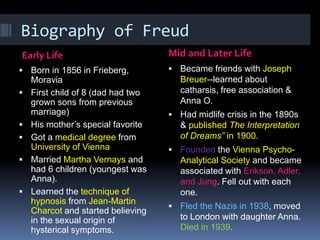
Biography of Freud
Early Life Mid and Later Life
 Born in 1856 in Frieberg,
Moravia
 First child of 8 (dad had two
grown sons from previous
marriage)
 His mother’s special favorite
 Got a medical degree from
University of Vienna
 Married Martha Vernays and
had 6 children (youngest was
Anna).
 Learned the technique of
hypnosis from Jean-Martin
Charcot and started believing
in the sexual origin of
hysterical symptoms.
 Became friends with Joseph
Breuer--learned about
catharsis, free association &
Anna O.
 Had midlife crisis in the 1890s
& published The Interpretation
of Dreams” in 1900.
 Founded the Vienna Psycho-
Analytical Society and became
associated with Erikson, Adler,
and Jung. Fell out with each
one.
 Fled the Nazis in 1938, moved
to London with daughter Anna.
Died in 1939.
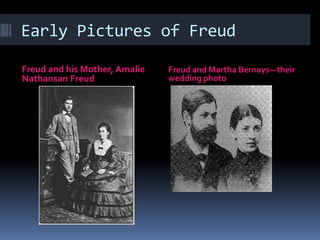
Early Pictures of Freud
Freud and his Mother, Amalie
Nathansan Freud
Freud and Martha Bernays—their
wedding photo
Freud's Psychoanalytic
Theory
 Based his model of human nature on the idea of
psychic energy—the source of energy within
each person that provides motivation
 Two assumptions about psychic energy:
 The amount one has remains constant throughout life
 Personality change can be viewed as a redirection of
the psychic energy
Research on ego depletion confirms that one seems to
have a limited amount of psychic energy and that self-
control in one area limits the amount of energy (or
control) you have for other areas.
Instincts
 The basic source of psychic energy are strong, innate
forces called instincts.
 Freud first thought the instincts were self-preservation
and the sexual instinct (based on Darwin).
 He later reviewed these into basic ones of life—libido—
and death—thanatos. They can work either in opposition
or together.
 Libido was basically sexual but referred to anything
pleasurable or life-sustaining.
 Thanatos refers to an urge to destroy, harm, or aggress
toward self or others.
Levels of Consciousness
 Three levels:
 Conscious—what we’re
thinking about right now
 Preconscious—what we
could be thinking about if
asked
 Unconscious—”seething
cauldron” of repressed
thoughts, desires, and
impulses.
Structure of the Personality
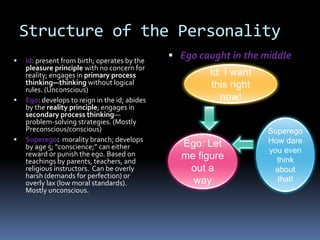
 Id: present from birth; operates by the
pleasure principle with no concern for
reality; engages in primary process
thinking—thinking without logical
rules. (Unconscious)
 Ego: develops to reign in the id; abides
by the reality principle; engages in
secondary process thinking—
problem-solving strategies. (Mostly
Preconscious/conscious)
 Superego: morality branch; develops
by age 5; “conscience;” can either
reward or punish the ego. Based on
teachings by parents, teachers, and
religious instructors. Can be overly
harsh (demands for perfection) or
overly lax (low moral standards).
Mostly unconscious.
 Ego caught in the middle
Id: I want
this right
now!
Ego: Let
me figure
out a
way
Superego
How dare
you even
think
about
that!
Anxiety
 Being caught in the middle
between the superego and id
makes the ego suffer anxiety.
 Anxiety is a signal that
something is wrong and that
the ego’s control is being
threatened.
 A well-balanced mind is the
result of having a strong ego
and is free from anxiety.
 Defense mechanisms help ego
cope with anxiety.
 Types of anxiety:
 Objective—real anxiety
based on external events
 Neurotic—occurs when
there’s a conflict between
the id and ego
 Moral—occurs when
there’s a conflict between
the ego and superego.
(Results in chronic shame
and guilt.)
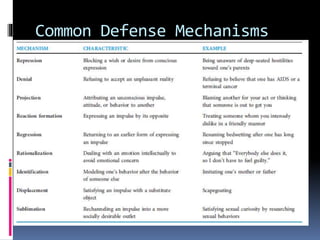
Common Defense Mechanisms
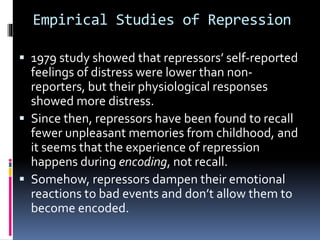
Empirical Studies of Repression
 1979 study showed that repressors’ self-reported
feelings of distress were lower than non-
reporters, but their physiological responses
showed more distress.
 Since then, repressors have been found to recall
fewer unpleasant memories from childhood, and
it seems that the experience of repression
happens during encoding, not recall.
 Somehow, repressors dampen their emotional
reactions to bad events and don’t allow them to
become encoded.
Theory of Psychosexual
Development
General Facts about the Stages
 Stage theory of development
 As sex instinct matures, its energy, the libido, moves into
a new body part, and the child is now at a different stage
of development.
 Each stage represents a conflict between early sources of
pleasure and constraints of reality
 Adult personality is the result of how well these conflicts
are resolved.
 One can become “fixated” at a particular stage of
development. (Fixation is closely related to regression.)
 Fixation occurs when the child’s needs are either not met
sufficiently or are over-gratified.
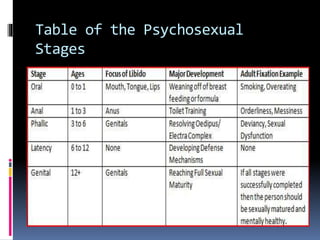
Table of the Psychosexual
Stages
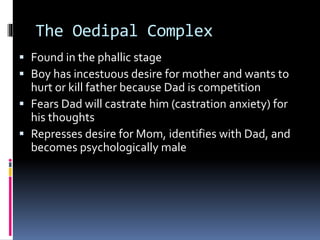
The Oedipal Complex
 Found in the phallic stage
 Boy has incestuous desire for mother and wants to
hurt or kill father because Dad is competition
 Fears Dad will castrate him (castration anxiety) for
his thoughts
 Represses desire for Mom, identifies with Dad, and
becomes psychologically male
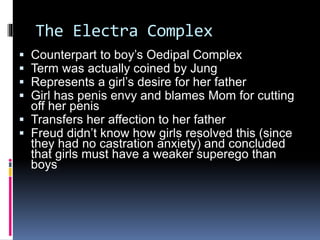
The Electra Complex
 Counterpart to boy’s Oedipal Complex
 Term was actually coined by Jung
 Represents a girl’s desire for her father
 Girl has penis envy and blames Mom for cutting
off her penis
 Transfers her affection to her father
 Freud didn’t know how girls resolved this (since
they had no castration anxiety) and concluded
that girls must have a weaker superego than
boys.
Psychoanalytic Techniques
Revealing the Unconscious
 Free Association—”the talking cure”—replaced
Freud’s use of hypnosis
 Dream analysis—manifest & latent content
 Projective techniques
The Process of Psychoanalysis
 Patient engages in free association
 Therapist offers interpretation of what patient
has said
 Through many interpretations, patient gains
insight—an understanding of the unconscious
source of problems
 Process is difficult & blocked with challenges
 Patient resistance
 Patient transference
 Repetition compulsion
Why do we care about Freud?
 Psychoanalysis has had a major impact on
psychology, psychiatry, and Western thought
generally
 Some of his terms have become part of our
everyday vocabulary.
 His “discovery” of the unconscious mind was
valuable.
 Psychoanalysis is still a major technique of
psychotherapy.
 Freud’s ideas are generating new research today.
Critics say…
 Freud’s theory is primarily of historical value
 Freud didn’t believe in the value of
experimentation or hypothesis testing in
establishing the validity of psychoanalysis.
 Freud relied on case studies of a handful of
wealthy neuroticViennese women.
 Freud’s view of human nature is generally
considered negative.
 His emphasis on sexuality in childhood has not
been well-received.

Sigmund Freud-Psychoanalytical theory

  • 1.
  • 4.
    Biography of Freud EarlyLife Mid and Later Life  Born in 1856 in Frieberg, Moravia  First child of 8 (dad had two grown sons from previous marriage)  His mother’s special favorite  Got a medical degree from University of Vienna  Married Martha Vernays and had 6 children (youngest was Anna).  Learned the technique of hypnosis from Jean-Martin Charcot and started believing in the sexual origin of hysterical symptoms.  Became friends with Joseph Breuer--learned about catharsis, free association & Anna O.  Had midlife crisis in the 1890s & published The Interpretation of Dreams” in 1900.  Founded the Vienna Psycho- Analytical Society and became associated with Erikson, Adler, and Jung. Fell out with each one.  Fled the Nazis in 1938, moved to London with daughter Anna. Died in 1939.
  • 5.
    Early Pictures ofFreud Freud and his Mother, Amalie Nathansan Freud Freud and Martha Bernays—their wedding photo
  • 6.
    Freud's Psychoanalytic Theory  Basedhis model of human nature on the idea of psychic energy—the source of energy within each person that provides motivation  Two assumptions about psychic energy:  The amount one has remains constant throughout life  Personality change can be viewed as a redirection of the psychic energy Research on ego depletion confirms that one seems to have a limited amount of psychic energy and that self- control in one area limits the amount of energy (or control) you have for other areas.
  • 7.
    Instincts  The basicsource of psychic energy are strong, innate forces called instincts.  Freud first thought the instincts were self-preservation and the sexual instinct (based on Darwin).  He later reviewed these into basic ones of life—libido— and death—thanatos. They can work either in opposition or together.  Libido was basically sexual but referred to anything pleasurable or life-sustaining.  Thanatos refers to an urge to destroy, harm, or aggress toward self or others.
  • 8.
    Levels of Consciousness Three levels:  Conscious—what we’re thinking about right now  Preconscious—what we could be thinking about if asked  Unconscious—”seething cauldron” of repressed thoughts, desires, and impulses.
  • 9.
    Structure of thePersonality  Id: present from birth; operates by the pleasure principle with no concern for reality; engages in primary process thinking—thinking without logical rules. (Unconscious)  Ego: develops to reign in the id; abides by the reality principle; engages in secondary process thinking— problem-solving strategies. (Mostly Preconscious/conscious)  Superego: morality branch; develops by age 5; “conscience;” can either reward or punish the ego. Based on teachings by parents, teachers, and religious instructors. Can be overly harsh (demands for perfection) or overly lax (low moral standards). Mostly unconscious.  Ego caught in the middle Id: I want this right now! Ego: Let me figure out a way Superego How dare you even think about that!
  • 10.
    Anxiety  Being caughtin the middle between the superego and id makes the ego suffer anxiety.  Anxiety is a signal that something is wrong and that the ego’s control is being threatened.  A well-balanced mind is the result of having a strong ego and is free from anxiety.  Defense mechanisms help ego cope with anxiety.  Types of anxiety:  Objective—real anxiety based on external events  Neurotic—occurs when there’s a conflict between the id and ego  Moral—occurs when there’s a conflict between the ego and superego. (Results in chronic shame and guilt.)
  • 11.
  • 12.
    Empirical Studies ofRepression  1979 study showed that repressors’ self-reported feelings of distress were lower than non- reporters, but their physiological responses showed more distress.  Since then, repressors have been found to recall fewer unpleasant memories from childhood, and it seems that the experience of repression happens during encoding, not recall.  Somehow, repressors dampen their emotional reactions to bad events and don’t allow them to become encoded.
  • 13.
  • 14.
    General Facts aboutthe Stages  Stage theory of development  As sex instinct matures, its energy, the libido, moves into a new body part, and the child is now at a different stage of development.  Each stage represents a conflict between early sources of pleasure and constraints of reality  Adult personality is the result of how well these conflicts are resolved.  One can become “fixated” at a particular stage of development. (Fixation is closely related to regression.)  Fixation occurs when the child’s needs are either not met sufficiently or are over-gratified.
  • 15.
    Table of thePsychosexual Stages
  • 16.
    The Oedipal Complex Found in the phallic stage  Boy has incestuous desire for mother and wants to hurt or kill father because Dad is competition  Fears Dad will castrate him (castration anxiety) for his thoughts  Represses desire for Mom, identifies with Dad, and becomes psychologically male
  • 17.
    The Electra Complex Counterpart to boy’s Oedipal Complex  Term was actually coined by Jung  Represents a girl’s desire for her father  Girl has penis envy and blames Mom for cutting off her penis  Transfers her affection to her father  Freud didn’t know how girls resolved this (since they had no castration anxiety) and concluded that girls must have a weaker superego than boys.
  • 18.
  • 19.
    Revealing the Unconscious Free Association—”the talking cure”—replaced Freud’s use of hypnosis  Dream analysis—manifest & latent content  Projective techniques
  • 20.
    The Process ofPsychoanalysis  Patient engages in free association  Therapist offers interpretation of what patient has said  Through many interpretations, patient gains insight—an understanding of the unconscious source of problems  Process is difficult & blocked with challenges  Patient resistance  Patient transference  Repetition compulsion
  • 21.
    Why do wecare about Freud?  Psychoanalysis has had a major impact on psychology, psychiatry, and Western thought generally  Some of his terms have become part of our everyday vocabulary.  His “discovery” of the unconscious mind was valuable.  Psychoanalysis is still a major technique of psychotherapy.  Freud’s ideas are generating new research today.
  • 22.
    Critics say…  Freud’stheory is primarily of historical value  Freud didn’t believe in the value of experimentation or hypothesis testing in establishing the validity of psychoanalysis.  Freud relied on case studies of a handful of wealthy neuroticViennese women.  Freud’s view of human nature is generally considered negative.  His emphasis on sexuality in childhood has not been well-received.